2026.7.1: Assist By Phone, Groups And A Stronger VoIP Stack

2026.7.1: Assist By Phone, Groups And A Stronger VoIP Stack
2026.7.1 contains the changes made after stable 2026.7.0. It expands
the Home Assistant phone system with real ring groups and conference rooms,
makes the Lovelace card more useful for both HA and ESP phones, and hardens the
call and audio paths for everyday use.
🏠 VoIP Stack / Home Assistant
- ☎️ The existing HA softphone can now publish its own extension, ring-group
membership, conference-group membership and conference-ringing preference. - 🔄 Changes made from the card or services are reflected through HA's virtual
endpoint and republished to the shared phonebook. - 💾 HA softphone extension, DND and group settings are persisted in the
integration config entry. The card writes through the softphone service and
reads the canonical snapshot back; the values survive integration reloads
and full Home Assistant restarts. - 🧑💼 Registered SIP phones are first-class endpoints. Their accounts can use
extensions and join the same ring or conference groups as HA and ESP devices. - 🌍 Incoming calls are not limited to callers stored in the phonebook.
Reachable and protocol-compatible SIP callers can ring HA or an ESP, subject
to normal destination, busy and DND checks. - 🧭 Extensions, group contacts, registered phones, ESP endpoints and optional
trunk routes all resolve through the same dial plan. - 🧹 Endpoint departure, reboot and roster-service timing are handled
automatically, so stale contacts and missed phonebook pushes are less likely.
🗣️ Call Home Assistant Assist By Phone
Enable Include voice assistant, choose HA's preferred Assist pipeline or a
specific one, and assign an extension. The selected assistant appears in the
same phonebook used by every other destination; no extension is assumed or
reserved automatically.
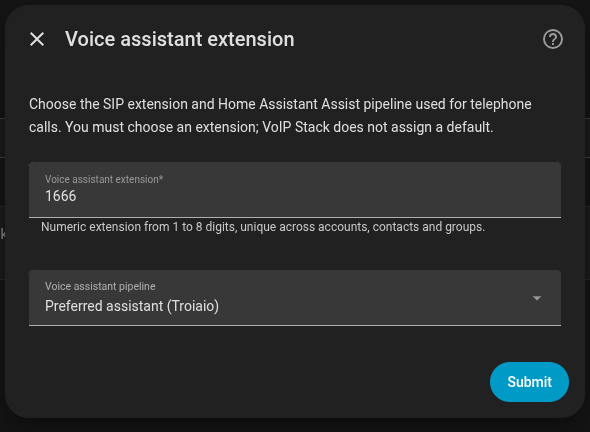
The optional second setup step keeps the SIP extension explicit and supports
both HA's preferred Assist pipeline and a specifically selected pipeline.
- 📞 ESP phones, locally registered SIP clients, direct compatible SIP callers
and external callers arriving through a trunk can call the assistant. - 👋 The assistant receives the SIP caller identity as its first turn and can
greet first. A matching phonebook name is used when available; otherwise the
original caller string or number is preserved. - 🔁 After speaking, it listens for the caller, runs STT and the conversation
agent, streams the TTS reply back into the same call, and repeats until the
caller hangs up. Conversation context is retained between turns. - 🧩 VoIP Stack runs the selected native HA pipeline, so its existing STT,
conversation agent, TTS, language and voice settings remain authoritative.
Piper, Wyoming, cloud providers and local HA agents use the same route without
provider-specific code. - 🏠 No separate Home Assistant VoIP integration, second SIP port or generated
Assist satellite is required.
🎛️ Lovelace Card
- 🪞 ESP mirror cards keep their original meaning: each card represents one ESP
phone and uses that ESP's own call controls and synchronized phonebook. - ⌨️ ESP mirror cards now include a keypad for a manual phonebook name, SIP URI,
extension or number without overwriting the contact selected on the device. - ⚙️ The Options view exposes Auto Answer, DND, extension, ring groups,
conference groups and conference ringing when the selected endpoint supports
them. - 📐 Option labels share one left edge; fields, selectors and checkboxes share a
clean right-hand control column. - 🏠 HA softphone cards expose the same HA-owned extension and group settings
without creating a second routing or call-state engine in the browser. - 📒 The main card now has a phonebook mode backed by the canonical HA roster.
It sorts contacts alphabetically, uses the available Sections grid area and
scrolls only when the roster is longer than that area. ↔️ ESP mirror, HA softphone and phonebook modes support native Home Assistant
Sections resizing. Their controls respond to both card width and height, and
an omittednameortitleleaves no empty header row.- 🔔 Ringtone, DND and terminal call state no longer race normal card refresh or
cleanup paths. - 🔌 ESP mirror availability follows the bound Home Assistant entity live. A
card becomes unavailable when its ESP leaves and recovers when it returns,
without a dashboard refresh or polling timer. - 🖱️ Internal card scrolling hands the remaining wheel/trackpad movement back
to the dashboard at the card boundary. - 🎨 Native contact selectors remain readable on both light and dark themes,
including the operating-system popup rows. - 🔒 Caller and destination labels are inserted as text, so SIP display strings
cannot become card markup.
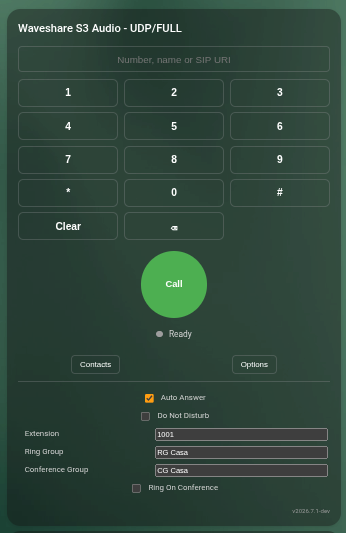
ESP mirror card with keypad, Auto Answer, DND, extension and group controls
expanded.
🔔 Ring Groups
Call a group such as RG Home and every available member rings together.
Home Assistant, ESP phones, registered SIP endpoints and manual contacts can all
participate.
The first member to answer wins. Other early legs are cancelled, and a late
answer cannot steal or duplicate the established call. Group contacts are
created from live membership and disappear when no endpoint declares them. The
card keeps the group name while dialing/ringing, then shows the actual endpoint
that answered, including the Home Assistant softphone.
🎙️ Conference Groups
Home Assistant can now host SIP conference rooms. Calling a contact such as
CG Home joins that room; members with conference ringing enabled can also be
invited when the room starts.
The conference focus mixes the active participants, applies additional headroom
as the room grows and cleans up invited legs and media ports when the owner or
last participant leaves.
📒 Phonebook And Dial Plan
- Group fields accept comma-separated membership, so one phone can belong to
more than one room or ring group. - The roster advertises directional media capabilities and the fields needed by
HA, ESP and registered endpoints. - Numeric inbound routing uses the same phonebook extensions instead of a
separate static route table. - HA refreshes the roster when an ESP's phonebook service appears after reboot,
closing the window where discovery could finish before the service was ready. - SIP authentication retries rebuild the transaction correctly for stricter
PBX and FRITZ!Box implementations.
📞 More Predictable Calls
- SIP transactions now match the correct Call-ID, CSeq, branch, dialog tags and
peer before changing a call. - Retransmissions, decline, cancel, busy, answer, hangup and immediate redial
have deterministic ownership and cleanup. - The Hang Up action remains available while an outbound call is still in
calling, including unreachable or slow external destinations. - A cancel that crosses a successful answer is completed with the proper
acknowledgement and teardown instead of leaving a ghost call. - Reused SIP/TCP connections serialize outgoing messages and keep pending work
bounded. - Unsupported hold or codec-changing re-INVITE requests receive
488 Not Acceptable Herewithout destroying the call already in progress. - Incoming digit routing accepts both standard RTP
telephone-eventand the
widely deployed legacy SIP INFO DTMF representation, including four-digit
trunk destinations entered at human speed. - During an established HA-bridged call, each RFC 4733 or compatible SIP INFO
DTMF key is also exposed asvoip_stack.dtmffor automations. This event
path is separate from pre-answer extension routing and never transfers the
call by itself. - Ring-group legs, conference members, RTP ports, registrations and transaction
caches all have explicit limits instead of growing without bound.
🧪 Experimental: Use Phone Keys In Home Assistant Automations
Caution
In-call DTMF automation events are experimental in 2026.7.1. Validate the
caller/source filters and the target action in a safe environment before
using phone keys for gates, locks or other security-sensitive controls.
During a call bridged by Home Assistant, every DTMF key now fires one
voip_stack.dtmf event. This makes practical actions such as press 1 to open
the gate possible while the conversation and audio continue normally.
triggers:
  - trigger: event
    event_type: voip_stack.dtmf
    event_data:
      source: Cordless
      digit: "1"
actions:
  - action: cover.open_cover
    target:
      entity_id: cover.gate
Events include caller, callee, source leg, digit, both call IDs and transport,
so automations can be restricted to the intended phone and active call. This is
not a second dial plan: initial extension collection remains separate and an
in-call key never transfers a call by itself. Detection is entirely HA-side;
no parser or additional real-time work is added to ESP firmware.
🔊 Audio And ESP Real-Time Performance
- Browser audio has one owner per call and uses stateful codecs, absolute pacing
and bounded queues. A short FIFO jitter buffer smooths Chrome microphone
bursts instead of discarding adjacent speech frames. - PCMA 8 kHz, L16 48 kHz and Opus 48 kHz paths are used where the endpoints on
that leg support them. - PCMA/G.711 handset audio now preserves the source speech level instead of
losing about 6 dB during A-law encoding, so Assist replies remain audible on
a normal phone earpiece without requiring speakerphone. - ESP audio conversion state and working buffers are prepared outside the
per-frame path. - Generic software-AEC presets use a previous-frame reference by default. The
optional ring-buffer reference is aligned to microphone-consumer sessions so
a new call cannot begin against stale playback audio. - The AFE worker is persistent and event-driven. It sleeps on notifications
while idle; no periodic delay was added to hide contention. - Single-microphone and dual-microphone AFE paths retain their appropriate
Espressif processing routes. - On Waveshare P4, the real-time I2S/AFE bridge stays in internal RAM and the
calibrated AEC path remains active under Sendspin and VoIP load. Music, TTS
and bidirectional VoIP were exercised together while monitoring heap, PSRAM
and main-loop latency.
🖥️ Device Runtime And P4 Touch
- P4's phone panel now switches explicitly between Contacts and a local
numeric Keyboard, avoiding gesture conflicts with the surrounding LVGL
page. - Assist, media, timer, ringtone, call, LED and ducking decisions converge
through the shared runtime controller. Device callbacks report facts; they do
not maintain a parallel display state machine. - Transition probes record every committed state rather than only the final
snapshot. Qualification rejects intermediate neutral/media screens between
Assist thinking and replying, stale Sendspin artwork after stop, and restored
ducking while a call is active. - Production profiles keep verbose probes disabled; diagnostics are opt-in and
add no delay to the real-time loop.
✅ Validation
- Automated release run: 309 integration/card/tooling tests plus 26 subtests,
57 ESP VoIP tests, 19 audio-stack tests and 12 runtime-controller tests. The
deterministic qualification matrix and seeded terminal-state regression
remain part of the release check. - Real WS3, Spotpear and Waveshare P4 calls covered HA-to-ESP, ESP-to-HA, ESP-to-ESP,
registered SIP endpoints, callers absent from the phonebook, ring groups,
conferences, DND, Auto Answer, trunk cancellation and immediate reuse. - Assist validation covered a local HA-registered SIP account over Opus 48 kHz
and an external mobile caller over trunk PCMA 8 kHz. The external call kept
one conversation across three spoken turns, including a Home Assistant
control request, with zero RTP drops or media errors. - WS3, Spotpear, P4 and generic/native profiles completed clean ESPHome 2026.6.5
builds and return-to-online checks. P4 additionally ran concurrent Sendspin,
Assist/TTS and VoIP state/audio qualification.
⚠️ Boundaries To Know Before Testing
Read Breaking Changes when updating an earlier
version. In particular:
- structured ESP contacts use
ipandtransport; richer number, extension
and group fields belong to the HA phonebook; - the phonebook is an outbound dial plan, not an inbound caller allowlist;
- full hold/resume renegotiation is not implemented;
- trunk digit routing accepts standard RTP
telephone-eventand compatible
legacy SIP INFO DTMF; acoustic in-band DTMF tones are not decoded; - ESP SIP/RTP remains plaintext and belongs on a trusted LAN or VPN, or behind
an SBC.
📦 Installation And Upgrade
Install or upgrade VoIP Stack through HACS, then restart Home Assistant when
prompted. Source installations can use the v2026.7.1 GitHub tag and copy
custom_components/voip_stack into Home Assistant's custom_components
directory.
For firmware builds, route the maintained project sources to their stable
branches before compiling:
./scripts/yaml_paths.sh remote \
  --intercom main \
  --voip main \
  --audio main \
  --runtime main
./scripts/yaml_paths.sh check
After restart, both the installed integration and the card footer must report
v2026.7.1. When reporting a regression, include the YAML, ESPHome and
Home Assistant versions, the caller and destination, and the negotiated audio
formats.