NCINM User Manual
National Cancer Institute dosimetry system for Nuclear Medicine (NCINM) is a computer software which can estimate organ and effective doses for patients undergoing nuclear medicine procedures. The program is based on a comprehensive library of S values, organ absorbed dose per administered activity, calculated through Monte Carlo radiation transport techniques for up to 70 source and 60 target regions within a series of computational human phantoms. Organ doses can be calculated using the following user input: patient characteristics, radionuclide or radiopharmaceuticals, administered activity, and biokinetic data.
You need to select which phantom library to use for dose calculations. In the latest version, NCINM2.0, two phantom libraries are available: the UF/NCI reference size phantoms and the ICRP reference voxel phantoms. For both phantom libraries, you can select the patient’s age from five age groups: newborn, 1, 5, 10, 15 years old, and adult (generally assumed to be over 20 years). For the patient with in-between age, you may interpolate two sets of organ doses calculated from younger and older phantoms (e.g., interpolate organ doses from 5 year and 10 year phantoms for a 7 year patient) or you may select a phantom with the age closest to your patient's age (e.g., select 5 year phantom for 6-year-old patient). When a phantom is selected, its frontal will be displayed.
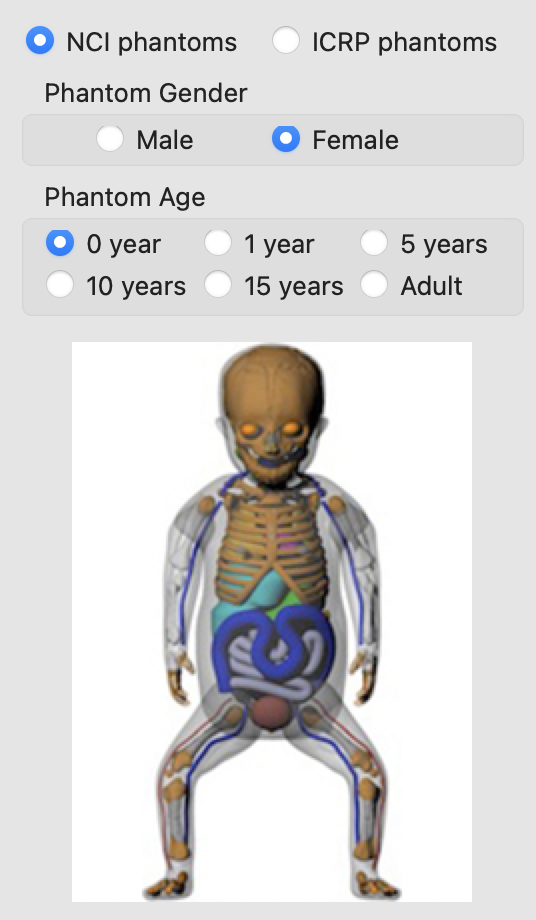
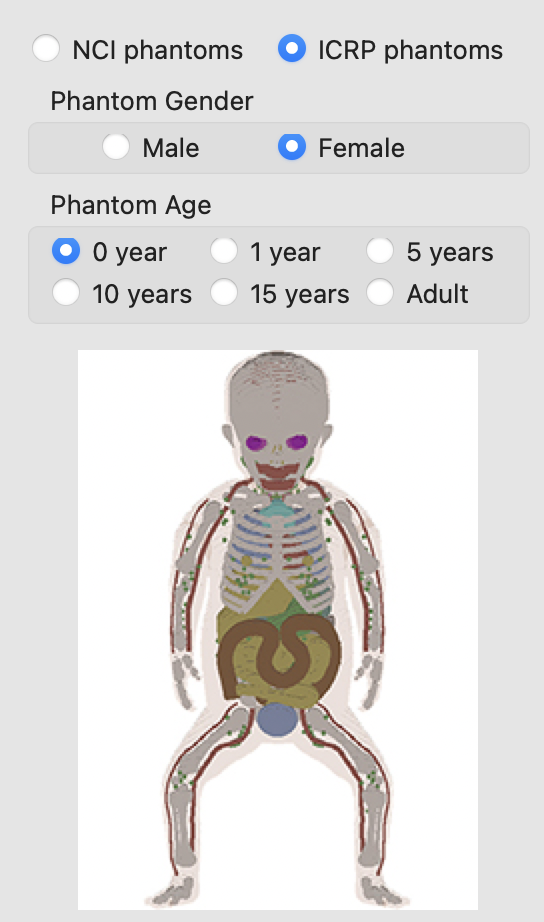
When you have biokinetic data available for the radiopharmaceutical of interest, you can select radionuclide from the list after selecting the tab, Radionuclide. About 300 radionuclides which are often used in nuclear medicine procedures are available.
When you do not know the biokinetic data of the radiopharmaceutical of interest, you can select the radiopharmaceutical from the list after selecting the tab, Radiopharmaceutical.
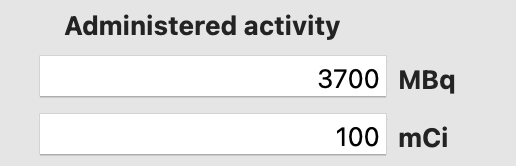
You need to input administered activity in MBq or mCi. The value entered in either unit will be automatically converted to the other unit. When Radiopharmaceutical tab is selected, organ doses will be calculated at this time when administered activity is entered. If radionuclide tab is selected, you need to enter biokinetic data to calculate organ doses.
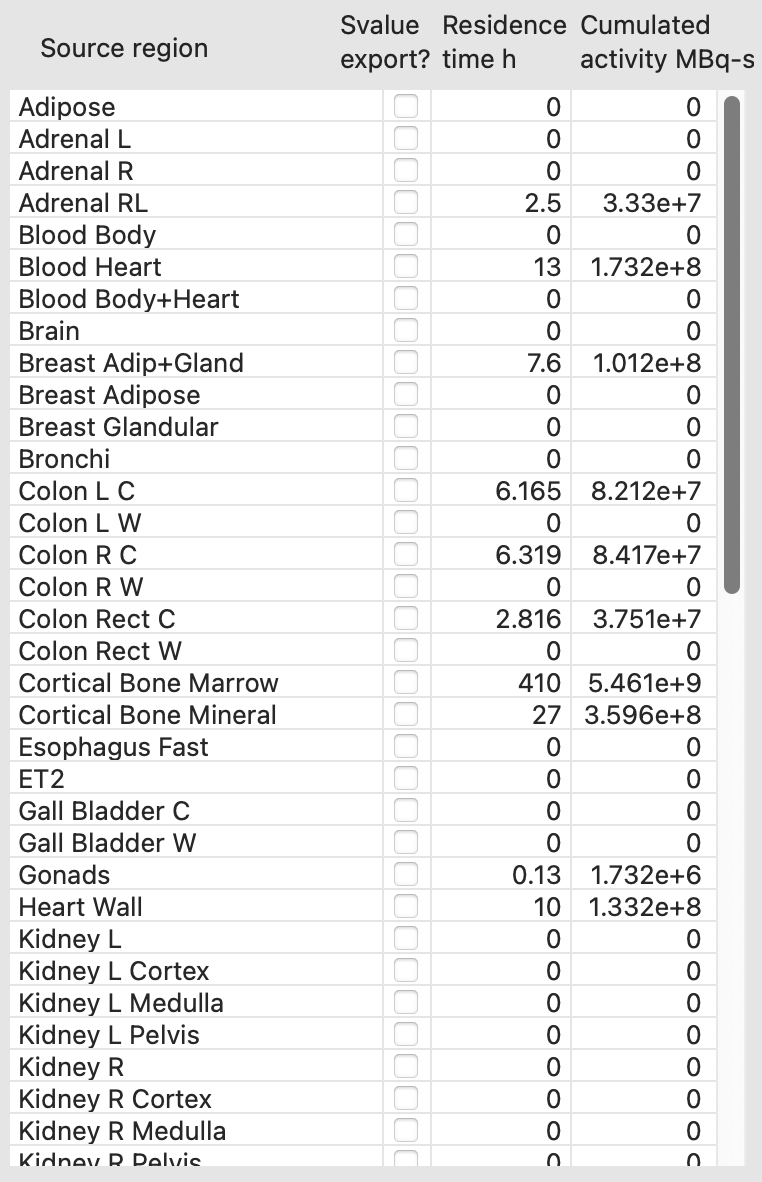
If Radionuclide tab is selected, you need to manually enter biokinetic data in the source regions. If residence time (h) (or time integrated activity coefficient, TIAC) is entered, cumulated activity (MBq-s) will be automatically calculated based on administered activity entered in the previous step. If cumulated activity is entered, the residence time is automatically calculated. If Radiopharmaceutical tab is selected in the previous step, the residence time column will be automatically populated. If you want to export S values for your own organ dose calculations, you can click Export S values button to save the S values for the selected source regions and the selected age in CSV file.
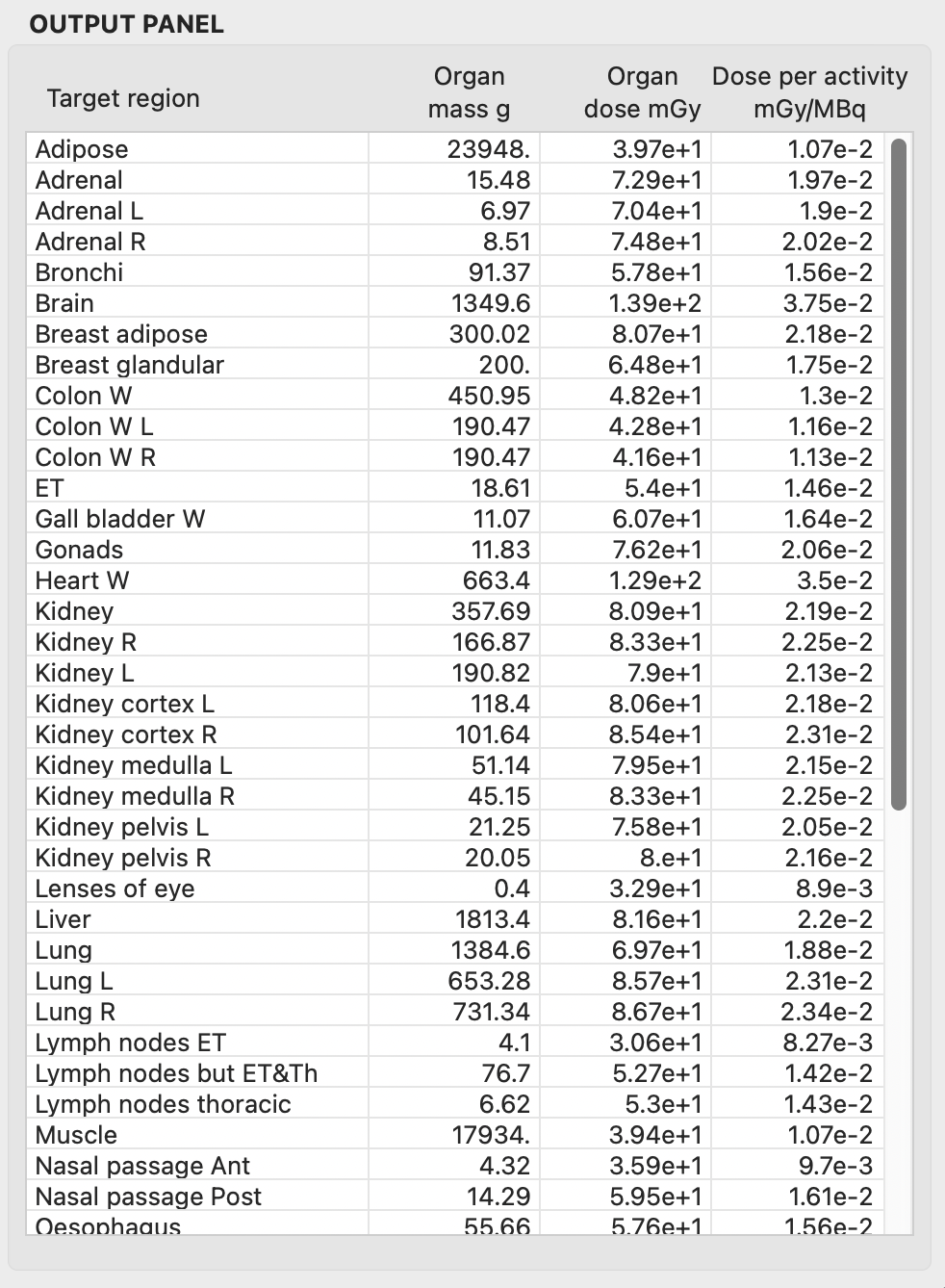
The OUTPUT PANEL includes the list of target regions, organ mass (g), dose absorbed dose, and dose per administered activity (mGy/MBq) (also known as absorbed dose coefficient). Whenever organ doses are updated, organ absorbed dose is automatically copied to Clipboard. You can also copy and paste the whole OUTPUT PANEL by dragging mouse.
When you click the button, Initialize parameters, the administered activity, residence time, and organ doses will be set zeros.
- Body size-dependent S values for skinny and obese patients
- S values for additional radionuclides
- Monte Carlo errors
- 20221215
- Mismatch between radionuclides and radiopharmaceuticals fixed
- Names of radiopharmaceuticals sorted in alphabetical order
- Effective dose calculation algorithm revised
- 20221214 Official release version 2.0.20221214
- NCINM2.0 published: Villoing et al., “Organ dose calculator for diagnostic nuclear medicine patients based on the ICRP reference voxel phantoms and biokinetic models,” BPEX 9:015004 (2023)
- For the ICRP pediatric and adult phantoms, when blood is the source, the target region mass now includes blood mass, which is consistent with ICRP Publication 133.
- Biokinetic data extended to 230 radiopharmaceuticals (ICRP 53, 80, 106, 128)
- 20221109
- Issues with mismatching between radionuclide and radiopharmaceuticals fixed
- Copy and paste by mouse dragging works now
- 20220919
- Self- and crossfire-SAFs for the gastrointestinal from ICRP133 used for adults
- Bug not exporting S values for the ICRP phantoms fixed
- 20220512
- Add the biokinetic data of four radiopharmaceuticals
- Issues with the ovaries in the ICRP 15-year-old female phantom fixed
- 20220420
- Revise NCI phantom-based active marrow and endosteum SAFs and S values using the latest dose response function adopted by the ICRP Committee 2
- 20220329
- Logical bugs in skeletal dose calculations fixed
- Effective dose per ICRP Publication 60 wT removed
- Effective dose per ICRP Publication 103 wT included into the target organ doses which are automatically copied to clipboard
- Wrong numbers in blood-inclusive target organ mass fixed
- Biokinetic data extended to 101 radiopharmaceuticals (ICRP 53, 80, 106)
- 20211129
- The frontal pictures of the ICRP voxel phantoms implemented replacing the frontal pictures of the NCI hybrid phantoms
- 20211113
- Zero adipose mass for the ICRP newborn female fixed
- Errors in the windows installation file fixed
- User interface revised to be more compact
- 20211019
- Biokinetic data for a total of 62 radiopharmaceuticals available
- Menus for User Manual and User Forum added under “Help” menu
- 20210515
- Blood mass was added to the target organ mass in the ICRP pediatric reference phantoms (consistent with the ICRP adult phantoms in Publication 133)
- 20210513 Official release version 2.0.20210301
- Biokinetic models for 12 radiopharmaceuticals extracted from several ICRP Publications
- S values from the 12 ICRP reference pediatric and adult phantoms added
- 20200720
- NCINM1.0 published: Villoing et al., “NCINM: organ dose calculator for patients undergoing nuclear medicine procedures,” BPEX 6:055010 (2020)
- 20200312 Official release version 3.0.20200312
- Comprehensive benchmarking conducted with OLINDA/EXM1.0 and IDAC2.1
- 20190822
- NCINM1.0 created based on the 12 NCI phantoms
- Alpha test conducted