Real-time American Sign Language → voice video chat,
running entirely in your browser, in about half a second.


About 500,000 Americans speak ASL as their first language.
The U.S. has roughly 10,000 certified ASL interpreters — and almost all of them are scheduled into healthcare, legal, and government calls.
For everyday video calls — a friend, a family member, a coworker — the Deaf side has been quietly left out, locked into a chat box while everyone else is talking. Imagine sitting in a video call where you can't talk. That's the everyday call for millions.
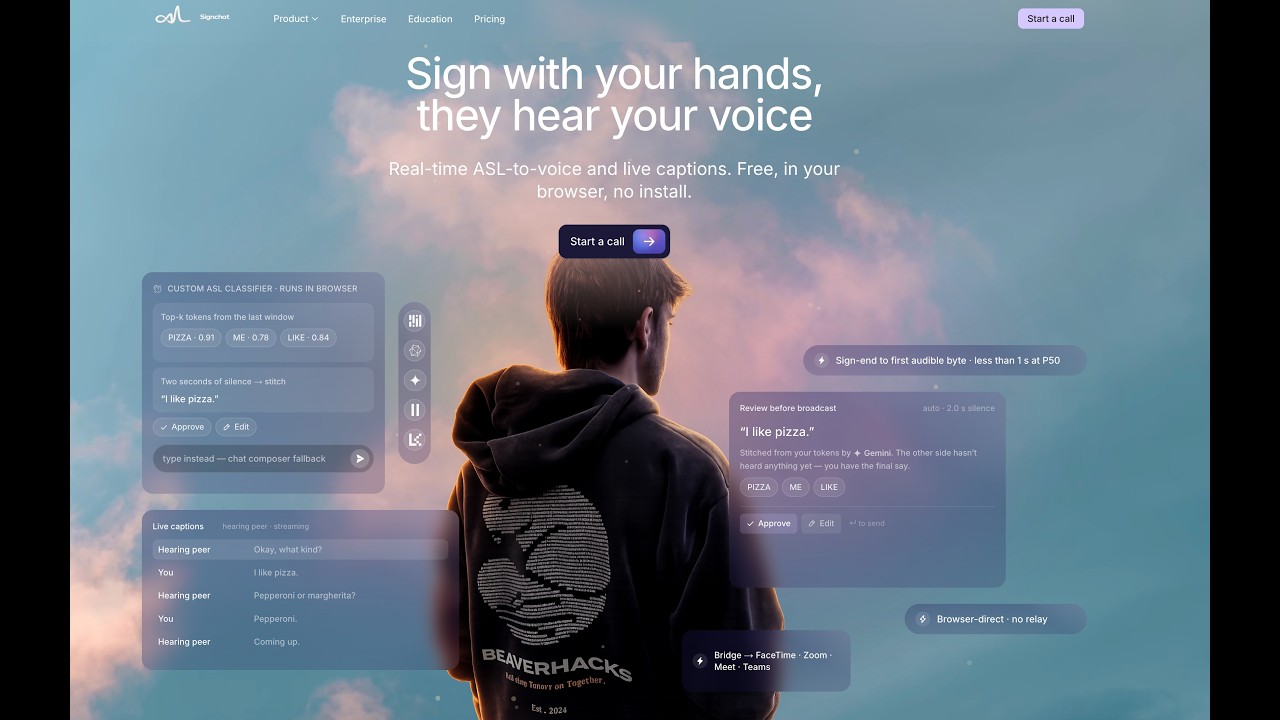
A custom 250-sign classifier runs locally in your browser. Recognized signs are stitched into fluent English by a fine-tuned LLM. The result is streamed back as natural synthetic voice — mixed with your real microphone into one stable channel. The receiving person just hears you talking.
Important
This is frontier-level work. Researchers have been chasing real-time ASL translation for years. We did it in a hackathon, in pure browser code, with sub-second end-to-end latency and zero relay servers.
Tip
The fastest way to understand Signchat is to open it in a browser with a friend on the other side. The whole product is one URL.
| Live app | https://signchat.org |
| 3-minute demo | https://www.youtube.com/watch?v=SENhVVNZQGY |
| Architecture deep-dive | ARCHITECTURE.md (17 sections) |
What you'll see in the demo:
- A real ASL signer signing into a webcam
- Recognized tokens appearing live, top-K with confidences
- A reconstructed sentence shown for review (Approve / Edit / Re-sign / Discard)
- Synthetic voice on the hearing peer's tile, with live captions on both sides
flowchart LR
    Camera[Webcam frames] --> MediaPipe[MediaPipe Holistic]
    MediaPipe --> ONNX[ONNX classifier in WASM]
    ONNX --> Admit[Admit stable / band tokens]
    Admit --> OpenRouter[OpenRouter sentence stitch]
    OpenRouter --> Review[Review: auto or proofread]
    Review --> ElevenLabs[ElevenLabs streaming TTS]
    ElevenLabs --> SignchatVoice["signchat-voice via LiveKit"]
    SignchatVoice --> Hearing[Hearing peer]
    Hearing --> STT[ElevenLabs voice-to-text]
    STT --> Captions[Live captions on both tiles]
Two browsers, three providers (LiveKit, OpenRouter, ElevenLabs), and one small Vercel surface that only mints credentials. Every per-turn hop goes browser-direct — no Signchat-operated relay, no server-side LiveKit bot, no TTS gateway.
The full spec lives in ARCHITECTURE.md — 17
sections, mermaid diagrams render inline on GitHub.
| Metric | Value |
|---|---|
| Sign-end → first audible byte (P50, end-to-end) | ~0.6 s |
| Sign-end → first audible byte (P95, end-to-end) | ~0.9 s |
| Vocabulary | 250 signs (PopSign / Kaggle ISLR) |
| Model size | ~1.7M params (Conv1D + Transformer) |
| Runtime | ONNX in WebAssembly (no GPU required) |
| Signchat-operated relay servers | 0 |
NEXT_PUBLIC_* secrets in the browser |
0 |
| Fallback voices that fake a failed turn | 0 |
apps/web— Next.js 16 app: meeting UI, marketing pages, credential-mint API routes. The thing you load at signchat.org.apps/bridge— Electron desktop companion that publishes a system-levelsignchat-voicevirtual microphone for FaceTime, Zoom, Meet, Teams, and Discord. Same browser pipeline, routed as a mic.
packages/sign-pipeline— MediaPipe and onnxruntime-web loaders, vocabulary fetcher, and theadmitTokenbuffer admit logic.packages/runtime-browser— OpenRouter HTTP client, ElevenLabs WSS streaming, mode-controller FSM, and the Web Audio graph that publishes thesignchat-voicetrack.packages/prompts— frozenLEAN_OPTIONS_SYSTEMprompt, the request builder, and a Zod-validated response parser.packages/contracts— shared sign / DataChannel / config types used across packages.
asl-classifier-model/— Python repo for the 250-sign Conv1D-Transformer classifier: configs, training, eval, RunPod orchestration scripts, per-run benchmark log.prompt-tester-service/— model sweep harness; full results incharts/RESULTS.md(10 models × 399 scenarios = 3,990 OpenRouter calls).signchat-workbench/— internal harness for landmark playback and classifier debugging.ARCHITECTURE.md— the canonical 17-section spec.
pnpm installcp apps/web/.env.example apps/web/.envThen fill in:
| Variable | Provider |
|---|---|
LIVEKIT_URL, LIVEKIT_API_KEY, LIVEKIT_API_SECRET |
LiveKit Cloud |
OPENROUTER_MANAGEMENT_API_KEY |
OpenRouter |
ELEVENLABS_API_KEY, ELEVENLABS_VOICE_ID |
ElevenLabs |
pnpm dev
# web → http://localhost:3000
To run only the web app:
pnpm --filter @signchat/web devTo run the Bridge desktop app against a local web server:
VITE_SIGNCHAT_API_BASE=http://localhost:3000 \
  pnpm --filter @signchat/bridge dev
To train (or audit) the classifier:
cd asl-classifier-model
make help                                  # lists every Makefile target
make eval CKPT=pretrained/phase1_kaggle/ # local CPU-only eval- Admit-before-stitch. Single-tick top-1 predictions are noisy. We
only commit a label to the buffer when it's stable across ticks
("stable") or top-1 with a credible top-2 contender ("band").
Lives in
packages/sign-pipeline/src/admit.ts. - Review-before-broadcast UX. The signer sees every reconstructed sentence before the hearing peer hears anything. Auto mode advances on a configurable silence; proofread mode requires Approve / Edit / Re-sign / Discard. Errors stay loud.
- Bridge as a system mic. Rather than build N integrations, we
publish
signchat-voiceas a BlackHole-backed virtual microphone via Electron. Any app that picks a mic — FaceTime, Zoom, Meet, Teams, Discord — works today, with no SDK or extension. - Browser-direct, on purpose. The deploy graph has zero Signchat
servers on the per-turn path. That's an architecture choice (see
ARCHITECTURE.md§15.3), not an accident — it makes the privacy and cost story honest. - Data-driven model selection.
prompt-tester-service/runs 10 models × 399 scenarios each release. Lowest reliable reconstruction call we measured:openai/gpt-5.4-nanoat p50 = 236 ms, p95 = 486 ms. Full report inprompt-tester-service/charts/RESULTS.md.
- Google Kaggle Isolated Sign Language Recognition (
asl-signs) competition — PopSign 250 dataset - MediaPipe Tasks Vision for landmarking
- ONNX Runtime Web for in-browser inference
- LiveKit Cloud for the SFU and DataChannel
- OpenRouter for unified access to LLMs (Gemini, GPT, Mistral, …)
- ElevenLabs for streaming TTS and voice-to-text
- Next.js, Electron, BlackHole, Phosphor Icons
MIT. The Signchat name and the signchat-voice device label are not
covered by the code license.