A typed, tree-based Flutter router with deep linking, nested navigation, guards, and external Page composition.
- Typed, URL-serializable route trees
- Route-owned or external Flutter Page composition
- Root and nested navigators driven by one route-state tree
- Guards, navigation history, results, and restoration
- Custom Pages, transitions, and independent nested stacks
- Built directly on top of Navigator 2.0 (
Router,RouterDelegate,RouteInformationParser)
This package is in early development. The API is not yet stable and may change significantly between versions.
Rolter requires Flutter 3.32 or later and Dart 3.8 or later. Development and canonical formatting use the latest stable SDK, while CI verifies the declared minimum and the latest stable release.
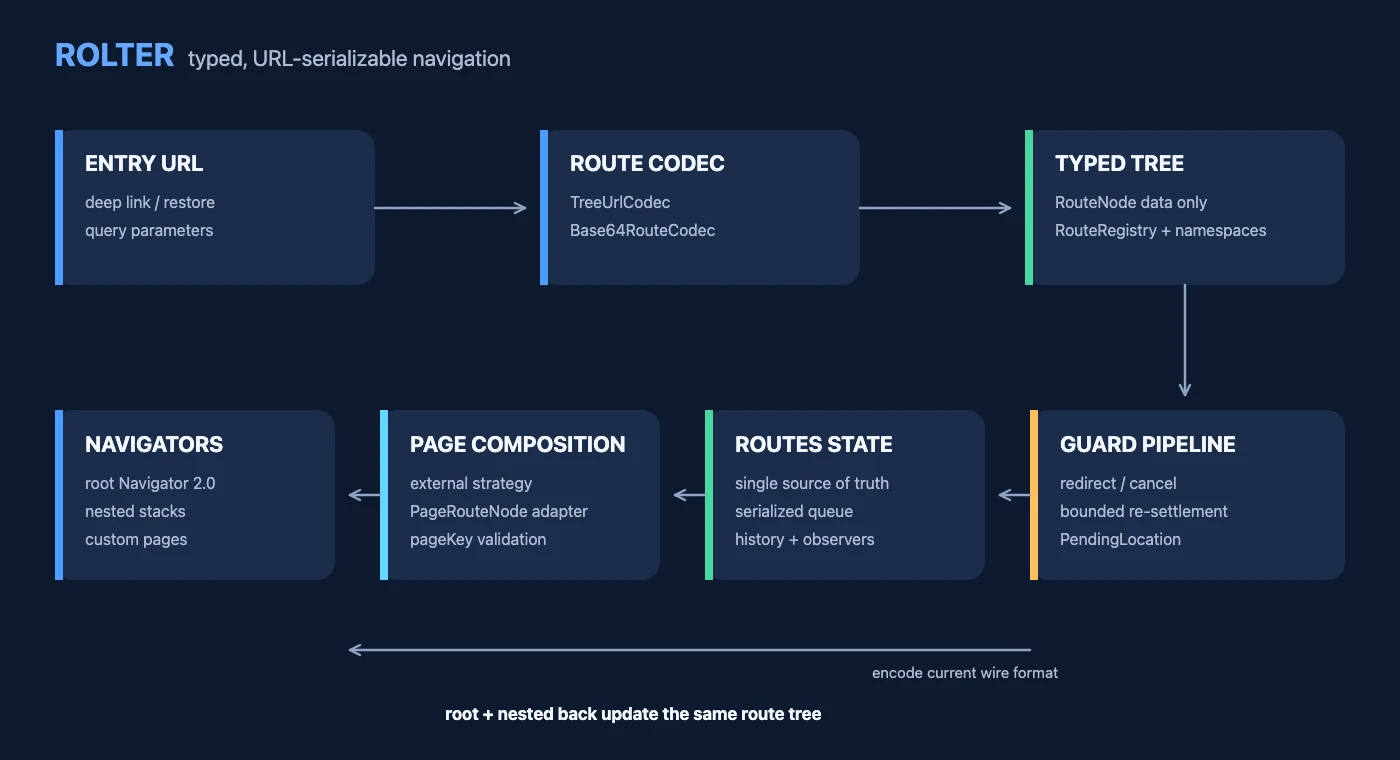
The URL codec reconstructs typed route nodes, guards settle the requested
tree, and RoutesState commits a single source of truth rendered by root and
nested navigators.
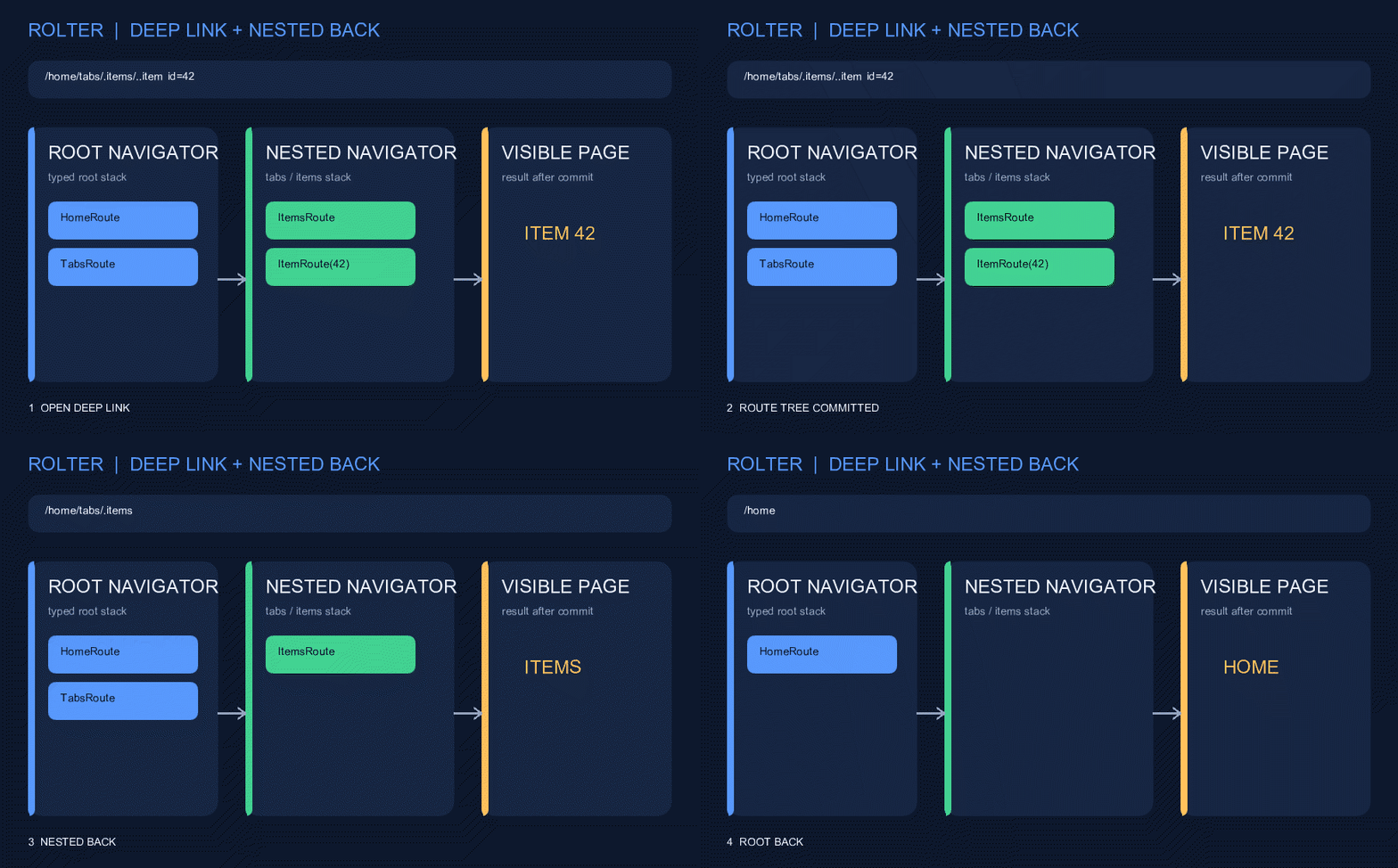
The animation opens a deep link into a nested stack, then removes the nested detail before returning through the root stack.
Add rolter to your pubspec.yaml:
dependencies:
rolter: ^0.2.0import 'package:flutter/material.dart';
import 'package:rolter/rolter.dart';
// 1. Define a typed route tree. PageRouteNode is the concise route-owned mode.
sealed class AppRoute with KeyedRouteEquality implements PageRouteNode {
const AppRoute();
@override
List<AppRoute> get children => const [];
@override
AppRoute withChildren(List<RouteNode> children) => this;
}
final class HomeRoute extends AppRoute {
const HomeRoute();
@override
LocalKey get pageKey => const ValueKey('home');
@override
String get name => 'home';
@override
Map<String, String> toParams() => const {};
@override
Page<Object?> buildPage(BuildContext context) => MaterialPage<Object?>(
key: pageKey,
name: name,
child: const Scaffold(body: Center(child: Text('Home'))),
);
}
// 2. Register decoders so URLs / deep links rebuild the tree.
final registry = RouteRegistry<AppRoute>(
{'home': (params, children) => const HomeRoute()},
fallback: (uri) => const HomeRoute(),
);
// 3. Wire Navigator 2.0.
final state = RoutesState<AppRoute>(const [HomeRoute()], (stack) => stack);
final app = MaterialApp.router(
routerDelegate: RoutingDelegate<AppRoute>(
state,
pageBuilder: buildPageFromRouteNode<AppRoute>,
),
routeInformationParser:
RoutingInformationParser<AppRoute>(TreeUrlCodec(registry)),
);To call navigation from screens via context.navigator, place a
NavigatorScope (with your NavigationController) above
MaterialApp.router — see the example/ app. The snippet above
renders and deep-links without it.
For application-owned composition, dependency-injection options, and exact
scope visibility, see Page composition. The
example/ app is the feature-first external-composition reference
and also demonstrates nested navigation, guards, results, and per-route scopes.
Import only package:rolter/rolter.dart. Anything under
package:rolter/src/ is implementation detail and may change in any release.
Choose the example that matches the shape of your application. Rolter itself
has only two core Page-composition modes: route-owned PageRouteNode, or a
data-only RouteNode mapped by an external RouteNodePageBuilder. The four
runnable architectures combine those primitives with different routing
ownership, dependency delivery, and portability requirements.
| Runnable architecture | Best fit | Main trade-off |
|---|---|---|
| Centralized route-owned | Conventional small apps that need one complete routing map | Least code; route data knows Flutter UI |
External builder + narrow Scope.of |
Existing inherited DI or staged UI separation | Clean route data; runtime scope placement |
| Feature-first + constructor injection | Modular Rolter apps (recommended) | Feature ownership and explicit dependencies; small application catalog |
| Router-neutral application adapter | Real multi-app or multi-router platforms | Portability for its bounded subset; two models and adapter tests |
Centralized versus feature-first describes who owns routing files. Scope versus constructor injection describes dependency flow. The adapter adds an application-owned portability boundary; it is example code, not a fourth Rolter composition API.
Route-owned composition uses the permanent adapter shown in the quick start:
final delegate = RoutingDelegate<AppRoute>(
  state,
  pageBuilder: buildPageFromRouteNode<AppRoute>,
);
With a data-only route, composition moves to an application builder:
Page<Object?> buildAppPage(BuildContext context, AppRoute route) =>
    switch (route) {
      MailboxRoute() => MaterialPage<Object?>(
        key: route.pageKey,
        name: route.name,
        child: MailboxScreen(repository: mailRepository),
      ),
    };

final delegate = RoutingDelegate<AppRoute>(
  state,
  pageBuilder: buildAppPage,
);
The builder can capture a constructor-injected dependency or read an
application-defined narrow scope. Both a scope above MaterialApp.router and a
scope returned by MaterialApp.router.builder wrap the Router, so both are
visible to the delegate Page builder and Page subtree. A user-defined
AppScope.of(context) still works; AppScope was example code, never Rolter
API. Prefer capability-specific scopes over broad container lookup from leaf
widgets.
The four runnable references are:
example/lib/apps/feature_first/: modular, constructor-injected Rolter-native enterprise reference and default app;example/lib/apps/centralized_route_owned/: centralized route-owned composition;example/lib/apps/external_builder_scope/: external builder with a narrow inherited scope;example/lib/apps/router_neutral_adapter/: application-only, router-neutral flat adapter example.
Each folder is an isolated application import graph. They share only pure Flutter presentation content for the same Home → Items → Item detail flow, so the routing and dependency differences can be compared without duplicating UI. The feature-first app additionally retains the complete advanced showcase.
From example/, select an app through the compile-time launcher:
flutter run --dart-define-from-file=env/feature_first.envOr run the dedicated entrypoint to verify its isolated import graph:
flutter run -t lib/apps/feature_first/main.dartOpen example/ as the VS Code workspace to use its four launch presets.
RoutingDelegate.pageBuilder and NestedNavigatorHost.pageBuilder are
required. Every result uses key: route.pageKey; builders are synchronous and
non-owning, so disposable resources belong to a provider or RouteScope.
Read Page composition and application architecture to choose by application shape and compare ownership, dependency flow, lifecycle, extensibility, and router portability. See Migration from 0.1.x to 0.2.0 for the exact breaking API diff.
NavigationQueue is a public, fail-fast FIFO primitive for custom navigation
architectures. It copies submitted snapshots, serializes asynchronous
processors, and never silently drops or coalesces requests. Requests queued
behind a failed processor are discarded, and a fresh request is accepted after
the failure has been observed through processingCompleted.
The queue intentionally has no built-in capacity or overflow policy. If an application can generate navigation faster than its processor can settle it, debounce or rate-limit that event source before adding snapshots.
RoutesState deliberately does not expose its mutable internal queue. Use its
navigation methods and the read-only isProcessing and processingCompleted
properties so every request passes through the configured ApplyPipeline.
A custom SnapshotProcessor is trusted application code and can choose not to
run route guards. Neither it nor RouteGuard is a security boundary: modified
clients can bypass client-side navigation policy. Always enforce authorization
again on the server before returning protected data or performing a protected
operation.
Every RouteNode must have value ==/hashCode, and its pageKey must encode
every identity-bearing param and be unique across the whole tree. The engine
detects changes with listEquals and keys pages by pageKey, so a param left
out of both is invisible (the navigation is silently a no-op) and a shared
pageKey would collapse two pages into one. RoutesState therefore rejects a
duplicate key before commit. For a leaf, put the params in the key and mix in
KeyedRouteEquality:
final class ItemRoute with KeyedRouteEquality implements RouteNode {
  const ItemRoute(this.id);

  final int id;

  @override
  LocalKey get pageKey => ValueKey('item:$id'); // every param in the key

  @override
  String get name => 'item';

  @override
  List<RouteNode> get children => const [];

  @override
  Map<String, String> toParams() => {'id': '$id'};

  @override
  RouteNode withChildren(List<RouteNode> children) => this;
}
A shell/tab node distinguished by its children or by a param not in pageKey
(e.g. the active tab) must override ==/hashCode to compare that state.
Serializable vs runtime params. Typed route fields carry both kinds, so
there is no separate arguments/extra split: toParams() is the URL wire
format — the serializable identity that survives a deep link (their
arguments). A typed field you don't put in toParams() is runtime-only
(their extra): fine within a session, but a cold deep link can't reconstruct
it, so keep anything that must survive in toParams().
Route guards run after a page is removed (onDidRemovePage), so they can't
pre-empt a back gesture. Block leaving with Flutter's PopScope on the screen,
then pop explicitly once confirmed:
PopScope(
  canPop: !hasUnsavedChanges,
  onPopInvokedWithResult: (didPop, _) async {
    if (didPop) return;
    if (await confirmDiscard(context)) context.navigator.pop();
  },
  child: /* ... */,
);
A guard's cancel is the programmatic safety net — the engine re-syncs the
navigator to the tree when a guard reverts a removal — but per-screen
confirmation belongs in PopScope. See the example's "Confirm on leave" demo.
A deep link is just a guard input: the guard pipeline runs on every
setNewRoutePath, so a guard can inspect and redirect the incoming stack — no
separate deep-link subsystem. To divert the user (e.g. to a lock/login screen)
and return them afterwards, share a PendingLocation with the guard:
final _pending = PendingLocation<AppRoute>();

@override
GuardResult<AppRoute> call(history, requested, context) {
  if (locked && wantsProtected) {
    _pending.remember(requested);                 // stash the intended target
    return const GuardResult.proceed([LockRoute()]);
  }
  if (_pending.hasPending && onLockScreen) {
    return GuardResult.proceed(_pending.take()!); // restore it on unlock
  }

  return GuardResult.proceed(requested);
}
Wire the guard's Listenable to RoutesState.reevaluate so unlocking reruns
the pipeline and replays the remembered location. See the example's LockGuard.
A RouteGuard is a Listenable — the pipeline reruns the guards whenever one
fires. A Bloc/Cubit is a Stream, not a Listenable, so bridge it with
StreamListenable instead of mixing in a ChangeNotifier: compose one, delegate
addListener/removeListener to it, and read the bloc's current value
synchronously from its state inside call:
final class LockGuard implements RouteGuard<AppRoute> {
  LockGuard(this._bloc) {
    _refresh = StreamListenable(_bloc.stream); // fires the guard on each event
  }

  final LockBloc _bloc;                        // Bloc<LockEvent, LockState>
  late final StreamListenable _refresh;
  final _pending = PendingLocation<AppRoute>();

  @override
  void addListener(VoidCallback l) => _refresh.addListener(l);

  @override
  void removeListener(VoidCallback l) => _refresh.removeListener(l);

  @override
  GuardResult<AppRoute> call(history, requested, context) {
    if (_bloc.state.isLocked && wantsProtected) {  // read current state, sync
      _pending.remember(requested);
      return const GuardResult.proceed([LockRoute()]);
    }
    if (_pending.hasPending && onLockScreen) {
      return GuardResult.proceed(_pending.take()!);
    }

    return GuardResult.proceed(requested);
  }

  void dispose() => _refresh.dispose();
}
The stream only signals when to re-evaluate; the decision reads the bloc's
state directly, so the guard stays decoupled from how state is stored (the
same shape works for a ValueNotifier, an rxdart subject, etc.). Pass an
already-distinct() (or mapped) stream to avoid redundant reruns.
NavigationHistory records committed states (wire it as a NavObserver) and
replays them through a restore callback, giving browser-like back/forward for
in-app controls or non-web targets (on the web the browser already does this):
late final RoutesState<AppRoute> state;
final history = NavigationHistory<AppRoute>((stack) => state.setRoot(stack));
state = RoutesState<AppRoute>(initial, pipeline, observers: [history]);

// `history` is a ChangeNotifier, so a control can rebuild its enabled state:
IconButton(onPressed: history.canGoBack ? history.back : null, icon: ...);
IconButton(onPressed: history.canGoForward ? history.forward : null, icon: ...);
A new navigation drops the forward entries (browser semantics); only
back/forward move the cursor without recording.
The parser depends on the RouteUrlCodec interface, not a concrete codec.
TreeUrlCodec is the default dot-depth implementation. Rolter also ships
Base64RouteCodec — a compact base64url-JSON-in-path codec for redirects that
strip the fragment (OAuth / Telegram): the whole route survives as one token
(/eyJuIjoiaG9tZSJ9). Or write your own, as long as decode(encode(tree))
round-trips.
Base64url is reversible encoding, not encryption, integrity protection, or authentication. Anyone can decode, modify, and re-encode the route token. Do not put secrets, credentials, or personal data in URLs; validate decoded route semantics and enforce protected data and operations on the server.
The built-in encoder always writes the current wire format. Before 1.0, a breaking URL grammar change increments the minor version, and the decoder keeps accepting the previous minor's format for at least one complete minor release cycle. Security-critical fixes may shorten that window and will be called out prominently in the changelog.
Deep links often outlive package constraints. If an application replaces a built-in codec or changes its route names or serialized parameters, the application owns the corresponding migration and backward-decoding policy.
A flat registry shares one route-name namespace. When features ship as separate
packages, mount each under its own sub-registry so their names are isolated —
two features can each define a detail:
final shopRegistry = RouteRegistry<AppRoute>(
  {'home': ..., 'detail': ...},   // names local to shop
  fallback: NotFoundRoute.new,
);

final appRegistry = composeFeatureRouters<AppRoute>(
  fallback: NotFoundRoute.new,
  decoders: {...homeRoutes},        // flat top-level routes still work
  features: [
    FeatureRouter(name: 'shop', mountDecoder: ..., registry: shopRegistry),
    FeatureRouter(name: 'blog', mountDecoder: ..., registry: blogRegistry),
  ],
);
// /shop/.detail and /blog/.detail resolve via their OWN registries.
Page keys stay global (the Navigator's requirement), so keep them unique across the whole tree (e.g. prefix by feature) even though URL names are isolated. See the example's "Feature sub-routers" demo.
The navigation tree is restored from RouteInformation, so it survives a web
reload / deep link and an OS-killed relaunch — just set restorationScopeId
on MaterialApp.router:
MaterialApp.router(
  restorationScopeId: 'app',
  routerDelegate: delegate,
  routeInformationParser: parser,
);
The delegate restores through the framework's default setRestoredRoutePath
(which funnels into the same setNewRoutePath), so no extra engine wiring is
needed. Per-screen ephemeral state (scroll offset, a half-typed field) is the
screen's own concern — use Flutter's RestorationMixin inside the screen (or a
RouteScope value), independent of the router.
rolter is URL-strategy-agnostic — pick one in your app's main():
- Hash (Flutter web default —
/#/hub/home~intent=stream): no server config, and the route lives in the fragment, immune to path normalization; but not SEO-friendly. - Path (
usePathUrlStrategy()—/hub/home~intent=stream): clean, shareable, SEO-friendly URLs, but the server must rewrite unknown paths toindex.html. One caveat: the dot-depth grammar puts leading-dot segments (.settings) and~in the real path, so a proxy/CDN that normalizes RFC-3986 dot-segments could rewrite them — test your hosting, or use the hash strategy /Base64RouteCodecif that bites.
A RouteNodePageBuilder may return any Page — the engine never downcasts
to a concrete page type, so flat, nested, dialog, and custom-transition routes
all share one code path. Pick by how much you need:
| Need | Return | Custom Route? |
|---|---|---|
| A bespoke transition (fade/slide/scale) | TransitionPage(transitionsBuilder: …) |
no |
| Full route semantics (drag-to-dismiss, barrier, predictive back) | your own PageRoute/ModalRoute (like NoAnimationPage) |
yes |
| No animation for a whole nested stack | a TransitionDelegate (e.g. NoAnimationTransitionDelegate) on the navigator |
— |
One invariant: a custom Page whose createRoute builds its own Route
MUST pass settings: this. The delegate matches a removed page back to its node
by pageKey read from the route's settings; omit it and the node leaks from
the tree.