Repo-local lint rules for the policies only your team knows.
polint is an OAIZ Labs open-source project maintained by OAIZ.
polint is a Rust framework for writing static-analysis rules that live in your repository. It gives those rules fast file discovery, parsers, typed facts, diagnostics, caching, CI output, and an SDK. You bring the policy.
Use it for conventions that generic linters cannot know: internal API usage, security guardrails, migration review rules, design-token rules, test-quality expectations, and the project-specific checks you keep repeating in prompts and review comments.
polint is not a replacement for ESLint, Biome, Ruff, golangci-lint, or formatters. It is the layer for rules that belong to your codebase.
Engineering teams are putting more work through AI coding agents, but agents do
not reliably remember local conventions from AGENTS.md, prompts, or review
comments. polint turns the parts that are statically checkable into executable
feedback.
Say your frontend must use design tokens instead of raw colors. A rule in your repository catches the violation and tells the agent how to fix it:
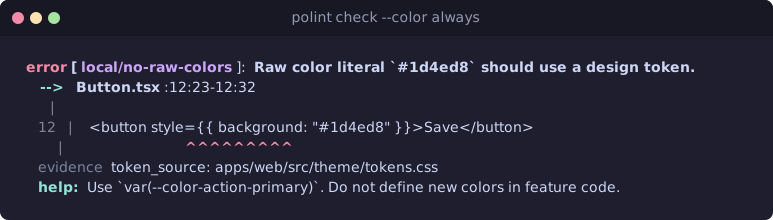
The rule does not just fail the code. It puts the missing project context back in front of whoever is repairing the change, human or agent.
The rule code stays in your repository, next to the code it protects. That makes the policy reviewable, testable, versioned, and runnable locally or in CI. polint ships no built-in policy rules.
cargo install polint --lockedOr from GitHub Releases:
curl -sSfL https://raw.githubusercontent.com/oaiz-io/polint/main/scripts/install.sh | bashThe default build includes Go and TypeScript/JavaScript analysis. Slim installs can select one frontend without compiling the other parser family:
cargo install polint --no-default-features --features lang-go
cargo install polint --no-default-features --features lang-typescript
If a repository contains a language whose feature is disabled, polint reports a
polint/capability diagnostic instead of running rules against placeholder
facts. See docs/CONSUMER-SETUP.md for the full matrix.
Run a self-contained example:
git clone https://github.com/oaiz-io/polint.git
cd polint/examples/config-denied-literal
polint check --color always --fail-on none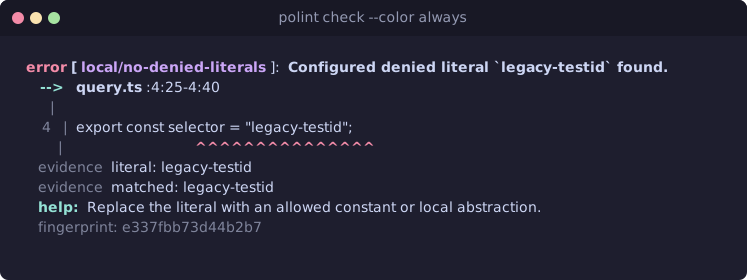
In your own repository:
polint init                        # scaffold .polint.toml and .polint/rules/
polint add-skill                   # install the agent skill
polint new-rule ts no-raw-colors   # add a rule module
polint test                        # run the rule fixtures
polint check                       # run every rule
polint init creates .polint.toml, .polint/rules/src/, .polint/cache/,
.polint/output/, .polint/.gitignore, and a root rust-toolchain.toml when
missing.
A rule declares the facts it needs in its signature. polint derives the analysis capabilities from that signature.
use polint::sdk::prelude::*;

#[polint::rule(
    id = "local/no-raw-colors",
    description = "Require design tokens instead of raw color literals.",
    severity = "error"
)]
pub(crate) fn no_raw_colors(
    ctx: &mut RuleCtx<'_>,
    literals: StringLiterals<'_>,
) -> RuleResult {
    for literal in literals.iter() {
        if literal.value.starts_with('#') {
            ctx.report(
                Diagnostic::error(
                    ctx.rule_id(),
                    ctx.file_path(literal.file),
                    literal.span.diagnostic_range(),
                    "Use a design token instead of a raw color literal.",
                )
                .with_evidence("literal", literal.value.clone()),
            );
        }
    }
    Ok(())
}
Rule packs live in your repository:
.polint.toml
.polint/rules/Cargo.toml
.polint/rules/src/main.rs          # calls polint::runner::run_cli(vec![...])
.polint/rules/src/no_raw_colors.rs
polint new-rule <go|ts|js|generic> <name> scaffolds a module and wires it into
main.rs, with positive and negative fixtures under .polint/tests/rules/. Use
--template <id> for a policy starter you edit to your own APIs, such as
secret-to-log, ssrf, or pii-to-analytics. These are scaffolds, not bundled
rules.
The facts available to rules are documented in docs/facts/.
polint checkruns every rule across the repository. This is where most rules live.polint review <ref>runs rules gated to a diff against a branch or commit, for policies that should only fire on what changed. See docs/REVIEW-RULES.md.
Profiles are explicit. polint check --profile web runs exactly
[profiles.web]. Unknown profiles are errors, and there is no default profile.
polint check --format ai-friendly --fail-on none   # compact output for agents
polint check --format sarif                        # for CI upload
polint check --stat                                # human scan summary
polint baseline create                             # adopt in an existing repo
polint ignores --stat                              # find suppressions to fix
polint cache status                                # inspect the local cache
polint inspect rule --format json                  # versioned JSON surfaces
--format ai-friendly prints counts by rule and at most ten example
diagnostics, then writes the full report to .polint/output/latest.json. Query
it with jq rather than pasting the whole file into a prompt.
- Consumer setup
- Fact reference
- Review rules
- Baselines
- Comment ignores
- Cache
- GitHub Action
- Agent playbook
- Releasing
polint is pre-1.0. Minor versions can change the rule SDK. Pin an exact version
in .polint/rules/Cargo.toml and upgrade deliberately.
The minimum supported Rust version is 1.95. polint init writes a matching
rust-toolchain.toml when your repository has none.
polint is under active development. Issues and pull requests are welcome. Read the contribution guide before you submit a change. Report security problems as described in the security policy.
polint is available under the MIT License.