
Synapse is an experimental project exploring alternative Edge IoT topologies. It substitutes centralized message brokers like MQTT or Kafka with a true decentralized Symmetric P2P Mesh topology over ZeroMQ. Integrity checks and anomaly detection are processed locally on each node using H3 spatial grids.
 (Above: Synapse dashboard. Hexagons turn yellow or red when sensors report anomalies compared to their local peers).
You can run a local simulation using Docker:
git clone https://github.com/onyks-os/Synapse.git
cd Synapse
docker compose -f docker/docker-compose.yml up --build
Open http://localhost:8081 in a browser to view the local dashboard of node-1. You can explore the decentralized network via the "Connected Peers" sidebar.
Synapse includes a built-in Chaos Monkey to test the spatial corroboration and node eviction mechanisms under stress.
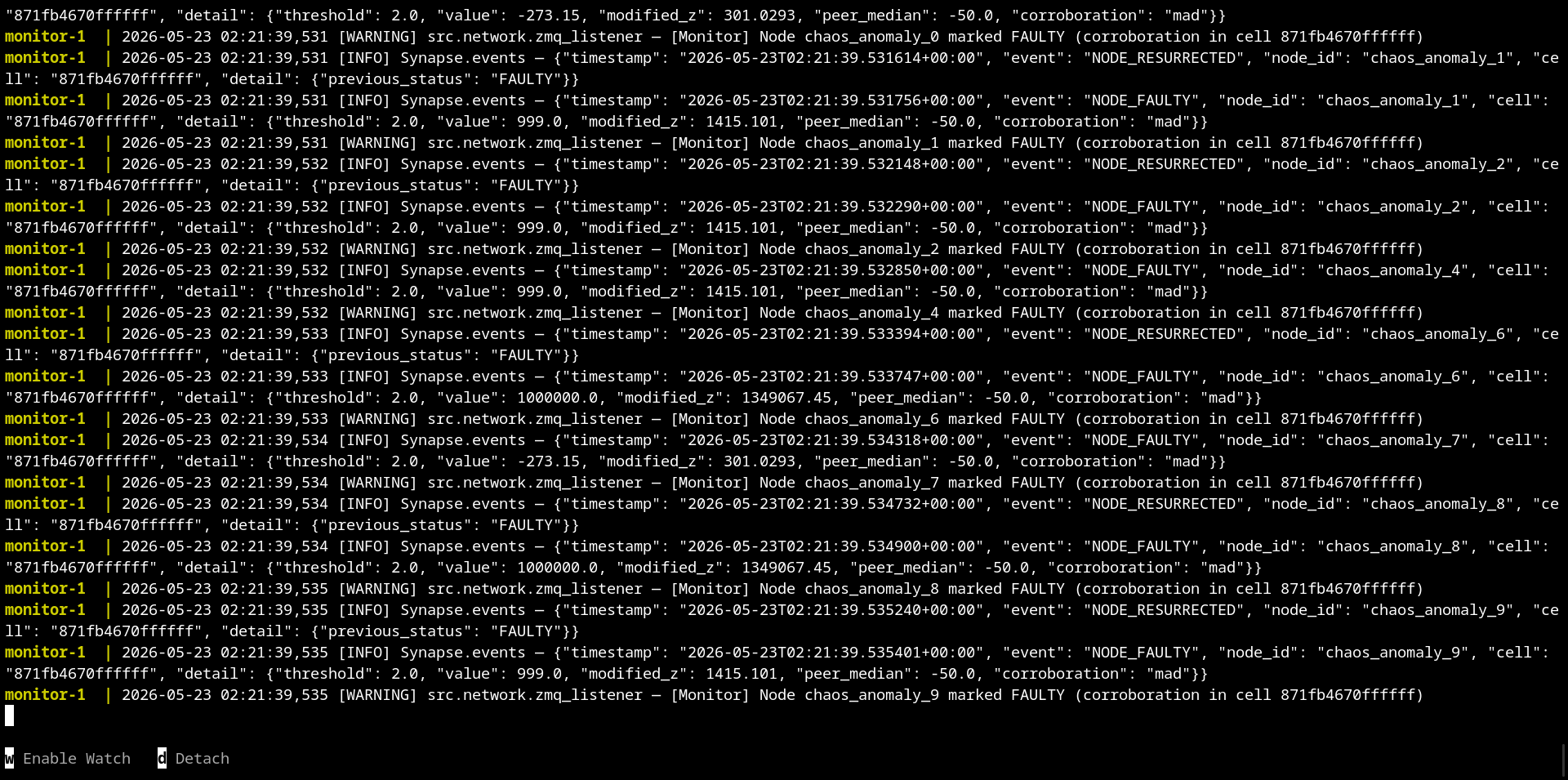 (Above: Injecting malicious payloads via the
 chaos_monkey.py CLI triggers the local MAD corroboration, immediately flagging the rogue nodes as FAULTY).
| Feature | Traditional IoT | Synapse |
|---|---|---|
| Topology | Hub and Spoke (Cloud Broker) | Symmetric P2P Mesh |
| Anomaly Detection | Centralized | Decentralized (H3/MAD) |
| Resilience | Single point of failure at the Broker | Decentralized |
| Footprint | High (JVM or heavy brokers) | Low |
- Networking: ZeroMQ for Pub/Sub messaging.
- Security: CurveZMQ (optional) for curve25519-based encryption.
- Spatial Engine: Uber H3 Hexagonal Hierarchical Spatial Index.
- Statistics: Median Absolute Deviation (MAD) for outlier detection.
To set up the local development environment:
- Install Python 3.11+ and venv.
- Set up the environment:
python3 -m venv .venv source .venv/bin/activate pip install .[dev] - Run the test suite:
pytest
Further details are available in the Contributing Guidelines, Architecture Document, and ADRs.
Distributed under the MIT License.