Repository navigation
browser compatibility
English · العربية · বাংলা · Čeština · Deutsch · Español · فارسی · Français
עברית · हिन्दी · Bahasa Indonesia · Italiano · 日本語 · 한국어 · Nederlands · Polski
Português · Русский · ไทย · Türkçe · Українська · Tiếng Việt · 简体中文 · 繁體中文
The existing device, media, legacy ES5/worker, native UI and Apple native-HLS checks remain required. The shared TypeScript workflow additionally runs the Plex scenarios against the exact packaged Mode A archive: two localized loading/reload flows, HLS.js and Video.js aspect persistence across media changes/reload, and strict-kiosk natural episode completion with HLS.js. The media scenarios use real decoding; all scenarios use real DOM/input. Only Plex data and the media source are synthetic local fixtures.
The aspect fixture transmuxes the checked-in H.264/AAC transport stream into
separate fMP4 renditions. Its initialization headers use an iso6 brand and
zero movie/track durations, as required by RFC 8216 section 3.3.
The AVC sample entry also uses the required reserved bits in its SPS count and
the signed -1 constant in its trailing pre_defined field. These correct
container syntax emitted by the pinned fixture muxer. A fixture contract checks
these headers and rejects malformed boxes while proving that codec parameter
sets, track IDs, timescales and media fragment
bytes are unchanged. This validates the synthetic input; it does not by itself
prove browser playback or replace the complete RC matrix.
Pull requests require current Chromium, Firefox and WebKit on Linux, Chromium
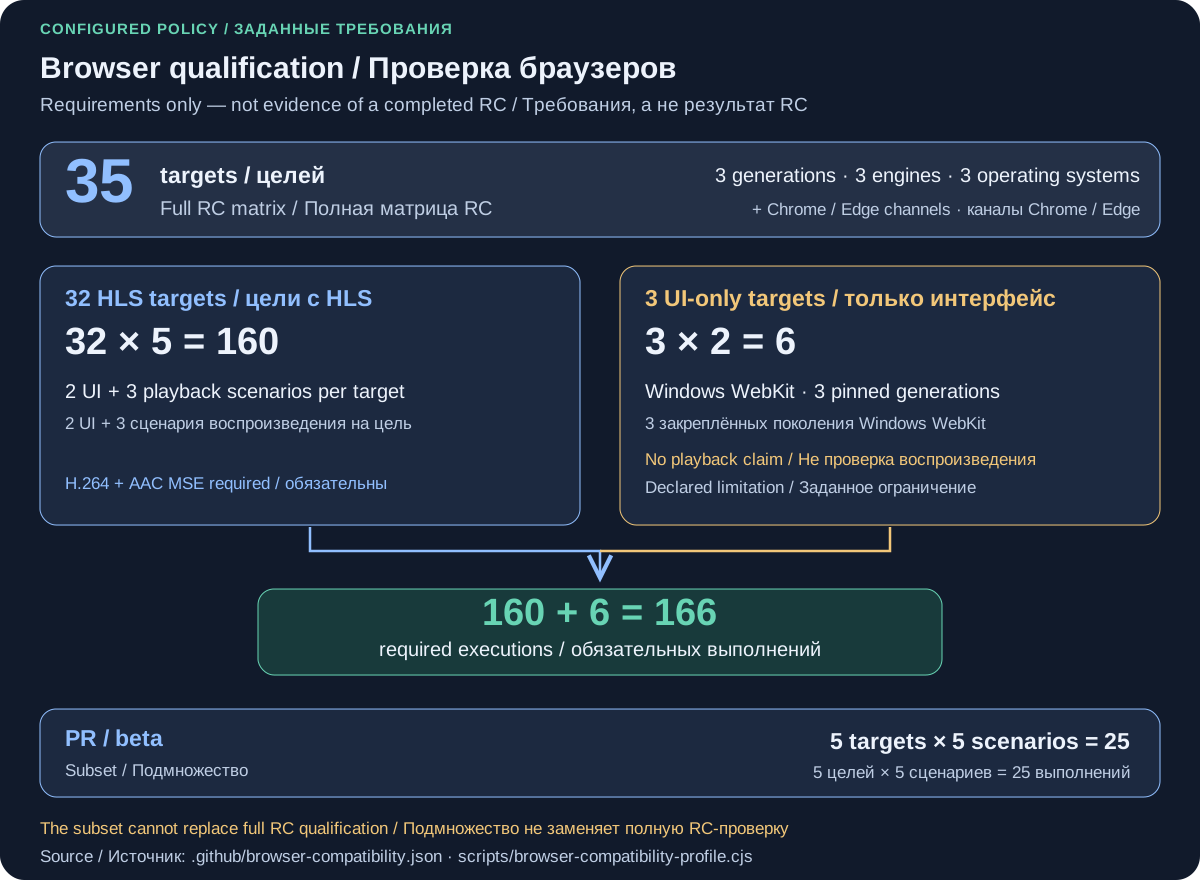
on Windows, and WebKit on macOS. Nightly and beta builds require these five targets. RC qualification requires
all 35 declared targets:
three exact Playwright/browser generations on Linux, Windows and macOS plus
installed stable Chrome/Edge on all three systems and beta Chrome/Edge on Linux.
The two historical macOS WebKit targets (Playwright 1.62.1 and 1.63.0) use
macos-15-intel; their receipts record the actual process architecture and
reject an ARM runner. Direct-MSE diagnosis found that the same H.264 initialization
and media bytes completed on Intel with 1.63 and on ARM with 1.64, while older
WebKit on the macOS 15 ARM VM stalled before updateend. Changing containers,
using ManagedMediaSource, or opening a browser window did not resolve that stall.
These two targets still require all five original playback/UI scenarios. This
runner choice is not a claim about every physical macOS device or native Safari.
Inventory regeneration must retain these reviewed runner overrides; the profile
contract rejects their removal.
All three Linux WebKit generations use the explicit ubuntu-26.04 x64 runner.
The reviewed official-runtime comparison reproduced the strict-kiosk transition
failure on Ubuntu 24.04 while the same candidate and five unchanged scenarios
passed four consecutive times on Ubuntu 26.04. This selects a coherent supported
runtime, without replacing individual multimedia libraries or relaxing playback
assertions. The other Linux browser targets retain their existing runners.
See Linux WebKit runtime qualification for the exact
source, artifact, comparison results and limits. The complete RC matrix and
separate packaged native acceptance remain required.
The tested product versions are recorded at runtime. Playwright Firefox is its patched build, not an assertion about native Firefox ESR; WebKit is not Safari. This matrix does not replace qualification on physical TVs or native shells.
The full inventory has 35 platform targets: 32 HLS-capable targets and three
Windows WebKit UI-only targets. The latter still require both localized
loading/reload flows; their WebKit build has neither MediaSource nor native HLS.
This is a declared limitation, not passed playback coverage. The exact three
target IDs are reviewed in scripts/browser-compatibility-profile.cjs.
A capability probe must confirm that limitation before their UI tests run. If
MSE (including ManagedMediaSource) or native HLS becomes available, the gate
fails until the profile is upgraded.
Every other target requires both H.264 and AAC MSE support and all five unchanged
scenarios; losing a capability fails instead of selecting a smaller suite.
The capability probe loads the candidate’s HLS library and checks the backend
selected by its pinned instance default: MediaSource, then ManagedMediaSource,
then WebKitMediaSource. The receipt names that backend and HLS version; a
changed default or version requires explicit review of the probe contract.
Consequently, a complete RC requires 166 successful scenario executions (32 × 5 + 3 × 2), with 35 target receipts. The PR/nightly/beta subset remains five targets and 25 scenario executions. Each receipt records its exact scenario set, capability probe and either passed HLS coverage or the explicit unsupported reason. These are configured requirements, not a claim that a particular RC has already completed them. The limitation is confirmed by the WebKit Windows build configuration used by Playwright 1.64 and by the pinned runtime probe.
Both paths download the producing job's exact current-run artifact ID. Archive checksums, source commit, packaged bundle/provider hashes, file types and paths are checked before serving a fresh extracted directory. Release checks also verify the frozen build receipt. Browser jobs do not rebuild the tested code. They install production dependencies only. The test server still requires the complete provider inventory from the source; the compiler loads only when an actual bundle is assembled, not when its inventory constants are read. Failed, skipped, stale or missing scenario evidence fails the shared gate; traces, actual runtime identity and candidate digest are retained for each target.
The seven generated inventory/lock files come from
venus-os-ci-toolkit/scripts/prepare_browser_compatibility.py. Application
packages and historical browser packages have separate lockfiles. GitHub-hosted
runners remain the default; the shared workflow retains the prepared Linux
reserve selection, while Windows/macOS targets require their native OS.
The shared release verdict verifies every selected target and its source SHA, run, attempt, channel and exact candidate artifact ID. RC cannot use the five- target beta evidence. Stable promotion consumes the accepted RC bytes. Re-run the whole qualification workflow after failure; older attempt receipts cannot complete a new qualification.
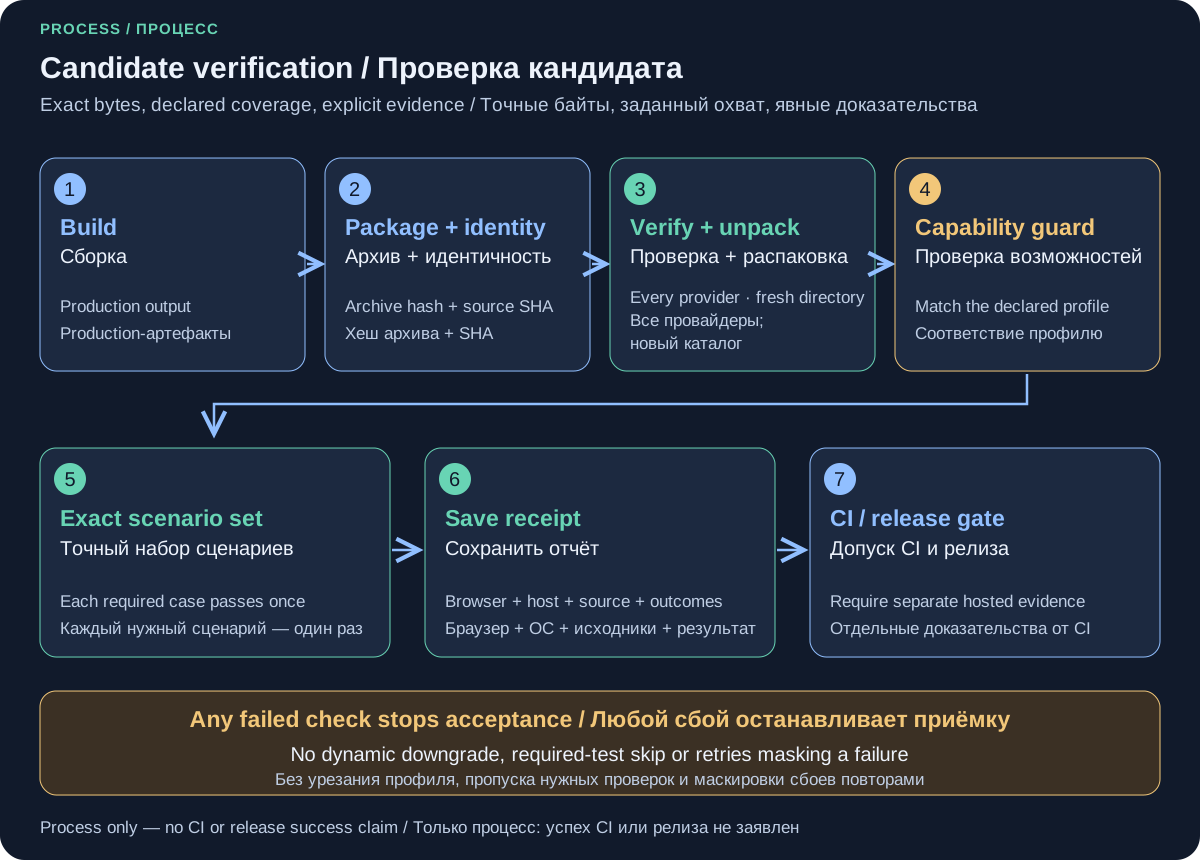
- Build the reviewed source and package the resulting Mode A files. Keep the archive checksum and source identity with the candidate.
- Before extraction, verify bounded archive size, safe paths, file types, source/version, and the complete entry/provider hash inventory. Release qualification additionally checks the frozen build receipt.
- Probe the actual browser version and media capabilities. Select the declared profile; a capability mismatch fails instead of silently reducing coverage.
- Run the exact scenario set against the extracted files, without rebuilding. Require every scenario exactly once, with no skips, failures or retries.
- Retain the runtime, capabilities, candidate digest and scenario results. The shared gate checks the required targets and matching run/attempt/source before accepting the evidence. Release coordination and device acceptance remain separate conditions.
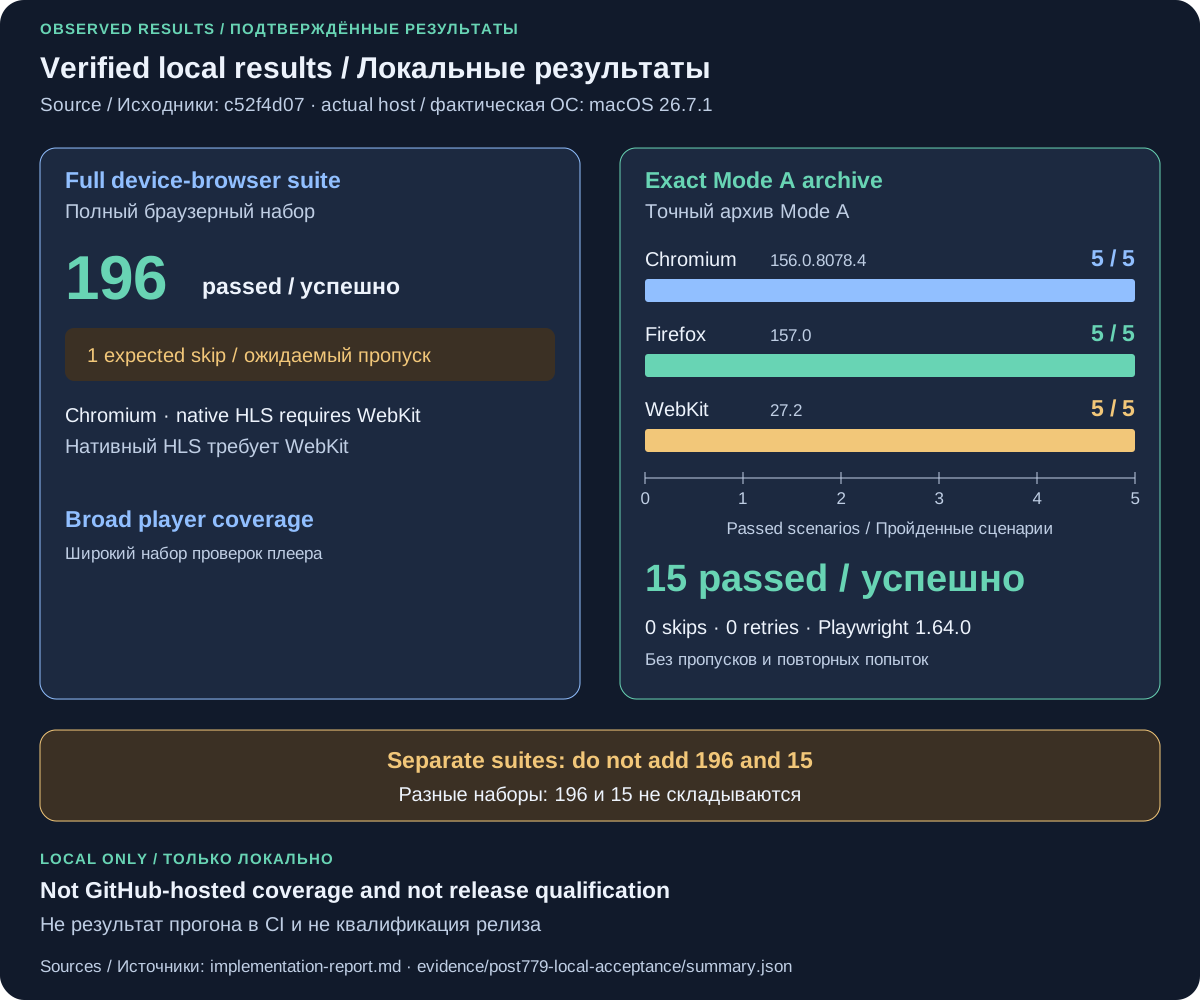
At source c52f4d07, the complete Chromium device-browser run passed 196 tests
with one expected native-HLS skip. Separately, the same packaged Mode A archive
passed five scenarios in each of Chromium 156.0.8078.4, Firefox 157.0 and WebKit
27.2: 15 passes, no skips or retries. These are different suites; their counts
are not a coverage percentage or proof that all 35 hosted targets passed.
The saved receipts identify the
actual macOS 26.7.1 host. They explicitly distinguish it from the macos-15
profile label and do not qualify a release. To repeat this local check on a Mac,
install the locked dependencies and Playwright 1.64.0 browsers, build the current
source, then run the saved recipe
with the repository directory as its argument. It packages the existing build,
checks the candidate, probes each browser and saves new receipts under
.compatibility/. It requires port 4189 and refuses to overwrite an existing
browser-candidate-web directory. Keep the source unchanged between building
and running the recipe. Hosted CI and physical-device results are tracked
separately in the implementation report.
Source revision: f51bac7a. This documentation may describe changes awaiting release; use the matching build.