Repository navigation
guide binding accessibility
English · العربية · বাংলা · Čeština · Deutsch · Español · فارسی · Français
עברית · हिन्दी · Bahasa Indonesia · Italiano · 日本語 · 한국어 · Nederlands · Polski
Português · Русский · ไทย · Türkçe · Українська · Tiếng Việt · 简体中文 · 繁體中文
Play the affected M3U channel, open Information → EPG, then edit the EPG source URL and the XMLTV ID. Enter the exact ID from the XMLTV file's <channel id="…">, not its display name. Choose Set to persist the binding and reload the playlist. Automatic removes this channel's override and reloads the original playlist mapping. Arrow movement alone never saves or resets a binding. Back leaves the stored binding unchanged.
This editor is available in the hosted browser deployment and native XMLTV shells (Tauri and Capacitor). It does not override provider-owned guides, explicit =source JSON endpoints or external companion servers. A plain legacy browser using a remote companion keeps its existing matching protocol. The first version accepts an exact ID; it does not download or display a searchable list of every XMLTV channel.
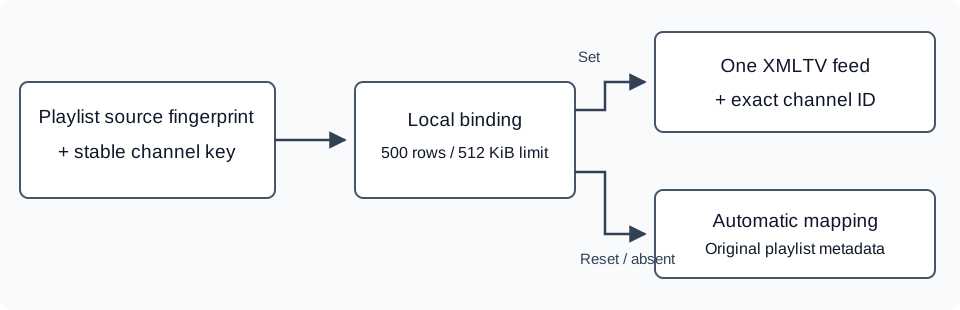
A binding stores the playlist source fingerprint, stable channel key, explicit feed URL and XMLTV ID. Renaming a display label or changing row order does not change a binding when the channel identity stays the same. Replacing the playlist URL/account changes the source namespace. For legacy M3U entries without itemId, the existing URL-derived channel ID is used; changing that URL changes its identity.
The selected channel keeps its display name and playback URL. Guide lookup uses one explicit feed and no name fallback, so a missing ID does not silently borrow another channel's programme. Automatic regional offsets inferred from a channel name do not apply to this exact binding; explicit playlist tvg-shift still applies. Set the correct regional XMLTV ID. If a custom HTTPS-hosted feed cannot be read because of CORS or mixed-content rules, the normal EPG diagnostics report that failure.
The local record is bounded to 500 bindings and 512 KiB per source; it is parsed once for a playlist load, not once per channel. Writes compare the prior value and read back the stored result before reloading. A late editor callback cannot save into a replacement source. This is a local preference, not cross-device synchronization. Feed URLs may contain credentials; avoid sharing storage exports publicly.
- The virtualized main list exposes a named listbox, selected option, full item count and absolute item position. Only the selected visible row is a Tab stop. Arrow navigation updates both the visual selection and semantic state; focus follows an already-focused list through page replacement.
- Standard information/confirmation dialogs, the editor and About panels expose modal roles and localized names. Tab and Shift+Tab cycle within the foreground modal. Closing a nested modal restores a still-visible parent control; stale scheduled opens cannot steal focus after dismissal.
- Information and confirmation messages describe their dialogs. Temporary notices use a polite status region.
- Existing translation catalogs supply all added labels. XMLTV and ID are protocol identifiers; channel names and feed hostnames remain source metadata.
The application keeps its remote-control routes and ES5 syntax. Semantic DOM checks do not constitute complete WCAG certification: device-specific focus, VoiceOver/TalkBack speech and TV browser behavior still require physical testing.
Run:
node tests/test_classic_accessibility.cjs
node tests/test_guide_bindings.cjs
node tests/test_screen_ownership.cjs
node tests/test_guide_integration.cjs
node tests/test_m3u_provider_driver.cjs
node tests/test_localization_catalog.cjs
npm run typecheck
Also run the ordinary build/ES5/bundle-size checks on the integrated branch. Browser checks should cover a long list across page boundaries; a nested confirmation; source replacement while editing; a correct, missing and removed binding; and an EPG download failure. The native Android application's semantic track preferences are implemented in its separate repository and are independent of these classic controls.
Source revision: f51bac7a. This documentation may describe changes awaiting release; use the matching build.