Repository navigation
playback stream policy
English · العربية · বাংলা · Čeština · Deutsch · Español · فارسی · Français
עברית · हिन्दी · Bahasa Indonesia · Italiano · 日本語 · 한국어 · Nederlands · Polski
Português · Русский · ไทย · Türkçe · Українська · Tiếng Việt · 简体中文 · 繁體中文
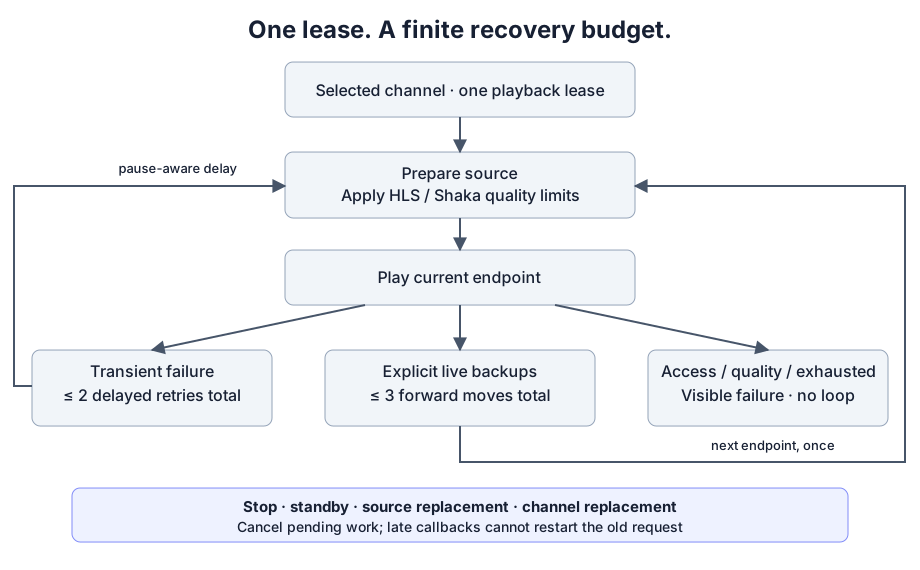
The managed HTML5/HLS/Shaka player retains one playback lease while recovering from a failed source. It can also use up to three explicitly configured backup URLs for a live channel. It never discovers, guesses or substitutes a channel by its title.
Open Settings → Interface settings and set Maximum video height (HLS/Shaka) and/or Maximum stream bitrate (HLS/Shaka). The two constraints apply together. Automatic removes that constraint. Supported choices are 360/480/720/1080/2160 pixels and 1/2/4/8/16 Mbps. Settings are stored locally, participate in the normal settings save/cancel flow and take effect on the next playback start, including a recovery restart.
These are ceilings, not transcoding settings. A 1080p-only stream cannot become 720p. If no advertised variant fits, the player reports No stream meets the quality limits and stops retrying that request. Unknown height/bitrate cannot prove that a constrained HLS variant fits.
HLS variant filtering happens before fragment loading. Current hls.js removes
ineligible variants; older builds without removeLevel can only retain a safe
contiguous prefix and may reject a manifest with otherwise eligible later
variants. Shaka uses application maxHeight/maxBandwidth restrictions.
Automatic adaptation continues among the remaining variants.
These settings apply to the managed HLS and Shaka engines. Plain HTML5, native platform decoders and retained TV/STB engines do not expose the same controls. Auto mode can select native playback; the setting does not force it into MSE. The player will not switch an already constrained HLS request to unconstrained native playback just to evade a decode error. No native transcoder, automatic hardware benchmark or claim of physical 720p output is implied.
- Start the intended live channel.
- Open Information → Backup streams.
- Select slot 1, 2 or 3 and enter a complete HTTP/HTTPS media URL.
- Reopen an occupied slot to Edit or Delete it. Start the channel again to use the updated list.
Each slot belongs to the current provider storage namespace and the exact
sourceId/channelId pair. The current playback generation and source
configuration fence the editor. Switching sources while a dialog is open
prevents that dialog from saving to the replacement source. A concurrent change
to the same slot is rejected instead of overwritten.
The first URL remains the channel's ordinary source. Duplicate and empty slots are skipped. A maximum of 256 channel records and 256 KiB of configuration are accepted. URLs with user-info credentials, whitespace, control characters, backslashes or an invalid port are rejected. Provider-supplied query tokens can still be part of a media URL: backup settings are local source configuration, not a mechanism to share credentials or make them public.
Backups are live only. Archive and VOD requests never use a live alternative: the recording, time origin, rights and seek semantics can differ. The owner must supply equivalent, authorized live endpoints. A matching channel title is not proof of equivalence. The stored channel identity, favourites and EPG binding remain unchanged when its transport endpoint changes.
- The request has at most two delayed transient same-URL retries in total and at most one forward move to each of its three backup slots: at most five recreations after the initial start. This budget is not reset by a new decoder instance or a successful manifest. Existing bounded in-engine HLS network and decode recovery runs before this outer recovery policy.
- HLS manifest/level parsing failures allow at most one same-URL reconnect per request, counted within the same two-retry total. A new decoder or backup endpoint does not reset this limit.
- Network failures without a status, HTTP 408/429 and 5xx can use the transient budget. Other HTTP 4xx can move to a configured alternative but do not retry the same URL. HTTP 401/403 and source sign-in errors terminate, without probing alternative credentials or backup endpoints.
- Decode failures can move forward to an explicit backup. Impossible quality limits terminate. There is no cycling back to the primary source.
- Delay is 500 ms, 1 s, 1.5 s, then at most 2 s. Repeated callbacks coalesce.
- Pause removes the scheduled timer while retaining its pending retry; Resume schedules it again. Stop, standby, source replacement and channel replacement invalidate delayed callbacks. A failed terminal request requires explicit reselection rather than autoplaying its retired decoder.
- Shaka load failures and critical error events share this path; cancellation errors are ignored. Reattachment waits for asynchronous Shaka destruction.
- Recovery re-resolves an opaque Stalker reference and prepares protected source access again. It does not reuse an expired iOS loopback URL. VOD/archive position is sampled before teardown; live backups start at their live edge.
The policy does not introduce a second stalled-frame watchdog. Existing kiosk, Auto/native and HLS recovery still cover their own observed failure cases. A stream that stalls silently without any existing detector reporting an error needs separate diagnosis.
window.__ottStreamPolicy.snapshot() exposes engine name, requested limits,
capability/availability, retry count, endpoint index and recovery state. It
contains no stream URL or provider credentials. Index zero means the ordinary
source; later indexes refer to nonempty unique alternatives. This is diagnostic
state, not a stable remote-control API.
Run:
node tests/test_stream_policy.cjs
node tests/test_port_engine_lifecycle.cjs
node tests/test_settings_parity.cjs
node tests/test_media_backend.cjs
npm run test:localization
npm run typecheck
npm run build:server
node scripts/check-es5.cjs --server-only
Tests exercise quality filtering with non-monotonic variant order, unavailable metadata, source-scoped editing, slot conflicts, duplicate errors, bounded budgets, HTTP authorization failures, pause/stop/source cancellation, Shaka teardown and VOD position retention. The five new playback labels are translated in all 88 shipped language packs; automated parity is not native-speaker review. Physical TV/D1 playback and provider-specific manifests still require device validation. Editable diagram source.
Source revision: f51bac7a. This documentation may describe changes awaiting release; use the matching build.