 GitHub Community
[projects beta] Handling features within a project (epics/umbrellas) #7267


|
I just started using the new projects beta and try to get my things organized in a way I am familiar with. Not sure if I am using it the right way but I will try to share some insights into my work style and hope it helps understanding the things which I am struggling with 😁: In my environment each project is a release cycle. So I create one project for each release I plan (e.g.
This project style is coming more from the scrum work style with a epic > stories > subtask structure where epics are usually larger features, stories are the broken down parts which fit into sprints and subtasks is the split of the work within the team (implementation, documentation, testing,..). Thinking of other (scrum) issue tracking systems I got in tough with, this structure was always somehow possible (CA Agile, Jira) and it seems especially large repositories on GH practice similar work styles where large scale features need to be broken down with a clean planning phase of a new project release cycle. Problem 1: Issue structureGitHub does not directly have the concept of nested issues where a parent can be considered an epic/feature. You can try to do it by creating issues where you link the other issues with task lists. This is nicely described here: https://docs.github.com/en/issues/tracking-your-work-with-issues/about-task-lists But this does not integrate well with the new projects beta yet. 😞 With the workflow described above you end up with following problems:
Workarounds
Problem 2: Board persistenceYou cannot define a board to have a default layout for everyone who opens it. I would like to create boards with defined filters and grouping rules that cannot be changed (only extended?). With this feature mentality I would like to have boards like the following in my project:
Workarounds
Solution proposalsWhile I am not sure if my work style fits the one of others too, I see the need for the following topics somehow addressed in the new projects system somehow:
I hope this gives some insights on what the new projects beta is lacking for me and how I plan to use it. I found various individual requests to add indention, nesting, grouping etc. but for me they were lacking a bit on the background why it is needed and how they plan to use projects so I thought sharing deeper insights. I also hope that maybe others can share some insights on how they are solving this issue of feature-issues/umbrella-issues/epics and they would like to have it reflected in the new project system of GH. |
Replies: 5 comments 16 replies

|
I'm with you on the same page. GitHub marketing did a great job and got me really excited to use it to track progress during our development cycles, but I feel that the end result is underwhelming. Weirdly enough, it's even included in their pitch:
So you open a new project board, create several issues with task lists and mark some of them as done. Now I would expect the project board to be updated and reflect the progress on the tracked issues. But it doesn't. I have to open each issue individually. And when a complex feature isn't tracked with a task list in an issue, but with a dedicated project I can't seem to link to this as a subproject — should I be using milestones instead? |
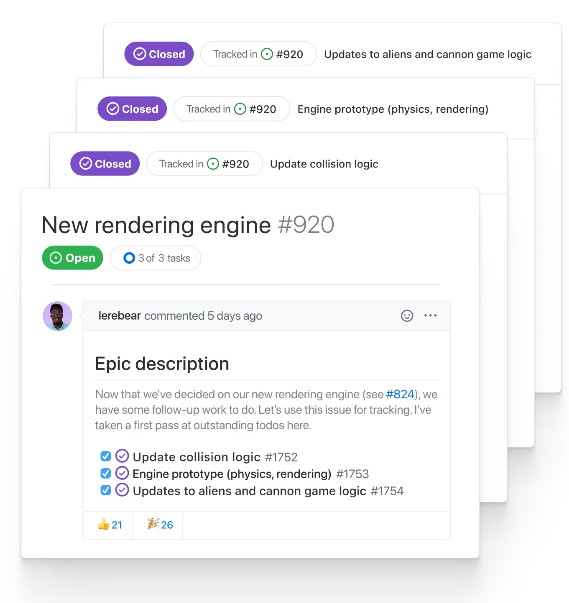

We're looking at migrating to GitHub Projects and I'm surprised that there's no way to accomplish this. Complex features across multiple repositories can't be properly tracked in single issue task list. Being able to create a backlog project where an entry could be a feature (child) project, instead of just an issue, would be ideal. |

|
Adding my two cents here. For me, using Milestones as "projects" or "epics" isn't a tenable solution as the list of milestones is unique per repository, and for our use cases, we have multiple repositories' worth of changes for each epic. Github has really taken the "Power Developer" approach here rather than the "Power User" approach (Keeping in mind all 3 roles -- applicable to developer, product owner, and scrum master roles, not just developer) to their project board offering here. GitHub Issues and GitHub repositories are 1st and 2nd class citizens respectively because they are what developers work with the most. This results in less of a focus on product owner use cases -- product backlog management features - I can't even clone a GitHub issue without using the API, let alone link GitHub issues to each other to track issue completion rolled up into an epic. I've helped Scrum teams in many different industries identify Agile tools that work for them. The tools I have seen have real success with product backlog management features are the tools that treat individually backlog items as a universal, internally linkable object (that could be a user story, bug, theme, enhancement, epic, issue, you name it -- the major differentiating factor being an 'issue type' on the atomic backlog item). This allows universal linking between items and parent/child nesting. |

|
@jfritz a simple github action to sync your milestones across your repos does the trick. We're adding our milestones into our main repo, and using that to copy them to our other repos. Since the milestones have the same names, within your github project you can filter by that 1 milestone and it tracks all issues across all repos. For backlog management, you can nest all your backlog user stories within a status or/and a milestone (since it's easy to move them out of it then, once you're ready to take care of those issues) |

|
Hello! 👋 Tasklists add support for issue hierarchy at GitHub and are currently in Private Beta! You can request access and join the waitlist here. For more information on how these work, check out the documentation. |

|
@rileybroughten @ankneis any update you guys could share given we are at the end of June? |

|
I see that the feature was marked as beta for Q2, but I'm not seeing it as an offered feature. Is there any hope this will land soon? 🙏 Edit: I also notice that there is no official documentation on github's support for organization projects |

|
@rileybroughten do you have any news about it ? |

|
@rileybroughten Also waiting for this. Really hoping to not have to go back to ZenHub |

|
How do I know if I am allowed to join the open beta? |
|
The private beta is now open for sub-issues, see this discussion for more details! |
|
👋 Check out the changelog announcement where you can sign up to gain access to sub-issues, issue types, and advanced search ✨ |


Hello! 👋 Tasklists add support for issue hierarchy at GitHub and are currently in Private Beta! You can request access and join the waitlist here.
For more information on how these work, check out the documentation.