Product Vision
The raw idea, a use case, or something we’ve seen that motivates us to work on this
We're organizing a one-day AI conference in Los Angeles, and we need a landing page where potential attendees can learn about the conference and register for a free ticket.
The core elements we came up with, presented in a form that’s easy for people to immediately understand
These are some concepts we would like to inform the solution:
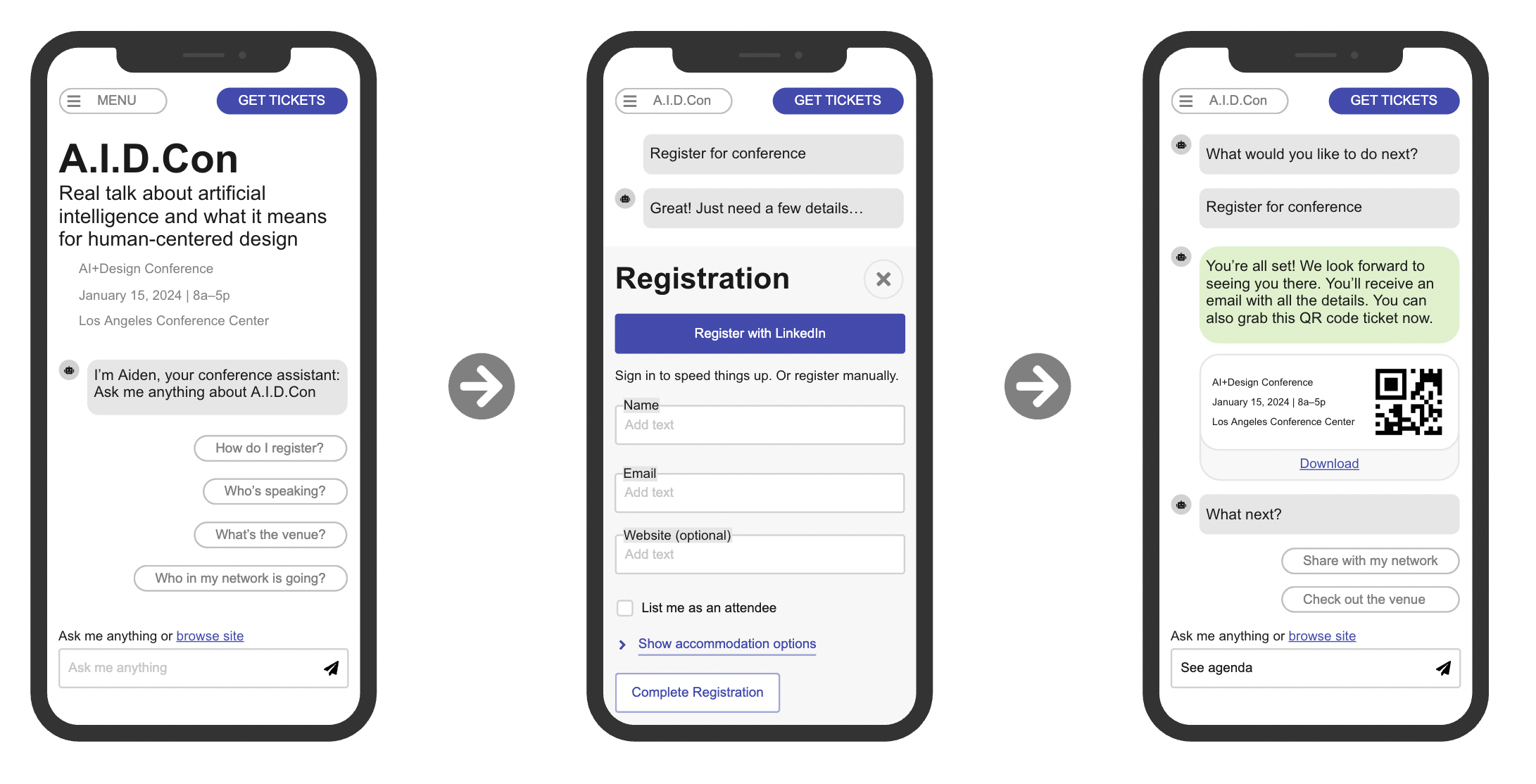
Chatbots and website assistants have been around for a while now. And many of us have learned through habit to either ignore or close them. But with the evolution of AI-based chat we've seen from tools like ChatGPT and others, some mature patterns have emerged with interactions like plain-language prompts, suggested questions, and human-like responses. Given the conventional nature of conference website content, A.I.D.Con is an opportunity to explore these patterns by seamlessly combining the chat experience with traditional webpage layouts.
A website has always been an attempt to answer the visitor's questions. The FAQ page could be considered an example of design laziness, but in some ways was a precursor to the technology that enables you to "ask questions of your content." Today, people have much higher expectations for receiving fast, relevant responses to questions asked on their terms, not the website designer's. Let's have fun with it!
Asking for too much personal information too soon on a web form can feel intrusive. But when you interact with a human who's helping you in real life, it's natural for them to want to build rapport by asking you your name and maybe some ice breaker questions like where you're from or what you're doing this weekend. Knowing something about who we're talking to enables a more personal, human experience. By using an authentication tool like LinkedIn, we're able to craft a more personal experience and make actions like registration effortless. The key is framing the authorization in terms of the benefit to the potential attendee, not the system. Instead of authenticating feeling like an annoying barrier, offering the option to "see who in your network is attending" creates a meaningful incentive, which brings us to the next key concept…
Registering for a free event can result in a low-commitment level for the potential attendee. Maybe they put it on their calendar, but they didn't have to ask their boss or spend any money, so when the day of the event arrives you may end up with more no-shows than you otherwise would at a paid event. Building on the value of having people authenticate with their LinkedIn profile, we can unlock further interactions to establish some social accountability by having people share their registration completion or give permission to list them as attendees. But it doesn't all have to be about authentication; by including the option for +1s, we can lower the barrier to "attendance referrals" by deferring the need for each individual to register up front.
How much time we want to spend and how that constrains the solution
Given the timeline, resources, and budget we have for this project, the appetite is 2 weeks. That's not a deadline. It simply means we expect to launch whatever a 2-week version of the site looks like with a two-person team working on it exclusively for that time period.
Details about the solution worth calling out to avoid problems
Although the concepts outlined in the Solution allow for some creative potential and sophisticated interaction, we have to keep the appetite in mind. All we really need for registration to a free event is an email address. So keep an eye for these potential rabbit holes:
-
Combining chat with form interactions: Integrating a chat experience with traditional content and forms has the potential to get weird. Although we've got an idea of how it might work from the user flows, we'll have to see how it feels in browser. If needed, we can fall back on a more clear delineation between "chat mode" and "browse mode."
-
"Ask me anything" search: Because we're not using actual AI (yet), we'll have to come up with some logic for what to show based on various free text user input, including fall back option when the input is not clear. Let's not over complicate it. Start with determining some keyword mapping that will bring up the various sections.
-
LinkedIn Profile API: The authentication aspect is key to personalization and social proof, but it still represents a third-party dependency that could eat up time if we run into problems. We can rely on traditional social share options if the API proves to be tricky.
Anything specifically excluded from the concept: functionality or use cases we intentionally aren’t covering to fit the appetite or make the problem tractable
To clarify, although the concept is to simulate an AI-chat experience for the site, we will not be using actual AI — at least not yet. If it resonates with the client and other we can explore building on this project with a larger appetite looking at event-focused large language models. The potential to spin up "event bots" simply based on a write-up of the event and some brand guidance could be interesting.