


Fork note: Upstream aleatory v1.2.1 merged; local ABP/RTP/CTRW additions retained.
Implements a nearest-neighbour continuous-time jump process on the full integer lattice
Signature
from aleatory.processes import ContinuousTimeRandomWalk

ContinuousTimeRandomWalk(
    rate_up=0.5,
    rate_down=0.5,
    initial=0,
    rng=None,
)
Arguments
-
rate_up: right-jump rate$\lambda \geq 0$ -
rate_down: left-jump rate$\mu \geq 0$ -
initial: initial state$x_0 \in \mathbb{Z}$ -
rng: optional NumPy random number generator
At least one of rate_up or rate_down must be positive.
Implements a nearest-neighbour continuous-time jump process on an integer state space with one-sided or two-sided reflecting boundaries. In the interior, the process jumps upward with rate
Signature
from aleatory.processes import ReflectingContinuousTimeRandomWalk

ReflectingContinuousTimeRandomWalk(
    rate_up=0.5,
    rate_down=0.5,
    initial=0,
    lower=None,
    upper=None,
    rng=None,
)
Arguments
-
rate_up: right-jump rate$\lambda \geq 0$ -
rate_down: left-jump rate$\mu \geq 0$ -
initial: initial state$x_0 \in \mathbb{Z}$ -
lower: optional lower reflecting boundary -
upper: optional upper reflecting boundary -
rng: optional NumPy random number generator
At least one of lower or upper must be specified. If both are specified, the class requires lower < upper, and the initial state must lie inside the admissible state space.
Implements a nearest-neighbour continuous-time jump process on an integer state space with one-sided or two-sided absorbing boundaries. In the interior, the process jumps upward with rate
Signature
from aleatory.processes import AbsorbingContinuousTimeRandomWalk

AbsorbingContinuousTimeRandomWalk(
    rate_up=0.5,
    rate_down=0.5,
    initial=0,
    lower=None,
    upper=None,
    rng=None,
)
Arguments
-
rate_up: right-jump rate$\lambda \geq 0$ -
rate_down: left-jump rate$\mu \geq 0$ -
initial: initial state$x_0 \in \mathbb{Z}$ -
lower: optional lower absorbing boundary -
upper: optional upper absorbing boundary -
rng: optional NumPy random number generator
At least one of lower or upper must be specified. If both are specified, the class requires lower < upper, and the initial state must lie inside the admissible state space.
Implements a two-dimensional active Brownian particle with self-propulsion, rotational diffusion, and optional translational diffusion. The particle moves at constant speed v0 in the direction of its current heading theta_t, while the heading itself evolves diffusively. This produces persistent motion over short times and progressive loss of directional memory over longer times.
The process is simulated from the Langevin system
where D_T is the translational diffusion coefficient and D_R is the rotational diffusion coefficient.
Signature
from aleatory.processes import ABP2D

ABP2D(
    speed=1.0,
    rotational_diffusion=1.0,
    translational_diffusion=0.0,
    T=1.0,
    x0=0.0,
    y0=0.0,
    theta0=0.0,
    rng=None,
)
Arguments
-
speed: self-propulsion speed$v_0 \geq 0$ -
rotational_diffusion: rotational diffusion coefficient$D_R \geq 0$ -
translational_diffusion: translational diffusion coefficient$D_T \geq 0$ -
T: end time of the simulation interval -
x0: initial x-coordinate -
y0: initial y-coordinate -
theta0: initial orientation angle -
rng: optional NumPy random number generator
The implementation uses an Euler discretisation on a uniform time grid over [0, T]. The planar sample returned by sample(n) consists of the coordinate pair (x, y). The most recently simulated orientation path is stored on the instance and can be accessed through last_theta, or returned explicitly by sample_with_orientation(n).
Implements a two-dimensional run-and-tumble particle with self-propulsion, Poisson-distributed tumble events, and optional translational diffusion. Between tumbles, the particle moves ballistically at constant speed in a fixed direction. At each tumble, the orientation is reset instantaneously by drawing a new heading uniformly from [0, 2π).
The process therefore alternates between straight runs and sudden reorientation events. In the discrete-time implementation, a tumble occurs during a timestep dt with probability lambda * dt, where lambda is the tumble rate.
Signature
from aleatory.processes import RTP2D

RTP2D(
    speed=1.0,
    tumble_rate=1.0,
    translational_diffusion=0.0,
    T=1.0,
    x0=0.0,
    y0=0.0,
    theta0=0.0,
    rng=None,
)
Arguments
-
speed: self-propulsion speed$v_0 \geq 0$ -
tumble_rate: tumble rate$\lambda \geq 0$ -
translational_diffusion: translational diffusion coefficient$D_T \geq 0$ -
T: end time of the simulation interval -
x0: initial x-coordinate -
y0: initial y-coordinate -
theta0: initial orientation angle -
rng: optional NumPy random number generator
The planar sample returned by sample(n) consists of the coordinate pair (x, y). The most recently simulated orientation path is stored on the instance and can be accessed through last_theta, or returned explicitly by sample_with_orientation(n). The indices of the most recent tumble events are also stored on the instance and are available through last_tumble_indices.
Refactor all processes that hardcode
style="seaborn-v0_8-whitegrid"with plt.style.context(style):- Explore
utils.plottersfor above
Bin processes.jump into 'discrete' & 'continuous'
Tidy up all __init__.py (every module)
Testing: ReflectingContinuousTimeRandomWalk
- constructor validation
- path structure invariants
- state-space invariants
- reflection-rule checks
- trapping edge cases
- comparison with the unbounded walk in a wide interval
- basic long-time bounded behaviour checks
Run it from the repo root with:
python -m unittest discover -s tests -p "test_reflecting_cont_time_random_walk.py"Testing: AbsorbingContinuousTimeRandomWalk
- constructor validation
- path structure invariants
- state-space invariants
- absorption-rule checks
- trapping behaviour at absorbing boundaries
- comparison with the unbounded walk in a wide interval
- basic long-time absorbing behaviour checks
Run it from the repo root with:
python -m unittest discover -s tests -p "test_absorbing_cont_time_random_walk.py"The aleatory (/ˈeɪliətəri/) Python library provides functionality for simulating and visualising stochastic processes. More precisely, it introduces objects representing a number of stochastic processes and provides methods to:
- generate realizations/trajectories from each process —over discrete time sets
- create visualisations to illustrate the processes properties and behaviour
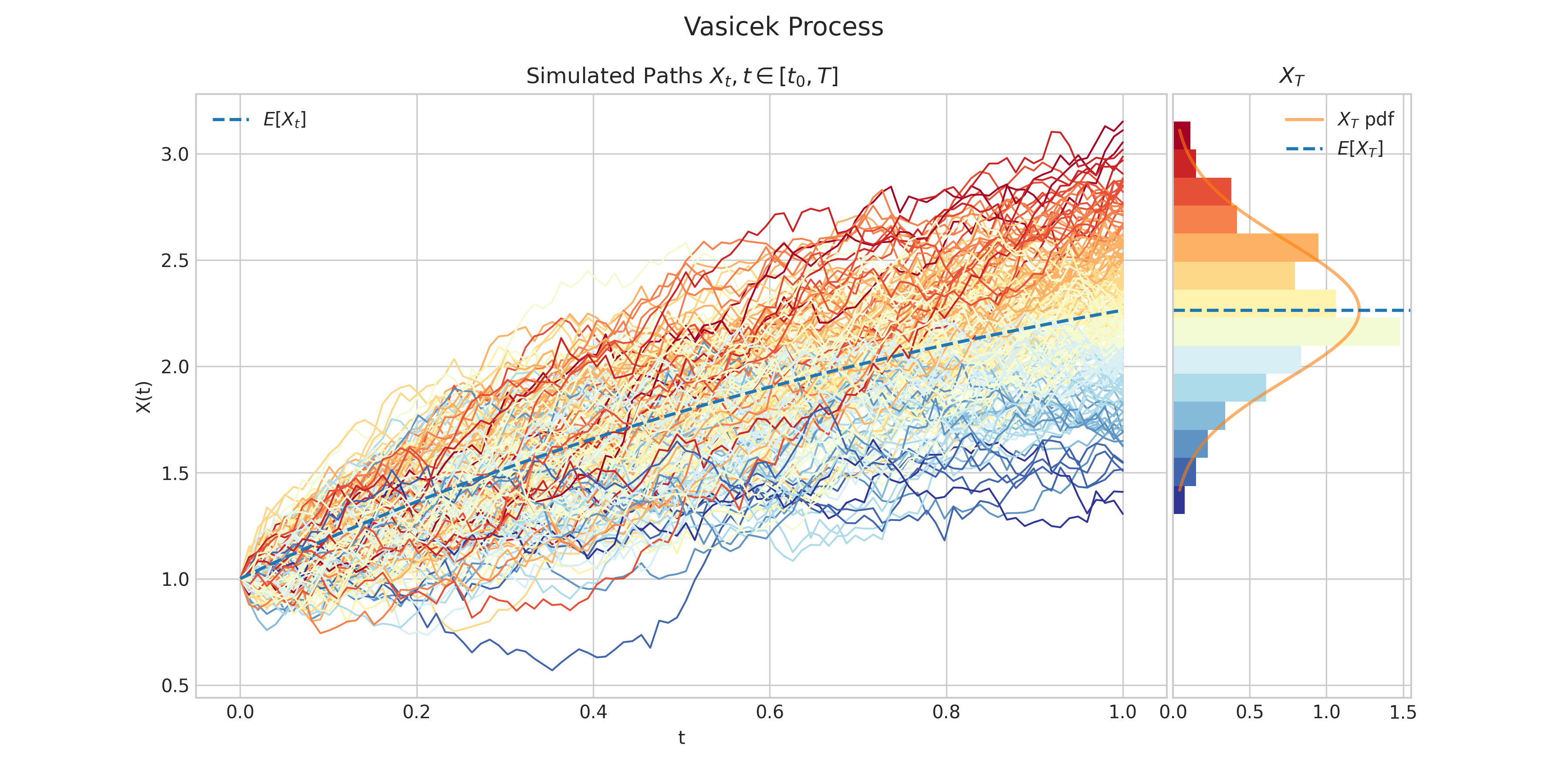
Currently, aleatory supports the following stochastic processes in one dimension:
- Arithmetic Brownian Motion (see Brownian Motion)
- Bessel process
- Brownian Bridge
- Brownian Excursion
- Brownian Meander
- Brownian Motion
- Constant Elasticity Variance (CEV) process
- Cox–Ingersoll–Ross (CIR) process
- Chan-Karolyi-Longstaff-Sanders (CKLS) process
- Fractional Brownian Motion process
- Galton-Watson process with Poisson branching
- Gamma process
- Gaussian Process with Constant Kernel
- Gaussian Process with Linear Kernel
- Gaussian Process with Matern Kernel
- Gaussian Process with Periodic Kernel
- Gaussian Process with RBF Kernel
- Gaussian Process with Squared Exponential Kernel
- General Random Walk
- Geometric Brownian Motion
- Hawkes process
- Inverse Gaussian process
- Inhomogeneous Poisson process
- Mixed Poisson process
- Ornstein–Uhlenbeck (OU) process
- Poisson process
- Random Walk
- Squared Bessel processes
- Vasicek process
- Variance-Gamma process
- White Noise
From v1.1.1 aleatory supports the following 2-d stochastic processes:
This fork additionally includes active-particle and continuous-time random-walk modules:
-
ContinuousTimeRandomWalk: nearest-neighbour continuous-time random walk on$\mathbb{Z}$ with rates$\lambda$ and$\mu$ . -
ReflectingContinuousTimeRandomWalk: nearest-neighbour continuous-time random walk with one-sided or two-sided reflecting boundaries. -
AbsorbingContinuousTimeRandomWalk: nearest-neighbour continuous-time random walk with one-sided or two-sided absorbing boundaries. -
ABP2D: two-dimensional active Brownian particle with self-propulsion, rotational diffusion, and optional translational diffusion. -
RTP2D: two-dimensional run-and-tumble particle with Poisson tumbles and optional translational diffusion.
The local CTRW boundary classes are covered by tests/test_reflecting_cont_time_random_walk.py and tests/test_absorbing_cont_time_random_walk.py.
Aleatory is available on pypi and can be installed as follows
pip install aleatoryAleatory relies heavily on
numpyfor random number generationscipyandstatsmodelsfor support for a number of one-dimensional distributions.matplotlibfor creating visualisations
Aleatory is tested on Python versions 3.8, 3.9, 3.10, and 3.11
Aleatory allows you to create fancy visualisations from different stochastic processes in an easy and concise way.
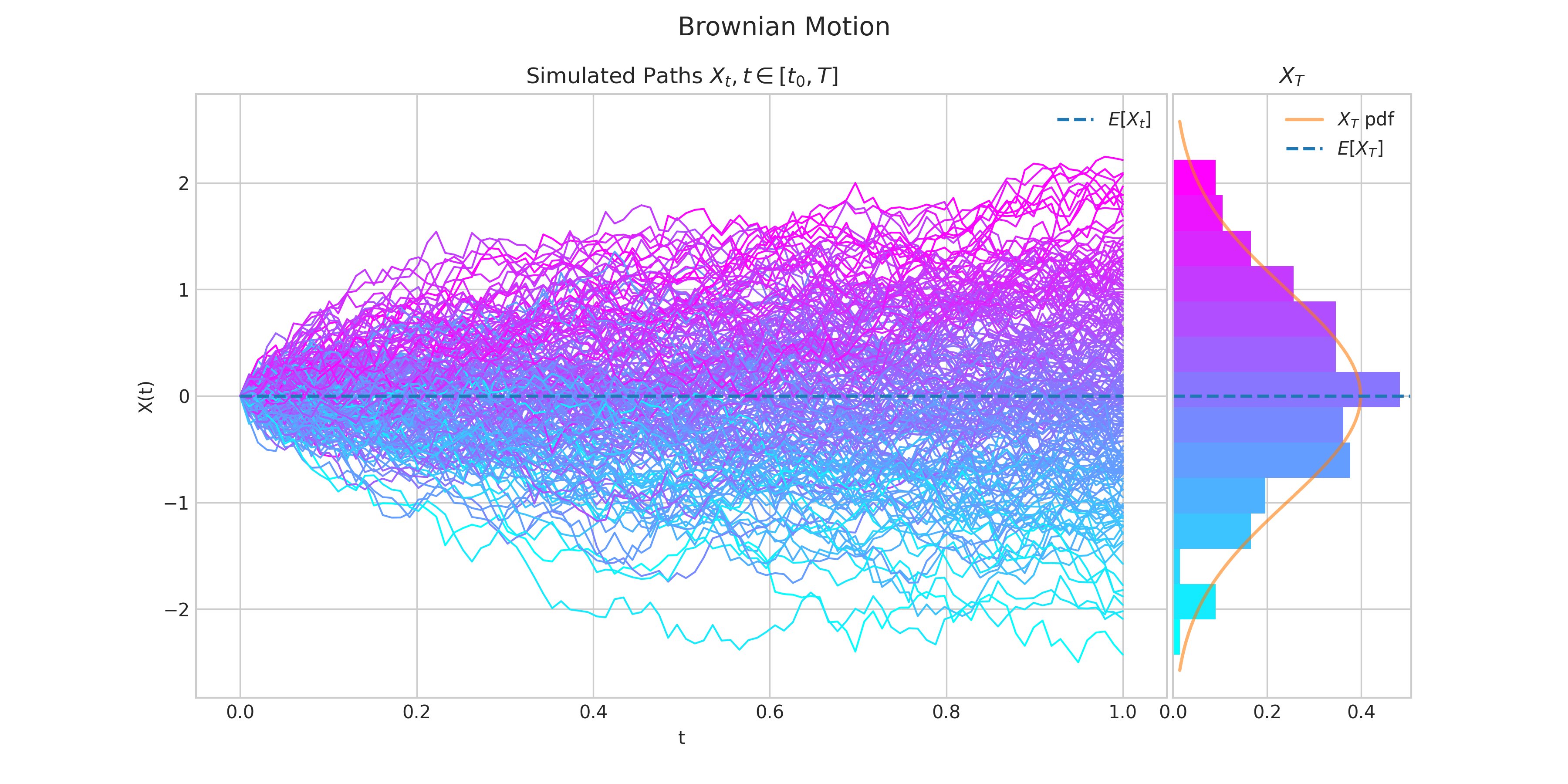
For example, the following code
from aleatory.processes import BrownianMotion

brownian = BrownianMotion()
brownian.draw(n=100, N=100, colormap="cool", figsize=(12,9))
generates a chart like this:
For more examples visit the Quick-Start Guide.
If you like this project, please give it a star! ⭐️
Connect with me via:
- 👾 Personal Website