Home
Certificate Gadgets is a browser-based certificate investigation tool and reusable TypeScript API. It loads X.509 certificates, displays certificate-focused fields and extensions, embeds the PkiStudioJS ASN.1 viewer, and supports explicit network-assisted validation workflows for AIA, OCSP, and CRL resources.
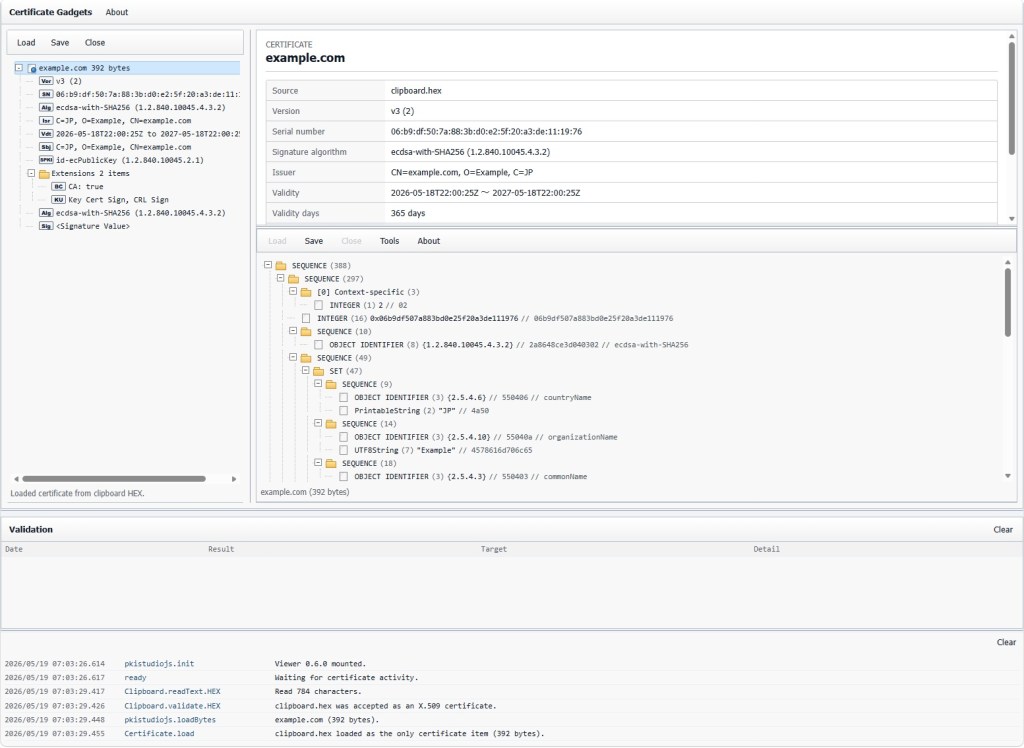
The package is published as:
npm install @pkistudio/certgadgetsCurrent package version: 0.1.4
- Getting Started: install, run locally, load certificates, inspect fields, and save DER or PEM output.
- Browser App: understand the certificate tree, detail pane, Validation pane, API Log, and embedded ASN.1 viewer behavior.
-
Core API: use
CertGadgetsCorefor certificate parsing, tree models, DER/PEM/HEX/Base64 helpers, and validation plan collection. -
Validation API: use
CertGadgetsValidationfor network validation planning, OCSP request preparation, response assessment, and artifacts. - Embedding: mount the application in a browser page or Webview host and provide host-owned networking callbacks.
- Testing: understand what the standard checks cover and where browser verification is still needed.
- Development: local checks, package entry points, wiki preview, and release notes.
- Certificate parsing and structural inspection run locally in the browser.
- Loaded certificate data is kept as DER bytes in browser memory.
- The app keeps one loaded certificate document at a time.
- X.509 parsing uses PKIjs and ASN.1 support from asn1js.
- PkiStudioJS is used as the ASN.1 inspection viewer; Certificate Gadgets owns certificate loading, validation actions, and selected-item routing.
- Network-assisted validation is explicit. The app does not silently fetch CRLs, OCSP responses, AIA resources, or issuer certificates.
- Host-specific networking, user confirmation, file access, dialogs, and Webview lifecycle remain outside the reusable core package.
- Browser-hosted validation can use host callbacks or a fetch proxy because many certificate endpoints are HTTP-only or omit CORS headers.
- Main repository: https://github.com/pkistudio/certgadgets
- npm package: https://www.npmjs.com/package/@pkistudio/certgadgets
- PkiStudioJS dependency: https://github.com/pkistudio/pkistudiojs