Push Notifications
cronstable can deliver job and daemon alerts as end-to-end encrypted push
notifications to paired devices, through a hosted relay, via a fifth
reporter named push that sits beside the mail, Sentry, shell, and webhook
reporters (see Reporting). The point is a page on a phone with
none of the usual trust cost: no third-party service ever reads the alert.
The encryption model in two sentences: the daemon seals each alert to every paired device's X25519 public key (a libsodium sealed box, X25519 + XSalsa20-Poly1305), so only that device's private key, generated on the phone and never leaving it, can open the payload. The relay that forwards alerts to the platform push service (APNs) sees only a device token, a ciphertext, an opaque coalescing hash (keyed with a per-installation salt the relay never sees), a priority, and an event flag, never job names, hostnames, or log lines.
Push is an optional extra. Install it alongside cronstable:
pip install "cronstable[push]"(The extra is PyNaCl, which bundles libsodium. The release binaries bundle it per architecture; a lane that cannot build it ships without the extra, and a config that asks for push then refuses to start with an error saying so.)
Then configure the daemon-global push: section, which says where alerts
go and where device pairings are stored:
push:
  relay:
    url: https://relay.example.net/v1/notify
    timeout: 10
  devicesFile: /var/lib/cronstable/devices.json
devicesFile is only needed on a stateless install; with a
state: section the registry rides the durable store
instead (see Where pairings are stored).
The section alone sends nothing. Each job hook (or the daemon-level
notify: block) opts in through the report schema, exactly like the other
reporters. A typical setup pushes on every failure via the file's
defaults::
defaults:
  onFailure:
    report:
      push:
        enabled: true
        priority: time-sensitive
        includeLogTail: true
The same block under notify.report
pushes daemon and orchestration events too: DAG failures, approval gates
awaiting a decision, and leadership and quorum changes:
notify:
  report:
    push:
enabled: trueAvailable on onFailure, onPermanentFailure, onSuccess, and onLate,
and under notify.report:
| Option | Type | Default | Description |
|---|---|---|---|
enabled |
bool (Opt) | false |
Opt this hook into the push channel. Enabling it anywhere requires the daemon-global push: section (a ConfigError otherwise). |
priority |
time-sensitive or passive (Opt) |
time-sensitive |
Relayed to APNs as the interruption level: time-sensitive breaks through scheduled summaries, passive does not. |
includeLogTail |
bool (Opt) | true |
Carry the last captured output lines (stderr when captured, else stdout, up to 40 lines) inside the sealed payload, trimmed oldest-first to fit the size cap. |
| Key | Type | Default | Description |
|---|---|---|---|
relay.url |
str (required) | none | The relay endpoint alerts are POSTed to. Must be an http(s) URL; the daemon never posts ciphertext anywhere the config did not spell out. |
relay.timeout |
float (Opt) | 10 |
Total timeout, in seconds, for each relay request. Must be greater than 0. Device POSTs go out together, so this is also the worst case a whole fan-out adds to a report, whatever the fleet size. |
devicesFile |
str (Opt) | unset | Path of a local JSON file holding the paired-device registry. Required when no state: section is configured; when set, it is used even if a state: section exists. |
allowUnauthenticated |
bool (Opt) | false |
Serve the /push/devices pairing endpoints on a routable (non-loopback, non-socket) listener even with no web.authToken. Fail-closed default: with no token the web app has no auth middleware at all, so a push: section alongside a routable listener raises a ConfigError at load. An https:// listener with web.tls.clientCa set is exempt without this flag (mutual TLS authenticates the caller); plain https:// is not. Set true only when the endpoints are protected by other means (an mTLS-terminating proxy, a network policy). |
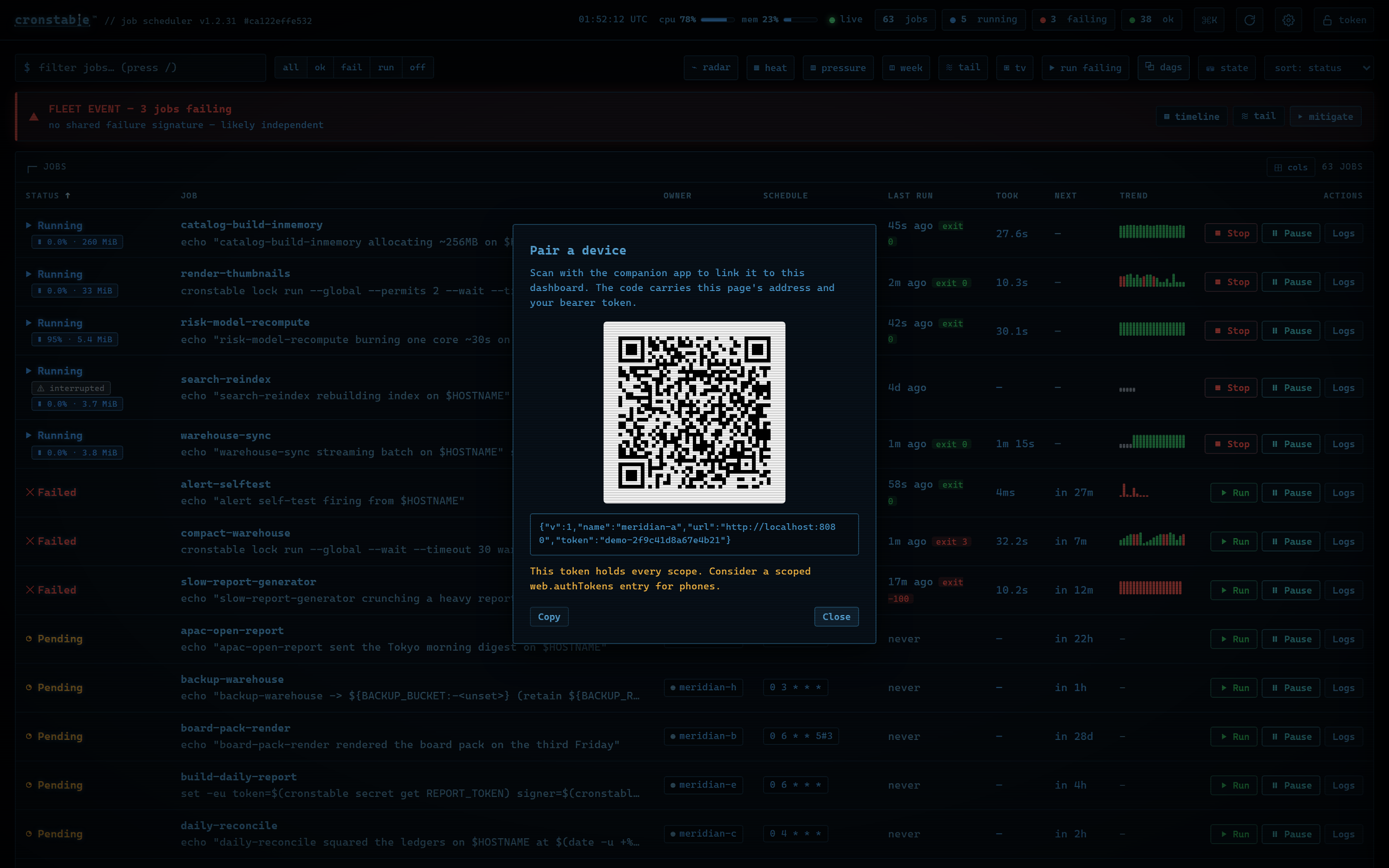
Pairing registers a device's public key and platform push token with the
daemon. The dashboard has a "Pair a device" panel (in the command palette
and in settings) that renders a QR code of {v: 1, name, url, token} plus
the same JSON as a copyable string; the companion app scans it and
completes the pairing by calling POST /push/devices with the scanned
token. The panel warns when the token it would embed is the all-scopes one;
give a phone a scoped
web.authTokens entry instead.
Pairing is also one API call (control scope):
$ curl -X POST http://127.0.0.1:8080/push/devices \
    -H "Authorization: Bearer s3cr3t" \
    -H "Content-Type: application/json" \
    -d '{"name": "parker-iphone", "platform": "ios",
         "publicKey": "jSNlDu28No2itHnvrs6ajHHuNAxvqgOjmGxHJrMo8yg=",
         "pushToken": "8f3a1bc2…d94af1c9"}'
{
    "device": {
        "id": "f1e2d3c4b5a69788",
        "name": "parker-iphone",
        "platform": "ios",
        "publicKey": "jSNlDu28No2itHnvrs6ajHHuNAxvqgOjmGxHJrMo8yg=",
        "fingerprint": "8c2f-91ab-04de",
        "pushToken": "…4af1c9",
        "createdAt": "2026-07-23T14:00:00+00:00",
        "createdBy": "parker-iphone"
    },
    "created": true
}
publicKey must be base64 decoding to exactly 32 bytes and be a usable
X25519 public key (an all-zero or low-order key that libsodium refuses to
seal to is rejected at pairing, not on the first alert); name,
platform, and pushToken are bounded strings. Validation
failures are a 400 naming the field. Re-pairing the same public key
(push tokens rotate; phones get renamed) answers 200 with
created: false and updates name/platform/pushToken in place,
keeping the record's id and createdAt so revocation references stay
stable. createdBy records the label of the bearer token that performed
the pairing.
List pairings (view scope; push tokens are redacted to their trailing six
characters, public keys are returned whole):
$ curl -H "Authorization: Bearer s3cr3t" http://127.0.0.1:8080/push/devicesSend a test alert through the relay to one device (control scope; 200
with the relay outcome, 502 when sealing or the relay failed, so a silent
phone is debuggable from the dashboard):
$ curl -X POST -H "Authorization: Bearer s3cr3t" \
    http://127.0.0.1:8080/push/devices/f1e2d3c4b5a69788/test
{"device": "f1e2d3c4b5a69788", "status": 200, "error": null}
Revoke a device (control scope):
$ curl -X DELETE -H "Authorization: Bearer s3cr3t" \
    http://127.0.0.1:8080/push/devices/f1e2d3c4b5a69788
{"revoked": "f1e2d3c4b5a69788"}
Revoking the pairing stops future alerts to that device; to also revoke its
API access, drop its web.authTokens entry and reload. Endpoint details
are on the HTTP API page.
Pairing endpoints sit behind the web API's bearer token whenever one is
configured, and the daemon refuses to start a push: section on a routable
listener that has none (see Failure behavior), so an
ungated pairing endpoint can only exist on loopback or a unix socket. Two
things still travel during pairing that are worth protecting: the QR
payload embeds a bearer token, and the pairing POST carries the device
public key
that every future alert is sealed to. On a transport an attacker can read
or rewrite (plaintext HTTP across a shared network), the token can be
stolen and, worse, the key can be substituted: alerts would then seal to
the attacker's key. So pair over HTTPS
(web.tls or a TLS-terminating
proxy), over loopback (an SSH tunnel to the daemon host), or on a network
you trust. With web.bonjour on, the daemon also
advertises its URL to the local network; the advert carries no secrets,
but it does make the daemon easier to find, which is one more reason
pairing belongs on a trusted network.
Key substitution is detectable after the fact, and the check takes ten
seconds: the pairing response and the device listing carry a
fingerprint (the first 12 hex characters of SHA-256 over the raw key
bytes, grouped for reading aloud), and the companion app displays the same
fingerprint for the key it generated. Compare them. If they differ, the
daemon stored a key that is not your phone's: revoke the device and pair
again over a trusted transport.
The registry has two homes; exactly one is in effect:
-
The durable state store (when a
state:section is configured anddevicesFileis not set): one document per device, so pairing and revocation are per-key atomic operations, and every node sharing the store sees the same registry. Whichever node fires a report pushes to the same device set. The documents are never swept by state garbage collection: a pairing lives until it is explicitly revoked. -
push.devicesFile(required on stateless installs): a single local JSON file, written atomically (a uniquely named temp file plus a rename) and created with owner-only permissions where the platform honors them. A file that fails to parse refuses writes rather than overwriting possibly recoverable pairings, and a temp file left beside it by a write that never finished is swept by a later one. Reads and writes run on a private worker thread, are bounded at 10 seconds, and are serialized process-wide per file path, so a registry on a hung mount degrades pairing (the endpoints answer503) without stalling the scheduler or process shutdown.
Both homes also hold the installation's collapse salt: the collapseSalt
key in devicesFile, or a pushmeta document in the state store. It is
the secret that keys the coalescing hash sent to the relay, created on
first use; every node sharing a registry derives the same hash for the
same alert, and the relay never sees the salt itself.
The reporting path reads an in-memory mirror of the registry, refreshed at most every 60 seconds, so a slow or briefly unavailable store can never stall a report fan-out; a pairing made on another node becomes effective within that window. A read that fails is remembered for about 5 seconds, so a burst of alerts against an unreachable store costs one attempt between them rather than one each. The pairing endpoints always read and write the store directly.
The sealed plaintext is a compact JSON document: v, kind (success,
failure, sla, event, or test), name, success, host, and ts,
plus the run context that is known (run_id, schedule, started_at,
exit_code, fail_reason), the log tail on job alerts (when
includeLogTail is on and output was captured), the event / subject /
message fields on daemon events, and the breach fields on SLA alerts.
The full field-by-field schema is in the
relay protocol document.
APNs rejects notifications over 4096 bytes, so the daemon caps the sealed,
base64-encoded ciphertext at 3000 characters, leaving the relay headroom
for its own envelope. An oversized payload is trimmed in order: log-tail
lines oldest-first (the newest lines carry the failure), then long
free-text fields halved (never below 64 characters), then the optional
context fields dropped. The alert's identity (name, kind, host) is
never trimmed. There is no per-job template: the companion app renders the
decrypted fields itself.
Push is an alerting channel, so its configuration fails closed: a channel
that silently self-disables is a missed page. All of the following are
ConfigErrors at parse time (so --validate-config catches them), never
runtime degradations:
- a
push:section on an install without PyNaCl (install thepushextra or remove the section); -
report.push.enabled: trueanywhere (a job, a DAG task,notify:) without apush:section; the error names the offenders; - a
push:section with neither astate:section nordevicesFile(the registry needs somewhere durable to live); - a
push.relay.urlthat is not http(s), or a non-positivepush.relay.timeout; - a
push:section on a daemon whose web API listens on a routable address with noweb.authToken/web.authTokens. Pairing is a mutating endpoint and a token is what installs the auth middleware at all, so without one anything that can reach the listener can pair its own key and keep receiving alerts. Give the web API a token, keepweb.listenon loopback or a unix socket, setweb.tls.clientCa, or setpush.allowUnauthenticated: true.
At runtime, delivery is deliberately non-fatal: a sealing failure or relay
outage is logged per device and never raised into the reporting path, so a
relay outage can never look like a reporting crash or affect the other
reporters. The devices are POSTed to concurrently, so an unreachable relay
delays a report by one relay.timeout rather than one per device, and
therefore does not hold up retry arming or a graceful shutdown by the sum.
An alert fired with no device paired is dropped with a warning naming the
pairing endpoint. When the registry store is unavailable, whether
unreachable or holding a document this build cannot read, report fan-outs
fall back to the last-known device set and say so, and the pairing
endpoints answer 503 per request.
The daemon-to-relay wire contract is documented in
docs/relay-protocol.md.
The relay implementation lives in a separate repository and its source will
be published; that file is the contract any implementation must satisfy.
The trust model: the relay is not a trusted party. It receives ciphertext
and routing metadata only (device token, coalescing hash, priority, event
flag), owns deduplication, rate limiting, and flap suppression (coalescing
on the hash without learning what it hashes; the hash is keyed with the
per-installation salt, so it stays opaque even for guessable job names),
and forwards to APNs with mutable-content set so the app decrypts and
renders the notification on the device.
- Reporting: the other four reporters and the shared report schema
-
HTTP Control API: the
/push/devicesendpoints andGET /whoami - Durable State: the store the device registry rides when configured
- LAN Discovery: how a companion app finds the daemon on the local network
-
Late-Run Detection: the
onLatehook push alerts can ride - Web Dashboard: the dashboard hosting the pairing panel