Retrieval tells the AI what it found. Qbrin decides whether it is safe enough to use.
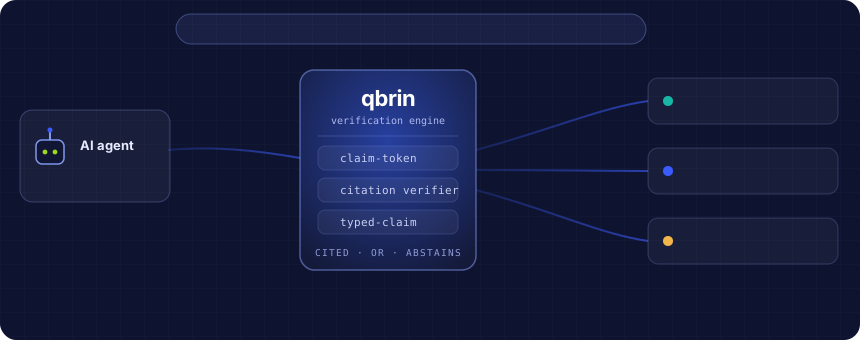


Your agent is about to act. Is the thing it believes actually true in your systems?
qbrin sits between AI agents and an organisation's own sources (Postgres, Slack, Gmail, Drive, GitHub, uploads) and answers one question extremely well: is this claim supported by the connected sources — yes, no, or not enough evidence? Every verified answer carries a citation behind every sentence. When the evidence isn't there, qbrin says so instead of guessing.
pip install qbrin
qbrin login          # sign in with Google — no token to copy
qbrin login opens your browser, authenticates with Google, and writes a scoped token to ~/.qbrin/credentials. After that, Qbrin() just works — no key in code.
from qbrin import Qbrin

qb = Qbrin()   # uses `qbrin login`; or Qbrin(api_key="qbrin_...")

v = qb.verify("Can I refund $500 for order ORD-200?")

v.decision      # "verified" | "rejected" | "need_more_evidence"
v.answer        # "[1] The refund limit for Support Managers is $300. ..."
v.explanation   # why qbrin decided this
v.evidence      # the cited source excerpts, with document ids and scores
v.claims        # per-claim verdicts from the verifier (verified answers only)
v.freshness     # evidence vintage + whether live query-in-place rows were used
v.trust         # the full trust certificate (gates run, axes, hashes)
Zero dependencies. Python ≥ 3.9. MIT.
| Decision | Meaning | What your agent should do |
|---|---|---|
verified |
The answer shipped and every claim passed the citation-support gate against the cited sources. | Act on answer; log evidence. |
rejected |
The sources contain evidence against the premise (false-premise guard or typed-claim contradiction). | Don't act; surface explanation. |
need_more_evidence |
The sources can't confirm it — entities unknown, or no gate-passing answer exists. | Ask for more context, connect a source, or escalate to a human. |
The failure mode this kills: an agent confidently acting on something that was never true in your systems. On a 1,000-question benchmark against naive RAG, qbrin took hallucinations on nonexistent entities from 56% to 0%, with zero false accepts on out-of-domain traps across every run to date.
sequenceDiagram
    participant A as Your agent
    participant Q as qbrin API
    participant R as Retrieval (ACL-enforced)
    participant G as Gate stack

    A->>Q: POST /api/verify {question}
    Q->>Q: intent routing (zero-LLM)
    Q->>Q: negative cache — entities unknown? → need_more_evidence (0 tokens)
    Q->>R: retrieve evidence (vector / lexical / hybrid / graph)
    Q->>Q: premise guard — premise unsupported? → rejected (0 tokens)
    Q->>Q: generate citation-first draft ([n] per sentence)
    Q->>G: claim-token gate → citation-support verifier → typed claims
    G-->>Q: pass / block
    Q-->>A: {decision, answer, evidence, trust}
Under the hood this is the same pipeline qbrin's own product surfaces use — one shared answer path is a trust invariant, so the benchmarks measure exactly what your agent gets. Highlights:
- Citation-first generation — every sentence must begin with its citation; an uncited sentence is dropped by construction.
- Deterministic gates before any LLM spend — unknown entities and false premises abstain at zero tokens.
- A separate verifier model audits each claim against only the chunks it cites, at temperature 0, fail-closed for API callers.
- A recovery ladder (graph-anchor traversal, executable retrieval plans, bounded graph walks) widens coverage on misses — and every recovered answer must clear the same unchanged gates, so recovery can never manufacture a false accept.
- Per-identity ACL at the retrieval choke point — the verification runs as you: sources your token's identity can't see are never used as evidence.
a = qb.ask("What is our refund policy?")   # grounded answer + citations
a.answer, a.citations, a.covered_by_map

hits = qb.search("refund policy", limit=10) # universal search, no LLMfrom qbrin import AuthenticationError, RateLimitError, FeatureDisabledError
try:
v = qb.verify("...")
except RateLimitError as e:
sleep(e.retry_after or 5)
except FeatureDisabledError:
# the server hasn't enabled the verification endpoint (VERIFY_API=1)
...The client retries 429/502/503/504 automatically (respecting Retry-After) and refuses non-HTTPS base URLs except localhost.
The verify endpoint is in beta (flag-gated server-side). qbrin connects sources by ingesting and indexing them (poll/webhook → chunks → embeddings → knowledge graph), and by live query-in-place: at question time it probes your own systems read-only for records matching the question's entities and folds them into the audited evidence, so verification reflects the state of your systems right now, not the last index. Six live connectors ship today — Postgres, MySQL, Salesforce, any REST/JSON API, Slack, GitHub — each deterministic (no LLM ever writes a query; tables/objects/fields come from an admin allowlist; question values are bind parameters or URL-encoded params). See CONNECTING.md.
On the roadmap: confidence bands, per-identity ACL for live sources, and streaming.
Your data reaches a verification two ways — indexed sources connected in the Console, or live query-in-place against your Postgres / MySQL / Salesforce / REST / Slack / GitHub. Live sources verify against current state and only ever read the exact records a question is about. Setup and the security model are in CONNECTING.md.
A JavaScript/TypeScript SDK with the identical contract lives at qbrin-js.
This SDK talks to a qbrin server (hosted at app.qbrin.com, or your own deployment — pass base_url). The server codebase is not part of this repo.
Made by qbrin — Building the Universal Trust Layer. Questions → katesaikishore@qbrin.com