Agentic orchestration for the LeRobot robotics pipeline — an orchestrator drives an automated collect → train → eval → improve loop over LeRobotDataset v3.0, with a deterministic loop controller, a constitution safety gate, verification gates before promotion, and (M2) a dashboard for visualizing the flow.
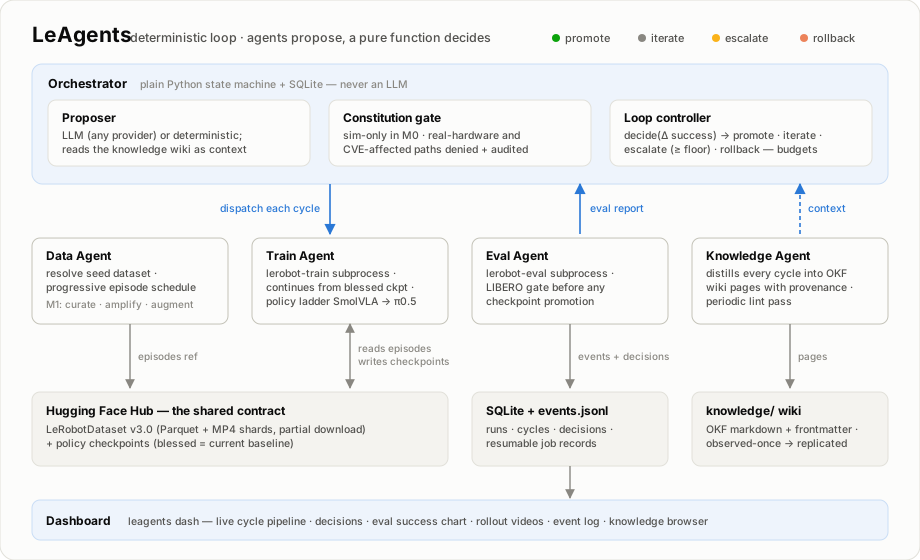
Architecture, research grounding (verified 2023–2026 papers), and roadmap: DESIGN.md.
| Milestone | Scope | Status |
|---|---|---|
| M0 | Sim-only loop on LIBERO: seed dataset → SmolVLA fine-tune → lerobot-eval gate → promote/iterate/escalate/rollback |
✅ done — full-scale autonomous run completed (see below); PushT/LIBERO smoke configs included |
| M1 | DexFlyWheel-style self-improvement, RoboGene-style task curation, policy escalation, OKF knowledge layer (Karpathy-wiki-style, DESIGN.md §3.6) + provider-agnostic LLM proposer | 🚧 knowledge layer + LLM adapter landed |
| M2 | Flow dashboard (Rerun episode replay, WandB curves, OTel agent traces) | 🚧 flow view v1 landed: runs → cycles → decisions live, eval chart, event log, knowledge browser (leagents dash) |
| M3 | Real robot: teleop collection, HIL-SERL adapter (requires lerobot ≥ 0.6.0, see CVE note in DESIGN.md §6) | planned |
What works today: the full loop state machine with budgets, the constitution gate, SQLite job store, JSONL event log, subprocess wrappers for lerobot-train / lerobot-eval, the OKF knowledge layer (knowledge/ pages with provenance, updated every cycle, linted), the DexFlyWheel data path (success-filtered rollout harvesting → accumulated mix → adaptation training), and a provider-agnostic LLM adapter (llm: gemini:*|anthropic:*|openai:*[@base_url], or none at all — every flow has a deterministic fallback). All covered by tests that run without a GPU or lerobot installed.
One M0 run on a single RTX 5070 Ti (16 GB), fully autonomous — 3 cycles, 6.1 GPU-hours, zero human intervention, every decision/event/knowledge-page update logged:
| Cycle | Data | Train | LIBERO spatial eval (100 episodes) | Decision |
|---|---|---|---|---|
| 0 | 40 episodes | 20k steps from smolvla_base (loss → 0.030) |
0% success — arm reaches targets, never completes | promote (baseline) |
| 1 | 80 | 20k steps, continued from the blessed checkpoint | 0% | iterate |
| 2 | 160 | 20k steps | 0% | iterate — the escalate_floor guard correctly refused to escalate a 0%-plateau to a bigger policy |
This run validated the loop — budgets held, weights carried over, and the decision function behaved exactly as specified.
Root-cause correction (same day): the flat 0% was first attributed to the data budget (4→16 episodes per task vs. the verified ~50). Digging into a follow-up run that stayed at 0% with 20 per task exposed the real cause: HuggingFaceVLA/libero is suite-ordered, and the [0..N) episode prefix belongs to other suites (libero_spatial episodes live around indices 1261–1538) — every run had trained on tasks disjoint from the eval. In the metrics this silent failure was indistinguishable from under-training. Fix: episode selection is now task-filtered against the eval suite (leagents.scripts.select_episodes, data.task_filter), balanced per task, and the Data Agent fails loudly if the selection doesn't cover the suite. The table above stands as a record of the failure mode.

pip install -e ".[dev]"
pytest

# dry run — no GPU, no lerobot; synthetic eval scores exercise the decision logic
leagents run -c configs/m0_libero.yaml --dry-run

# real run (Linux; needs a GPU and the LIBERO extras)
pip install -e ".[lerobot]"
leagents run -c configs/m0_libero.yaml

# inspect runs, cycles, decisions, blessed checkpoints
leagents status

# flow dashboard — runs, cycle pipeline, decisions, eval chart, events, knowledge
pip install -e ".[dash]"
leagents dash # → http://127.0.0.1:8321On shared servers the only step that needs sudo is LIBERO's egl-probe build (system EGL headers). pixi supplies Python, the EGL/OpenGL headers, a C++ toolchain, and CMake 3.x from conda-forge instead — zero root required:
pixi run test                  # loop tests, no GPU needed
pixi -e lerobot run doctor     # full environment checks (GPU/EGL/LIBERO)
pixi -e lerobot run smoke-pushtEach cycle trains a candidate checkpoint and evaluates it on LIBERO. The decision is a pure function of success-rate deltas vs. the blessed baseline (leagents/orchestrator/decision.py):
- promote — candidate beats baseline by ≥
promote_delta; it becomes the new blessed checkpoint - iterate — small improvement; collect more data on failing task variations
- escalate — plateaued for
plateau_cycles; move up the policy ladder (SmolVLA → π0.5) - rollback — regression; the blessed checkpoint stands
Control flow is deterministic Python persisted to SQLite — LLM agents (task proposal, curation; M1) only make proposals inside the gates, never control-flow decisions.
leagents/
├── orchestrator/   # loop controller, decision logic, constitution gate, proposer
├── agents/         # data / train / eval / improve agents (LeRobot CLI wrappers)
├── contracts/      # typed records: DatasetRef, CheckpointRecord, EvalReport
├── events/         # JSONL event bus (dashboard reads this in M2)
└── store/          # SQLite job store (runs, cycles, checkpoints)
configs/            # m0_libero.yaml, constitution.yaml
tests/              # loop e2e with fake runners — no GPU needed
Apache-2.0