step1:
-
React v18
-
Setup React project
-
Creating a single-page app
npx create-react-app my-app
-
Server-rendered website with Node.js
Next.js
-
Include React and ReactDOM JS in HTML
  <script crossorigin src="https://unpkg.com/react@18/umd/react.development.js"></script>
  <script crossorigin src="https://unpkg.com/react-dom@18/umd/react-dom.development.js"></script>
-
-
JSX
-
Work like real DOM, enable attributes and events
1).
-
Prevents XSS Injection Attacks
1). Everything is converted to a string before being rendered
-
Actual work
const element = ( <h1 className="greeting"> Hello, world! </h1> ); equels: const element = React.createElement( 'h1', {className: 'greeting'}, 'Hello, world!' ); -
-
Rendering Elements
-
Actual work
const root = ReactDOM.createRoot( document.getElementById('root') ); const element = <h1>Hello, world</h1>; root.render(element); -
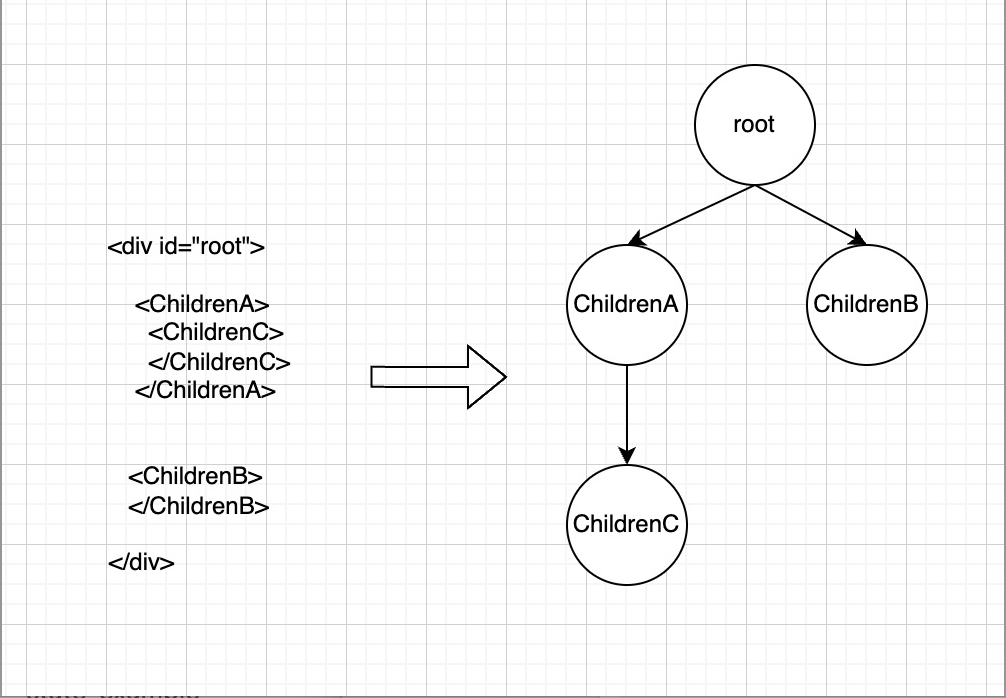
Only update what’s necessary
1). More efficient than manipulate on real DOM
-
Virtual DOM tree
-
-
Components and Props
-
Write pure funciton
1). React.Component instance
  class Welcome extends React.Component {
    // Basic doing things in constructor
    constructor(props) {
      super(props);
      this.state = { counter: 0 };
      this.handleClick = this.handleClick.bind(this);
    }

    // Component mounting callback
    componentDidMount() { ... }

    // Component updating callback
    shouldComponentUpdate()
    componentDidUpdate()

    // render method to return JSX
    render() {
      return <h1>Hello, {this.props.name}</h1>;
    }
  }
2). Pure funciton instance
function Jsx(props) { const user = { firstName: "Harper", lastName: "Perez", }; const formatName = (user) => { return user.firstName + " " + user.lastName; }; const Element = <h1>Hello, {formatName(user)}!</h1>; return <div className="jsx">{Element}</div>; } -
Nested child components
-
One-way transfer props
-
-
State and Lifecycle
- State response to user actions, network responses
-
Composition, NOT Inheritance
-
Handling Events
-
React events are named using camelCase, rather than lowercase.
-
With JSX you pass a function as the event handler, rather than a string.
-
Actual work
In HTML: <button onclick="activateLasers()"> Activate Lasers </button> In React: <button onClick={activateLasers}> Activate Lasers </button> -
-
Forms
step2:
-
useState
const [count, setCount] = useState(0); -
useEffect
useEffect(() => { }, []); -
Rule of Hooks
-
Lighter than React.Component
1). Without writing a class, avoid lifecycle callbacks like componentDidMount...
-
Call Hooks at the Top Level
-
-
Building hooks