Stop passing giant transcripts between agents. Give them a shared memory and let each one recall only what it needs.





Contents · Problem · Compare · Architecture · Features · Install · Demo · API · Config · Benchmark · Deploy · Roadmap
Multi-agent frameworks route work by passing ever-larger context blobs from agent to agent. The shared history grows with every hop, so token cost climbs super-linearly and the genuinely relevant facts drown in noise.
        ❌ Without Context Bridge                  ✅ With Context Bridge

  Agent A ──[full history]──▶ Agent B          Agent A ─┐        ┌─ Agent B
     │                          │                       ▼        ▼
     └──[bigger history]──▶ Agent C             ┌─────────────────────┐
            tokens 📈📈📈 cost 💸               │   Shared memory pool │
                                                │  (write • recall)    │
   every agent re-reads everything              └─────────────────────┘
                                                each agent recalls only its
                                                task-scoped, budgeted slice
Context Bridge is a standalone service that turns agent memory into a shared, governed, queryable pool. Agents write their outputs into it and recall just the slice they need for the current task — under a strict token budget.
- Shared, not per-agent. Memory is a first-class service every agent reads from and writes to — with full provenance — not a private scratch buffer.
- Governed writes. Confidence gating, near-duplicate suppression and optional summarize-before-store stop the pool from poisoning itself.
- Token budgets are explicit. Every recall is bounded and reports exactly what it spent — the measurable cost-savings lever.
| Transcript passing (AutoGen-style) |
Per-agent memory (mem0 / Letta) |
Context Bridge | |
|---|---|---|---|
| Memory scope | none — re-sent each hop | private per agent | shared across agents |
| Token cost | grows ~quadratically | linear-ish | bounded by budget |
| Retrieval | — | dense only | hybrid + rerank + MMR |
| Provenance | — | partial | full (agent / task / session) |
| Write governance | — | varies | dedup + confidence + TTL |
| Multi-tenant | — | — | namespace RBAC |
Context Bridge is not another agent framework — it's the memory layer any framework can point at.
flowchart TB
    subgraph Agents
      A1[Agent A]
      A2[Agent B]
      A3[Agent C]
    end

    subgraph CB["Context Bridge API (/v1)"]
      MM[MemoryManager]
    end

    subgraph Tiers["Memory tiers"]
      W[("Working memory<br/>in-process / Redis")]
      S[("Semantic memory<br/>Qdrant · dense + sparse")]
      E[("Episodic / provenance<br/>SQL · SQLAlchemy")]
    end

    A1 & A2 & A3 -->|remember / recall| MM
    MM --> W
    MM --> S
    MM --> E
| Tier | Purpose | Backing store |
|---|---|---|
| Working | Recent per-session scratchpad, ephemeral | In-process / Redis |
| Semantic | Long-term embedded knowledge | Qdrant (dense + sparse) |
| Episodic | Task graph & provenance ("who/what/when/why") | SQL (SQLite / Postgres) |
sequenceDiagram
    participant Agent
    participant API as Context Bridge
    participant V as Qdrant
    participant DB as SQL

    Note over Agent,DB: WRITE (governed)
    Agent->>API: remember(content, agent_id, namespace)
    API->>API: chunk → embed (dense+sparse)
    API->>API: dedup + confidence gate
    API->>V: upsert chunks
    API->>DB: store parent doc + episode

    Note over Agent,DB: RECALL (token-budgeted)
    Agent->>API: recall(query, token_budget)
    API->>V: hybrid search (RRF fusion)
    API->>API: rerank → MMR → assemble ≤ budget
    API-->>Agent: context + cited sources + tokens_used
Every provider sits behind a small Protocol — VectorStore, Embedder,
Reranker, WorkingMemory, Summarizer — so backends are swappable without
vendor lock-in.
| 🔀 Hybrid retrieval | Dense + sparse vectors fused with Reciprocal Rank Fusion |
| 🎯 Reranking + MMR | Cross-encoder precision, then diversity to kill redundancy |
| 💰 Token budgeting | Recall is bounded and reports tokens_used |
| 🧬 Small-to-big chunks | Match a small chunk, expand to its parent on demand |
| 🛡️ Write governance | Dedup, confidence gating, summarize-before-store |
| 🧾 Provenance | Every memory is attributable; full session timeline |
| ⏳ TTL & decay | Expiry at query time + background/endpoint sweep |
| 🏢 Multi-tenant RBAC | API keys scoped to namespace globs + read/write permissions |
| 🔑 Auth & rate limit | Constant-time keys; in-memory or Redis limiter |
| 🔌 Embedder choice | Local (FastEmbed), OpenAI, Cohere — all behind one protocol |
| 📡 Streaming recall | Server-Sent Events: render context progressively |
| 📊 Observability | Prometheus metrics, request IDs, structured errors |
| 🐳 Production-ready | Dockerfile, CI, Alembic migrations, typed SDK |
| 🔌 Pluggable | Swap Qdrant/embedder/reranker behind protocols |
Beyond storage — the shared pool consolidates, reconciles and learns:
| 💤 Reflective consolidation | Cluster related memories and synthesize higher-order insights no single agent wrote |
| ⚖️ Truth-maintenance | Detect contradictions between agents, flag and resolve them |
| 🕸️ Knowledge graph | Extract entity/relation triples; multi-hop GET /v1/graph/neighbors |
| 🔁 Learning recall | Outcome feedback re-ranks future retrieval |
| 🔒 PII/secret redaction | Mask sensitive data before it enters the shared pool |
The pool doesn't just remember — the team gets better over time:
| 🏅 Agent reputation | Per-namespace profiles learn who is reliable at what (GET /v1/agents) |
| 🎯 Outcome credit | A task's success/failure propagates to the memories and agents behind it (POST /v1/outcomes) |
| 📒 Procedural memory | Reusable playbooks with success tracking, so solved problems aren't re-solved (/v1/procedures) |
| 🧷 Salient distillation | Stream cheap turns; the system keeps only what was dwelled upon and carries it into future chats (/v1/sessions/{id}/distill) |
| 📅 Temporal recall | Memories carry dates; recall with include_dates and since/until — remembers when, human-like |
| 🧭 Ontology alignment | Agents that named the same entity differently converge on one canonical name — auto (POST /v1/graph/align) or by alias (POST /v1/graph/aliases) |
| 📈 Collaboration-quality score | One 0-100 metric (GET /v1/quality) blends recall hit-rate, feedback positivity and conflict health, so a team can watch shared memory pay off |
| 🧯 Failure memory | Capture a lesson from a mistake; the system proactively raises it as a guardrail before similar work, so the team stops repeating errors (/v1/lessons) |
| 🧰 Preflight briefing | Before a task, get the lessons to avoid and the playbooks that worked in one call (POST /v1/preflight) |
| 🔄 Belief revision | Resolving a contradiction decays the loser's trust; confidence-weighted recall sinks discredited memories and retires repeat losers — the pool changes its mind |
| ⚗️ Auto lesson distillation | Cluster memories implicated in failures into auto-drafted lessons, no human in the loop (POST /v1/lessons/distill) |
| 🔎 Recall explainability | Every recalled chunk carries per-signal scores and a plain-language why it was retrieved (match, feedback, confidence, age) |
| 🩺 Memory health panel | One pulse-check per namespace: volume, trust distribution, conflicts, lessons, quality (GET /v1/namespaces/{ns}/health) |
| ⚖️ Auto conflict resolution | Close contradictions automatically when one side decisively leads, leaving ambiguous ones for a human (POST /v1/conflicts/auto-resolve) |
| 🧬 Belief timeline | A memory diff: how belief about a topic changed over time — which claim fell out of favour, and when (GET /v1/namespaces/{ns}/beliefs) |
| ⏱️ Scheduled maintenance | One housekeeping cycle — sweep + auto-resolve + consolidate + distill — on demand or on a timer (POST /v1/maintenance/run) |
| 📡 Event webhooks | Best-effort notifications on conflict.opened / conflict.resolved / lesson.created, never blocking a write (WEBHOOK_URLS) |
| 📦 Namespace portability | Export a namespace to a portable, vector-free document and restore it anywhere — re-embedded on import (/v1/namespaces/{ns}/export · …/import) |
pip install context-bridge-memory                      # core
pip install "context-bridge-memory[fastembed,redis,postgres]"   # full local stack
The distribution is published as
context-bridge-memory; the import package stayscontext_bridge(e.g.from context_bridge.sdk import ...).
From source (for development):
git clone https://github.com/sa-aris/context-bridge && cd context-bridge
uv pip install -e ".[dev]"# 1. (optional) backing services — Qdrant + Postgres + Redis
docker compose up -d
# 2. run the API
context-bridge # if installed from PyPI -> http://localhost:8000
make run # from source (auto-reload) -> http://localhost:8000/docsOpen http://localhost:8000 for the service banner, or /docs for interactive
API docs.
Out of the box the defaults are dependency-light and fully offline: an
in-process Qdrant (QDRANT_URL=:memory:), a deterministic hashing embedder and
SQLite. Flip EMBED_PROVIDER=fastembed for production-quality local embeddings
and point QDRANT_URL / DATABASE_URL at real services. See
.env.example for every option.
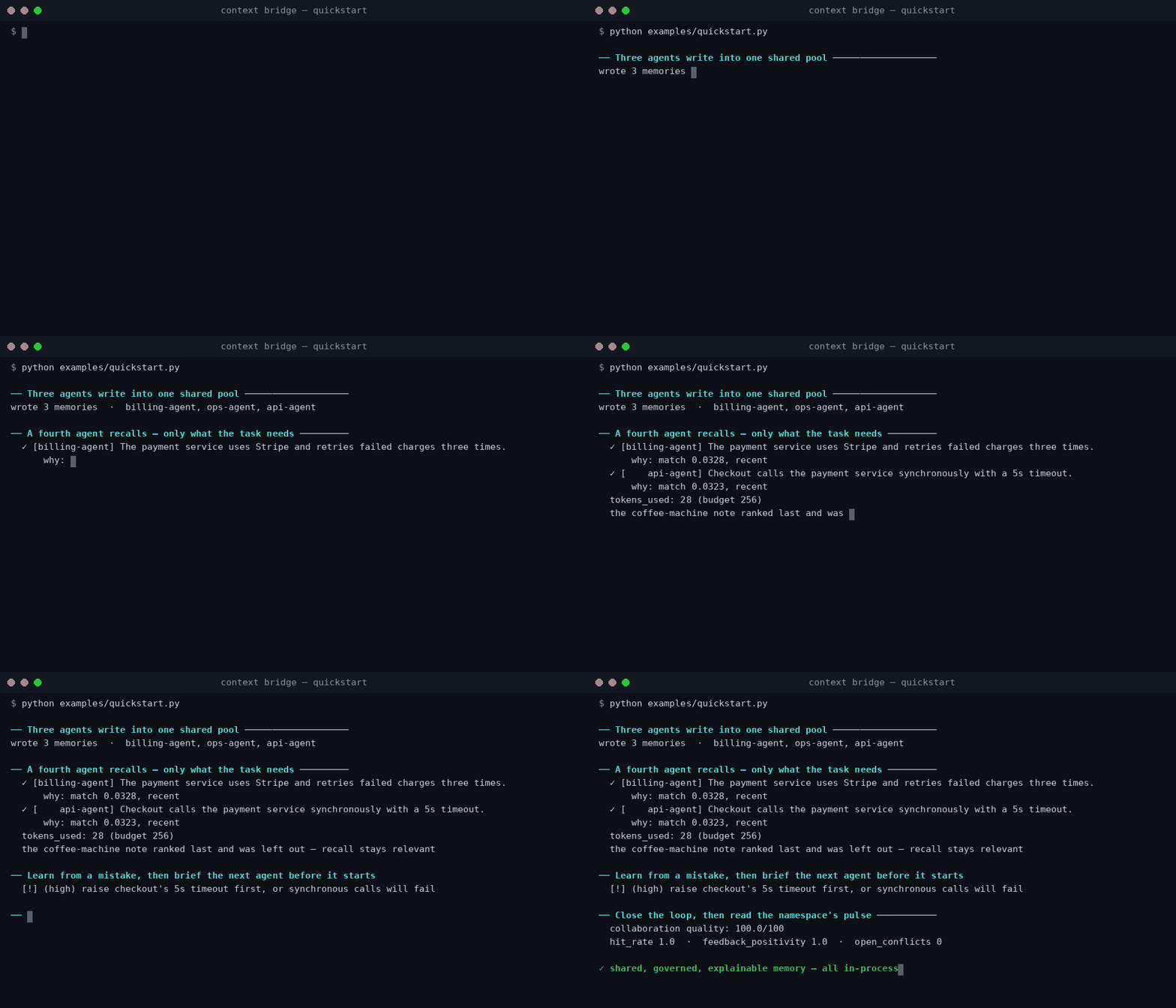
Run the whole tour offline in one command — it uses real local embeddings (a small model is fetched once) and needs no external services:
python examples/quickstart.py
Or drive it over HTTP. Write two memories from two different agents, then recall just the relevant one:
# Agent 1 writes
curl -s localhost:8000/v1/memory/write -H 'content-type: application/json' -d '{
  "content": "The payment service uses Stripe and retries failed charges three times.",
  "agent_id": "billing-agent", "session_id": "run-42", "namespace": "project-x"
}'

# Agent 2 writes something unrelated
curl -s localhost:8000/v1/memory/write -H 'content-type: application/json' -d '{
  "content": "The office coffee machine is broken; a replacement is on order.",
  "agent_id": "ops-agent", "session_id": "run-42", "namespace": "project-x"
}'

# Another agent recalls — within a token budget
curl -s localhost:8000/v1/memory/query -H 'content-type: application/json' -d '{
  "query": "how does the payment service handle failed charges?",
  "namespace": "project-x", "token_budget": 256
}'The coffee-machine note never shows up — only the budgeted, reranked, deduped slice the query actually needs, with provenance for every line.
from context_bridge.sdk import ContextBridgeClient
with ContextBridgeClient("http://localhost:8000") as cb:
cb.remember(
"The payment service retries failed charges three times.",
agent_id="billing-agent", session_id="run-42", namespace="project-x",
)
result = cb.recall(
"how are failed charges handled?",
namespace="project-x", token_budget=512,
)
print(result["context"]) # budget-bounded, reranked, deduped
print(result["sources"]) # provenance for every included chunkAn AsyncContextBridgeClient with the same surface is available for async agents.
| Method | Path | Description |
|---|---|---|
POST |
/v1/memory/write |
Chunk, embed, govern and store content |
POST |
/v1/memory/write_batch |
Write many memories in one request |
POST |
/v1/memory/query |
Hybrid recall within a token budget |
POST |
/v1/memory/query/stream |
Hybrid recall streamed as Server-Sent Events |
GET |
/v1/memory |
List / paginate records by namespace |
GET · DELETE |
/v1/memory/{id} |
Fetch / remove a single record |
DELETE |
/v1/memory?namespace=&session_id= |
Erase all memory for a namespace/session |
POST |
/v1/memory/summarize |
Compress a session into a summary memory |
POST |
/v1/memory/feedback |
Signal whether a recalled memory was useful |
GET |
/v1/sessions/{id}/timeline |
Episodic / provenance view |
POST · GET |
/v1/sessions/{id}/turns |
Append / read ephemeral conversational turns |
POST |
/v1/sessions/{id}/distill |
Promote salient turns into durable cross-session memory |
POST |
/v1/maintenance/sweep |
Delete TTL-expired memories |
POST |
/v1/maintenance/consolidate |
Cluster & synthesize insights for a namespace |
POST |
/v1/maintenance/run |
Run a full housekeeping cycle (sweep + per-namespace upkeep) |
GET |
/v1/conflicts · POST /v1/conflicts/{id}/resolve |
Inspect / resolve contradictions |
POST |
/v1/conflicts/auto-resolve |
Auto-close decisive contradictions (belief revision) |
GET |
/v1/graph/neighbors |
Traverse the knowledge graph |
POST |
/v1/graph/aliases · /v1/graph/align |
Map an alias · auto-merge entity variants |
GET |
/v1/agents |
Agent reputation leaderboard |
POST |
/v1/outcomes |
Credit a session's memories & agents by outcome |
GET · POST |
/v1/procedures · …/{id}/outcome |
Playbooks with success tracking |
GET · POST |
/v1/lessons · …/{id}/confirm |
Capture / list / confirm lessons from past mistakes |
POST |
/v1/lessons/distill |
Auto-draft lessons from memories implicated in failures |
POST |
/v1/preflight |
Pre-task briefing: lessons to avoid + playbooks that worked |
GET |
/v1/quality |
Collaboration-quality score for a namespace |
GET |
/v1/namespaces/{ns}/health |
Memory health panel for a namespace |
GET |
/v1/namespaces/{ns}/beliefs?query=… |
Belief timeline (memory diff) for a topic |
GET · POST |
/v1/namespaces/{ns}/export · …/import |
Back up / migrate a namespace's knowledge |
GET |
/health · /healthz · /metrics |
Liveness · readiness · Prometheus |
Interactive OpenAPI docs are served at /docs.
| Variable | Default | Description |
|---|---|---|
QDRANT_URL |
:memory: |
Qdrant location or :memory: |
EMBED_PROVIDER |
hashing |
hashing · fastembed · openai · cohere |
RERANK_PROVIDER |
identity |
identity · fastembed · cohere |
DATABASE_URL |
sqlite+pysqlite:///./context_bridge.db |
Episodic store |
WORKING_PROVIDER |
memory |
memory or redis |
SUMMARIZER_PROVIDER |
extractive |
extractive or llm |
DEFAULT_TOKEN_BUDGET |
2048 |
Default recall token budget |
API_KEYS |
(empty) | Comma-separated keys; empty = open |
API_KEY_POLICIES |
(empty) | JSON RBAC: key → namespace globs + read/write |
RATE_LIMIT_PER_MINUTE |
0 |
Per-identity limit; 0 = disabled |
SWEEP_INTERVAL_SECONDS |
0 |
Background TTL sweep; 0 = disabled |
See .env.example for the complete list.
A runnable benchmark compares transcript passing vs. shared-memory recall over a synthetic multi-agent task:
python -m context_bridge.benchmark agents transcript bridge savings
------------------------------------------
4 216 222 -2.8%
8 1,008 670 33.5%
16 4,320 1,566 63.8%
32 17,856 3,358 81.2%
With a handful of agents the transcript is cheap, but the advantage compounds: transcript passing grows ~quadratically while budgeted recall stays bounded, so by 32 agents Context Bridge uses ~81% fewer context tokens.
Docker
docker build -t context-bridge .
docker run -p 8000:8000 \
-e QDRANT_URL=http://qdrant:6333 \
-e DATABASE_URL=postgresql+psycopg://user:pass@postgres/context_bridge \
context-bridgeThe image runs as a non-root user and ships a /health healthcheck. Apply
database migrations with alembic upgrade head (the API also auto-creates
tables for local development).
Kubernetes (Helm)
helm install cb deploy/helm/context-bridge \
--set image.repository=ghcr.io/you/context-bridge \
--set ingress.enabled=trueThe chart includes a Deployment, Service, ConfigMap, ServiceAccount, optional Ingress and a CPU-based HorizontalPodAutoscaler.
/metrics exposes write/query/dedup counters, token-usage and chunk-count
histograms, sweep totals and a request-latency histogram. Every response carries
an X-Request-ID. Spin up a ready-made Prometheus + Grafana stack (a dashboard
is auto-provisioned):
docker compose -f docker-compose.yml -f docker-compose.observability.yml up -d
# Grafana -> http://localhost:3000 (admin / admin)For distributed tracing, install the otel extra and set TRACING_ENABLED=true
with OTEL_EXPORTER_OTLP_ENDPOINT — the write/query pipeline stages emit spans
via OTLP to Jaeger/Tempo/Grafana.
make test # pytest (hermetic: in-memory Qdrant + SQLite)
make lint # ruff
make typecheck # mypy
make fmt # ruff format + autofixSee CONTRIBUTING.md. The test suite needs no network: it uses in-process Qdrant, SQLite and a deterministic embedder; model-dependent tests skip automatically when offline.
- Hybrid sparse vectors for OpenAI/Cohere providers (SPLADE side-car)
- gRPC API surface alongside REST
- Per-tenant usage accounting & quotas
- Managed cloud offering
{
  "context": "The payment service uses Stripe and retries failed charges three times.",
  "tokens_used": 14,
  "chunks": [{ "id": "…", "agent_id": "billing-agent", "score": 0.83, … }],
  "sources": [{ "agent_id": "billing-agent", "session_id": "run-42", … }]
}