
Slipway 0.0.52 is the largest production-hardening release since Slipway was
introduced. It turns Bridge into a configurable Sails-native application
backend, rebuilds Helm into a safer production workspace, makes deployments
recoverable under interruption, adds deployment-native secrets and release
flags, and closes dozens of smaller correctness gaps across Dock, Lookout,
Content Manager, validation, ingress, and the operator experience.
The release contains more than 50 merged pull requests and closes more than 50
tracked issues. The important change is not the count. It is that the paths
between source, build, traffic, data, observation, and rollback are now much
more explicit and much harder to leave in an ambiguous state.
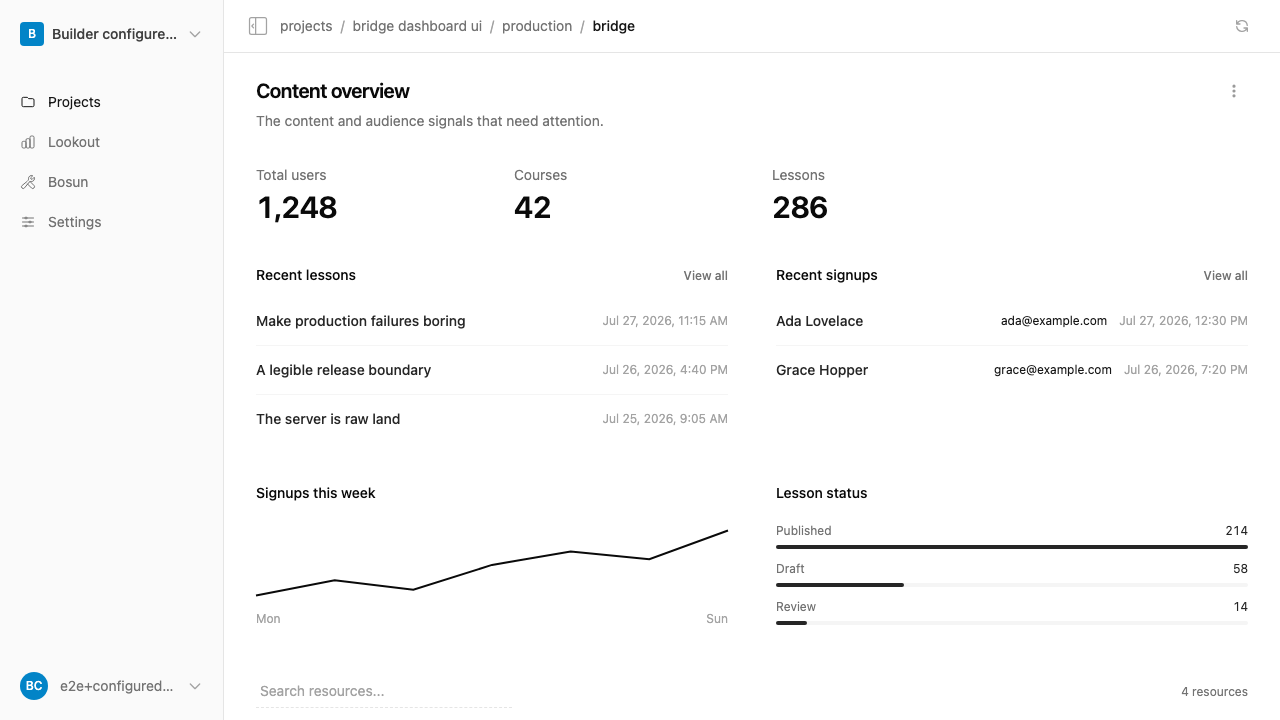
A visual tour
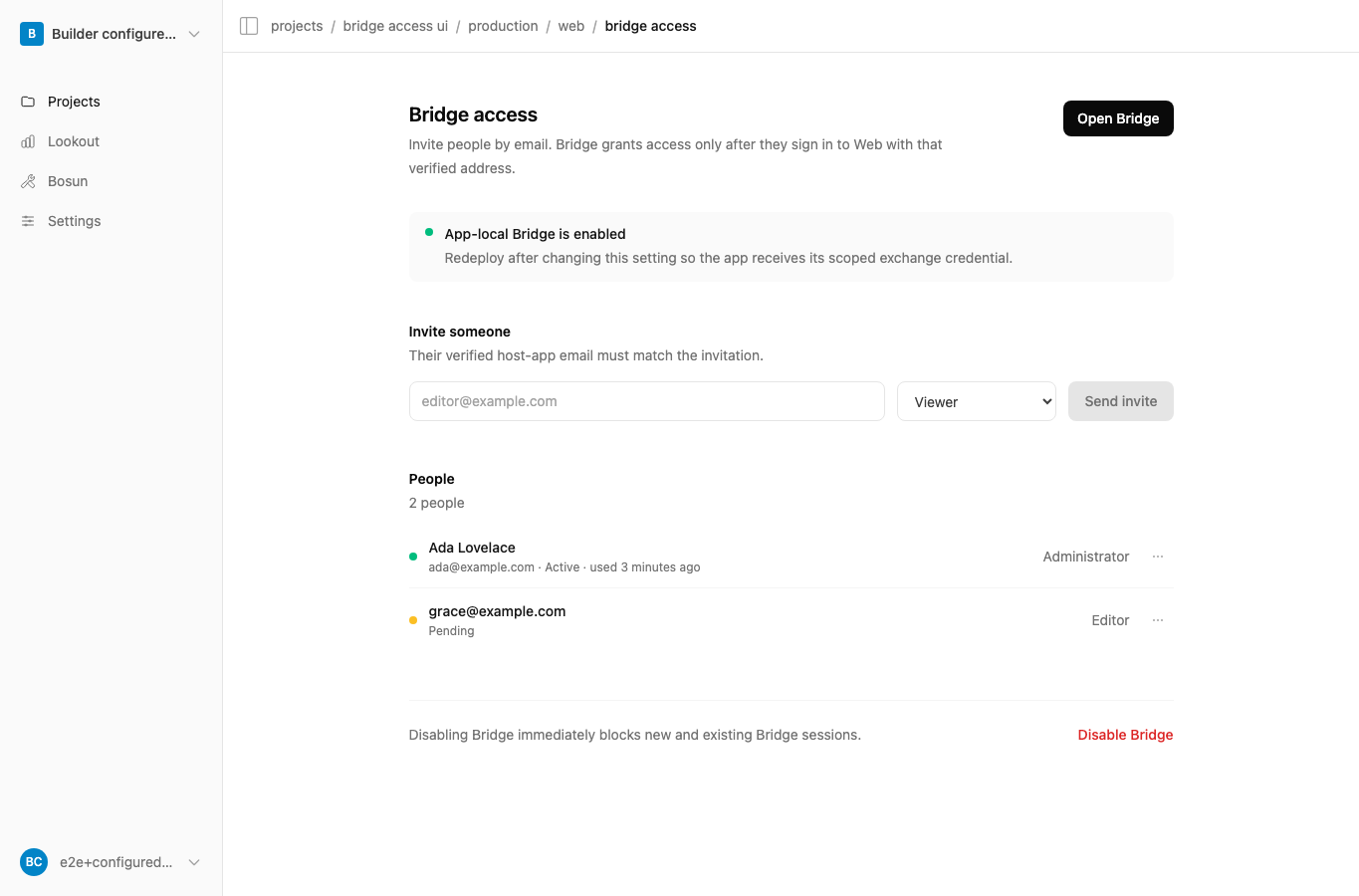
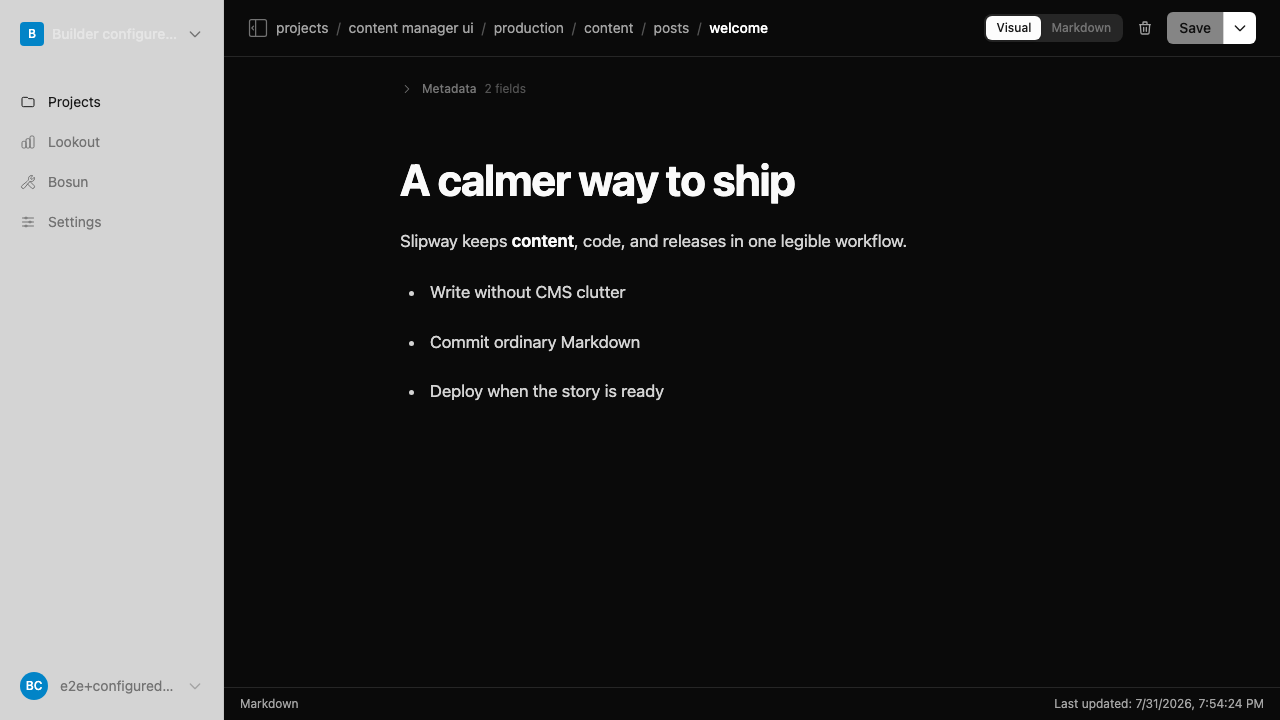
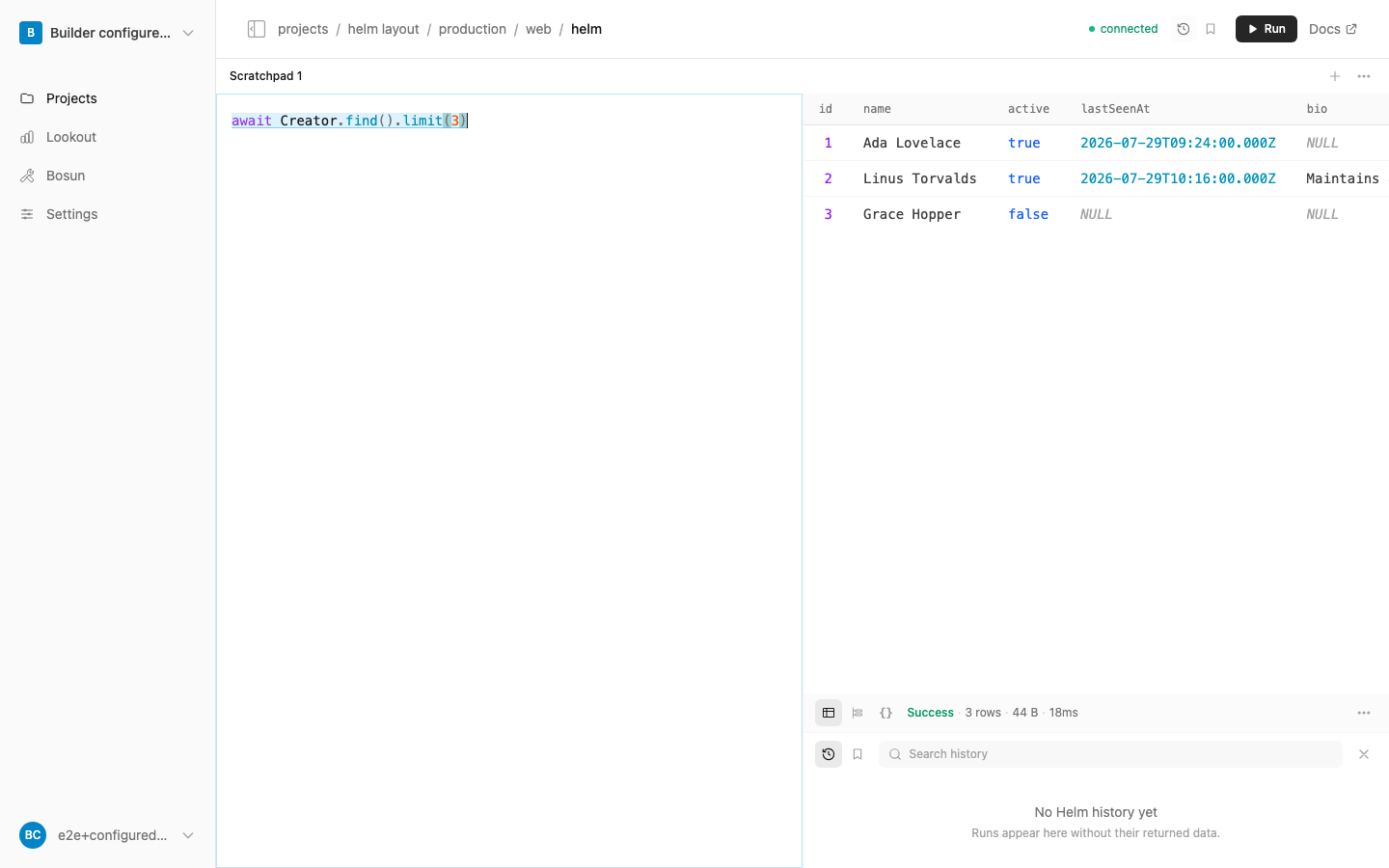
These are real browser states captured by Slipway's Sounding test suite with
seeded application data. Every surface follows the same restrained interface
in system light and dark modes.
| Bridge dashboards | App-local Bridge access |
|---|---|
 |
 |
| Git-backed Content | Helm structured results |
|---|---|
 |
 |
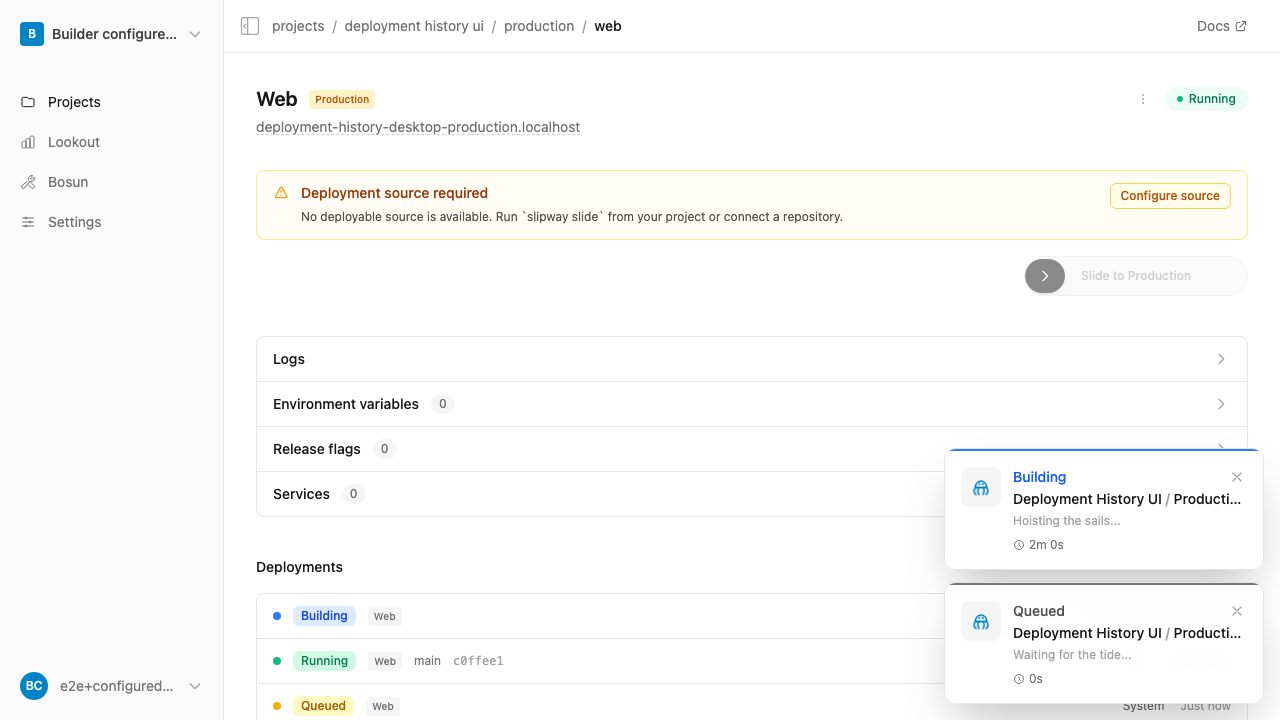
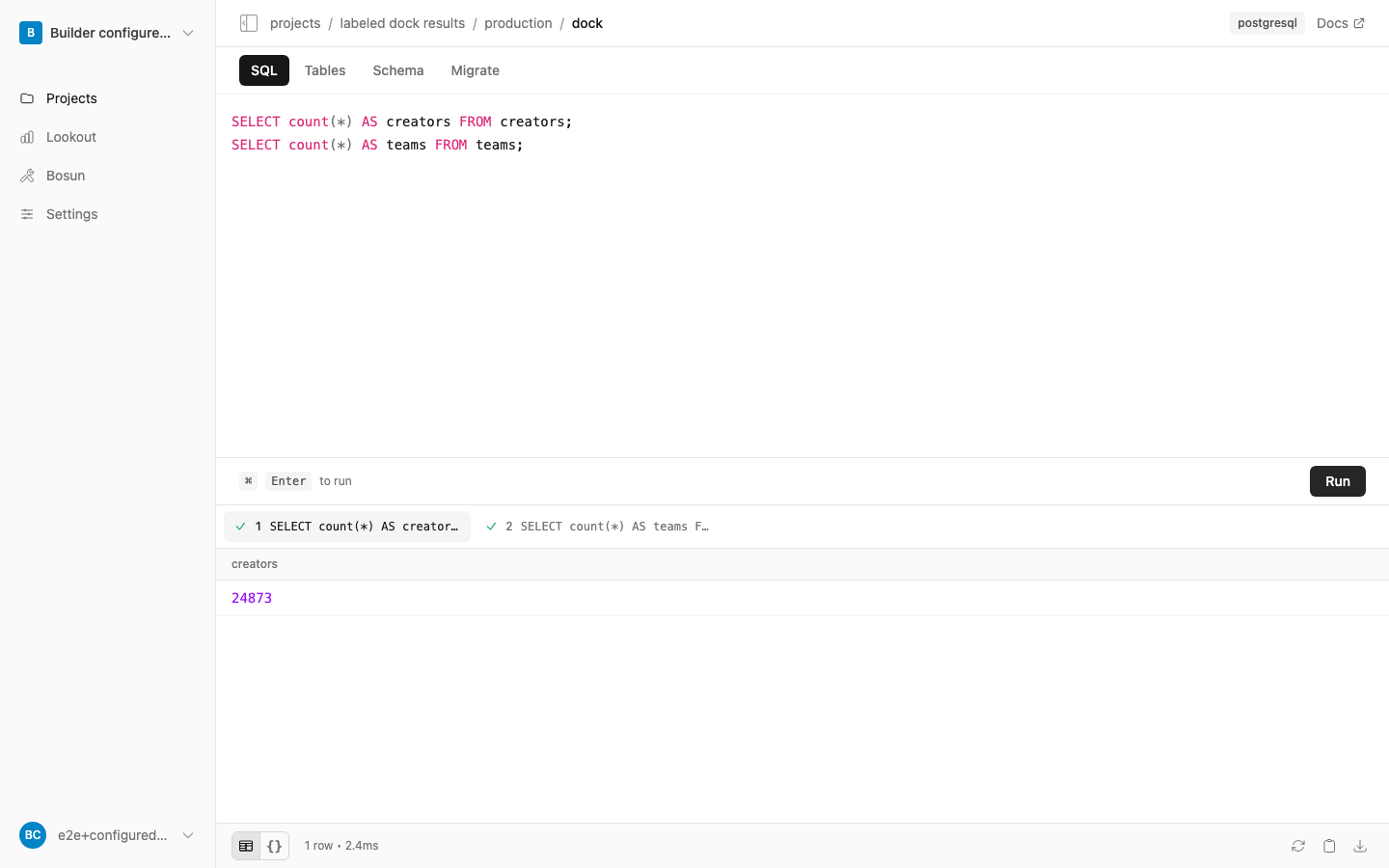
| Deliberate deployment ordering | Multiple Dock results |
|---|---|
 |
 |
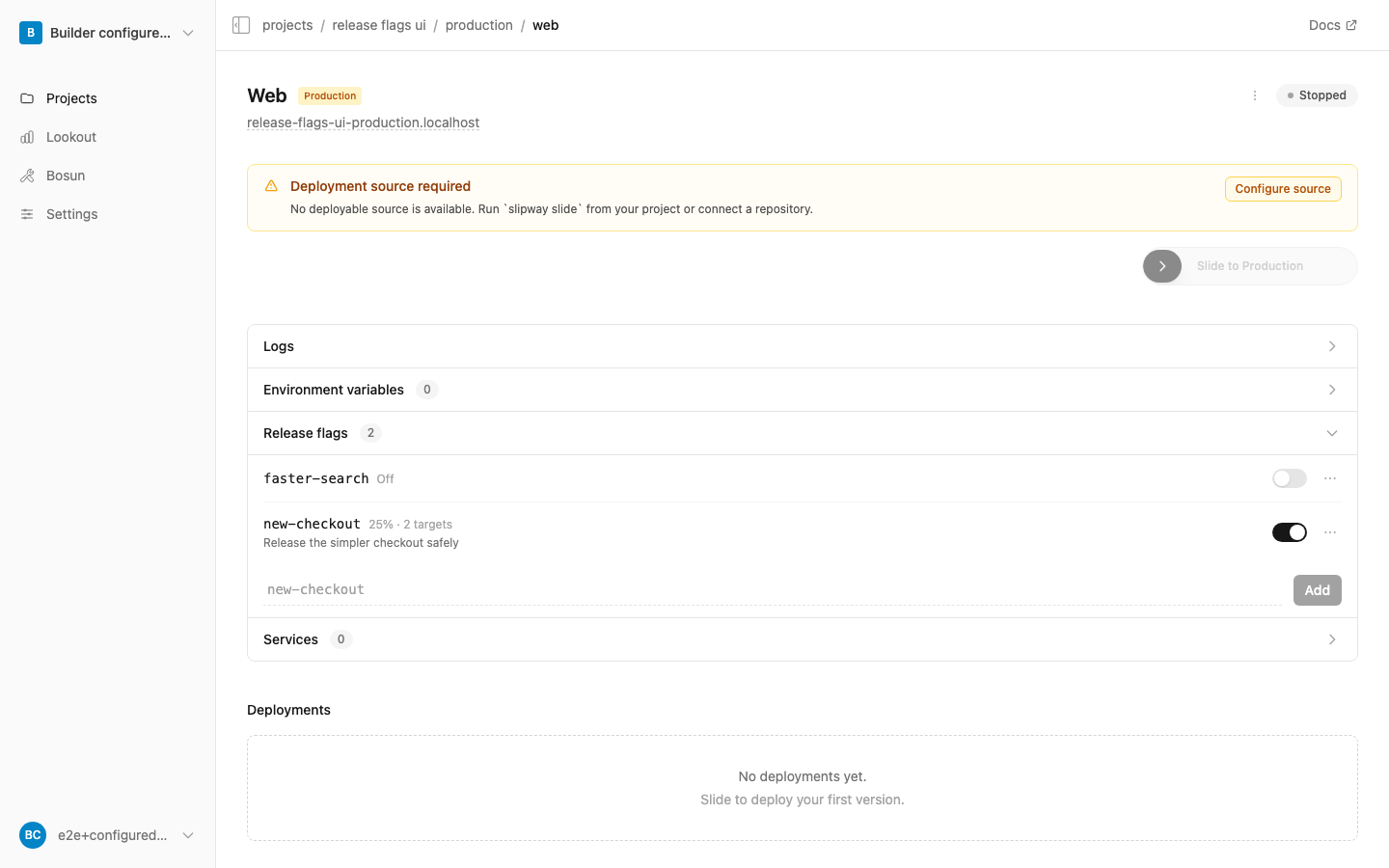
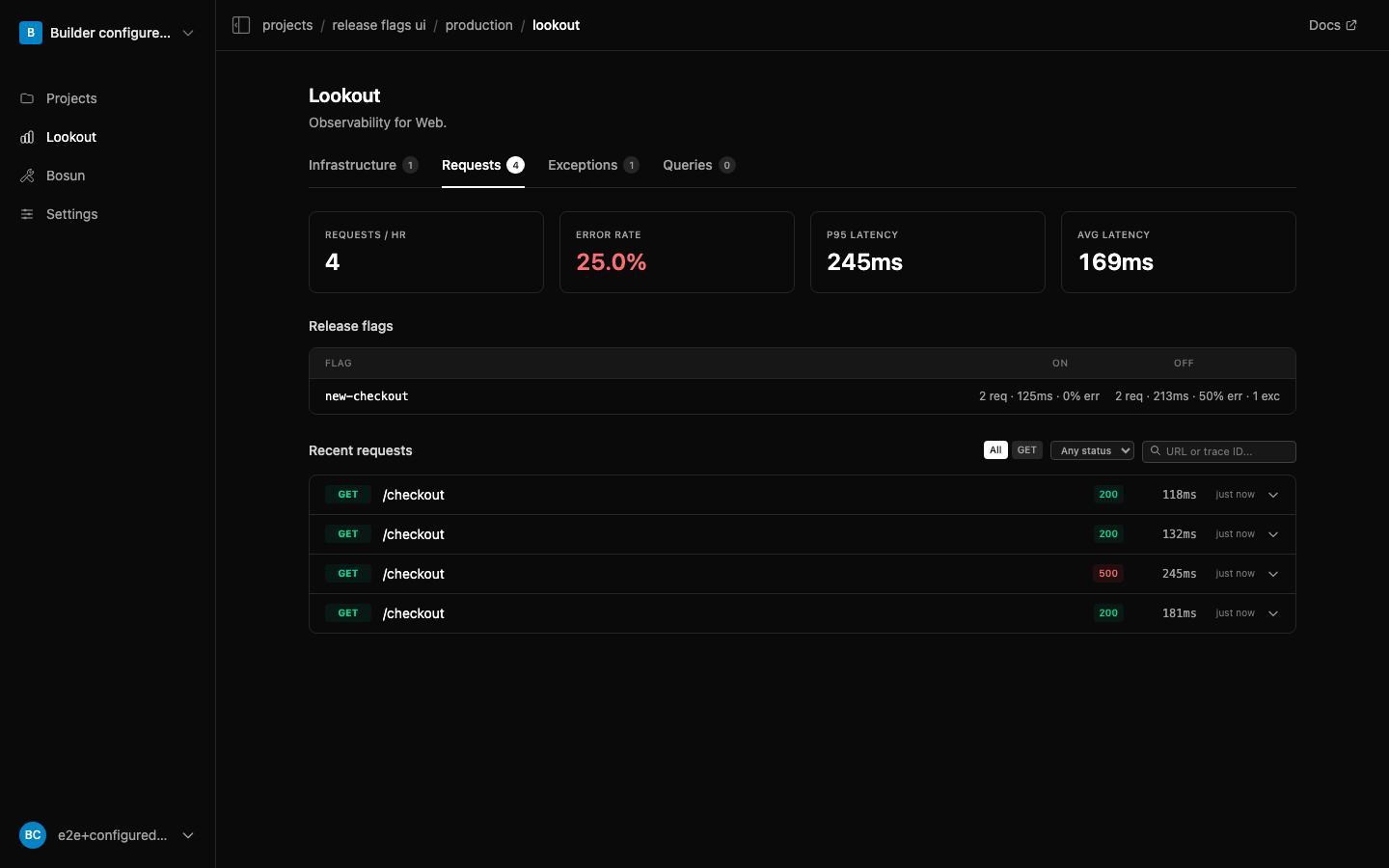
| Release controls | Flag-aware observation |
|---|---|
 |
 |
Read this before upgrading
Node.js 22 is now required
Slipway, its CLI, and sails-hook-slipway now require Node.js 22 or newer. The
Docker image already contains the supported runtime. Install Node.js 22 before
using the CLI or the hook directly on another host. This aligns development,
CI, production configuration, and documentation around one tested baseline
(#239, #210).
Existing SQLite installations: prepare the Bridge columns in Bosun
Upgrading an existing SQLite-backed Slipway installation to 0.0.52 requires a
one-time Bosun migration for the two Bridge columns introduced on the App
model. Until those columns exist, the candidate container fails its health
check with SQLITE_ERROR: no such column: bridge_enabled. The previous
Slipway container remains active after this failed update.
Before retrying the update, open the currently running Slipway, go to Bosun →
Console, select SQL and the app database, and inspect the control-plane
apps table:
PRAGMA table_info(apps);This is Slipway's own app database. Do not run these statements against the
observability or cache databases, or against a deployed application's
database. Take a VPS snapshot or your normal database backup before arming
Bosun writes.
If bridge_enabled and bridge_secret are absent, arm writes and run:
ALTER TABLE apps
ADD COLUMN bridge_enabled BOOLEAN NOT NULL DEFAULT 0;

ALTER TABLE apps
ADD COLUMN bridge_secret TEXT;
If inspection shows that either column already exists, skip its corresponding
ALTER TABLE statement. SQLite rejects adding a duplicate column. Run
PRAGMA table_info(apps); again, confirm both columns are present, and retry
the 0.0.52 update. The remaining Bridge access tables are created
automatically when the new release lifts successfully.
Messages about a closed database connection, an unregistered datastore, or
Lookout collector persistence after the missing-column error are cascading
shutdown noise rather than additional migrations to perform.
Existing installations: harden the public port boundary
Fresh installations need no migration. They expose Caddy on ports 80 and 443,
while the Slipway dashboard and allocated application ports bind to
127.0.0.1 by default.
Existing installations deliberately retain their previous public bindings on
the first update. Slipway does this so a security update cannot silently break
an operator who still relies on a raw SERVER_IP:PORT URL. To opt into the new
private boundary, first record the current state:
sudo docker ps --format 'table {{.Names}}\t{{.Ports}}'
sudo ss -lntp
sudo ufw status || true
sudo firewall-cmd --list-ports || true
Also record the inbound rules in your VPS provider firewall. Do not share
values from /etc/slipway/.env in an issue or support conversation.
Then rerun the installer with private dashboard and application bindings:
curl -fsSL https://raw.githubusercontent.com/sailscastshq/slipway/main/install.sh -o /tmp/install-slipway.sh
sudo env \
  SLIPWAY_DASHBOARD_HOST=127.0.0.1 \
  SLIPWAY_APP_PORT_HOST=127.0.0.1 \
  bash /tmp/install-slipway.sh
Redeploy every public application. Existing containers keep their previous
Docker binding until Slipway replaces them. Before closing ports, verify:
- the Slipway dashboard domain loads through Caddy;
slipway whoamisucceeds;- every application domain loads;
- webhooks and realtime/SSE flows still work where used;
docker psshows127.0.0.1:1337for the dashboard;- redeployed apps show
127.0.0.1:13xxbindings; - local health checks work from the server; and
- external raw
SERVER_IP:13xxrequests fail as expected.
After verification, remove inbound port 1337 and the 1338–1500 range from the
VPS provider firewall. The installer aligns active UFW or firewalld rules, but
it cannot edit provider firewalls or SSH policy (#202, #241).
If you must restore raw IP access, roll back the binding explicitly:
sudo env \
  SLIPWAY_DASHBOARD_HOST=0.0.0.0 \
  SLIPWAY_APP_PORT_HOST=0.0.0.0 \
  bash /tmp/install-slipway.sh
Redeploy the affected apps and reopen only the ports you still require. You can
make only application ports public with SLIPWAY_APP_PORT_HOST=0.0.0.0 while
leaving the dashboard behind Caddy.
This migration and rollback were rehearsed on an existing Hetzner Cloud
installation on July 31, 2026. The public baseline exposed the dashboard and
four application ports. A disposable application port was then moved from a
public binding to loopback: it remained healthy locally, became unreachable
externally, and became reachable again after rollback. The installer moved the
live dashboard to 127.0.0.1 without changing its Caddy-served response or any
application domain, restored the public binding during rollback, and returned
to the private binding successfully. Docker reported the final dashboard as
healthy. Existing application containers deliberately kept their old bindings;
the persisted private app setting takes effect as each app is redeployed after
the upgrade.
Read the complete Ingress and Firewall
guide for the default VPS, explicit direct-access, and optional Cloudflare
Tunnel modes.
Upgrade the Slipway hook where it is installed
Applications using Lookout, app-local Bridge, or release flags should install
the matching hook release and deploy once:
npm install sails-hook-slipway@0.0.4Bridge and release flags receive private app-scoped credentials during that
deployment. Later release-flag changes do not require another deploy.
Bridge is now an application backend
Bridge began as useful Waterline introspection. In 0.0.52 it becomes a
production-grade, configurable operational and content-management layer for a
Sails application.
- Resource contracts.
config/slipway.jscan define labels, list/show/form
fields, sorting, search, actions, rich Markdown fields, and deliberately
hidden resources. Safe Waterline discovery remains the zero-configuration
default (#216, PR #277). - Opaque identifiers. Numeric, string, and UUID primary keys now survive
every record and relationship path without coercion. Apps can use their own
helper to generate required identifiers (#217, PR #278). - Authorization at the target app. Field visibility and view, create,
update, delete, bulk-delete, and custom-action decisions can be resolved by a
Sails helper inside the application. Sensitive attributes are hidden by
default and forged hidden fields are rejected before execution (#218,
PR #279). - Typed forms. Bridge understands text, booleans, enums, money, JSON,
dates, URLs, Markdown, relationships, images, files, and protected values.
Create actions remain disabled until required fields are valid (#219,
PR #280). - Managed uploads. R2 and S3 uploads stream through app-, environment-, or
instance-scoped credentials. Bridge stores only the canonical public URL in
the Waterline record and protects the mutation with a short-lived signed
receipt (#219, #225; PRs #280 and #287). - Reusable storage layouts. Upload path templates can reference authorized
fields and relationships, so course, chapter, lesson, thumbnail, and video
hierarchies are application configuration rather than Slipway hardcoding.
Existing conventionalR2_orS3_credentials can be reused (#225,
PR #287). - Waterline relationships. Belongs-to selectors are bounded and
searchable. Collection attach/detach is an explicit opt-in and never deletes
related records (#220, PR #281). - Custom actions. Resource, record, and bulk actions call ordinary target
app helpers, reuse typed fields, and repeat authorization at execution time
(#221, PR #282). - Dashboards. App and resource dashboards can expose metrics, trends,
partitions, recent records, custom helper values, and quick actions. A broken
card fails independently instead of taking down the page (#222, PR #283). - Secure app-local access. An application can expose
/bridgeto verified
host-app users through invitations and viewer, editor, or administrator
grants. Single-use launch codes, dedicated sessions, revocation, audit
history, and app-scoped credential rotation keep Slipway access separate
from the app's own identity system (#223, PR #284). - Filters and lenses. Bridge now has type-aware allowlisted filters and
shareable saved views with fixed filters, columns, sorting, and optional
custom helpers (#224, PR #285). - Markdown without editor lock-in. Tiptap provides a minimal visual writing
surface, Markdown shortcuts, contextual formatting, and inline image upload,
while ordinary Markdown remains the stored value. Raw HTML is denied by
default (#216, #219, #225).
The result is closer to a Sails-native Laravel Nova than a generic database
viewer: the application owns its models and authorization, while Slipway owns
the reusable operational interface.
Read the complete Bridge guide.
Helm is now a production workspace
Helm still lets you run Sails code inside the selected application. The
difference is that it now treats production execution as a bounded,
observable, reversible operator workflow instead of a large textarea and an
unstructured return value.
- Project Helm and Bosun share one parser-backed runtime for declarations,
expressions, statements, async work, console output, and timeout behavior
(#267, PR #288). - Run only the current selection while preserving its real line and column, or
run the full document when nothing is selected (#268, PR #289). - View compatible results as a table, JSON tree, or raw value. Console output
stays separate and bounded, CSV export is scoped to compatible results, and
returned HTML remains inert (#269, PR #290). - Syntax and runtime errors appear on the exact CodeMirror token that caused
them, while complete stacks remain available on demand (#270, PR #291). - Stop an active execution. Slipway terminates the isolated process, keeps
bounded partial output, ignores late responses, and reports success, error,
timeout, or cancellation with timing and size metadata (#271, PR #292). - Complete live Sails model names, attributes, helpers, configuration paths,
Waterline methods, and query modifiers without sending configuration values
or records to the browser (#272, PR #294). - Keep private, source-only execution history and reusable personal or project
snippets with explicit retention and ownership (#273, PR #296). - Arm likely production writes for a short, single-use window bound to the
exact actor, source, app, container, and deployment. Audits remain
privacy-safe (#274, PR #297). - Add
// @inspectfor bounded inline values and// @trace queriesfor
redacted Waterline/native query traces without rewriting snippets to add
temporary logs (#275, PR #300). - Maintain named scratchpads with independent source, target, and result-view
state. A confirmation protects production target changes, and returned data
is not persisted (#276, PR #301). - Oversized output now scrolls inside its own pane instead of replacing the
editor, and long team names truncate without changing the existing minimal
layout (#229, PR #247).
All editor-backed surfaces now use a shared CodeMirror component rather than
transparent textarea/highlighting overlays. That gives Dock, Bosun, Helm, and
environment configuration real selection, undo history, indentation,
accessibility, wrapping, keyboard submission, and system light/dark theming
(#212, PR #264).
Read the complete Helm guide.
Deployments now fail and recover deliberately
The deployment pipeline received the deepest reliability work in this
release.
- CLI-pushed projects can be redeployed from the web using their persisted
source snapshot. Missing source is rejected before creating misleading
history, and preflight failures remain visible without stream logs (#230,
#242; PR #244). - Deployment history remains visually compact while ordering active work,
current releases, and chronological history correctly across legacy and
current records (#240, PR #245). - Direct app URLs are advertised only after verifying the actual Docker port
mapping. Installer, updater, port range, and host firewall behavior now agree
(#241, PR #246). - Docker is the source of truth for lifecycle reconciliation, so an app that
Docker automatically recovers returns from Stopped to Running in Slipway
without corrupting transitional deployment states (#228, PR #248). - Caddy cutover is transactional. Slipway stages and verifies a candidate
route while the old route remains live, commits app state before retiring the
previous release, and restores both route and state if promotion fails
(#232, PR #249). - Deployments and rollbacks are serialized per app through durable queues and
renewable fenced leases. Startup and the Quest watchdog recover interrupted
builds, containers, ports, images, and cutovers (#233, PR #250). - Cancellation is now a real process signal, not a database label. It stops Git
sync, Docker build, startup, and health checking before cutover; removes the
candidate; preserves the live release; and lets the next queued deployment
proceed (#231, PR #254). - CLI deployments without Git branch or commit metadata now reach their
uploaded build context instead of failing Sails helper validation (#303,
PR #304). - Signed pull-request and branch-delete webhooks are acknowledged without
inventing preview environments. New and repaired GitHub hooks subscribe only
to pushes (#298, PR #302). - Custom domains, generated domains, and verified direct URLs now follow one
canonical precedence everywhere—including the app page, command palette,
logs, rollback output, and worker messages (#211, PR #263). - Browser favicons reflect building/running work and briefly report success,
failure, or cancellation before returning to idle when seen or timed out
(#214, PR #266). - The production asset pipeline now uses the current Boring Stack Inertia v3
and Shipwright path and excludes hostnode_modulesfrom Linux Docker build
contexts, eliminating the browserprocess is not definedfailure class.
Read How deployments work
for the complete queue, health-check, cutover, cancellation, and recovery
model.
Safer data and infrastructure operations
- Backups, restores, S3/R2 transfers, and Dock imports stream with
backpressure instead of buffering entire payloads in Slipway memory. Size,
disk reserve, timeout, cancellation, stdout, and stderr limits are bounded,
and destructive restores require a verified safety snapshot (#234,
PR #251). - Project, environment, app, service, and legacy preview cleanup now runs
through one durable, resumable, idempotent operation. Traffic and active work
stop before containers, ports, records, and optional retained artifacts are
removed (#236, PR #260). - PostgreSQL, MySQL, Redis, and MongoDB use tested version lines and immutable
image references. Legacylatestservices preserve their exact image and
volume; supported adjacent major upgrades use backup, fresh-volume restore,
readiness verification, cutover, and recovery (#238, PR #257). - Lookout collection no longer gates retention or disk-health work on Docker
availability. Telemetry moves into the observability datastore with a
restart-safe migration, bounded retention, query-shaped indexes, and visible
collector/retention health (#237, PR #259). - Environment values can safely reference
$VARor${VAR}, including the
authoritative allocatedPORT, without invoking a shell. Cycles, unknown
values, excessive expansion, and literal dollars are bounded, while Docker
errors redact environment values and build arguments (#226, PR #262).
Deployment-native secrets
Slipway now encrypts app-scoped configuration instead of treating every
runtime value as a broadly inherited environment setting (#200, PR #312).
- Values remain write-only; the UI and audit log receive safe metadata.
- Global, environment, app, and platform configuration resolve through one
precedence path. - Managed credentials cannot be casually overwritten by ordinary edits.
- Every deployment records a keyed configuration fingerprint and a value-free
manifest, making config-only changes distinguishable without leaking values. - Environment-copy policies can inherit, omit, or randomize specific values.
- Bridge storage and access credentials retain explicit scope precedence.
Read Secrets and
Environment variables.
Release flags complete the Lookout loop
Slipway can now deploy code before releasing behavior (#227, PR #313).
const useNewCheckout = await sails.helpers.flags.enabled.with({
  key: 'new-checkout',
  req: this.req,
  defaultValue: false
})
Flags are scoped to one app and environment. The first release supports an
audited master kill switch, typed user/account/tenant/team allowlists, and
deterministic 0–100% cohorts. sails-hook-slipway caches the private contract,
refreshes in the background, and uses the last valid snapshot or explicit
default when the control plane is unavailable.
The app-facing API is a genuine Sails helper machine furnished through the
built-in helpers hook. Sails validates its inputs, the helper works through the
ordinary .with() contract, and an app-owned flags.enabled helper is never
overwritten (#314, PR #316).
The useful unit is not only the switch. Lookout compares flag-on and flag-off
request count, latency, 5xx rate, and trace-linked exceptions. A team can
release to itself, expand gradually, observe whether the new path is healthier,
and kill it without rebuilding or redeploying.
Read Release Flags.
Content Manager and Dock
- Content Manager now commits create, update, and delete operations to the
connected GitHub repository using Conventional Commits and optimistic blob
SHAs. Save & Deploy builds the exact content commit, while duplicate webhook
deployments are suppressed (#235, PR #252). - The Markdown textarea and permanent split preview have been replaced with a
minimal Tiptap visual editor. Markdown remains canonical; unsupported syntax
stays safely in source mode; pasted HTML and unsafe URLs are sanitized; and
provider-backed images upload directly into portable Markdown (#253,
PR #255). - Dock preserves every PostgreSQL/MySQL statement result, identifies partial
failures without discarding earlier successes, and scopes copy/export to the
selected result (#213, PR #265). - Command-only and mixed SQL output now use compact ordered summaries instead
of occupying the result area with repeated command text (#293, PR #295).
Correct web contracts and calmer validation
- Browser actions now use proper Inertia redirects, flash messages, and
validation errors instead of ad-hoc JSON responses. Immediate-result uploads
live under/api/v1, and Inertia location responses work for every HTTP
method (#243, PR #256). - Setup, login, password recovery, password reset, and profile forms validate
against server-owned rules before submission without consuming rate limits,
sending email, mutating accounts, or revealing whether an account exists
(#205, PR #306). - Project, environment, app, and service forms validate before database,
Docker, Caddy, webhook, audit, or restart work. Stable environment URLs no
longer change when display names change (#206, PR #307). - Instance, Git, environment, notification, upload, team, and token settings
share the same field-scoped validation and keep stored credentials out of
Inertia validation payloads (#207, PR #308). - Bridge and Content Manager validate target-model fields, slugs, metadata,
Markdown, and JSON before mutation without losing local edits (#208,
PR #309). - Slipway-owned, responsive light/dark 404 and 500 pages replace the default
Sails views. Production failures remain generic, and Inertia errors fall back
safely (#204, PR #305).
Testing, runtime, and maintenance
- All Slipway unit, functional, Inertia, and browser trials now run through the
public Sounding 0.2 API. Controller imports, private testing internals,
hand-built CSRF sessions, and mixed runners were removed (#242, PR #244). - CI and release workflows use current Node 24-based GitHub Actions while the
application runtime remains Node.js 22 (#210, PR #261). - README links, generated production configuration, CLI runtime checks, and
docs/runtime consistency now have automated regression gates (#239,
PR #258).
Upgrade checklist
-
Read the ingress migration above and capture the existing server boundary.
-
Update Slipway through Bosun or rerun the installer.
-
If upgrading an older installation, opt into loopback bindings, redeploy
apps, verify domains/CLI/webhooks/realtime, then close old provider ports. -
Upgrade apps that use Slipway integration:
npm install sails-hook-slipway@0.0.4
-
Deploy those applications once to receive current app-scoped Bridge,
Lookout, and release-flag credentials. -
Verify database services before choosing any offered major-version upgrade.
-
Review the new secret scopes and convert broadly inherited credentials to
app scope where appropriate.
Full changelog
Every item above was exercised through Sounding unit, functional, or real
browser trials. UI work was reviewed in light and dark mode, and the deployment,
cutover, backup, installer, and service paths include focused failure and
recovery coverage.
Full changelog: v0.0.51...v0.0.52
Bridge worker correction (August 1): Bridge model and data workers now explicitly load the deployed application in production mode. This prevents a healthy production app from falling back to development datastore settings such as
redis://localhost:6379during Bridge model discovery, while preserving app-scoped credentials and explicitsails_environmentvalues.
Second 0.0.52 corrective rebuild (August 1): Bridge enable, role-update, and revoke mutations now use mutation-safe Inertia redirects, eliminating
ERR_TOO_MANY_REDIRECTS. Expected loopback app-port bindings are now treated as a quiet secure default in both the app page and successful deployment output, while genuinely missing or invalid Docker mappings remain diagnostic.
Release correction: The 0.0.52 image was rebuilt after removing an
unbounded legacy Lookout metrics copy from web bootstrap. Existing ephemeral
metrics remain untouched inapp.db, new samples continue in
observability.db, and the dashboard becomes healthy without waiting on
historical data. The correction also derives secure session cookies from an
HTTPSSLIPWAY_URLand removes an irrelevant GET-route CSRF override.