
Automatically generate RESTful API documentation with Swagger 2.0 for Go.



gopher image source is tenntenn/gopher-stickers. It has licenses creative commons licensing.
- Getting started
- Go web frameworks
- Supported Web Frameworks
- How to use it with
gin? - Implementation Status
- swag cli
- General API Info
- Security
- API Operation
- TIPS
- About the Project
Swag converts Go annotations to Swagger Documentation 2.0. We've created a variety of plugins for popular Go web frameworks. This allows you to quickly integrate with an existing Go project (using Swagger UI).
-
Add comments to your API source code, See Declarative Comments Format.
-
Download swag by using:
$ go get -u github.com/swaggo/swag/cmd/swag- Run
swag initin the project's root folder which contains themain.gofile. This will parse your comments and generate the required files (docsfolder anddocs/docs.go).
$ swag init- In order to serve these files, you can utilize one of our supported plugins. For go's core library, check out net/http.
- Make sure to import the generated
docs/docs.goso that your specific configuration getsinit'ed. - If your General API annotation do not live in
main.go, you can let swag know with-g.
swag init -g http/api.goFind the example source code here.
- After using
swag initto generate Swagger 2.0 docs, import the following packages:
import "github.com/swaggo/gin-swagger" // gin-swagger middleware
import "github.com/swaggo/gin-swagger/swaggerFiles" // swagger embed files- Add General API annotations in
main.gocode:
// @title Swagger Example API
// @version 1.0
// @description This is a sample server celler server.
// @termsOfService http://swagger.io/terms/

// @contact.name API Support
// @contact.url http://www.swagger.io/support
// @contact.email support@swagger.io

// @license.name Apache 2.0
// @license.url http://www.apache.org/licenses/LICENSE-2.0.html

// @host localhost:8080
// @BasePath /api/v1

// @securityDefinitions.basic BasicAuth

// @securityDefinitions.apikey ApiKeyAuth
// @in header
// @name Authorization

// @securitydefinitions.oauth2.application OAuth2Application
// @tokenUrl https://example.com/oauth/token
// @scope.write Grants write access
// @scope.admin Grants read and write access to administrative information

// @securitydefinitions.oauth2.implicit OAuth2Implicit
// @authorizationurl https://example.com/oauth/authorize
// @scope.write Grants write access
// @scope.admin Grants read and write access to administrative information

// @securitydefinitions.oauth2.password OAuth2Password
// @tokenUrl https://example.com/oauth/token
// @scope.read Grants read access
// @scope.write Grants write access
// @scope.admin Grants read and write access to administrative information

// @securitydefinitions.oauth2.accessCode OAuth2AccessCode
// @tokenUrl https://example.com/oauth/token
// @authorizationurl https://example.com/oauth/authorize
// @scope.admin Grants read and write access to administrative information

func main() {
	r := gin.Default()

	c := controller.NewController()

	v1 := r.Group("/api/v1")
	{
		accounts := v1.Group("/accounts")
		{
			accounts.GET(":id", c.ShowAccount)
			accounts.GET("", c.ListAccounts)
			accounts.POST("", c.AddAccount)
			accounts.DELETE(":id", c.DeleteAccount)
			accounts.PATCH(":id", c.UpdateAccount)
			accounts.POST(":id/images", c.UploadAccountImage)
		}
    //...
	}
	r.GET("/swagger/*any", ginSwagger.WrapHandler(swaggerFiles.Handler))
	r.Run(":8080")
}
//...- Add API Operation annotations in
controllercode
package controller

import (
	"fmt"
	"net/http"
	"strconv"

	"github.com/gin-gonic/gin"
	"github.com/swaggo/swag/example/celler/httputil"
	"github.com/swaggo/swag/example/celler/model"
)

// ShowAccount godoc
// @Summary Show a account
// @Description get string by ID
// @ID get-string-by-int
// @Accept  json
// @Produce  json
// @Param id path int true "Account ID"
// @Success 200 {object} model.Account
// @Failure 400 {object} httputil.HTTPError
// @Failure 404 {object} httputil.HTTPError
// @Failure 500 {object} httputil.HTTPError
// @Router /accounts/{id} [get]
func (c *Controller) ShowAccount(ctx *gin.Context) {
	id := ctx.Param("id")
	aid, err := strconv.Atoi(id)
	if err != nil {
		httputil.NewError(ctx, http.StatusBadRequest, err)
		return
	}
	account, err := model.AccountOne(aid)
	if err != nil {
		httputil.NewError(ctx, http.StatusNotFound, err)
		return
	}
	ctx.JSON(http.StatusOK, account)
}

// ListAccounts godoc
// @Summary List accounts
// @Description get accounts
// @Accept  json
// @Produce  json
// @Param q query string false "name search by q"
// @Success 200 {array} model.Account
// @Failure 400 {object} httputil.HTTPError
// @Failure 404 {object} httputil.HTTPError
// @Failure 500 {object} httputil.HTTPError
// @Router /accounts [get]
func (c *Controller) ListAccounts(ctx *gin.Context) {
	q := ctx.Request.URL.Query().Get("q")
	accounts, err := model.AccountsAll(q)
	if err != nil {
		httputil.NewError(ctx, http.StatusNotFound, err)
		return
	}
	ctx.JSON(http.StatusOK, accounts)
}

//...
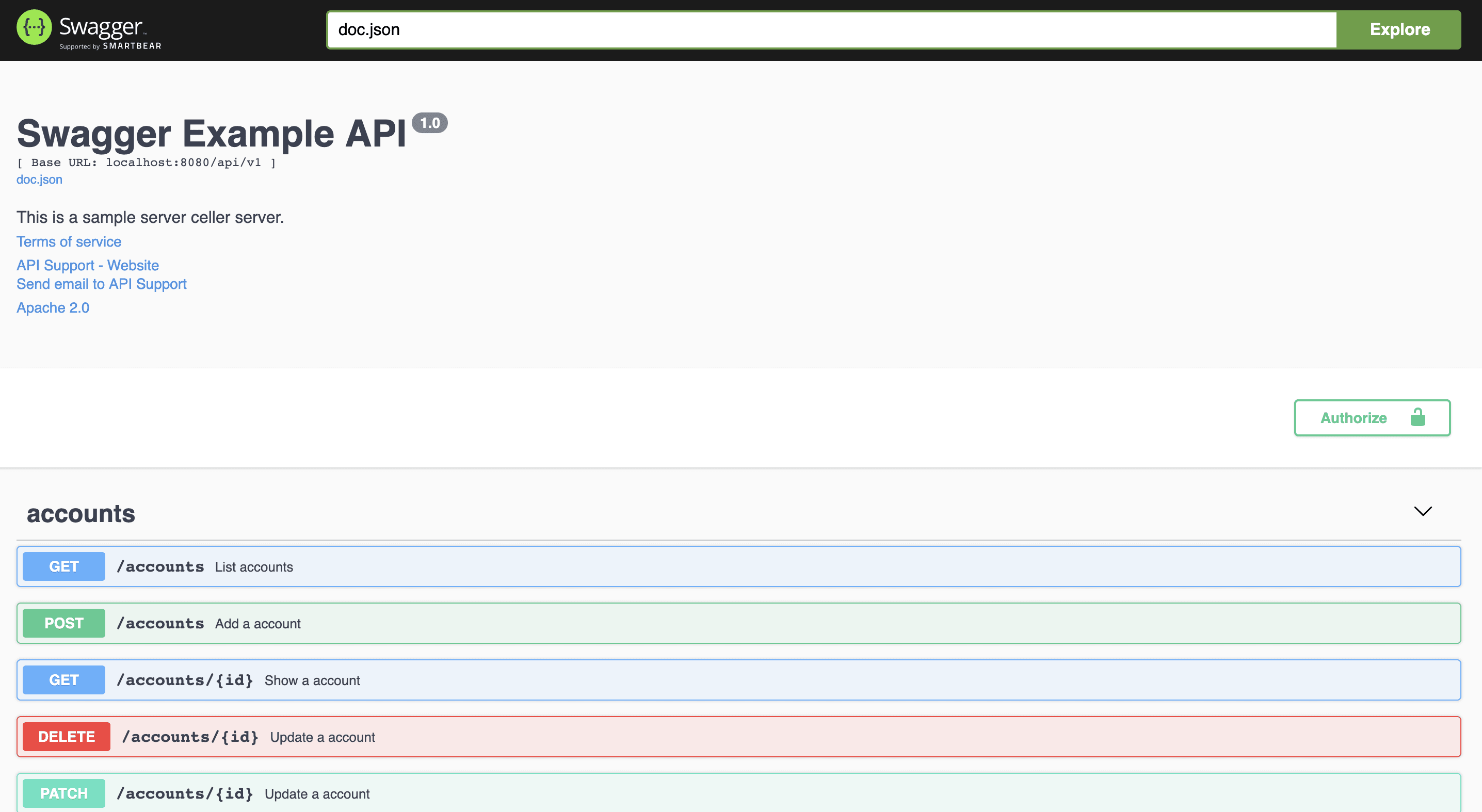
$ swag init4.Run your app, and browse to http://localhost:8080/swagger/index.html. You will see Swagger 2.0 Api documents as shown below:
- Basic Structure
- API Host and Base Path
- Paths and Operations
- Describing Parameters
- Describing Request Body
- Describing Responses
- MIME Types
- Authentication
- Basic Authentication
- API Keys
- Adding Examples
- File Upload
- Enums
- Grouping Operations With Tags
- Swagger Extensions
$ swag init -h
NAME:
   swag init - Create docs.go

USAGE:
   swag init [command options] [arguments...]

OPTIONS:
   --generalInfo value, -g value       Go file path in which 'swagger general API Info' is written (default: "main.go")
   --dir value, -d value               Directory you want to parse (default: "./")
   --swagger value, -s value           Output the swagger conf for json and yaml (default: "./docs/swagger")
--propertyStrategy value, -p value Property Naming Strategy like snakecase,camelcase,pascalcase (default: "camelcase")Example
celler/main.go
| annotation | description | example |
|---|---|---|
| title | Required. The title of the application. | // @title Swagger Example API |
| version | Required. Provides the version of the application API. | // @version 1.0 |
| description | A short description of the application. | // @description This is a sample server celler server. |
| termsOfService | The Terms of Service for the API. | // @termsOfService http://swagger.io/terms/ |
| contact.name | The contact information for the exposed API. | // @contact.name API Support |
| contact.url | The URL pointing to the contact information. MUST be in the format of a URL. | // @contact.url http://www.swagger.io/support |
| contact.email | The email address of the contact person/organization. MUST be in the format of an email address. | // @contact.email support@swagger.io |
| license.name | Required. The license name used for the API. | // @license.name Apache 2.0 |
| license.url | A URL to the license used for the API. MUST be in the format of a URL. | // @license.url http://www.apache.org/licenses/LICENSE-2.0.html |
| host | The host (name or ip) serving the API. | // @host localhost:8080 |
| BasePath | The base path on which the API is served. | // @BasePath /api/v1 |
| annotation | description | parameters | example |
|---|---|---|---|
| securitydefinitions.basic | Basic auth. | // @securityDefinitions.basic BasicAuth | |
| securitydefinitions.apikey | API key auth. | in, name | // @securityDefinitions.apikey ApiKeyAuth |
| securitydefinitions.oauth2.application | OAuth2 application auth. | tokenUrl, scope | // @securitydefinitions.oauth2.application OAuth2Application |
| securitydefinitions.oauth2.implicit | OAuth2 implicit auth. | authorizationUrl, scope | // @securitydefinitions.oauth2.implicit OAuth2Implicit |
| securitydefinitions.oauth2.password | OAuth2 password auth. | tokenUrl, scope | // @securitydefinitions.oauth2.password OAuth2Password |
| securitydefinitions.oauth2.accessCode | OAuth2 access code auth. | tokenUrl, authorizationUrl, scope | // @securitydefinitions.oauth2.accessCode OAuth2AccessCode |
| parameters annotation | example |
|---|---|
| in | // @in header |
| name | // @name Authorization |
| tokenUrl | // @tokenUrl https://example.com/oauth/token |
| authorizationurl | // @authorizationurl https://example.com/oauth/authorize |
| scope.hoge | // @scope.write Grants write access |
Example
celler/controller
| annotation | description |
|---|---|
| description | A verbose explanation of the operation behavior. |
| id | A unique string used to identify the operation. Must be unique among all API operations. |
| tags | A list of tags to each API operation that separated by commas. |
| summary | A short summary of what the operation does. |
| accept | A list of MIME types the APIs can consume. Value MUST be as described under Mime Types. |
| produce | A list of MIME types the APIs can produce. Value MUST be as described under Mime Types. |
| param | Parameters that separated by spaces. param name,param type,data type,is mandatory?,comment attribute(optional) |
| security | Security to each API operation. |
| success | Success response that separated by spaces. return code,{param type},data type,comment |
| failure | Failure response that separated by spaces. return code,{param type},data type,comment |
| router | Path definition that separated by spaces. path,[httpMethod] |
| Mime Type | annotation |
|---|---|
| application/json | application/json, json |
| text/xml | text/xml, xml |
| text/plain | text/plain, plain |
| html | text/html, html |
| multipart/form-data | multipart/form-data, mpfd |
| application/x-www-form-urlencoded | application/x-www-form-urlencoded, x-www-form-urlencoded |
| application/vnd.api+json | application/vnd.api+json, json-api |
| application/x-json-stream | application/x-json-stream, json-stream |
| application/octet-stream | application/octet-stream, octet-stream |
| image/png | image/png, png |
| image/jpeg | image/jpeg, jpeg |
| image/gif | image/gif, gif |
General API info.
// @securityDefinitions.basic BasicAuth

// @securitydefinitions.oauth2.application OAuth2Application
// @tokenUrl https://example.com/oauth/token
// @scope.write Grants write access
// @scope.admin Grants read and write access to administrative information
Each API operation.
// @Security ApiKeyAuthMake it AND condition
// @Security ApiKeyAuth
// @Security OAuth2Application[write, admin]- object (struct)
- string (string)
- integer (int, uint, uint32, uint64)
- number (float32)
- boolean (bool)
- array
- string (string)
- integer (int, uint, uint32, uint64)
- number (float32)
- boolean (bool)
- user defined struct
// @Param enumstring query string false "string enums" Enums(A, B, C)
// @Param enumint query int false "int enums" Enums(1, 2, 3)
// @Param enumnumber query number false "int enums" Enums(1.1, 1.2, 1.3)
// @Param string query string false "string valid" minlength(5) maxlength(10)
// @Param int query int false "int valid" mininum(1) maxinum(10)
// @Param default query string false "string default" default(A)| Field Name | Type | Description |
|---|---|---|
| default | * | Declares the value of the parameter that the server will use if none is provided, for example a "count" to control the number of results per page might default to 100 if not supplied by the client in the request. (Note: "default" has no meaning for required parameters.) See https://tools.ietf.org/html/draft-fge-json-schema-validation-00#section-6.2. Unlike JSON Schema this value MUST conform to the defined type for this parameter. |
| maximum | number |
See https://tools.ietf.org/html/draft-fge-json-schema-validation-00#section-5.1.2. |
| minimum | number |
See https://tools.ietf.org/html/draft-fge-json-schema-validation-00#section-5.1.3. |
| maxLength | integer |
See https://tools.ietf.org/html/draft-fge-json-schema-validation-00#section-5.2.1. |
| minLength | integer |
See https://tools.ietf.org/html/draft-fge-json-schema-validation-00#section-5.2.2. |
| enums | [*] | See https://tools.ietf.org/html/draft-fge-json-schema-validation-00#section-5.5.1. |
| Field Name | Type | Description |
|---|---|---|
| format | string |
The extending format for the previously mentioned type. See Data Type Formats for further details. |
| multipleOf | number |
See https://tools.ietf.org/html/draft-fge-json-schema-validation-00#section-5.1.1. |
| pattern | string |
See https://tools.ietf.org/html/draft-fge-json-schema-validation-00#section-5.2.3. |
| maxItems | integer |
See https://tools.ietf.org/html/draft-fge-json-schema-validation-00#section-5.3.2. |
| minItems | integer |
See https://tools.ietf.org/html/draft-fge-json-schema-validation-00#section-5.3.3. |
| uniqueItems | boolean |
See https://tools.ietf.org/html/draft-fge-json-schema-validation-00#section-5.3.4. |
| collectionFormat | string |
Determines the format of the array if type array is used. Possible values are:
csv. |
// @Success 200 {array} model.Account <-- This is a user defined struct.package model
type Account struct {
ID int `json:"id" example:"1"`
Name string `json:"name" example:"account name"`
}/// ...
// @Param group_id path int true "Group ID"
// @Param account_id path int true "Account ID"
// ...
// @Router /examples/groups/{group_id}/accounts/{account_id} [get]type Account struct {
ID int `json:"id" example:"1"`
Name string `json:"name" example:"account name"`
PhotoUrls []string `json:"photo_urls" example:"http://test/image/1.jpg,http://test/image/2.jpg"`
}type Account struct {
// ID this is userid
ID int `json:"id"
}This project was inspired by yvasiyarov/swagger but we simplified the usage and added support a variety of web frameworks.