Repository navigation
Evidence and Reports
Evidence is the part of an engagement a client can verify without trusting the report: each capture is written once, hashed with SHA-256, indexed in a manifest and packaged with checksums. Reports are rendered from the same store, never from model memory, and a report generated before closure is marked as a draft.
On this page: evidence kinds · automatic capture · hashing and immutability · redaction · the ZIP package · the project bundle · report formats · the OSINT report · validation and retest · draft versus final · hand-off · limits.
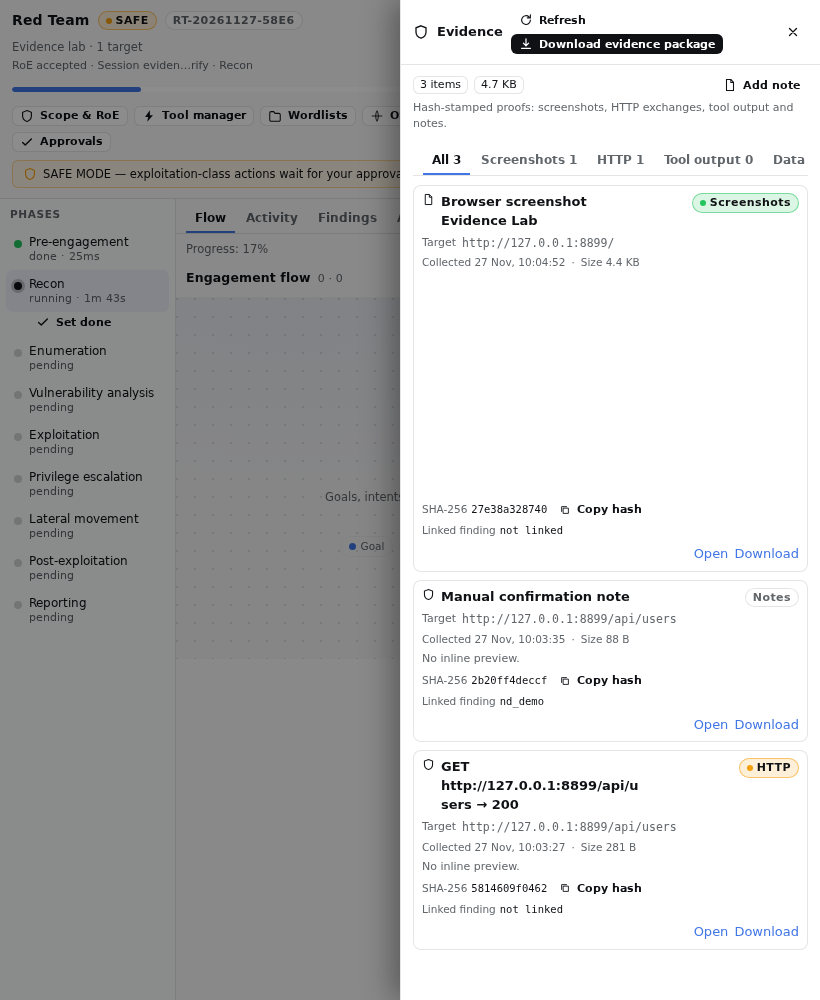
The vault accepts nine kinds: screenshot, http, tool-output, json, text, note, file,
har and scan. The pentest_evidence_add tool exposes the common ones (note, text, json, http,
screenshot, tool-output, file, scan); har exists for captured browser traffic. Filters in the
drawer group them as all, screenshots, HTTP, tool output, data and notes.
Most evidence is created by the engine; pentest_evidence_add stores the kind you ask for.
| Source | Captured as |
|---|---|
pentest_exec stdout/stderr (200 KiB per stream) |
tool-output, linked to the run |
| Browser screenshot |
screenshot in the artifact directory, then the vault |
pentest_api_request exchange |
http with credentials redacted |
| API discovery inventory and fuzz summary | json |
pentest_web_assess result |
json assessment plus a fact |
pentest_osint result |
json with the normalized facts |
pentest_retest { action: "run" } |
json retest lifecycle record (verdict, response summary, hash) |
A record can be linked to a finding, fact or asset with pentest_attach_evidence; linking is
idempotent.
Every record lives at $DSH_HOME/redteam/evidence/<session>/<evId>/<slug>.<ext> and is written
with flag: 'wx' — create-exclusive, never overwritten. Next to the file sits a meta.json with
id, kind, title, actor, target, source, mime, bytes, SHA-256, file path, links, sensitive flag and
redaction flag. The session keeps:
-
manifest.json— the authoritative index, rewritten atomically; -
manifest.jsonl— an append-only copy, one record per line.
If the manifest is corrupt or missing, the vault scans the record directories, rebuilds it from
meta.json and logs the heal instead of failing the engagement. Directories are 0700, files
0600, and the vault caps a session at 5000 records and 32 MiB per record by default.
Text is redacted before it is written, not when it is displayed:
- header values for
Authorization,Proxy-Authorization,Cookie,Set-CookieandX-Api-Keybecome<redacted>, with the header name kept; - query values whose name looks like token,
api_key,keyorpasswordare masked; - metadata strings pass through the same text redaction;
- binary evidence, such as a screenshot, is never rewritten; the record says whether redaction was
applied (
redacted: true) andsensitiveis set when it was.
pentest_evidence_package (or Download evidence package in the drawer) builds a ZIP by hand —
no external zip binary — containing:
| Entry | Contents |
|---|---|
manifest.json |
Every included record with its SHA-256, size, kind and links |
README.txt |
Session, engagement id, record count, authorization disclaimer, verification command |
sha256sums.txt |
<hash> files/<id>-<name> for every included file |
files/<id>-<name> |
The stored bytes, unchanged |
The result reports the ZIP path, byte size, record count, uncompressed total and the SHA-256 of the
ZIP itself. The package is capped at 256 MiB by default (evidence.maxPackageBytes) and refuses to
build when the cap would be exceeded. Downloads are served by the bridge routes /evidence/file
and /evidence/package, with a realpath check confining both to the session directory.
pentest_export_bundle (or Export bundle (ZIP) in the Report tab) is the hand-off archive.
It contains the reports, the evidence vault files grouped by kind, findings/findings.csv,
findings/findings.json and findings/findings.sarif, the engagement state, the audit trail and
the tool-run log, plus a
manifest.json (counts, bytes, per-file SHA-256), README.txt and sha256sums.txt. The archive
is written under $DSH_HOME/redteam/bundles/<session>/, recorded in state.bundle and the audit
trail, and is deterministic for the same recorded state. The vault-only
pentest_evidence_package remains available when the client only wants the evidence.
pentest_report renders from the snapshot only. Six formats:
- Markdown — portable, good for review and diffing;
- HTML — one self-contained file, with evidence screenshots embedded as data URIs in a captioned gallery; responsive and print-first;
- JSON — the full model, useful for automation;
- PDF — dependency-free writer with an embedded TrueType font, Latin and Cyrillic, page numbers and simple tables; complex HTML is flattened by design;
- DOCX — WordprocessingML with a cover, document control, a real TOC field, heading/table styles, A4 pages, PAGE/NUMPAGES headers/footers and captioned PNG evidence images;
- Slides — a Markdown outline suitable for a deck.
Sections, in order: document control and contents, executive brief (business verdict, the three
issues that matter, what to fix first, scope/coverage and evidence confidence), scope, methodology,
findings as primary cards (CVSS base-metric breakdown, mappings, evidence, reproduction,
remediation/retest registers), then risk posture, narrative, simulation, compliance and audit as
collapsed secondary sections. The HTML brief keeps detail behind a native per-finding disclosure,
expands everything for print, and uses stable F-01 finding ids with absolute anchors. Findings carry severity, CVSS and vector, CWE, OWASP, WSTG ids,
evidence excerpts, remediation and, when pentest_verify has run, the deterministic verdict with
its confidence and checks. A retest verdict appears in the retest register and on the finding. The risk index and recommended SLAs are additive triage aids,
not CVSS or client-agreed values. The audit appendix is the bounded tail (400 entries) of the
same append-only trail, and the evidence register is capped at 200 rows with an explicit
truncation line when there are more. English and Russian templates are built in, independent of
the UI language.
Separate from the six engagement formats, pentest_osint_report writes a Markdown, HTML or JSON
intelligence deliverable (lib/host/osint-report.js) from stored facts and enrichment results:
scope and authorization, summary, IP/CIDR table (ASN, country/city, ISP, rDNS, observed ports,
reputation, confidence, sources), domains/hostnames (resolved IPs, NS/MX, SPF/DMARC), certificates,
relationships, confidence basis, sources and timestamps, lookup history, observations and
limitations. It is deterministic, escaped per format, scrubbed of secrets, writes no network call,
and never overwrites an existing file. It also has its own action in the OSINT tab.
pentest_verify stores its result on the finding (meta.validation, last five records) and the
report model renders it in every format: verdict (confirmed/refuted/inconclusive),
confidence, CWE and the named checks. It is evidence-only — no request is sent — and a confirmed
verdict may promote an unverified finding to verified; it never sets exploited.
pentest_retest stores a lifecycle record in state.retests and summarises it on
finding.meta.retest. The retest register in the report shows the method, URL, expected and actual
status and verdict; the response is captured as JSON evidence and linked to the finding. Neither
surface rewrites the original evidence.
-
pentest_reportproduces a draft:draft: truewhenever the engagement is not yet completed. A draft is useful for review; it is not the deliverable. -
pentest_complete_engagementis the closing step. It refuses while any non-reporting phase is neitherdonenorskippedwith a written reason, and refuses ablockedreporting phase. When the checklist passes it marks reporting done, sets the engagementcompleted, writes the final set (defaultmd,pdf,json) and returns the paths plus the checklist. - The checklist reports
canComplete, open phases, reporting status, finding counts (total and verified/exploited), evidence count and bytes, and whether a report was already generated.
Files are written once with create-exclusive semantics, so a repeated generation creates a new
file with a numeric suffix rather than overwriting the previous one. pentest_state exposes the
same checklist, which is the cheapest way to see what still blocks closure.
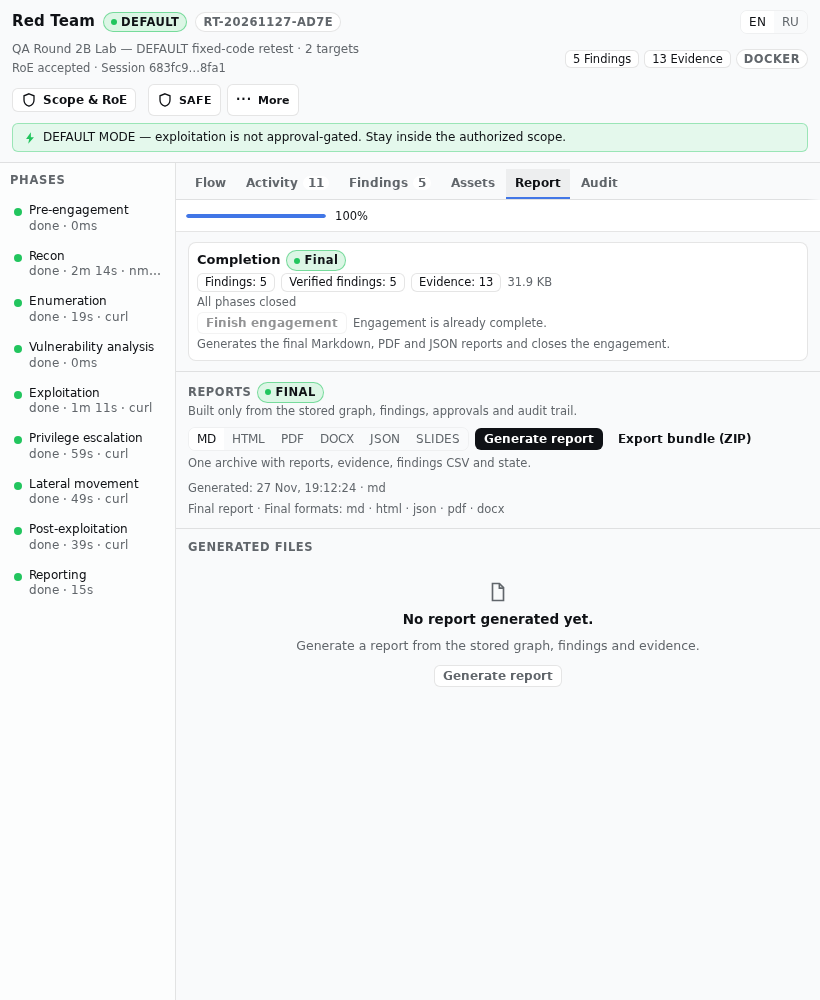
- Finish the phases, then run
pentest_complete_engagementwith the formats you need. - Run
pentest_export_bundle(or Export bundle (ZIP) in the Report tab) for one archive with the reports, evidence, findings CSV/JSON and state; use the vault-only package only when that is all the client wants. - Send the archive, plus the engagement id. The report names the engagement and includes the audit appendix; the bundle README repeats the authorization disclaimer and the manifest lists every file with its hash.
- Tell the client how to verify:
unzip bundle-<session>-<stamp>.zip -d bundle
cd bundle
sha256sum -c sha256sums.txt          # every file matches
sha256sum bundle-*.zip # compare with the hash returned at export time- A record's hash in
manifest.jsonis the same value the report cites, so a modified file, a missing file or a swapped file is detectable without the plugin.
| Limit | Default |
|---|---|
| Record size | 32 MiB |
| Records per session | 5000 |
| Package size | 256 MiB |
| List page size | 200 (tool allows up to 300) |
| Report download / audit tail | 64 MiB / 400 entries |
| Bundle entries / evidence files | 4000 entries / 1000 evidence records per export |
Evidence and reports are client data: store them encrypted, delete them when the engagement ends, and remember that screenshots and HTTP exchanges can contain personal data and production secrets.
- Configuration — evidence caps and report font path
- OSINT — the standalone OSINT report
- Exploitation loop — retest and verifier discipline
- Web and API testing — automatic HTTP evidence
- docs/REPORT-DESIGN.md
- Field manual: evidence and verification
- Field manual: building the report
- Field manual: the export bundle