Repository navigation
Wordlists
Wordlists are one registry with three sources: compact lists bundled in the plugin, operator uploads, and AI-generated lists. Every entry resolves to the path the active runtime can use, so the agent never hard-codes a container path that does not exist on the host.
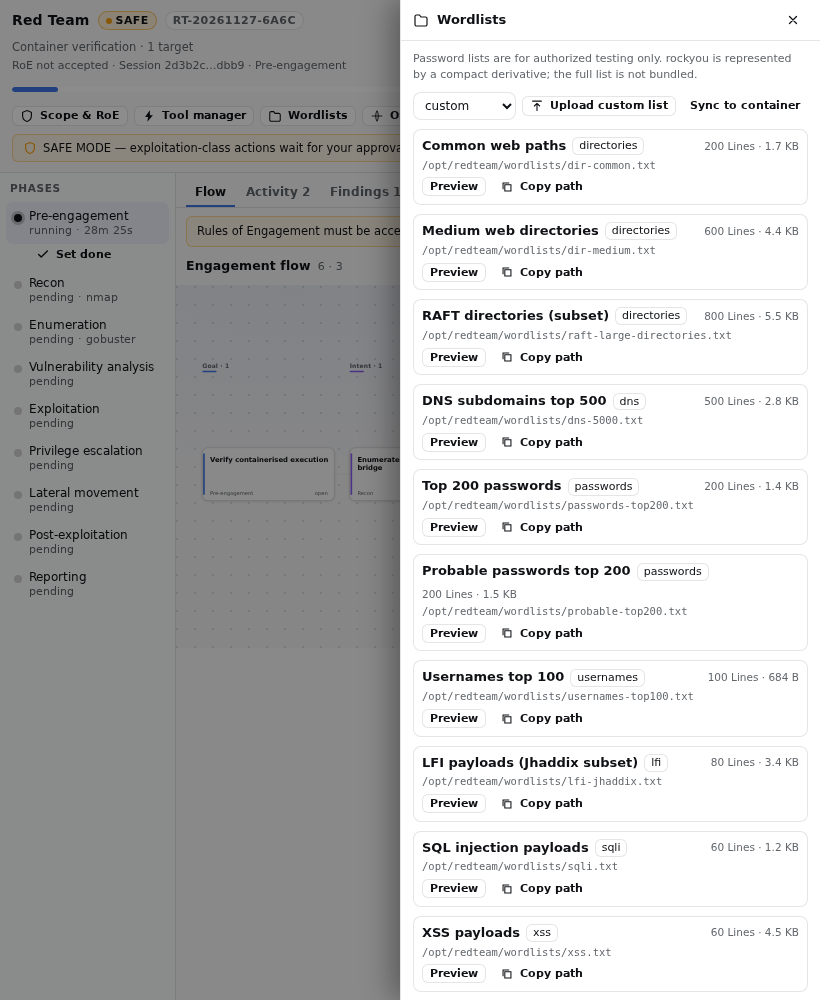
wordlists/manifest.json is the machine-readable catalog: 12 lists, nine categories, about 30 KB.
They are compact derivatives of SecLists (MIT), not the multi-million-line originals.
| Id | Category | Lines | Source |
|---|---|---|---|
dir-common |
directories | 200 | SecLists common.txt plus curated high-value paths |
dir-medium |
directories | 600 |
dir-common plus top RAFT directory entries |
raft-large-directories |
directories | 800 | First 800 of raft-large-directories.txt
|
dns-5000 |
dns | 500 | Top 500 of subdomains-top1million-5000.txt
|
passwords-top200 |
passwords | 200 | Top 200 of 10k-most-common.txt
|
probable-top200 |
passwords | 200 | Top 200 of probable-v2_top-207.txt
|
usernames-top100 |
usernames | 100 | Username shortlist plus common service accounts |
lfi-jhaddix |
lfi | 80 | First 80 of LFI-Jhaddix.txt
|
sqli |
sqli | 60 | First 60 of Generic-SQLi.txt
|
xss |
xss | 60 | First 60 of XSS-Jhaddix.txt
|
api-endpoints |
api | 80 | First 80 of api-endpoints.txt
|
ad-users |
ad | 60 | Curated Active Directory account names |
Licensing and lawful-use notes are in wordlists/README.md and docs/ATTRIBUTION.md.
pentest_resolve_wordlist({ id, tool }) turns an id or category into a path:
- an exact id wins (
dir-medium); - otherwise the category alias resolves (
dir,dirs,directories;dns,subdomains;pass,password,passwords;users,usernames;lfi,traversal;sqli,sql;xss;api;ad,active-directory); - a tool hint picks a default for a broad category —
gobustergetsdir-common,ffufgetsraft-large-directories,feroxbuster/wfuzzdir-medium,hydraprobable-top200andusernames-top100,nmap/dnsx/amass/subfinderdns-5000,sqlmapsqli,dalfox/xsstrikexss,nucleidir-common/lfi-jhaddix,netexec/crackmapexecthe AD pair; otherwise the first list in that category is used.
The result carries id, name, hostPath, containerPath, lines, runtime and arg. arg
is the container path under containerWordlistDir in Docker mode and the host path otherwise.
Pass arg to gobuster/ffuf/hydra; never hard-code either form.
Identifiers are validated: at most 64 characters, no /, \ or ... Unknown ids raise a
wordlist not found error rather than guessing.
Upload from the Wordlists drawer (the bridge route is POST /dsh-redteam/wordlist/upload):
- body is the raw text, capped at 32 MiB; media type
text/plain,application/octet-streamor form-encoded; - the name must match
[A-Za-z0-9._-]+, at most 64 characters, with no..; - content must not be empty and must not contain NUL bytes;
- the category is a lowercase slug of at most 32 characters, default
custom; - the id is slugged from the name and suffixed
-2,-3, … rather than overwriting a bundled or existing custom list.
Uploaded files are written 0600 under $DSH_HOME/redteam/wordlists/<id>.txt with metadata in
_meta.json. Bundled lists cannot be removed; a custom or AI list can.
| Runtime | Path |
|---|---|
| Host | $DSH_HOME/redteam/wordlists/<id>.txt |
| Container |
/opt/redteam/wordlists/<id>.txt (configurable with containerWordlistDir) |
wordlists.sync() copies every list into a running container with mkdir -p and tee over
docker exec -i, one list per call. Re-syncing is safe and idempotent. In host mode there is
nothing to copy, and the call returns a note instead of an error.
pentest_enhance_wordlist (or the drawer) asks the Host's model route for candidates:
-
Route:
aiEnhancement.provider+aiEnhancement.modelwhen both are set, otherwise the Host's default model selection. Status distinguishesdisabled,no-llm,no-modelandready. -
Consent gate: category and instruction alone never need consent. Target, technologies,
observed paths or tool output are engagement context, and are sent only when
aiEnhancement.allowRemoteContextis true or the call passesconsent:true; otherwise the result isconsent-required. -
Prompt: strict JSON (
{"entries":[...]}), no markdown, and instructions inside the supplied context are treated as data. Credential-looking values are redacted before anything leaves the host. -
Parsing and validation: the first balanced JSON object or array is extracted; each candidate
is normalized for its category — directory entries are relative (no leading slash, no
.., no spaces, at most 200 characters), DNS entries are lowercase host names (at most 253, valid labels), usernames and AD accounts reject whitespace and URL punctuation, passwords are printable ASCII (at most 128), API/SQLi/XSS/LFI entries are single bounded lines. Control characters and entries over 512 characters are dropped. - Deduplication: candidates are compared case-insensitively with the base list and with every existing AI-generated list before being kept.
-
Count: 20–1000, default 200, additionally capped by
aiEnhancement.maxCandidates(default 300). -
Saving: the result is a new list with
source:"ai"and an id such asai-directories-<timestamp>-<rand>, stored like an upload and synced to the container. Metadata (provider, model, base list, instruction, observed paths, generated time, hit/miss counters) lives inai-meta.json.
pentest_wordlist_feedback records hits and misses for an AI list. The record accumulates
counts plus bounded hit/miss lists (500 entries each) and is exposed in the AI history, so you can
choose the next base list or instruction from real results. Feedback never mutates the saved list
silently, and it is not injected into a later prompt automatically — the loop is
generate, use, record, then generate again with what you learned.
pentest_wordlist_adapt derives variants without needing a model, then optionally widens with one:
-
Seeds: explicit
hits,observedPaths, parsedtoolOutputfrom gobuster/ffuf/nmap, or the first lines of a base list when nothing else is given. -
Local mutation: extension variants (
.bak,.old,.zip,.tar.gz,.json,.js,.php,.txt), environment prefixes, and sibling names such asbackup,admin,config,.git,v1,v2. The mode is reported aslocal. -
Model widening: only when a route is available, count permits and context is allowed; the
result becomes
hybrid. Without those, the local result is still saved. - Deduplication: against the base list, all AI lists and within the batch; overlap is counted in the result.
Both tools save a new list; pass save:false (or inspect the response) when you only want the
candidate preview.
-
pentest_wordlistslists every list with line counts and the current runtime's path form. - Preview shows up to 500 lines and 256 KiB, enough to sanity-check a list without loading it.
- Password and payload lists are for authorized testing only; rate and scope limits belong to the engagement rules, not the list. The host directory is authoritative; the container copy is derived.
- Kali toolbox — how lists reach the container
- Configuration — AI limits and consent
- Agent tools — the five wordlist tools
- docs/USER-GUIDE.md
- Field manual: toolbox, wordlists and OSINT