This is the list of projects completed in the 2025 programme.
- FakeMyVoice
- Train Your Foes
- Traffiq
- Voice2English
- Reinforcents
- Neural Quest
- Encrypted Chat Application
- Text to Handwritting
- EEG Analyser and Simulator
- MuseGan
- Multimodal Graph DB with RAG
- CodeSage
- Sera
- Kernel Design
- Cryptanalysis
- AI Ops
Mentors:
Domains:
Train Your Foes is a game where your greatest enemy is a machine that learns from you. Built in Unity 6, the game is split into two parts. First, you face The Gauntlet: four intense platforming levels that test your speed and precision. If you survive, you enter The Duel: a final boss fight that isn't scripted. Instead of following a set pattern, the boss uses Artificial Intelligence (Q-Learning) to study your health, energy, and moves. It chooses the best strategy to defeat you based on thousands of past battles, creating a unique challenge that feels alive and unpredictable.


1. Documentation: Full Documentation Site
2. Source Code: GitHub Repository
3. Engine: Unity Engine (6000.2.1f1)
4. Algorithm: Custom Q-Learning Implementation using the Bellman Equation:
Mentors:
• Abhay Varnekar
• Ishaan Shaikh
Domains: Game Development, Artificial Intelligence, Reinforcement Learning
Mentors:
Domains:
Mentors:
Domains:
Mentors:
Domains:
Mentors:
Domains:
Mentors:
Domains:
This project generates realistic handwritten text from typed input using a Conditional Generative Adversarial Network (CGAN).
Unlike traditional handwriting synthesis systems that require large datasets or fixed vocabularies, this model learns writer-specific style from a small set of handwriting samples (approximately 15 images per writer).
A Content Encoder preserves textual correctness, while a Style Encoder captures unique handwriting characteristics. The Generator combines both representations to produce natural-looking handwritten word images.
The system produces handwritten word images that reflect:
- The provided input text
- Writer-specific stylistic features
- Natural handwriting variations


- GANwriting: Content-Conditioned Generation of Styled Handwritten Word Images
- IAM Handwriting Word Database
- Deep Learning Specialization — DeepLearning.AI
- Kaggle Datasets
Mentors:
Domains: Computer Vision, Generative Adversarial Networks (GANs), Natural Language Processing
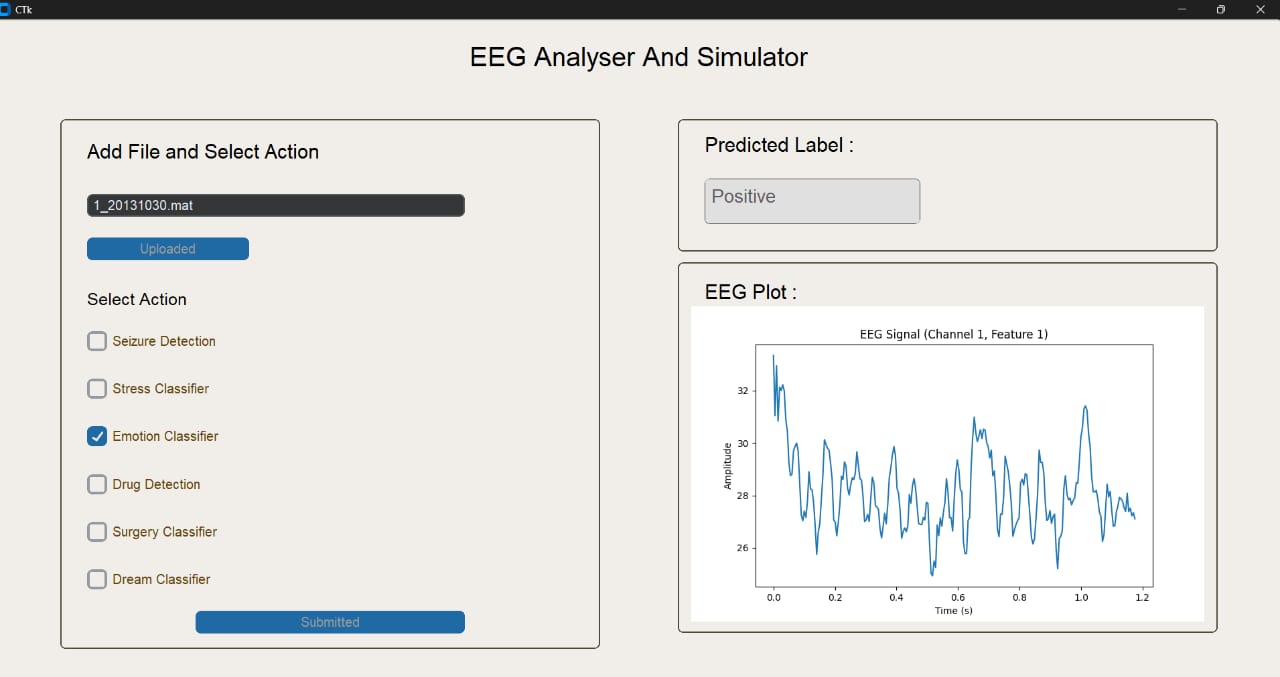
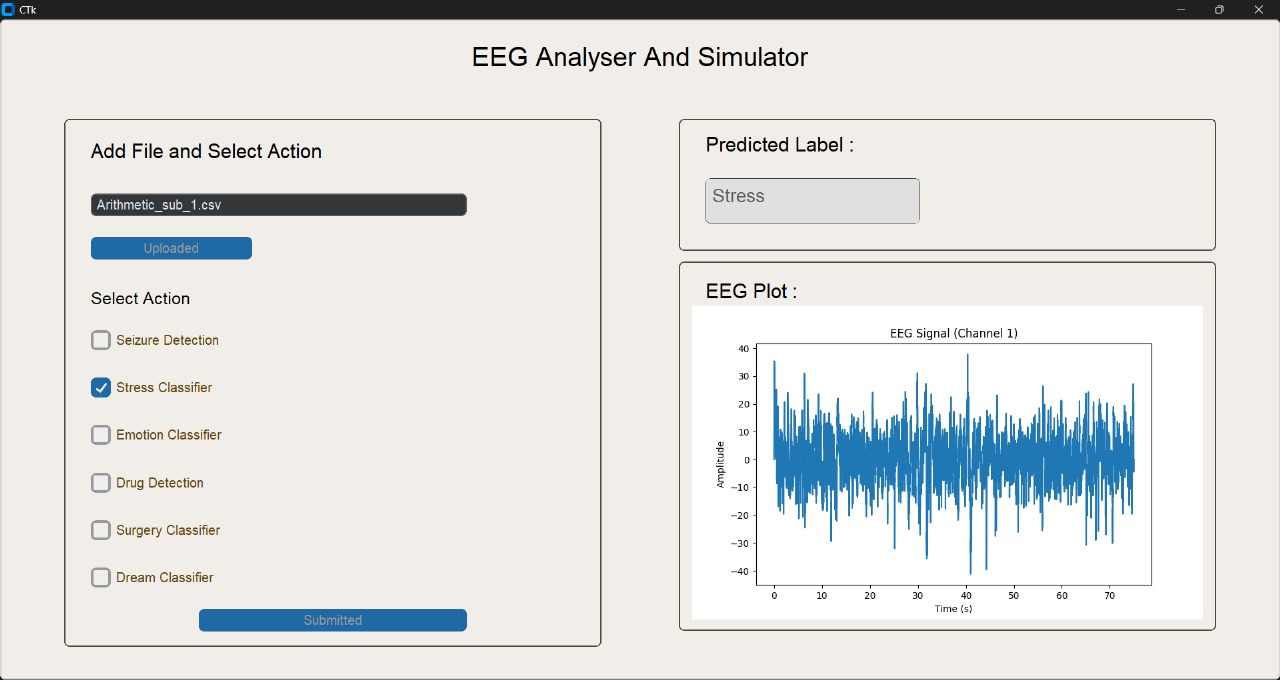
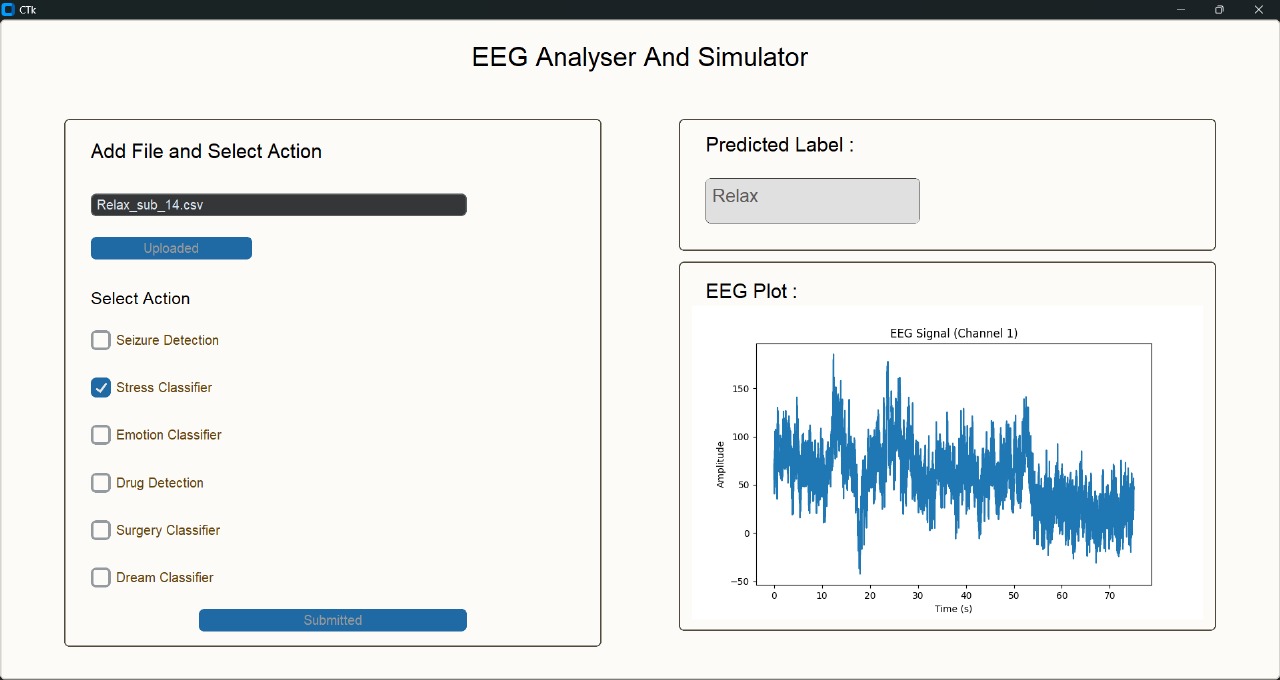
EEG Analyser and Simulator is a AI-driven simulation and prediction of brain dynamics using EEG data. This project aims to develop an AI-powered system that constructs a personalized Digital Twin of the Brain using EEG (Electroencephalogram) data. The system leverages deep learning and signal processing to analyze, predict, and simulate neurological patterns — enabling early detection of epilepsy, cognitive stress, depression, and other brain-related conditions. The system also aims to classify emotions in awake and dream phase. Other implications include the prediction of failure and success of surgery and drug identification and simulation of its effects on EEG data. In addition, the project explores neural generative modeling to interpret REM-phase brain activity into abstract visual representations, pushing the boundaries of dream analysis and subconscious understanding.
The system predicts the desired label for EEG signal and also plots it.
- Transformer paper
- Datasets:- SEED, TUH HUP, HUP iEEG, SAM40, DEED
- LSTM
- EEG SIGNAL PROCESSING
Mentors:
Domains: Signal processing, Machine Learning, Deep Learning
MuseGan is a GAN-based project for generating multi-track polyphonic music. It can generate coherent 4-bar music for 5 instruments from scratch and also supports Human-AI collaboration by conditionally generating tracks based on one human input track.


- Documentation: MuseGAN
- MuseGAN README: MuseGAN.md
- MuseGAN Repository: MuseGAN Repository
Mentors:
Domains: Music Generation, Generative Adversarial Networks (GANs), Temporal Sequence Modeling
Mentors:
Domains:
CodeSage is a Python-based framework that executes code and explains its logic in simple, human-readable language.
It combines compiler concepts with AI-based summarization to help users understand how code works internally.
- Lexer → Converts source code into tokens
- Parser → Builds an Abstract Syntax Tree (AST)
- Summarizer → Generates structured explanations
- Interpreter → Executes the AST (tree-walk)
- NLP (Optional) → Refines explanations
- GUI (Tkinter) → Editor, output, AST view, summaries
- Help students understand how interpreters work
- Explain code behavior clearly
- Visualize program structure
- Bridge programming with AI-based explanation
CodeSage runs code and explains it step-by-step.


Mentors: Yadnyesh Patil, Rupak Gupta
Domains: AST Parsing NLP
Mentors:
Domains:
Mentors:
Domains:
Mentors:
Domains:
Mentors:
Domains: