The hexagonal-phase(β) NaREF4 upconversion nanocrystals (RE = rare earth elements) are an important family of luminescent nanomaterials due to its unique optical properties. This piece of code simulates the energy migration over the Ytterbium sublattice network of NaYbF4 via Dexter's exchange mechanism. The β-NaYbF4 crystal adopts a hexagonal lattice configuration where Yb3+ ions sites forms connected hexagons if viewed along the Z-direction, i.e. from the top of the unit cells. In the following cartoon illustation of the unit cell, the solid green balls are Ytterbium ions (1a sites), half green/half orange balls are Sodium/Ytterbium ions with 50% occupancy each (1f sites) and half white/half orange balls are Sodium ions with 50% vacancies. When multiple unit cells were plotted together, we could easily visualize those connected hexagonal Yb3+ networks.
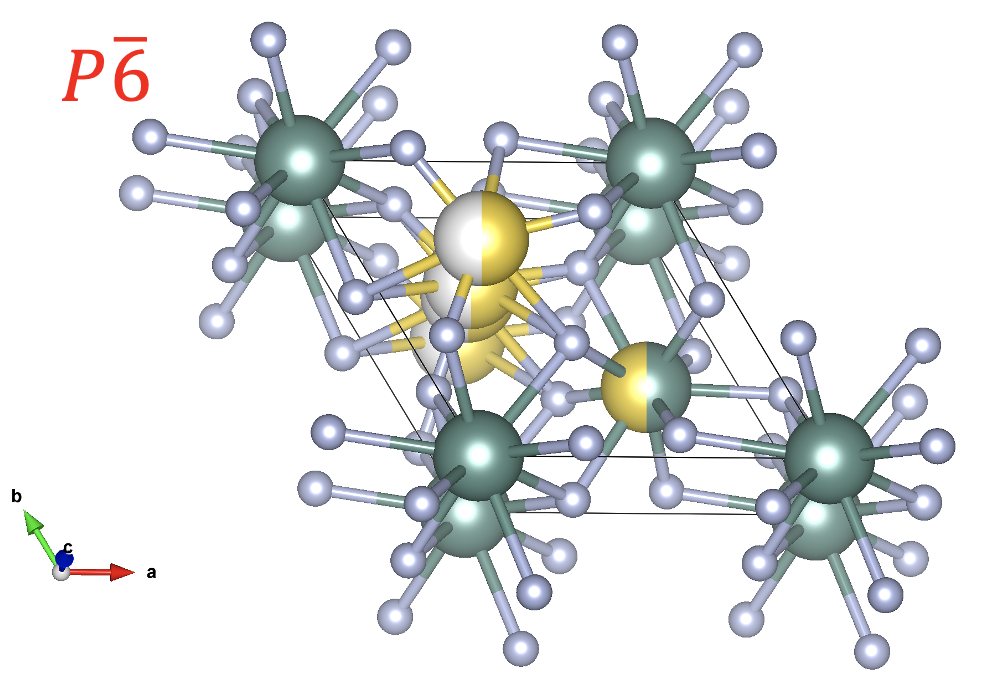
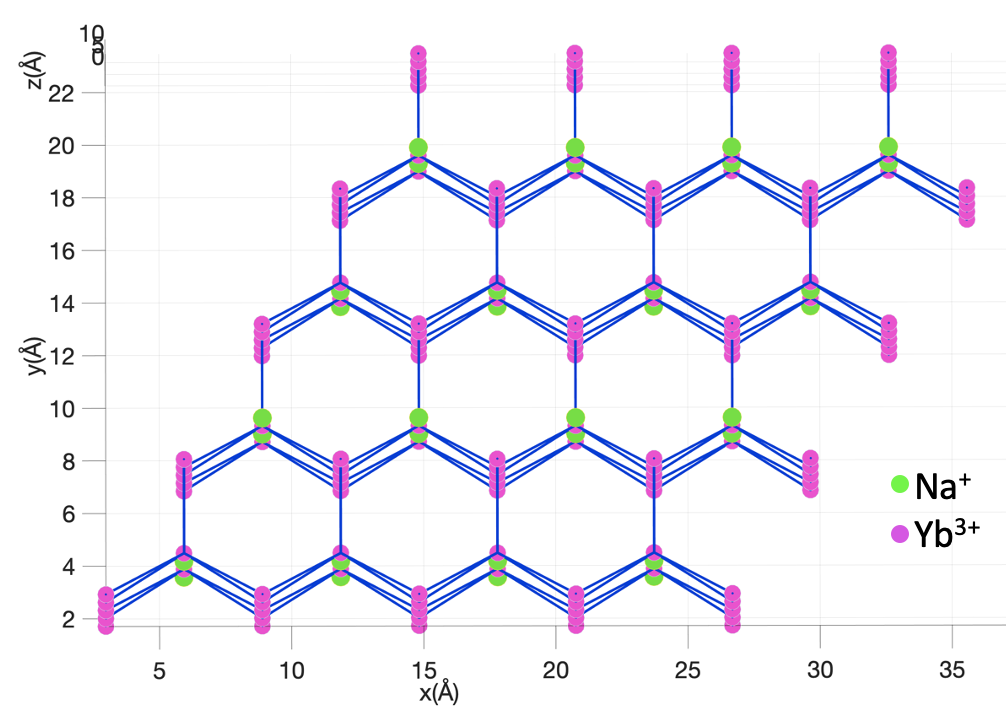
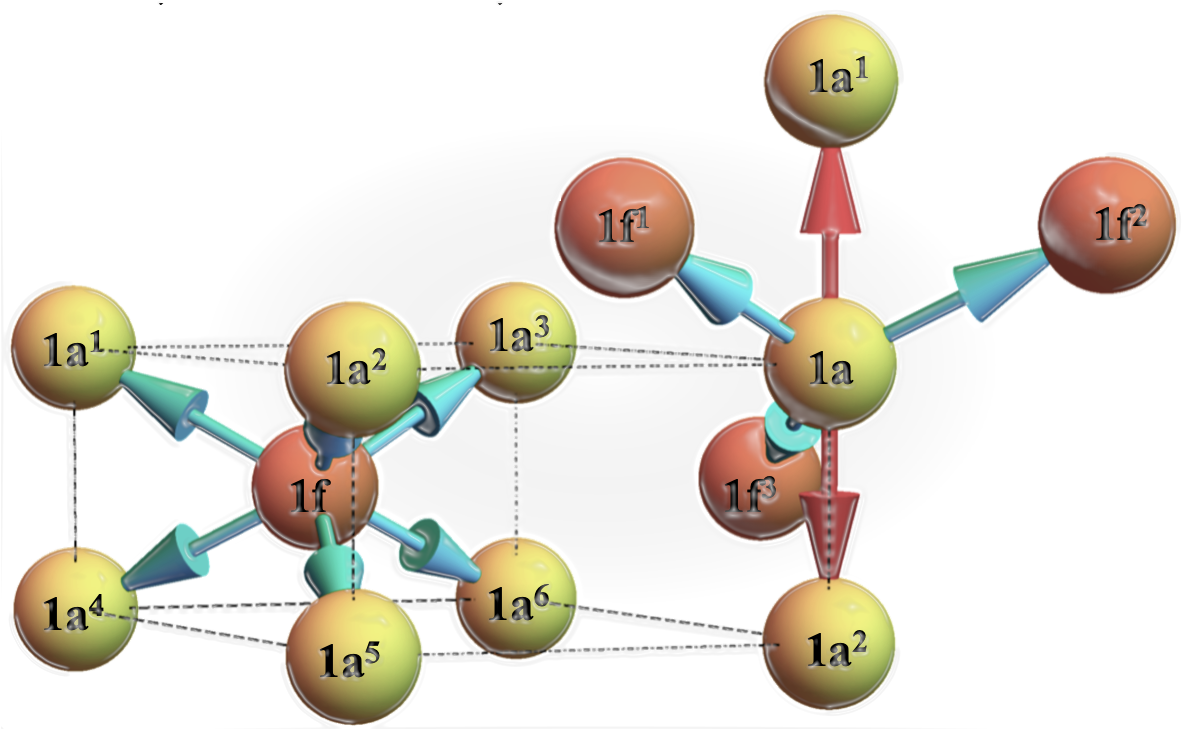
In the Yb3+ sublattice, each Yb3+ at the 1a site has 5 closest Yb3+ neighbors (2 on 1a sites and 3 on 1f sites) while each Yb3+ at the 1f site has 6 closest Yb3+ neighbors (all on 1a sites). The MC simulation starts with a quantum of photon energy absorbed by a Yb3+ ion and migrates to its cloest neighbors with distance dependent probabilities described in Dexter's original work. Specifically speaking, the energy migrate from 1f site to neighboring 1a sites with equal probability of 1/6; the energy migrate from 1a site to neighboring 1a site with 44.35% and 1f site with 3.76% probability.
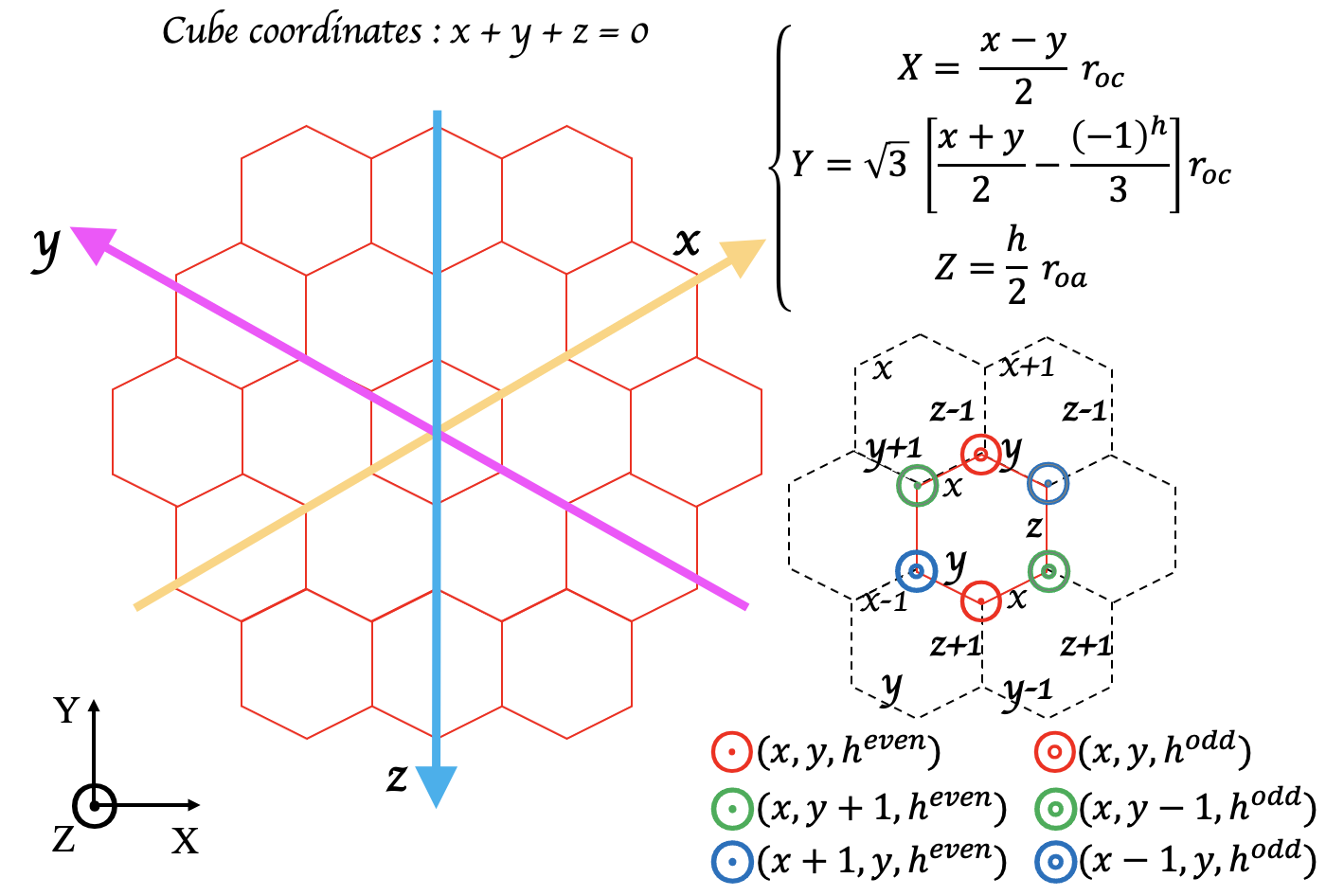
We borrowed the cube coordinates (x,y,z) with x+y+z=0 to label the hexagons seen from the top. Locally each hexagon is not on the same plane but instead with 3 vertices on even integer height and 3 others on odd integer height in units of half of the unit cell height. Lattice grid points with odd integer height were the 1f sites where the occupancy should be 50%. Therefore with (x, y, h) and the occupancy constraints, all the Yb3+ sites are well defined in space and are ready for MC simulation.
This piece of code simulates the energy migration trajectories for a quantum of photon energy absorbed by each individual sensitizer Yb3+ ions followed by its hopping over the Yb3+ sublattice according to the exchange mechanism until it is terminated at the boundary of core-shell interface. Core/shell diameters may be changed to different values and number of grid points need to be adjusted accordingly to cover the core-shell structure. Core:Shell volume ratio can be tuned this way and verifed by checking the number of RE3+ sites. To simulate inward energy migration from shell to core please set "inward=1" or otherwise set "inward=0" for outward migration. Simulation results were recorded as HDF5 files in the same directory.
This software is provided as is without any warranty whatsoever. Permission to use, copy, modify, and distribute modified or unmodified copies is granted, provided this copyright and disclaimer are included unchanged.