strands-robots v0.5.0

Release date: 2026-08-03 · Previous release: v0.4.1 (2026-07-01)
804 commits · ~146 merged pull requests across five weeks. This is the largest
release since the project began: a new NVIDIA Isaac Sim backend, agent-facing
analytic motion primitives, a remote-inference client/server split, terrain
locomotion curricula, and a deep hardening pass across every numeric input the
agent and mesh surfaces accept.
strands-robots is the robot-control library for Strands Agents:
policy inference, teleoperation, calibration, recording, and simulation (MuJoCo,
Newton, and now Isaac) behind one agent-callable tool surface.
Highlights
- NVIDIA Isaac Sim backend - full
IsaacSimulationwith procedural scene loading,
LeRobotDataset recording parity, a delta-EEF differential-IK controller for GR00T
actuation, EEF-state grounding for LIBERO, and pip-isaacsim6.0.x support. - Analytic motion primitives -
move_to/set_gripper/rotate_wrist, backed
by one shared mink IK bridge, give an agent the staging/transport/release vocabulary
to position a robot around a learned policy's competence region. stop_when=semantic early-return - a rollout terminates as soon as the world
reaches a predicate state, withstopped_reasontelemetry, turning a monolithic
rollout into a retryable primitive.- Remote policy inference - a client/server split so an edge robot can drive a
policy running on a remote GPU. - LeRobot 0.6 policy support - the
[lerobot]/[molmoact2]extras now track
lerobot>=0.6.0,<0.7.0, soMolmoAct2resolves straight from PyPI (no from-source
build) and the policy resolver covers every family lerobot 0.6.x ships. - Terrain locomotion curricula -
create_world(terrain=..., difficulty=...)for
stairs / slope / rough / pyramid heightfields, a full locomotion reward/predicate DSL,
and shippedgo2/g1/t1benchmarks. - rosbridge transport -
use_rosbridge+RosbridgeRobotdrive ROS1 robots and
any host with no ROS install (verified live against the NASA Curiosity Mars rover
Gazebo sim). - A repository-wide input-hardening pass - every numeric knob on the simulation,
hardware, mesh, teleop, and recording surfaces now refuses a value it cannot honor
instead of silently clamping, coercing, or reporting a false success.
The changelog assembly moved to per-PR news fragments (
changelog.d/) this
cycle, so overlapping PRs no longer conflict on the shared[Unreleased]anchor.
New backend: NVIDIA Isaac Sim
Isaac joins MuJoCo and Newton as a first-class simulation backend behind the same
tool surface.
IsaacSimulation- procedural scene building, robot/object/camera lifecycle,
and physics stepping.- LeRobotDataset recording parity (
IsaacRecordingMixin) - Isaac rollouts record
the same dataset format as MuJoCo and Newton. - GR00T action actuation - an Isaac-side delta-EEF differential-IK controller
converts GR00T's task-space{x, y, z, roll, pitch, yaw, gripper}deltas into joint
targets (no robosuite dependency). - EEF state grounding -
IsaacSimulation.get_body_stateplusLiberoAdapter
EEF-pose/gripper state sources so language-conditioned policies get the
state.x/y/z/...they require; this also unblocks the predicate DSL on Isaac. - LIBERO init-state arm qpos - robosuite joint names are mapped onto the USD
articulation so an episode starts from the LIBERO ready pose rather than the USD
default. - pip-
isaacsim6.0.x support - synchronous physics-view invalidation, camera
warm-up under a stopped timeline, matrix-parser tolerance, and documented install
collateral (thecoverage>=7.6+OMNI_KIT_ACCEPT_EULAcaveats). - URDF joint names - the importer's USD-mangled joint names are demangled back to
the URDF's own names, so the same URDF reports one joint vocabulary on Isaac and MuJoCo.
Agent capabilities
Analytic motion primitives (move_to / set_gripper / rotate_wrist)
The Harness VLA staging vocabulary, backed by one shared mink DLS IK bridge
(strands_robots/simulation/ik.py, deduplicated from the cosmos3 and vera copies):
move_to(robot_name, position, orientation=None, ...)- position-only when
orientation=None(the right contract for 5-DOF arms), DLS IK to the world-frame
target then a servo-drive loop; returns the IK residual on an unreachable target
rather than hanging or raising.set_gripper(state="open"|"close")- ctrlrange-endpoint set-point with registry-driven
open/close convention.rotate_wrist(target_yaw)- wrist-yaw set-point while every other actuator holds.
All three refuse to run while a policy drives the same robot, take the engine lock per
control tick so renders and stop_policy interleave, and are not collision-aware
(a future curobo backend can drop in). Registry gripper metadata (gripper block per
robot) resolves which actuators the primitives command, so an arm actuator whose name
collides with a gripper hint is no longer silently excluded from IK.
The figure under pixel-to-world grounding below is the end-to-end demo: an agent
names a pixel, get_world_point turns it into a world coordinate, and move_to
puts the jaw there.
get_world_point(camera, pixels) - pixel-to-world grounding
Instead of reading privileged object poses, an agent picks pixels on a target's visible
surface and this call unprojects each through the pixel-aligned metric depth buffer
(p_world = T_world_cam · depth · K⁻¹ · [u, v, 1]), with built-in multi-pixel median
and per-pixel validity. Works identically on hardware with an RGB-D camera, so grounding
built on it transfers.
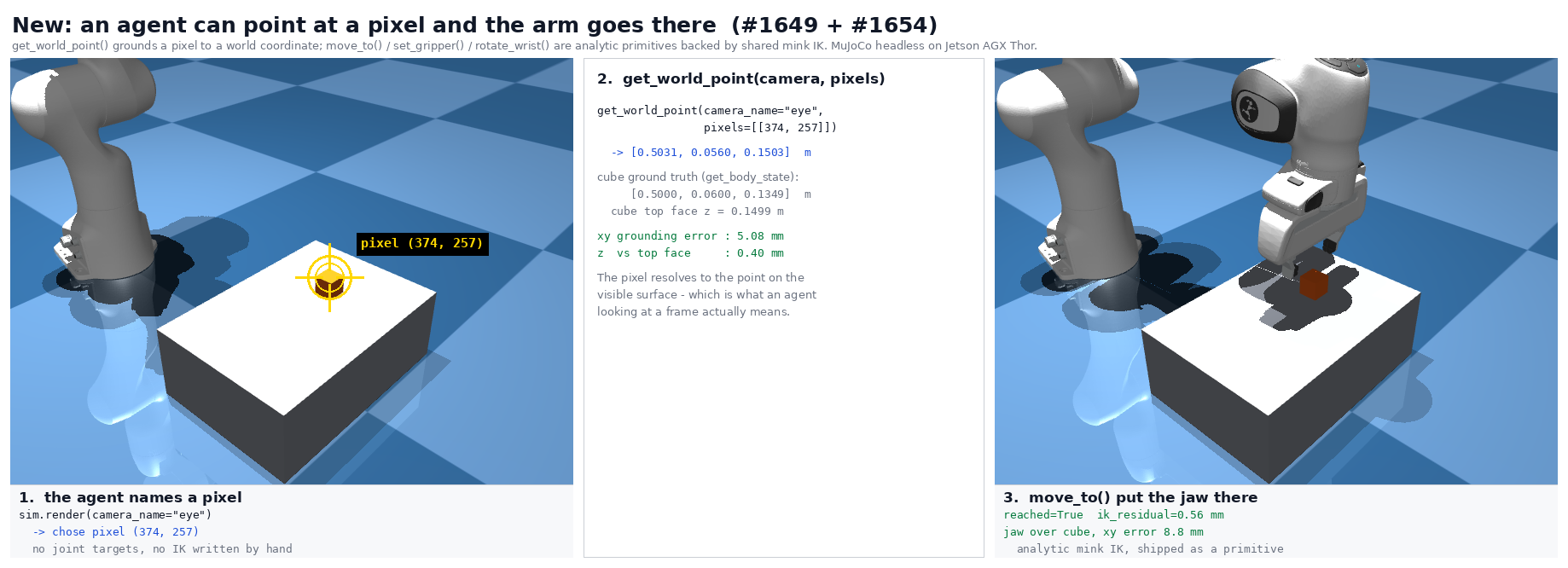
Figure 1 - point at a pixel, the arm goes there (#1649 + #1654).
Left: the frame the agent saw, with the single pixel it named - no hand-written joint
targets. Middle: get_world_point unprojects that pixel and the result is compared
against the cube's privileged pose; the pixel resolves to the point on the visible
surface, which is what "looking at a frame" actually means. Right: move_to
drives the jaw to that coordinate and reports its IK residual. Rendered headless
(MUJOCO_GL=egl) against the tagged source.
stop_when= semantic early-return
run_policy(stop_when={"predicate": "grasped", ...}) terminates the rollout as soon as
the world reaches the predicate state (checked every control step, on both the
synchronous and async-RTC paths), and reports stopped_reason ∈
predicate | budget | cancelled | error plus steps_used. This turns a rollout into a
retryable primitive an agent can stage → invoke → inspect → re-invoke, and composes with
recording (the recorded episode's frame count equals steps_used).
Remote policy inference
A client/server split (strands_robots/inference/) so an edge robot can drive a policy
that runs on a remote GPU. lerobot_async gained a rename_map for remote
observation-key remapping and now forwards it to the PolicyServer, and a numeric
handshake (set_control_frequency / set_rtc_observed_delay) is validated at the call
rather than mid-rollout.
LeRobot 0.6 policies
The [lerobot] and [molmoact2] extras now require lerobot>=0.6.0,<0.7.0 (was
>=0.5.0,<0.6.0), and the 0.5.1-era torch/torchcodec overrides are dropped - lerobot
0.6 ships mature, platform-correct dependency pins of its own.
MolmoAct2installs from PyPI.MolmoAct2Policyships in lerobot 0.6 (lerobot
PR #3604), sopip install 'strands-robots[molmoact2]'resolves it directly - the old
"install lerobot from source" step, thetransformers==5.3.0pin, and the
lerobot[smolvla]==0.5.1guidance are all gone.- The policy resolver covers the full lerobot 0.6.x family -
pi0,pi0.5,
pi0_fast,SmolVLA,MolmoAct2,ACT,Diffusion, and the newereo1/
vla_jepa- with a regression guard so a family a future lerobot release adds is
picked up automatically. Bothlerobot_async's server-supported set and the training
expert_onlyset are sourced live from lerobot rather than a hard-coded list that
drifts. expert_onlyfine-tuning (freeze the VLM, train only the action expert) is now
gated per policy: a run is allowed iff that policy's lerobot config actually declares a
train_expert_onlyfield, instead of against a fixed{pi0, pi05, pi0_fast, smolvla}
tuple (PI0FASTConfig, for one, exposes no such field).- RTC seam documented honestly -
run_policy(async_rtc=...)no longer claims
SmolVLA/MolmoAct2 blend the chunk seam internally; the publiclerobot/smolvla_base
shipsrtc_config=Noneand MolmoAct2 has none, so the library's own real-time-chunking
path is what joins the seam.
Locomotion & terrain curricula
- Terrain heightfields -
create_world(terrain="stairs"|"slope"|"rough"|"pyramid", difficulty=...)as a curriculum knob a locomotion trainer ramps across resets, plus
get_ground_height(x, y)to query the local surface, floating-base seating on the
terrain surface, and terrain-relative reward measurement. - Reward/predicate DSL -
base_velocity,base_height,base_orientation,
base_lin_vel_z/base_ang_vel_xy,base_velocity_trackingreward terms; and
base_beyond_x/y,base_yaw_beyond,base_below_z,base_tippedpredicates. - Shipped benchmarks -
go2_walk_forward,go2_strafe_left,go2_turn_left,
g1_walk_forward,t1_walk_forwardviaregister_builtin_benchmarks(). - Declarative benchmark spec accepts a natural-language
instructionfield.
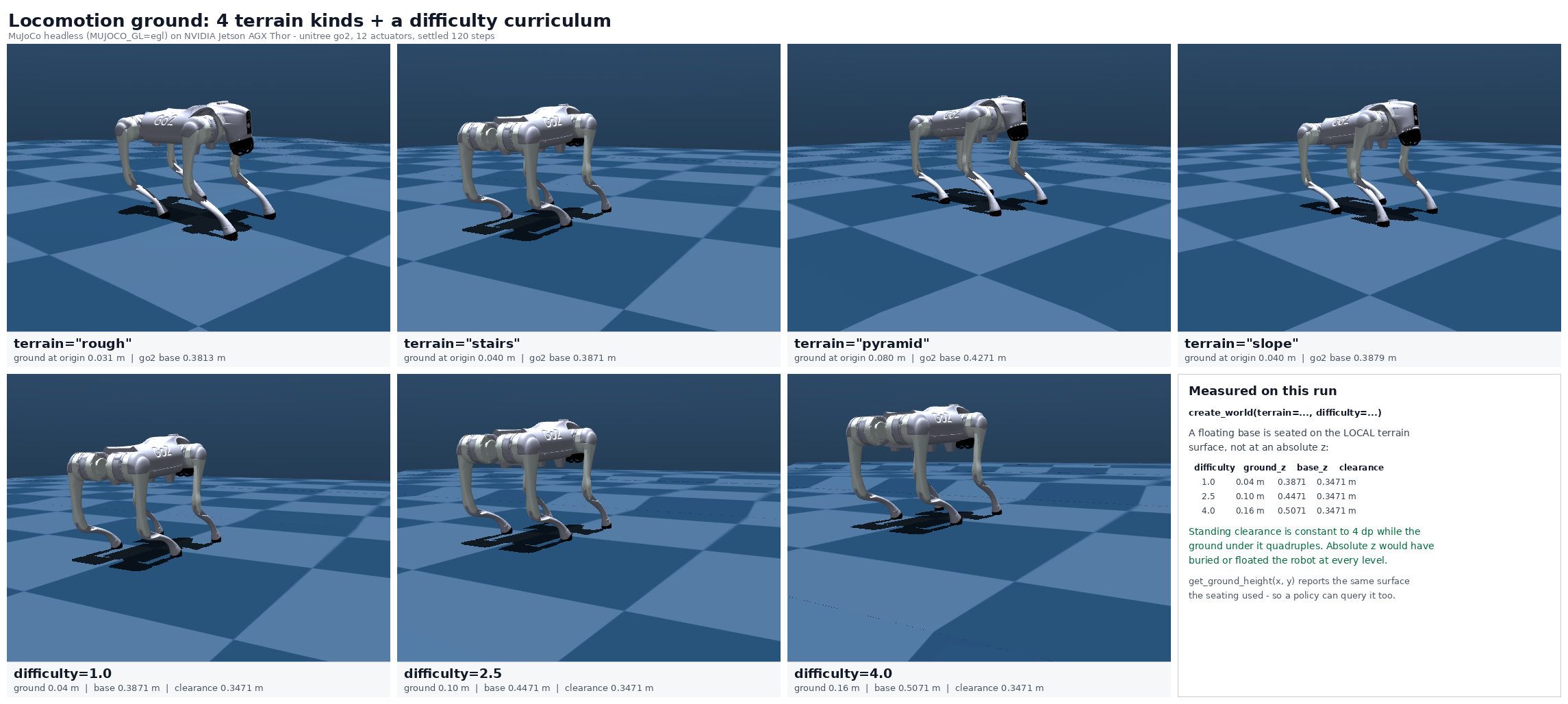
Figure 2 - locomotion ground: four terrain kinds and a difficulty curriculum.
unitree_go2 settled on each heightfield create_world(terrain=...) generates. The
quadruped's standing clearance is identical on every panel while the ground beneath
it changes - that is floating-base seating placing the robot on the local surface
rather than the nominal plane, which is what makes difficulty a curriculum knob a
trainer can ramp across resets instead of a reset that drops the robot into geometry.
rosbridge transport - ROS1 and ROS-less hosts
use_rosbridge (tool) + RosbridgeRobot (mesh) speak the rosbridge WebSocket JSON
protocol via pure-pip roslibpy (new [rosbridge] extra), reaching every ROS1 robot
and any machine without a ROS install - the two gaps use_ros (rclpy) and use_rtps
(DDS) leave open. RosbridgeRobot.from_curiosity() preconfigures the NASA Curiosity Mars
rover Gazebo sim; the full NL→agent→WebSocket→ROS1 pipeline was verified live driving the
rover across Mars terrain.
Recording, datasets & rendering
DatasetRecorder.create(overwrite=...)for honest re-recording into an existing
repo_id;sync_dataset_to_bucket(root, bucket)for lifecycle-independent bucket
sync;eval_policy(video=...)/evaluate_benchmark(video=...)record a
per-episode rollout MP4.verify-datasetflags truncated/partial-encode videos and now localises partial
parquet corruption - one broken shard is named, and every other check still runs,
instead of collapsing the whole report.- Rendering pipeline (
strands_robots/rendering/) - gaussian-splat and panorama
backgrounds, a hybrid depth compositor, and an MJPEG live-stream + clip encoder, each
refusing render options it cannot honor. - Recording-rate integrity - a dataset can no longer be recorded, resumed, or driven
at anfpsthat disagrees with the rollout'scontrol_frequency(the recorder writes
one un-decimated frame per control step, so a mismatch mislabels the episode timebase).
A lost dataset frame now fails the rollout rather than silently producing a re-timestamped
episode.
Reliability & safety hardening
This release's largest single theme: the agent and mesh surfaces now refuse a value
they cannot honor rather than clamping it, coercing it, or reporting a false success.
Many of these are subtle - a rollout that reported success while doing nothing, a
recording that reported success with no file on disk, an actuator command silently
rewritten to full travel. Each fix ships with a regression test that fails on the prior
code and a measured before/after artifact.
Safety-critical
-
Emergency stop / lockout - four independent defects each defeated e-stop or lockout
on some path (mesh resume-proof on the fallback publish path, cloud fan-out dropping the
second e-stop as a replay, Reachy Mini e-stop no-op under an RPC allowlist, and
broadcast()undercounting acks) are all fixed. -
E-stop honesty - an emergency stop now reports the peers that did not stop
(peers_not_stopped) instead of a clean acknowledgement from a robot that never stopped.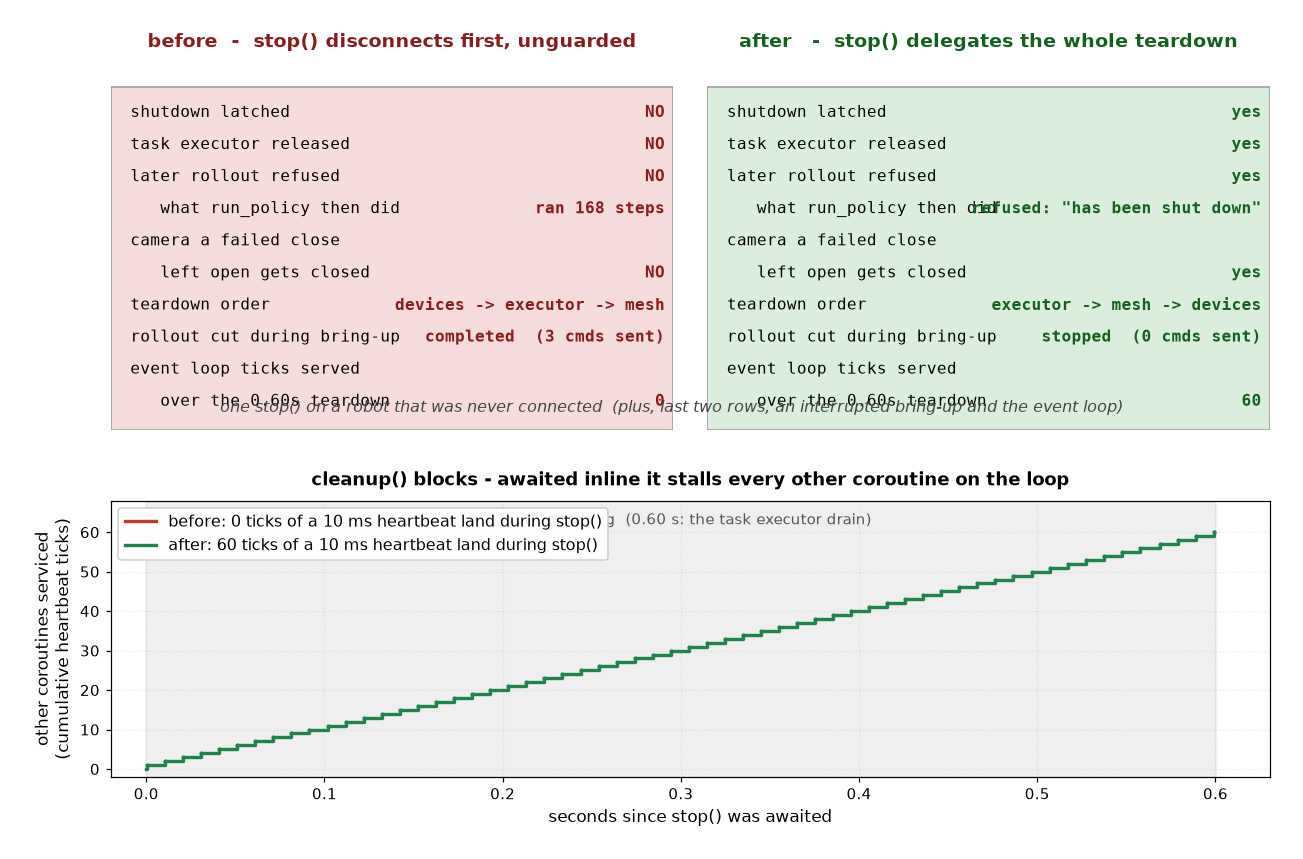
-
pose_toolemergency_stop actually de-energizes the arm (writesTorque_Enable=0
to every motor) instead of returning a fabricated success while nothing touches the bus. -
Teleop slew bound - a teleop stream inside every other cap can no longer reverse a
joint full-scale on every frame (~14× the servo's rated speed); a per-joint slew bound
refuses commands a joint cannot physically travel that fast, and the bound is frame-shape
independent.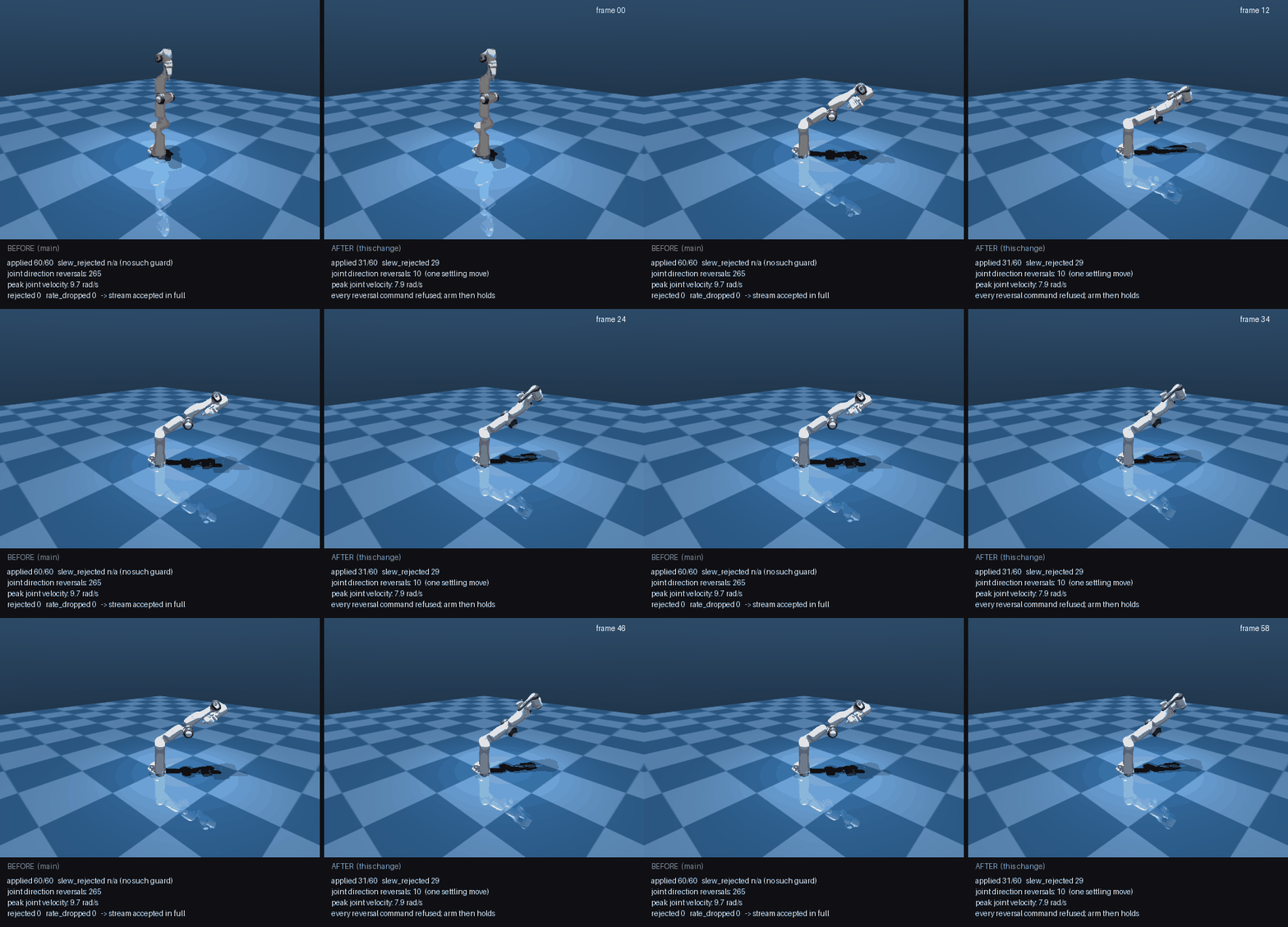
-
Teleop source scoping - a wildcard
source_peer_id(*/**) is refused, so a
receiver can no longer follow every peer on the mesh.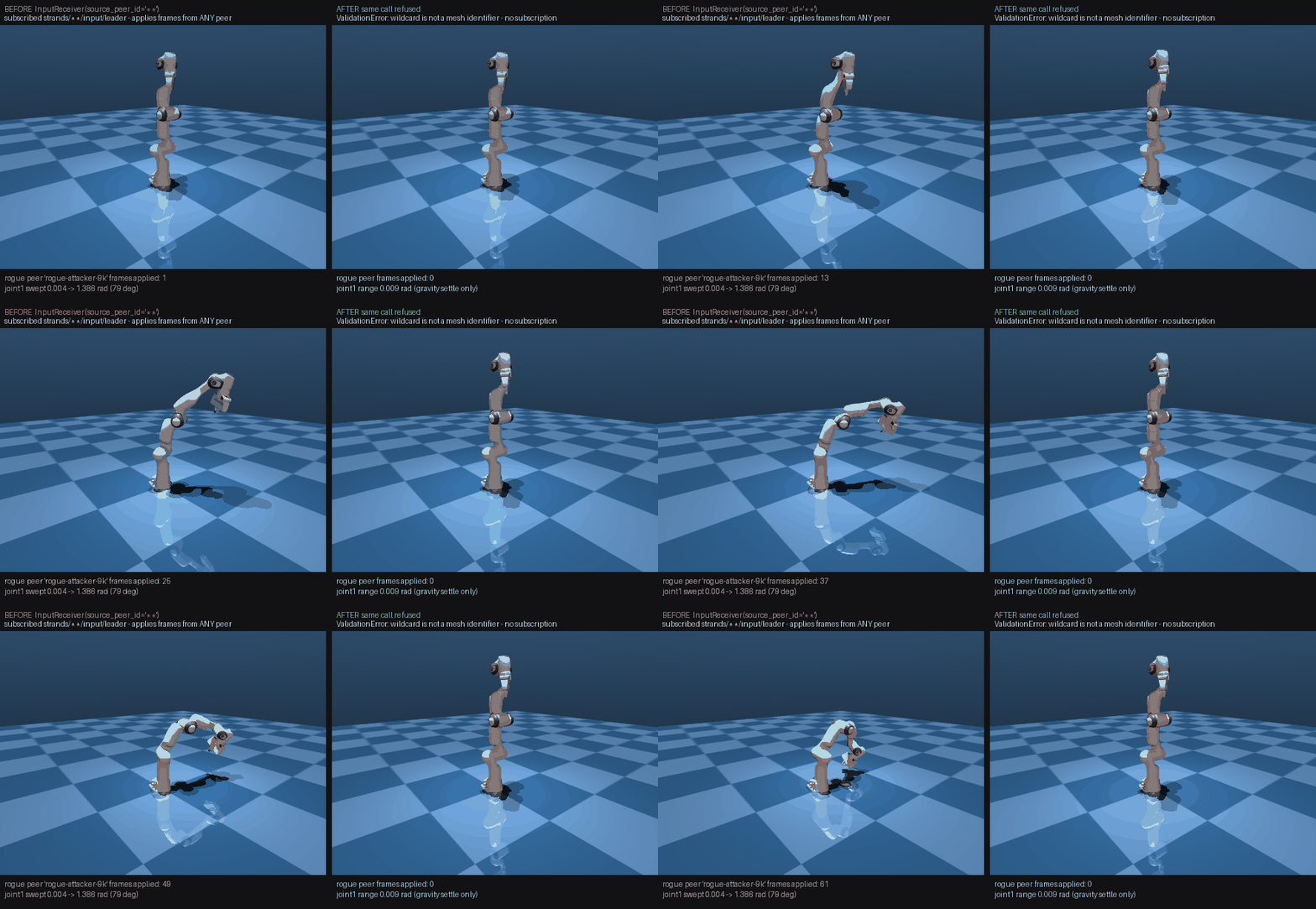
Hardware task lifecycle
-
A stop pressed during bring-up now actually stops the task instead of letting the
arm move once connection finishes.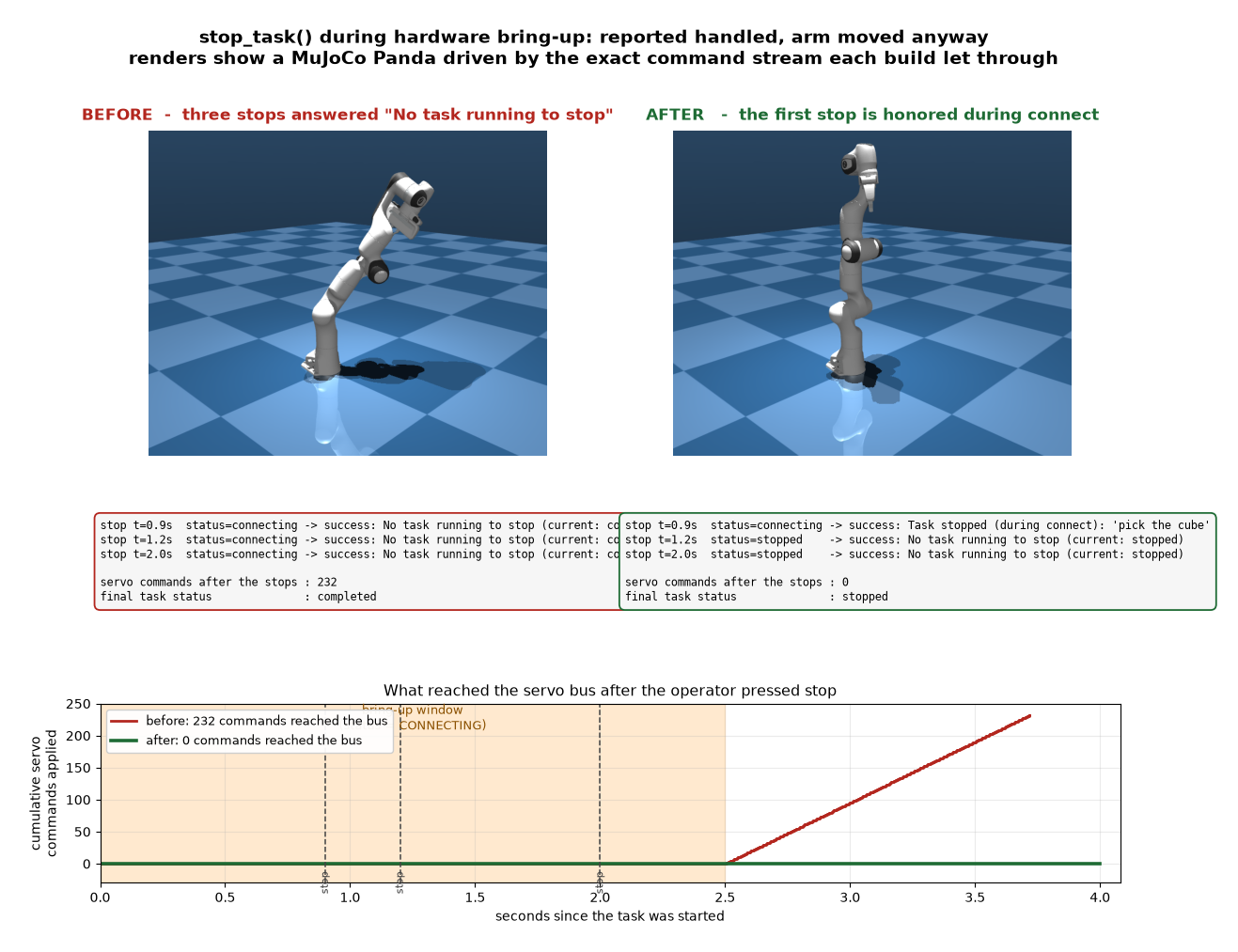
-
One rollout per bus - a second rollout is refused while another owns the motors bus,
instead of two control loops driving one arm.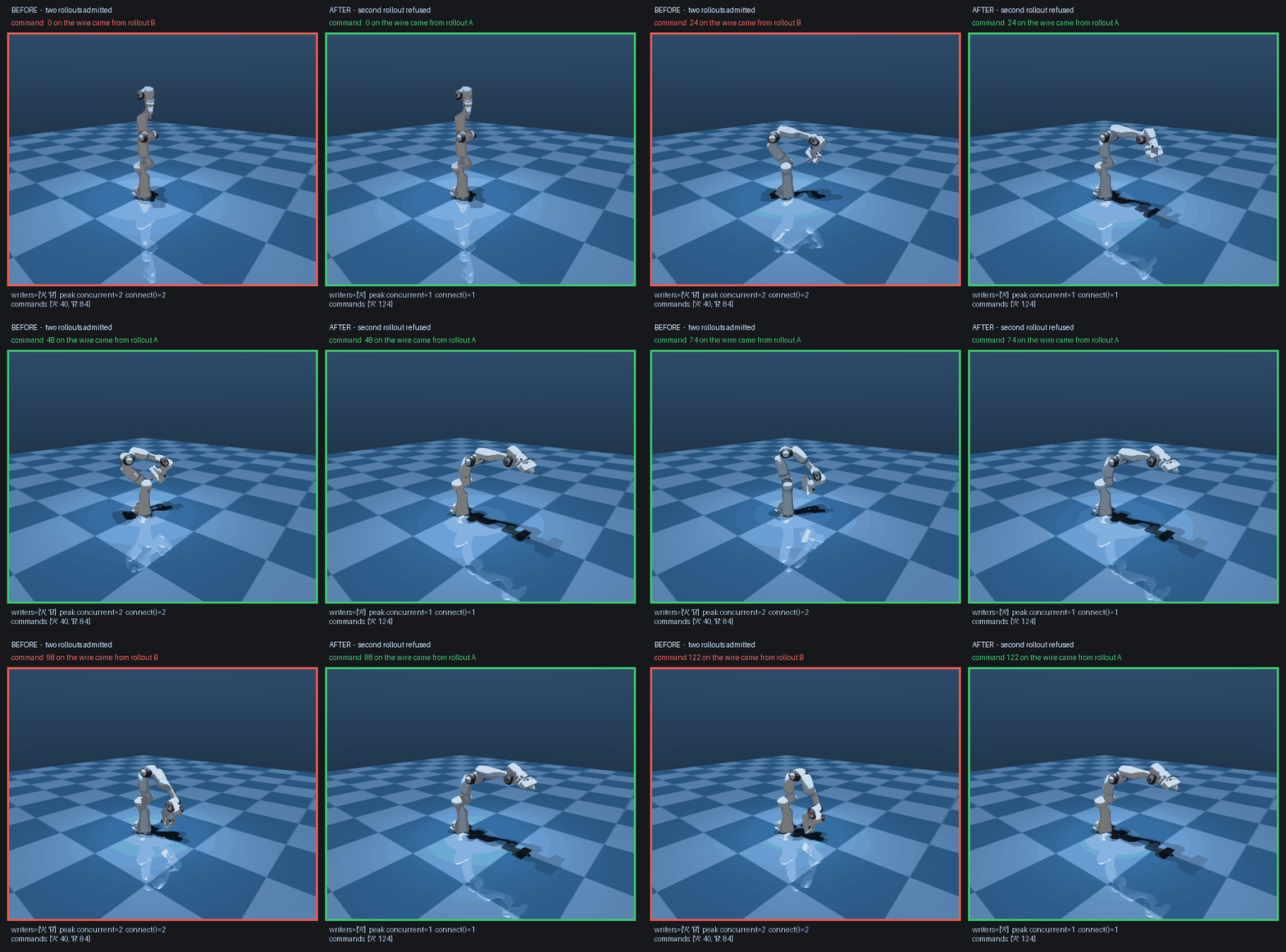
-
cleanup()/stop()are now genuinely terminal: they close the motors bus and every
camera, refuse later rollouts, and run teardown off the event loop; a failed connect
closes every half-open device; a per-taskPolicy.reset()clears stale per-episode state. -
Hardware
control_frequency, taskduration,action_horizon,max_relative_target,
and per-camera options are validated at the call, before the serial port opens.
Simulation input domains
Every numeric knob on the sim surface now honors or refuses - no silent clamp:
-
add_object-mass(an acceptedinfmass NaN'd the whole world),size,color,
and the object's inertia is now integrated from its shape rather than a hardcoded
constant.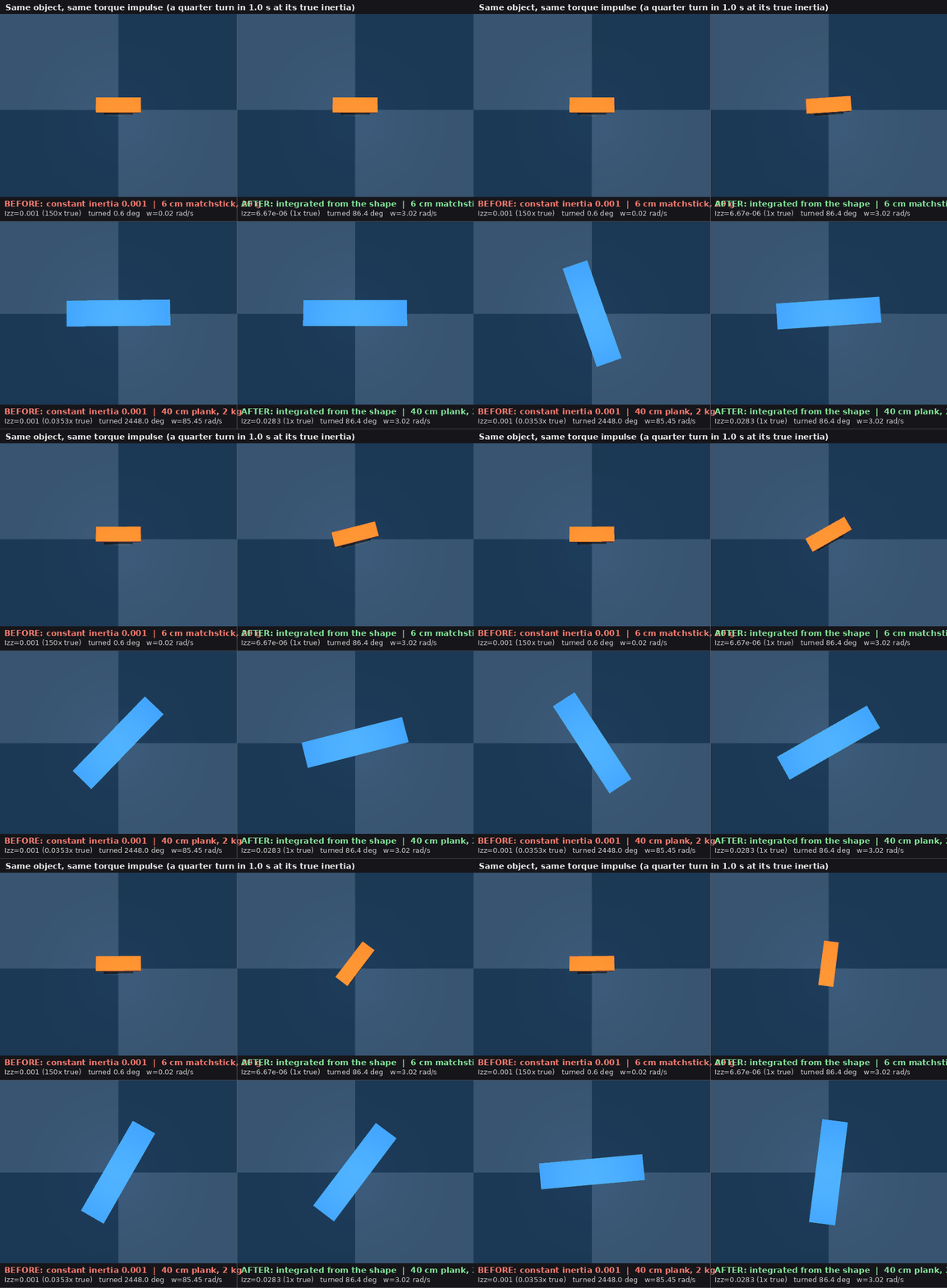
-
send_action- a boolean actuator command is refused rather than silently written as
full-travel1.0/0.0; an actuator-name key and its joint-name alias now write the
same value; a non-finite action value is refused instead of teleporting the whole scene.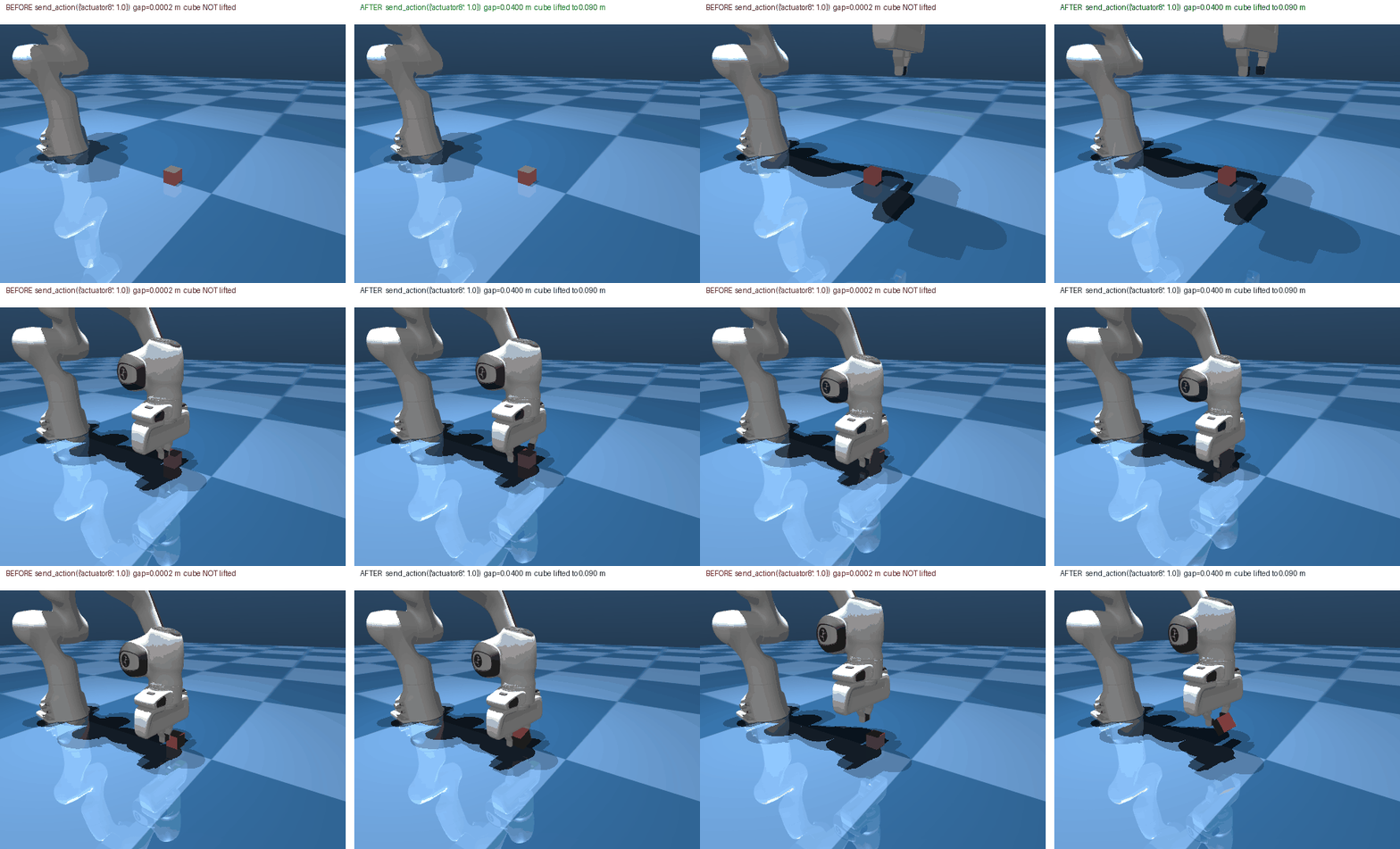
-
run_policy(n_steps=N)executes exactly N steps at every control frequency (a float
round-trip previously truncated 1 step at 49 Hz to 0), andduration/control_substeps
/policy_config/stop_whenare all validated up front. -
create_world(timestep/gravity),set_geom_properties,set_body_properties,
randomize/set_obs_noise,raycast,patch_scene_mjcf,get_camera_params,
get_world_point, and the whole vector-parameter family now read caller vectors by
membership (accepting NumPy arrays) rather than truthiness. -
Physics setters (mass / size / gravity / timestep) survive the next scene recompile
instead of being silently reverted; a resized geom re-derives its owning body's inertia;
a physics checkpoint is refused once its model is swapped; a latched external wrench
belongs to the body it was applied to.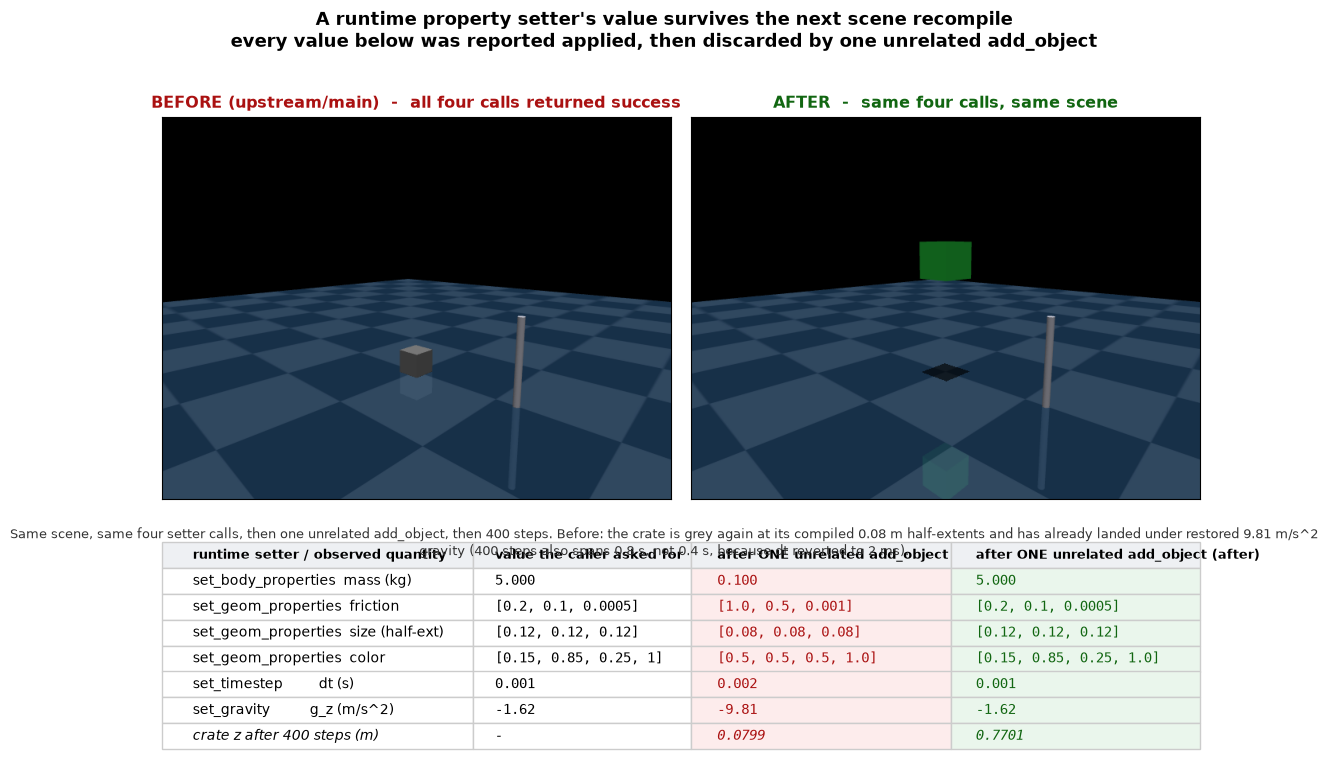
-
A robot is simulated under the solver settings its own model declares. MuJoCo's
<option>is model-global and does not survivespec.attach(), so every solver
setting a robot MJCF declared for itself was discarded when the robot was composed
into a generated scene - 42 of the shipped registry robots declare one.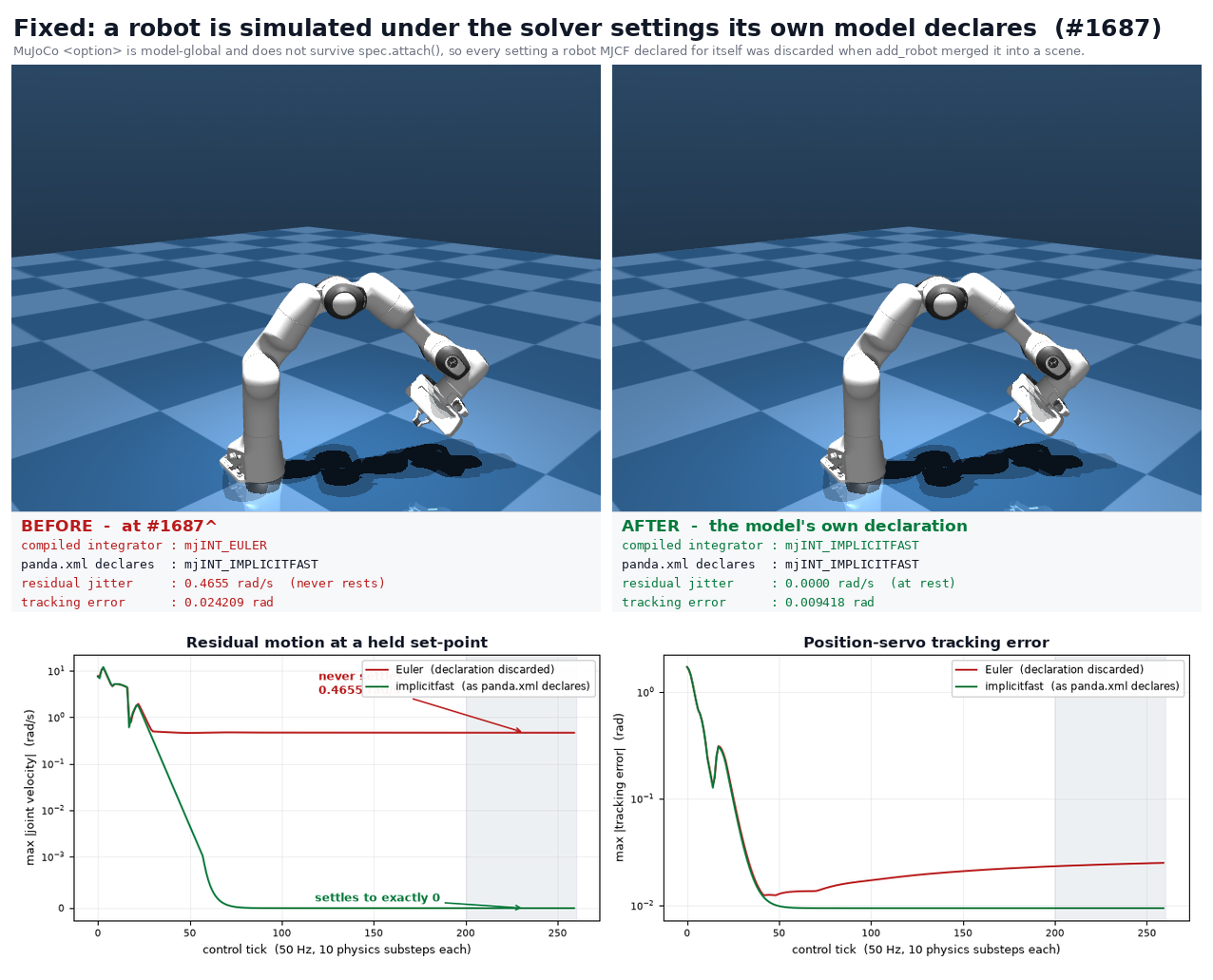
Figure 3 - the declared integrator, honored (#1687). Under the integrator the
scene silently fell back to, a stiff position servo never settles; under the one
panda.xmldeclares, the same hold settles to zero residual joint velocity with a
smaller tracking error. Same scene, same command - the only difference is whether the
model's own declaration survived composition.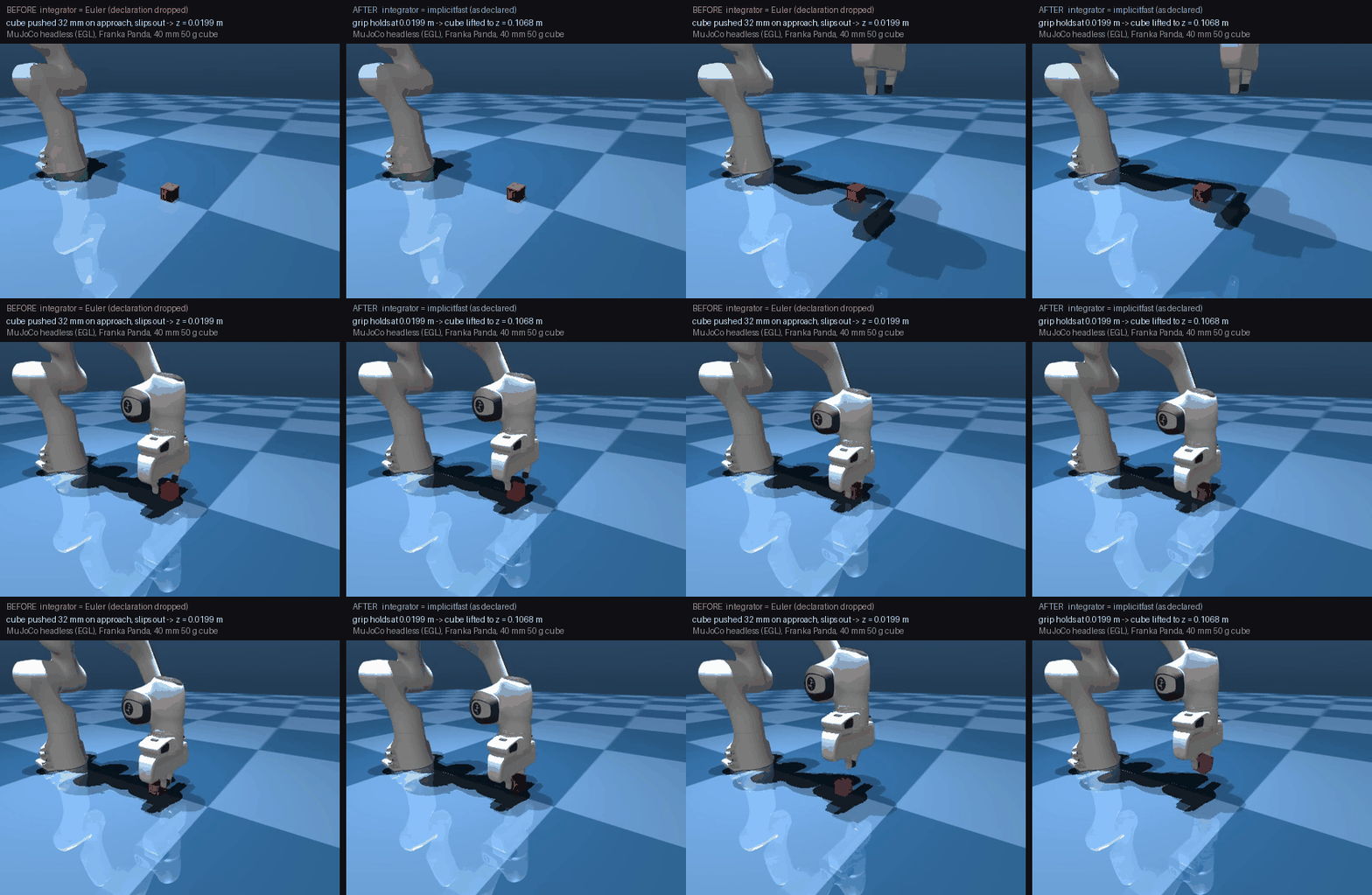
The same fix in motion: with the declaration discarded the scripted pick pushes the
cube on approach and squeezes through it on the lift; with it honored, the grasp holds. -
Adding a robot no longer rewinds the scene it joins.
add_robotreset the whole
world to give the newcomer a clean start, so one ordinary incremental edit discarded
every pose, contact and servo set-point already established.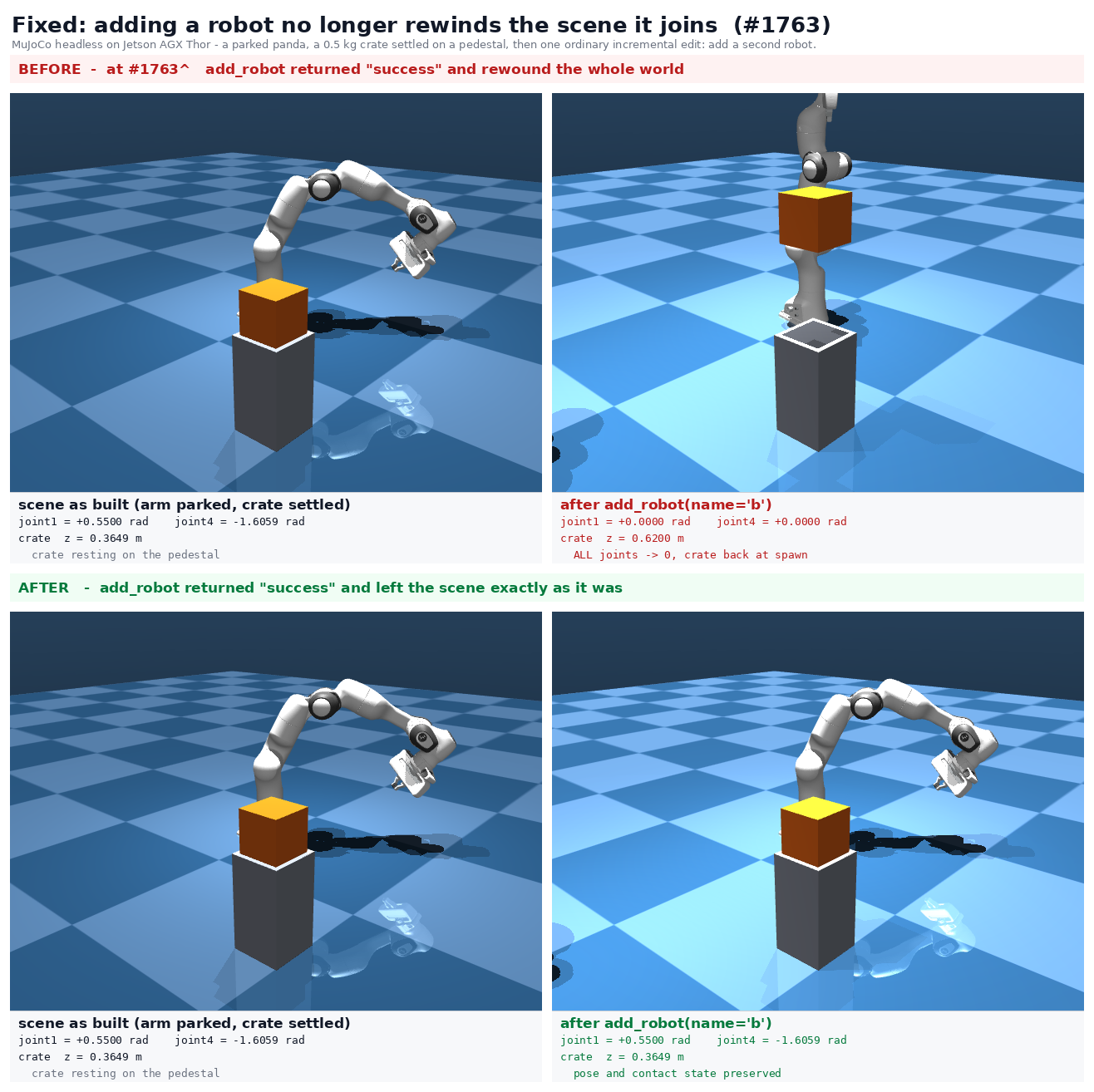
Figure 4 - an incremental edit is no longer destructive (#1763). A parked arm and
a crate settled on a pedestal, then a second robot is added. Before: every joint
returns to zero and the crate teleports back to its spawn height - reported as a
successful add. After: pose and contact state are preserved. -
move_toon the advertised[all]/[sim-mujoco]install now runs - the extra declares
the QP solver its IK needs.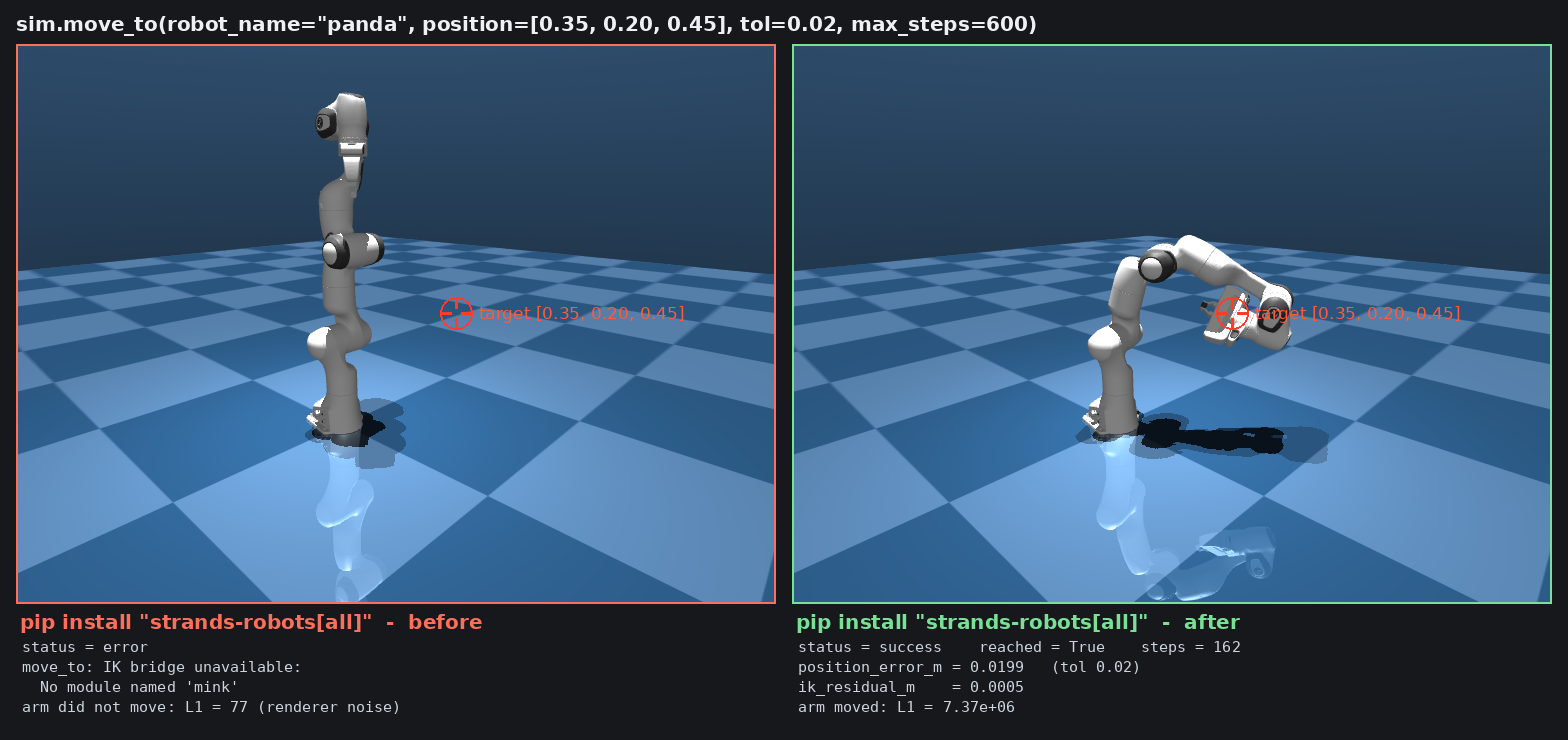
Policy & training correctness
- The local LeRobot policy state and action sides agree on what a hardware observation is
(a mixed-dtype observation no longer silently mis-scaled a command). - In-process LeRobot training -
resume, LoRAuse_peft, andbase_modelwarm-start
correctness;val_episodesnow produces an actual validation loss. - A short action vector no longer fabricates zero commands for the unmatched actuators
(which would drive them to zero at servo speed); a chunk count the consumer cannot execute
is refused; SO-101 real-hardware camerafourcc+ sim-embodiment policies now work. PersistentPolicyasyncget_actionsno longer deadlocks under two-thread contention.
Registry & robot factory
- A
register_robotalias collision now fails closed rather than bricking every subsequent
lookup; alias-less names resolve;vera://host:portURLs parse; a leader arm is refused
byRobot()(it is a teleoperator, not a follower) instead of being driven as a position
servo; every documented install hint names an extra that exists.
Migration notes
- Python 3.12+ remains required (
lerobot>=0.6.0; the 0.5.1-era torch/torchcodec
overrides are dropped). [sim-mujoco]and[all]now declare the mink +qpsolvers[daqp]IK stack, so
move_toruns on the advertised install. Isaac Sim is still installed separately (pip
isaacsim6.0.x or the Omniverse launcher) - see the caveats indocs/simulation/isaac.md.- Recording
fpsmust matchcontrol_frequency. A rollout will now refuse to record,
resume, or run against a dataset whosefpsdisagrees with the rollout's control rate.
Align the two (record at the rollout rate, or drive at the dataset rate); the error
message names both remedies. - Numeric-input strictness. Calls that previously succeeded with an out-of-domain
value (fps=0,mass=inf,duration=-1, a boolean gripper command, a wildcard teleop
source, …) now return a structured error. This is intentional - the prior behaviour was a
silent false success - but a caller relying on the old leniency will see the refusal. register_robotalias collisions now raise. A registration whose alias collides with
an existing canonical name or another robot's alias is refused at write time rather than
saved and then failing every later read.- New extras:
[rosbridge](pure-piproslibpy),[ollama](local-LLM agent path).
Contributors
Thanks to everyone who contributed to this release:
- @cagataycali - maintainer; the input-hardening pass,
motion primitives IK, recording integrity, and most of the release. - @yinsong1986 - NVIDIA Isaac Sim backend, GR00T delta-EEF
actuation, LIBERO EEF grounding,get_world_point,stop_when=, analytic motion
primitives, and per-robot gripper metadata. - @Vivek0712 - rosbridge transport (
use_rosbridge+
RosbridgeRobot, NASA Curiosity verified live) and ROS 2 action support inuse_ros. - @mertkrgl - hardware
run_policy(policy_object=...)
sim parity, the[ollama]extra, and teleop status/example fixes. - @sundargthb - streaming-data-loop notebook and
storage-bucket example fixes. - @max-rattray-aws - HIL gate for
lerobot_trainpretrained_path. - @CurrentlyAWey - HIL gate for the
lerobot_train
extra_flagspassthrough.
Full changelog
168 behavioural changelog sections across this release (43 additions, 114 fixes, 8 docs,
2 changed, 1 quality). See CHANGELOG.md (assembled from the changelog.d/ fragments) and
the full commit comparison.