Please contact @tedtay for permission to reference or use any of ideas or the work/ code in this repository
Lack of sleep costs the UK economy £40 billion per year . However, this is unsurprising considering that over third of UK adults struggle to get to sleep at least once a week and of this group 46% say that their poor sleep ‘severely’ or ‘very severely’ impacts their focus levels at work.
This dissertation details the planning and development of a prototype device that is able to combat the UK’s, along with other countries’, issues resulting from a lack of sleep amongst their populations.
The device created encourages napping through providing more control and certainty to users over their nap duration and therefore helps to mitigate the impact of a lack of sleep.
This project has successfully developed a proof-of-concept system that uses electroencephalogram (EEG) brain data to determine when a subject has fallen asleep and allow an alarm to be set from that moment.
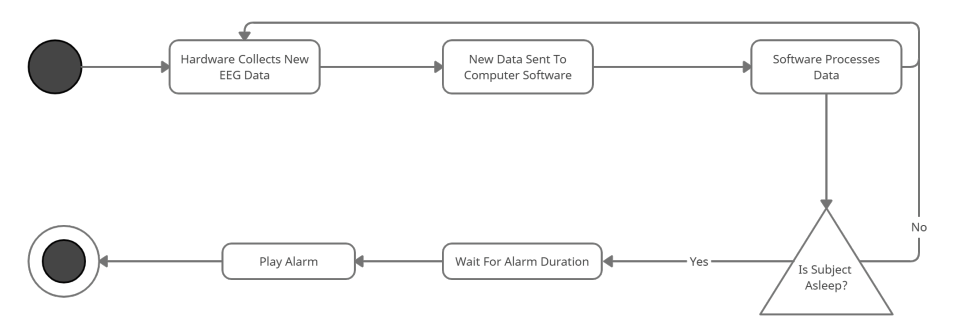
This system was implemented in two stages: hardware development and software development. The hardware functions as a sensor and relay, meaning it collects the brain wave data and then sends it to the software. The software acts as the brains of the operation – processing the raw data to determine when the user has fallen asleep.
Initial hardware setup and Arduino configuration was followed from the @kitschpatrol BrainGrapher repo. I thank @kitschpatrol for allowing me to use his method in this project.
Initial Setup Follows: https://github.com/kitschpatrol/BrainGrapher
• Main.java
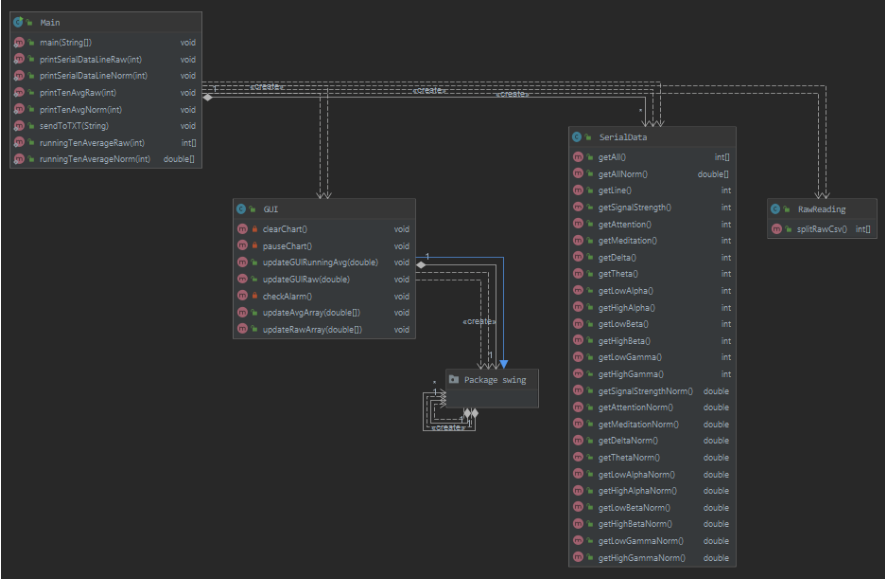
The main method starts off by listening for available serial ports and creates a Scanner object out of the first open communication port it finds. This scanner object is then used to listen for new data in the data stream.
The main method also starts the GUI class as well as creates the other class objects which facilitates the data processing. In addition, the Main class provides helpful test functions such as printing live data to terminal, saving test data to a text file as well and catching exceptions if any are thrown.
• RawReading.java
The RawReading object is one of the first class objects to be created (besides the GUI), this objects only purpose is to take in the String object from the scanner, which originated from the Eleegoo Uno, and split this CSV-style string into 11 individual values which can be called upon later. Therefore, this class only has one method ‘splitRawCsv’ and takes a single String in its constructor called ‘rawCsv’.
• SerialData.java
The SerialData class is where most of the data formatting take place. This class takes multiple integer parameters which have been created from the splitting of the String in the RawReading method. These values can then be processed, this is done using many methods which return the normalised values of the integers passed (the raw readings from the MindFlex). These values can be remotely accessed individually or as a group in an Array object.
• GUI.java
The GUI class takes care of the user interface and charts. To achieve this it holds arrays of rolling averages of the data collected so far which are then updated and plotted onto the line chart. This class also takes care of listening for user inputs such as the pressing of buttons. It also takes care of deciding when the alarm should be set using its ‘checkAlarm’ method. This method checks that the past 100-sample average reading for the meditation value is above 0.75 and the 100-sample average for the alpha value is above 0.05 and if so, the wait to sound the alarm begins.
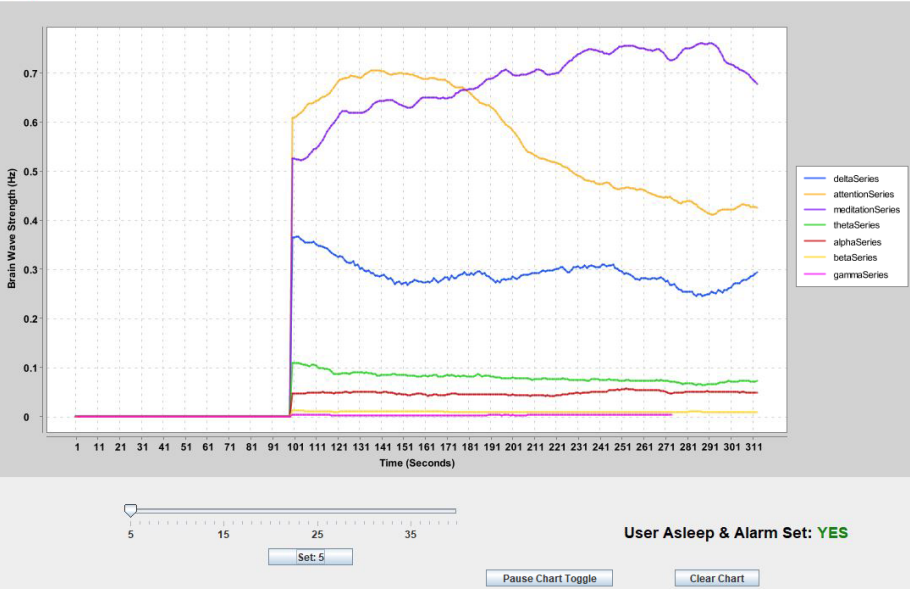
The test subject was able to fall asleep quite quickly and around at the 150 second mark the attention value fell sharply while the meditation value continued to rise. This is the first indication the subject is beginning to drift off to sleep. Then around the 230 second mark the alpha readings began to rise ever so slightly, this indicates the subject’s mind state is no longer thinking about anything in particular which is typical of the early sleep stages. At around the 240 second mark both the meditation value was greater than 0.75 and the alpha value was above 0.05 meaning the alarm was set at that moment. This is a good demonstration of the system working perfectly the system working perfectly