



A diagram you talk back to — edit your agent's plan, send structured feedback.
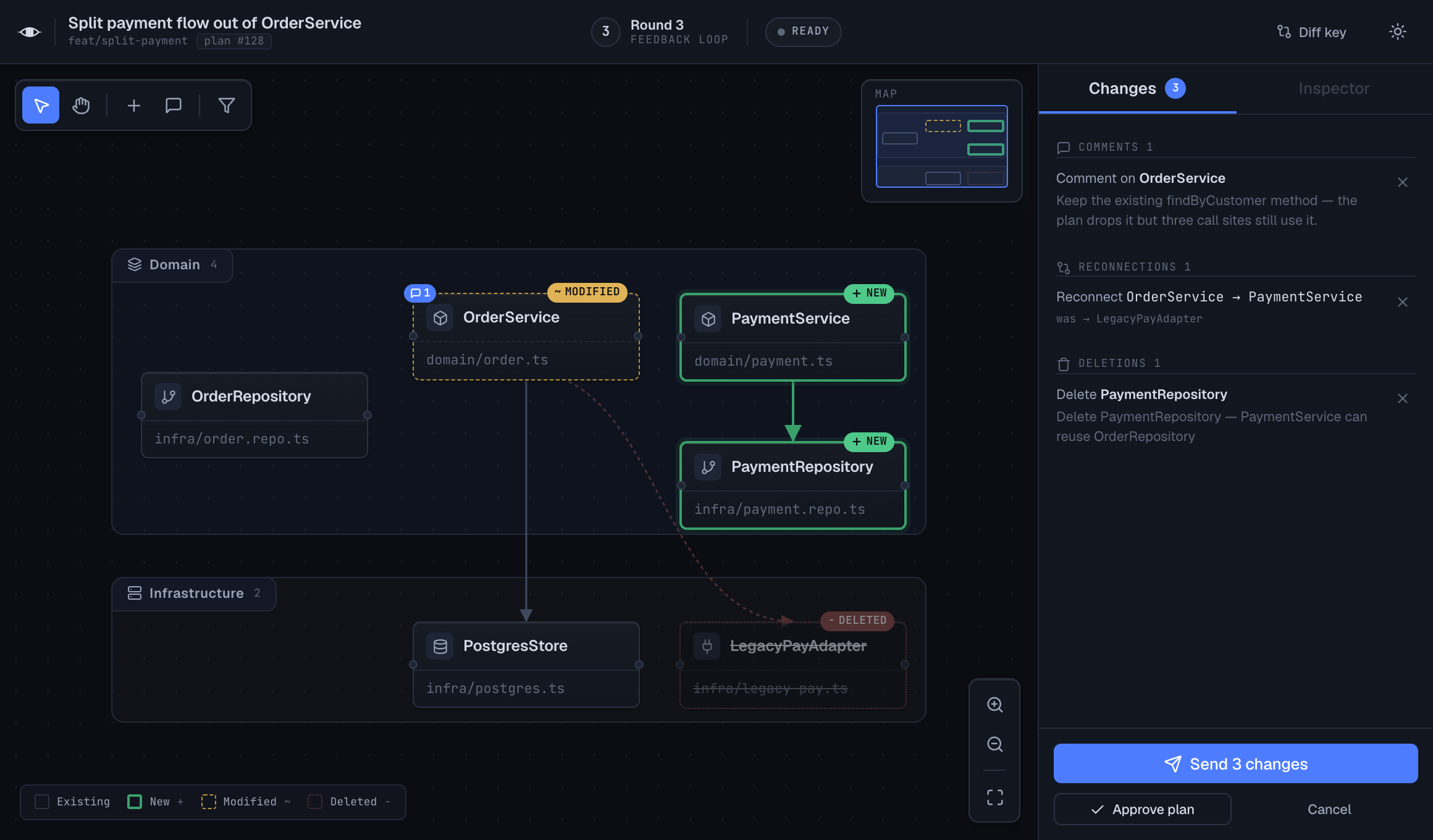
Every other tool in this space is one-way: code or plan in, picture out. ArchEyes closes the loop. Your coding agent renders an architecture as an interactive graph; you drag nodes, reconnect edges, draw new ones, and comment on nodes (with @mentions); you hit Send; the edits flow back to the agent as revision instructions with exact node IDs — no prose, no ambiguity. It revises and re-renders. Repeat until you're happy.
It's not just for plans. Ask your agent to graph anything with a shape:
- A plan it just proposed — review the architecture before any code is written.
- Your existing codebase — "visualize the architecture" and actually see how it hangs together.
- A feature or subsystem — map one slice of the system on its own.
- A refactor — current vs. planned in a single before/after diff (solid = today, dashed = coming, struck-through = going).
You install one thing: the skill. Your agent does the rest — it fetches and runs the ArchEyes tool for you automatically (via npx). You never install a CLI, run a command, or start a server.
Claude Code:
/plugin marketplace add thisAAY/archeyes
/plugin install archeyes@archeyes
Then just ask — "diagram this plan", "visualize the current architecture" — or invoke /archeyes:review.
Cursor:
- Download
SKILL.mdfrom this repo. - Save it in your project as
.cursor/rules/archeyes.mdcwith this on top:(paste the rest of--- description: Render an architecture as an editable ArchEyes diagram alwaysApply: false ---SKILL.mdbelow it) - Ask Cursor's agent to "diagram this with ArchEyes."
Any other agent (Codex, Cline, …): give it SKILL.md as a rule or system prompt. That's it.
The only prerequisite is Node on your machine (that's what
npxuses). The skill handles everything else — nonpm install, no setup.
Status reads by border style first (colorblind-safe), color second — with a + ~ − pill:
| status | border | color |
|---|---|---|
| existing | thin solid | gray |
| new | thick solid + glow ring | green |
| modified | dashed | amber |
| deleted | dotted + faded + strikethrough | red |
Node kind is an icon (service, repository, datastore, adapter, …); groups are container regions. Dark by default, light theme included.
Building on ArchEyes, or curious how it works? See DEVELOPMENT.md — the CLI, the protocol, the architecture, security, and how to run it locally.
MIT © thisAAY