How to consistently create arcs of ellipses for rotated normals #773

Description

I currently use OCC version (7, 4, 0, '-rc1') and tried to create arcs of an ellipse for three normals:
- (0,0,1) rotated by 30° around x-yaxis
- (0,0,1) rotated by 45° around x-yaxis
- (0,0,1) rotated by 46° around x-yaxis
from OCC.Core.gp import gp_Elips, gp_Ax2, gp_Pnt, gp_Dir
from OCC.Core.GC import GC_MakeArcOfEllipse
from OCC.Core.BRepBuilderAPI import BRepBuilderAPI_MakeEdge

from math import pi, sin, cos
import numpy as np

def rad(deg):
    return deg /180.0 * pi

def Rx(angle, t):
    angle = rad(angle)
    mat = np.array([
        [1, 0,           0         ],
        [0, cos(angle), -sin(angle)],
        [0, sin(angle),  cos(angle)]
    ])
    return tuple(np.matmul(mat, t))

def sample(d):
    pnt = gp_Pnt(0.0, 0.0, 0.0)
    dir_ = gp_Dir(*d)

    ellipse_gp = gp_Elips(gp_Ax2(pnt, dir_), 20, 10)
    ellipse = BRepBuilderAPI_MakeEdge(ellipse_gp).Edge()

    ellipse_geom = GC_MakeArcOfEllipse(ellipse_gp, 0.0, pi/2, True).Value()
    return BRepBuilderAPI_MakeEdge(ellipse_geom).Edge()

sample(Rx(30, (0,0,1)))
sample(Rx(45, (0,0,1)))
sample(Rx(46, (0,0,1)))
The result is surprising (magenta=30°. black=45°, cyan=46°):
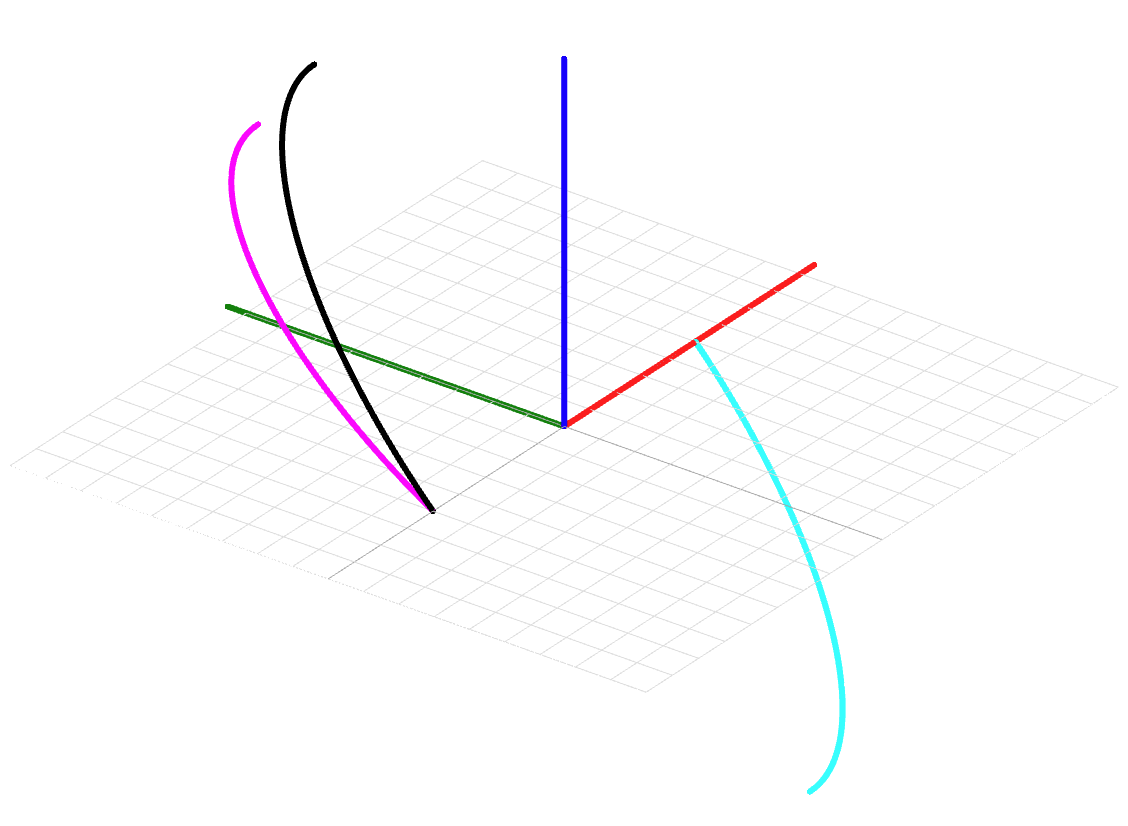
Why does the arc flip to the other side when I move from 45° to 46°?