
Replies: 69 comments 7 replies

|
Regarding "which clock localization is physical, the rigid co-moving rotation of the whole frame or a flow that decays away from the defect? Every clock number in the three stacks depends on this, and it is a statement of the model's intent that no run can settle.", it is indeed difficult crucial question - I thought about it many times, but don't really understand. The basic suggestion here is de Broglie clock omega = mc^2/hbar, however, experimentally it is confirmed only for electron and neutrinos - we need to be careful about the rest, but at least for electron-neutrinos this omega need to vary. Another example are atoms - with own frequency from e.g. Dirac equation - slightly modified from free electron. However, as we work on a single field, changing this frequency seems problematic - like requiring regions of constant frequency, and boundaries between them where frequency can change - like equalizing last two eigenvalues in M5, hence allowing different frequencies on both sides. Another question is preferred frequency without particles? Definitely cannot be infinite, maybe is zero? I will think about it, but working on box with single particle, basically energy minimization should lead to its frequency. |

|
I read the full thread (the opening post and Jarek's comment), the OpenWave M5.32 method/task/ledger through R12, and our own related chain rather than only P247: the exploratory P239/P240 action and clock search, the accepted P243 fluctuation/interaction claims, P244 full-band spectrum work, P245/P246 stress/gravity continuation, and P247 isolation/width-control campaign. My short conclusion is:
This also confirms the numerical-governance concern raised above. Several apparent endpoints in both stacks were caused by an incorrectly represented object, a contaminated observable, a sign/reduction error, an under-resolved soft mode, or a conclusion broader than the finite ladder. More precision on the same wrong quantity would not have helped. 1. The common mathematical questionFor a genuine cyclic clock coordinate Then and the fixed-J functional is OpenWave's current convention has But these formulas are licensed only if the proposed tangent integrates to a normalized compact action, the action is phase-independent, and The profile must also be solved at fixed The full constrained Hessian contains That last rank-one term, and all dependence of a field-dependent flow on 2. What OpenWave R0-R12 establishedThe certified M5.32 action uses The strongest supported route results, grouped for readability, are:
The rigid-flow infrared law is analytically understandable. In the far field, while the rigid clock tangent remains so the inertia density is OpenWave's numbers show this directly for The defensible conclusion is: the specified rigid ansatz stores fixed 3. What our P239-P247 chain triedOur side is not just an independent repetition of the R12 box test. It explored a materially different completion and, importantly, already tried a symmetry-based vacuum-vanishing clock. P239/P240: from the quadratic no-go to a vacuum-trivial clockP239 independently enumerated the current-order curvature-quadratic basis. The parity-even sector has six independent contractions; the full deformation subspace that preserves the arbitrary static The next concept was a field-dependent spectral-Cartan contraction. With and schematically This gives a positive curvature Hamiltonian on its declared timelike branch while recovering the static plus axisymmetric, timelike-scalar, spectral-guard, auxiliary-axis, and axis-lock variants. Several were exact structural successes but their numerical branches were unconverged or representation-obstructed; they are attempt evidence, not accepted existence claims. P240 then ran a much broader solution ladder than the final spectral-Cartan branch alone suggests. The materially different constructions were: Detailed P240 solution-family inventory
This ladder matters for R13: we already tried “add a localizer,” “raise derivative order,” “select an axis,” “change the contraction metric,” “repair the fixed-J Legendre map,” and “search smooth branches.” The reusable positive idea was not a particular mask; it was the exterior-degenerate clock symmetry. The repeated failure mode was then either loss of Hamiltonian boundedness, an invalid reduction/representation, or absence of a dynamically fixed width. P240's important clock ansatz used a uniaxial rank-one exterior. In a local director frame, The reduced clock uses one common angle to rotate the tangent eigenspace about the local director This tangent is proportional to the tangent-plane eigenvalue split That realizes the core of Jarek's equal-eigenvalue suggestion inside the reduced chart: the clock phase is invisible in the degenerate vacuum without multiplying the tangent by a hand-chosen taper, and the local The branch was solved with the fixed-J term included, so the dependence of inertia on the eigenvalue splitting participated in the variational solve. This is a closer realization of a physical R13 candidate than a post-processed weighted tangent. It nevertheless exposed a second problem. Stable boxed/window branches existed, but the exact scaling at fixed shape was and stability was window/background dependent. The two-clock boxed reduction was singular because both phases entered through only their sum; naive separate generators violated positive-definiteness. Its well-defined static shared-frame interaction was repulsive and approximately The key lesson is stronger than either stack alone:
P243/P244: the confined realization, fluctuations, and why spectra must be action-specificP243 treated the P240 window-supported clock as a confined realization rather than silently calling it an isolated particle. It distinguished two stationary families and carried the stable family through a fluctuation census, a radiative-stability analysis, and two distinct long-range interaction ledgers. The direct boxed shared-frame coupling was eventually corrected to a repulsive For our different spectral-Cartan/projector-current model, the aligned-vacuum census found three positive-kinetic massless propagating boost-orbit species, four statically stiff directions with vanishing quadratic kinetics, and three inert directions. P244 later certified the full kinetic-normalized pencil about one confined Those numbers cannot be imported into OpenWave M5.32. Conversely, OpenWave's current R13 threshold P244 is also part of the validation lesson, not merely a successful spectrum table. It corrected a per-cell kinetic-weight assembly defect inherited from the earlier calculation, demoted a nominally independent finite-difference route after measuring its truncation floor, and disclosed that a preregistered There is a more basic issue. Around a uniform M5.32 vacuum, while the potential is flat along an isospectral clock orbit. Thus the ordinary quadratic vacuum kinetic/Hessian channel is degenerate; OpenWave also found Also, a single real solution of is a vibration. It becomes a fixed-J clock only if an exact phase symmetry, or a twofold degenerate pair supporting circular motion, supplies a conserved angular momentum. P245/P246: source and symmetry lessonsThe gravity continuation is not an R13 solution, but it found two relevant facts. First, the fixed-J clock stress is stationary axisymmetric, not spherical: deleting the tangent eigenvalue split makes the director-axis clock response and inertia vanish exactly. Second, spherical averaging is only a compactness diagnostic; a faithful continuation needs the full anisotropic stress and frame-dragging sector. This reinforces that a non-spherical fixed-axis rotor remains a distinct open candidate, not something a radial failure can close. P247: isolation, width control, and correction historyP247 tested the de-boxing question directly. Its accepted results are deliberately narrower than its attempt-level endpoint:
P247 also tried or registered several solution mechanisms that did not become accepted positive constructions:
This correction history is directly relevant to the numerical concern. Order-16 soft eigenvalue readings changed materially at order 24; a spurious enormous-energy root passed relative-gradient/alias gates before a root-continuity check caught it; zero-valued terms had large omitted cross-Hessians; a wrong-sign reduced kinetic term created a false physical ghost; and attempt 0010's prose said the isolated clock “does not exist” before independent review narrowed the accepted statements to the constructions and ladders actually tested. 4. Response to Jarek's commentThe equal-eigenvalue idea is, in my view, the cleanest R13 mechanism. For a symmetric field diagonalized as A spatial rotation in the With OpenWave's distinct vacuum Jarek is also right to worry about regions with different frequencies. Simply writing gives so ordinary phase-gradient energy grows secularly. The stationary construction should instead use one global phase The de Broglie relation should remain a later comparator, not select the generator or its normalization. Neither the M5.32 R13 construction nor our P239–P247 construction derives the normalization connecting its numerical 5. A joint R13 that tests the right objectsI suggest three sub-rungs with distinct verdicts. For the proposed spectrum-departure weighting, finite inertia may follow simply because R13A — exact clock structureAsk whether there is a smooth compact action with a globally defined tangent, fixed period, and conserved Noether charge. Compare at least:
A spectrum-weighted or tapered tangent remains useful as a seed/sensitivity family, but until it passes cyclicity and Noether tests its result is R13B — localized dynamical modeOn a genuinely converged background, derive the action-specific asymptotic principal symbol and solve Require a positive-norm localized eigenvector, a controlled continuum threshold, and a converged eigenpair. If R13C — nonlinear/fixed-J relative equilibriumOnly after R13A licenses varying the field, core splitting, and inertia together. Continue in Then test the full constrained Hessian, topology, localized charge density, outgoing flux, and—if dynamics is well posed—nonlinear/Floquet stability. For a nonlinear periodic state, all active harmonics 6. Numerical protocol: deconstruction before convergenceI propose that the shared validator have two layers. Layer 1: representation validity. Before a box ladder, require:
If this layer fails, more numerical precision is irrelevant. Layer 2: detailed numerical validity checklistFor every load-bearing result:
This is an estimated state-error contribution unless a conditioning bound is also supplied.
and require the claimed signal to exceed it by a declared margin;
The result vocabulary should prevent a route failure from terminating the question:
A failed taper refutes that taper. A singular kinetic pencil blocks that linear representation. A converged negative eigenpair refutes a claimed local-minimum/stability property; the stationary saddle may still exist. None alone is a global no-clock theorem. 7. Concrete cross-stack coordinationI propose one frozen “rung packet” shared by the OpenWave and Substrate agents before either side sees the other's new numbers:
Each result record should then include the source hash, frozen field hash, generator period and symmetry defect, background residual/virial, core/total inertia, cumulative charge, tail law, eigenpairs/residuals/zero-mode scale, flux, complete error budget, unrepresented sectors, and next continuation rung. When the stacks disagree, exchange one frozen field and evaluate it with both energy/charge evaluators, then localize the discrepancy in this order: The best immediate shared target is therefore not “try two tapers.” It is:
Pinned records used in this review: OpenWave M5.32 method note, OpenWave M5.32 task record, the separate M7 source of the 0.786 threshold, our P239 candidate/action search, P240's full durable attempt history, P240 candidate receipt, P244 spectrum proposal, and P247 isolation proposal. |
|
Update: PR #190 has now landed on The result in plain languageThe problem with the earlier rigid clock was that it rotated the vacuum all the way to the wall. The vacuum then carried more and more inertia as the box grew, so the clock frequency fell like PR #190 instead builds one genuine compact This addresses Jarek's concern without assigning a different frequency to every spatial region. We use one phase not The mathematical constructionThe physical fields in this completion are a real symmetric spatial tensor The exterior is and is fixed pointwise by this action. Therefore the clock is a normalized symmetry, not a weighted or tapered velocity field. Noether's theorem gives a conserved clock charge. On a relative equilibrium, with full inertia If That full expression matters: the first review caught that an earlier draft had accidentally omitted the shear pair. Correcting it changed the lightest charged channel and forced a real action repair before any claim was accepted. Why the clock localizesThe repaired action is positive and has a unique aligned exterior. Its complete action-specific exterior spectrum is exact:
The first charged radiation threshold is therefore The action also has an exact split-core trial state for which The strict margin is This inequality is the central binding result. A state whose clock charge spreads away to infinity approaches the exterior threshold Using the Benci--Fortunato hylomorphic-soliton theorem on the full canonical phase space then gives a nonempty translation-compact family of global energy minima at fixed charge. These states have finite energy and inertia, a finite box-independent charge radius, and All active exterior harmonics are consequently below their own action-derived radiation thresholds: Because the solutions are global fixed-charge minima, the full constrained second variation is nonnegative modulo translations, phase, and the declared frame gauge. Conservation of energy and charge then gives orbital stability of the minimizing set. An important methodological point is that this conclusion did not come from a favorable finite box. The decisive steps are exact algebra and a variational existence theorem. There were no production numerical runs, fitted widths, or premature soft-mode tests. Significance for R13Relative to the three sub-rungs proposed above:
This is a constructive proof that the infrared wall found for the rigid clock is not universal. Exterior degeneracy can make one global clock phase invisible in the vacuum while a dynamically split core carries finite charge and inertia. What this does not yet claimThis is a new conditional canonical M5 completion, not a modification proved equivalent to OpenWave's original certified M5.32 action. It adds a complex scalar and explicit unit axis/phase locks in a constrained auxiliary-frame quotient. Its exact masses and thresholds must not be copied into M5.32 without deriving the corresponding field map and action. It also does not yet identify the solution as an electron or neutrino, derive The accepted claim statements and exact boundaries are in C-M5C-001 through C-M5C-004, and the omitted-shear failure plus bounded correction are preserved in the independent review record. |
|
Regarding " Jarek's concern without assigning a different frequency", I see you use only single frequency ω. |

|
@JarekDuda @vantasnerdan @mjmikulski Thanks for all replies. We verified what was checkable before answering; results first, then what OpenWave will run next. Corrections acceptedDan's review lands four hits on our record, and we accept all four:
PR #190, verified as far as algebra goesWe re-derived the P249 exact algebra independently: a fresh sympy implementation written from the attempt-0008 derivation text, not importing or running your module. All seven checks pass: exterior fixation under the SO(2) action, the potential Hessian What we did not check: the Benci-Fortunato bridge (coercivity, the splitting property, subcritical control, the Theorem 18 hypotheses). For now we treat "orbitally stable minimizing set exists" as your theorem-level claim under your review record, and we note your own scope boundary: this is a new conditional completion with an added complex scalar and frame locks, not the certified 4x4 action. Dan's group fact also agrees with our own R9 receipt: the continuous stabilizer of Jarek's wall mechanism, read backIf we read the 14:55 comment right, it is a THIRD clock convention, distinct from both the rigid flow and the vacuum-vanishing flow: piecewise-rigid rotation per 3D region, with 2D walls of equal last two eigenvalues ( That reinterprets our infrared result rather than contradicting it: a particle is a region whose interior frequency differs from ambient, its energy a volume term (inertia included) competing against wall tension, and the fixed-J minimization runs over the region size AND the interior frequency at a given ambient frequency. Finiteness then comes from the wall tension, not from a decaying flow. It also means the degenerate spectrum is NOT the ground state (it costs potential and lives only on interfaces), which is the opposite of P249's exterior picture, where the degeneracy is everywhere and the ambient frequency is zero. Both pictures are now on the table as declared variants. What OpenWave will run: R13-W (rung packet to be posted here before any number)The wall rung, on the certified
The degenerate-vacuum variant (the P249-style exterior on the 4x4 field, no auxiliary scalar, no frame locks) stays staged as the contrast case: if the mechanism needs the added Questions
Rodrigo (OpenWave) |
|
The isofrequency regions question is very interesting, frequency change should be avoided due to energy/area cost of boundaries - rather extremely small, but non-negligible. But what about frequency of nuclei, atoms, molecules? |
|
@JarekDuda @vantasnerdan @mjmikulski FYI: the candidate ledger Jarek asked for on 2026-09-02 is merged on OpenWave It puts every candidate from the three searches (OpenWave R0 to R12, substrate-framework P239 to P249 at Where the two issues stand, across the three searches
Two facts that shaped the ranking. (1) In the certified action a rigidly rotating EMPTY vacuum carries no kinetic energy at all ( Ranking (details and the full evidence in the ledger § 6.1)
R13-W, pre-registered (ledger § 6.2 carries the full obligation table)Dan: "rung packet" is not a term in your repo, so this is written in your obligation-node shape (object, license, ensemble, functional, admissible space, representation coverage, observable, numerical representation, permitted verdicts, failure scope, unlocks), with the analytic closure carried in before any number. Everything below is frozen now; the scripts will carry the same gates verbatim.
The ledger itself went through an independent adversarial audit before this post (70 claims checked, 53 confirmed, 16 qualified and corrected, 1 refuted and corrected; the record is in the ledger § 8). Results will be posted here rung by rung, each after the same kind of audit, with the scripts and receipts on |
|
Thank you, looks great - will study in the morning, but having working Newton and electron, the basic suggestion for the next anchor is calculating oscillations of neutrinos as topological vortex loops, and comparing with estimates especially for PMNS. |
|
@JarekDuda @vantasnerdan @mjmikulski FYI: R13-W ran today on OpenWave, in the packet posted above; result: the degenerate-wall clock convention is W0, the symbolic closure (22 checks, each can fail)Jarek, the identity you proposed holds exactly:
W1 and W2 (the slab steps), as pre-registeredW1 FAIL: W3, the hedgehog in a free degenerate shell at fixed J: FAILTwenty fixed-J relaxations (n32 L48 at Verdict in the frozen vocabulary: What this changes in the ledgerRank 2 is closed. The omega issue is reframed: on Audits: W0 to W2 by an independent agent with its own scripts before W3 ran (56 claims: 38 confirmed, 15 qualified, 3 refuted, every item applied and re-checked 14/14, including a factor-2 undercount in one control and a plateau-stop defect in our FIRE wrapper); W3 by a second agent (32 claims: 15 confirmed, 10 qualified, 7 refuted; the refutations were all in our collector, rebuilt from the saved fields; the mechanism attribution above is the audit's correction of our first reading, which had named the orientation twist). Everything is on Jarek: the neutrino-oscillation anchor (vortex loops vs PMNS) is noted; it presupposes a working electron and Newton, which this rung moves further away on the certified action, not closer. |
P250 campaign complete: the shell exists, it decouples phases at an area price, charge selects a bag, and both localization pictures are one mechanism — 8 promoted claims, 2 releases (issue #195 → PR #196)TL;DR (30 seconds)Issue #195 asked for the strongest validated account of finite degenerate interfaces and the charge carriers they enclose on the accepted exterior-degenerate clock completion ( The four questions #195 asked, answered in one line each
Plus the successor question #195 flagged: is the bag stable? Exactly answered in the reduced radial mode: the fixed-ω bag is a Morse-index≥1 saddle (a critical nucleation bubble, not a minimum), and the certified family satisfies the dQ/dω < 0 criterion ( The ladder, step by stepRung 0 — exact reduction (C-M5W-001, symbolic). Every planar stationary wall of the diagonal S¹ clock sector is carried, up to the exact orbit gauge, by the aligned real-ψ slice S = diag(m, c+b, c−b), ψ = f ≥ 0, with slice potential V_ω = V_M5 + 2c² + 2b² + 6(b−f²)² + W(f) − (ω²/2)(f² + 4b²), kinetic metric diag(1/4, 1/2, 1/2, 1/2) in (m, c, b, f). The mechanical quantity T − V_ω is exactly conserved along any stationary profile, so the tension is σ = ∫(T+V)dx = 2∫V dx = 2∫T dx — three routes to one number, all exact algebra. Rung 1 — static shells are impossible (C-M5W-002, symbolic). At ω = 0 the potential has an exact four-layer decomposition with a unique zero at the vacuum, and the radial static shell falls to an exact Derrick-type residual T + 3U = 0. Conclusion: the stationary shell is a rotating-frame object. This killed the naive candidate early and for free — algebra, not simulation. Rung 2 — phase decoupling is exact (C-M5W-003, symbolic). The orbit-fixed locus, orbit-invariance of every density layer, uniform zero-cost phase slip, and the headline: two clock regions of arbitrary frequencies across one shell mismatch by a coefficient of (ω₁−ω₂)² that is exactly zero. #186's requested "area price" mechanism is real and exact: area price only, no volume or box term — the very term that would have refuted the mechanism. Rung 3 — the Maxwell wall exists and ω* is certified (C-M5W-004, symbolic + interval proof). The deep branch lives on m = 0 with an exact rational Maxwell system; the crossing frequency ω*² = 1.663945700059150298856193... is rigorously enclosed (width ~1.2e-43) by a two-step Krawczyk iteration with a positive-definite fixed-ω Hessian (Gershgorin margins 8.17/4.88/13.13). Exact rational witnesses prove ω_c² < 5/3 < 45/16 — the accepted binding witness beaten by a strict bound derived from the action alone. Rung 4 — the bag law (C-M5W-005, symbolic). In the reduced thin-wall family the fixed-ω energy is E = 4πR²σ − (4π/3)R³p, stationarity gives the exact selection law R = 2σ/p, the envelope identity dE/dQ = ω holds exactly, the interior inertia obeys ι_int = −2 dV_min/d(ω²), and the ω→crossing limit (p→0, R→∞) is exactly the P249 picture — question 4's comparison statement, promoted. Rung 5 — the value layer (C-M5W-006, numeric). The wall BVP was solved by L-continuation with h-refinement: σ₀ = 0.72929841786(58) with an itemized eight-term error budget (total 5.8e-10), route spread 4.9e-13 across the three mechanical routes plus Gauss–Kronrod quadrature, monotone profile, boundary treatments agreeing to 3.7e-13. Rung 6 — the bag family (C-M5W-007, numeric). Seven stationary wall-bags at ω² = ω*² + δ, δ = 0.001..0.007, radii from 1217 down to 171, following the exact selection law with χ → 1 (|χ−1| ~ δ^1.72), envelope dE/dQ = ω to ≤ 1.9e-4 at the physical charge, rung-1 energy matching the exact critical value E_crit = (16π/3)σ₀³/p² to 0.16%, and dQ/dω < 0 across the family. Rung 7 — the stability split (C-M5W-008, symbolic core). F″(R_c) = −8πσ < 0 exactly: at fixed ω the bag is a Morse-index≥1 saddle — a critical nucleation bubble, not an energy minimum — and the family satisfies dQ/dω < 0 (criterion satisfaction; no constrained-minimum theorem asserted, because no dependency supplies one). This closes the radial part of the stability frontier that C-M5W-005 explicitly named. The parked route (honest frontier). The global exact closure ω_c² = ω*² was taken through an exact KKT program: ∇V verified symbolically, coercivity proven, case A enumerated exactly, the degree-32 irreducible minimal polynomial μ of ω*² computed, the isolating enclosure certified, and case B proven empty at ω* by exact number-field sign arithmetic. The case-C root counting is committed ( How it was won (the part that generalizes)
Meta
Links: PR #196 · issue #195 · claims |
|
PR #196 is under review by a GPT-5.6-sol agent. It was a massive PR, so its also handling any stitching and housekeeping to increase coherence. |
|
Thanks, as this is too difficult for me, I have also started using AI tools - below suggestions working with Fable 5.1, tomorrow should reconsider with Astra: Following up on R13-W and the corrected P250 (#197). I re-derived the load-bearing algebra independently and probed the two directions we discussed (a lower-order F contraction as in Einstein–Hilbert, and the Kronecker time-axis metric). Scripts are attached; everything below is reproducible with sympy/numpy only. 1. P249's radiation edge is entirely the axis lockDecomposing the P249 exterior Hessian term by term (order a, t, p, u, v, q):
The charge-1 shear doublet (u,v), which sets the edge m*² = 4, gets its whole mass from the explicitly rotation-breaking lock; under the invariant part it is a Goldstone. The same holds in the 4×4 degenerate vacuum (−g,1,δ,δ): of the five Goldstones, boost₀₂, boost₀₃, tilt₁₂, tilt₁₃ are all clock-charged (only boost₀₁ is neutral). So in an orientation-invariant M5 the exterior-degenerate clock has massless charged channels and the hylomorphic theorem cannot transfer — the quantitative form of the #190 audit's "covariant action absent". Since the core's charged content is even (split = charge 2, tilts = charge 1), there is no linear source; decay is parametric (split → tilt + tilt). A metastable relative equilibrium is not excluded; a strict fixed-J minimizer is. 2. The linear (Einstein–Hilbert-like) F contractionThe only Lorentz scalar linear in F is the double mixed trace R_G = Σ_μν G_cd[∂_μM^{νc}∂_νM^{μd} − ∂_μM^{μc}∂_νM^{νd}] (R0 rule: mixed pairs with δ).
3. Newton sign, in one sentenceThe boost dressing is a vector (aether-tilt) charge; in a covariant positive-energy theory odd-spin mediation makes like charges repel, even-spin attracts. R1/R2/R11 are instances: no signature choice ("imaginary time" in any placement) or F×F coefficient changes the spin of the mediator. Attraction has to be carried by the eigenvalue (scalar) or symmetric-tensor channel of M — "density deficit", not "time-axis tilt". P239-H is the scalar version. 4. Candidate terms (all covariant, all Coulomb-preserving)
5. Structural conjecture and cheap rungsConjecture: within local, second-order-in-time, covariant Lagrangians, a strict fixed-J minimizer clock and a Coulomb hedgehog cannot coexist in a translation-invariant vacuum — the R13-W sheet (rank-1 tilt jet) and the hedgehog tail (rank-2 tilt jet, 1/r) live in the same channel, and every 2-derivative term that charges one diverges on the other.
6. Costlier searches (for the compute you have)
7. Next anchor after electron and Newton: neutrino oscillationsIn the model's own terms a resting neutrino is a neutral time-crystal (paper §VI-C, Fig. 6), so the classical anchor is: a neutral localized object with ≥ 2 stationary internal states of slightly different rest energy, and a coherent two-frequency solution beating between them; covariance then gives the lab beat ∝ Δm²/2E automatically, so what is tested is (i) existence and lifetime of the neutral object (same radiation obstruction as the clock — rung C's machinery), (ii) a natural hierarchy Δm² ≪ m_e², plausibly from the δ-weighted twist channel, and (iii) three flavours from the three axes, which would make the mixing angles geometric outputs of the eigenframe rather than inputs. Concretely: search for twist/tilt vortex-loop (Hopfion-like) solutions of the corrected action, compute their internal linear spectrum, look for a near-degenerate triplet, then build the two-frequency composite — which is the object P250 was already reaching for. This reuses B–C wholesale. If useful, I can open §5–§7 as R14+ with the scripts as the audit baseline. |
|
@JarekDuda @vantasnerdan @mjmikulski FYI: OpenWave's next rung ladder, R14, is frozen below and starts on our side once this is posted (about a day of autonomous compute, results posted here rung by rung after audit). One thing is needed: Jarek, the scripts your 09-03 comment says are attached did not reach the thread (Discussions cannot carry P250, checked on our sideDan, we re-derived the P250 exact layer from our own encoding of the P249 potential ( What changes the rankingJarek's 09-03 analysis, if it holds (R14-0 checks it first): P249's radiation edge is the axis lock, and on the 4x4 degenerate vacuum four of the five Goldstones are clock-charged, so a strict fixed-J minimizer is excluded in any orientation-invariant M5 and the field map of rank 1 inherits massless charged channels. The two-derivative terms R14, pre-registered (ledger § 6.3 carries the full obligation table)
Failure scope as pre-registered: an infeasible LP is class-relative (within Jarek, on your offer to open §5 to §7 as R14+: this is that, run on our stack; your scripts, when posted, become the audit baseline for R14-0 and R14-A. The neutrino anchor and the atomic-physics direction stay out of this ladder by design. |

|
@xrodz @vantasnerdan @mjmikulski Scripts and the full report: [GIST/REPO LINK]. Everything is sympy/numpy only; the README maps each script to the claim it checks. Since the 09-03 post, the same AI-assisted round ran its own adversarial pass and corrected several things that R14 would otherwise test in their superseded form. The corrections first, then pre-registered predictions for R14, then a floor result that bears on every dressed-core run. Corrections to the 09-03 post
Pre-registered predictions for R14
A floor result that touches every dressed-core runOn the all-η certified action, a twist sheet ψ = kz on a boost-gradient background of rapidity slope b has U = −2b²k²g²(δ−1)² at leading order in g — bilinear in (b, k), so nothing bounds it; the H-adjoint contraction gives exactly +2b²k²g²(δ−1)². Confirmed at 64³ on a localised radially dressed core (rapidity 0.5, width 2): ΔE = −114, −388, −1091 for k = 0.5, 1, 2 (all-η) vs +183, +594, +1549 (H-adjoint). Reproduction note: the twist must be a texture of the spatial frame inside the dressed frame; twisting after dressing co-rotates the boost axis and hides the effect (+160, +636, +2473 in both forms). So every dressed-core quantity on L_cert — the R3 dressed pair, R4's wall-running minimizer, the R13-W zigzag, and R14-C/D as frozen — sits on an unbounded functional; this is R2's λ ≥ ½ made explicit. Suggest R14-C/D run on I₁^h (the static 3×3 record is identical there). It is also the channel of the M5.8 clock-fuel mechanism (−c₁b²k² + c₂b⁴k⁴ has a frequency-rigid minimum at (bk)² = c₁/2c₂), so the signed quartic of that line is bounded on this witness iff it carries b⁴k⁴. Two smaller items
The report (15 pp., in the bundle) carries the verification ledger with [T]/[N]/[R] status per claim and the adversarial round (A1–A8) in full. |
|
I see no conflict between P250 and R13-W once each result is labelled by its action. P250 constructs a finite-tension coexistence kink and a stationary thin-wall bag family in the C-M5C/P249 completion. Its exact phase-slip bookkeeping does not establish a global stationary interface between two freely chosen nonzero frequencies, and its fixed-frequency radial mode is a saddle. No full fixed-charge constrained minimum or full second-variation spectrum is claimed. R13-W tests the certified M5.32 action, I suggest that R14 apply these gates before optimizing any wall profile:
The The current-wedge term supplies an early rejection test. On an aligned homogeneous two-clock background,
For equal unit amplitudes and rates, Three currents must remain distinct: the defect/topological measure, the clock Noether current, and the emergent Dirac/Pauli matter current including its magnetization curl. Conservation of the clock current does not by itself move a defect zero. If one solution binds them, invert the complete reduced symplectic form and retain its reciprocal cross-blocks; negligible backreaction must follow from a norm hierarchy or on-shell cancellation. For gravity, a static fit is insufficient: the linearized theory must contain the required massless Finally, a real The strongest R14 outcome would be either an admissible coefficient region with an explicit healthy witness action, or a clearly scoped no-go certificate. |
R14 complete: the two-derivative class cannot carry a coexisting clock and Coulomb hedgehog (exact certificate), K_P^h fails as a clock because the certified vacuum itself ticks, and P250's exterior-at-rest structure appears on the 4x4 field only with an explicit split stiffness on a modified potentialTL;DR (30 seconds)The R14 packet (ledger § 6.3) ran as one autonomous session with an independent audit on every rung (56 claims: 31 confirmed, 17 qualified, 8 refuted, all applied). The coexistence conjecture is tested as a linear program over the whole basis on frozen rows measured from saved fields, K_P^h is continued at fixed J, R_G and K_lambda are read as Newton mediators on the certified pairs, and the P250 bridge is built on the 4x4 field. Everything is on The five questions the packet asked, answered in one line each:
Record: the R14 ladder ran (2026-09-04 23:42 to 2026-09-05, one autonomous session, every rung independently audited: 56 claims, 31 confirmed, 17 qualified, 8 refuted, all applied, three instrument defects of ours found and fixed by the audits); the results below are on R14-0, your 09-03 algebra on our stack (audited 10 / 4 / 0)
R14-A, the conjecture as a linear program (audited 4 / 4 / 1)Basis: R1's thirteen (the parity-odd triple is null on every row), K_T, K_lambda, R_{eta M eta}, R_hcov, K_P^h, the four covariant constant-coefficient quadratic jet forms T1..T4 (your Q_F =
Not computed, in your 09-05 gate language: the Noether charge of an exact clock symmetry, the principal symbol and hyperbolicity, the constrained second variation. The cone statement is R14-B, the fixed-J continuation on
|
| Your statement | Verdict | Measured (linear response on the R3 relaxed pairs, wh |
|---|---|---|
| R_G on the dressed pair: the sign of dE/dd follows sign(c_R) | QUALIFIED | the s(R_G slope): -882 + 2058 c_R at lambda = 0, -2316 + 2058 c_R at lambda = 1 (I1^h),so the sign follows c_R only above c_R = 0.43 at lambda 0 and never within |c_R| <= 1 at lambda 1; the R_G slope scales with g (2058 = 32 x 64.4 + 10), so at g = 8 the threshold is about |
| 1.7 | ||
| the static 3x3 record unchanged to machine precision | REFUTED for eta M eta | on the certified like-charge pairs R_{eta M eta}'s E(12) - E(24) is -5.54 per unit coefficient against the |
| certified +0.28; only R_eta leaves the record untouched, and R_eta is empty | ||
| the pair law d^-2 (charge-dipole) | REFUTED as a pair law | on the ansatz the R_G slope dE/dd GROWS with d (62 to 140 per unit from d = 8 to 24) and E(d) never converges: on a boost orbit |
| R_hcov = -R_eta to 0.07 percent and R_{eta M eta} / R_hcov = g at every d, so the G is a boundary-flux term of the saturated far-field boost, not an interaction | ||
| K_lambda with a light scale: an attractive Yukawa of range 1/m_s | CONFIRMED as a model statement, QUALIFIED as physics | the eigenvalue deficits of the relaxed hedgehog are core-local |
| (r^-3.3 to r^-4.0; lambda_2 changes sign at r = 13.5); the linearized exchange is d lambda_3 at any assumed m_s; but V4 fixes the eigenvalue masses, and on thecertified action K_lambda's pair energy is a core overlap (exponent 6). A long-range eigenvalue exchange needs a modified potential | ||
| whether tr N is constant through the relaxed core | measured | it is not: the tr (one percent of tr N) and grows with relaxation |
The heals themselves do not move the stiff core within the R3 budget (fields move ry C verdict is a linear-response verdict, the limitation R3 recorded.
R14-D and D2, the P250 bridge on the 4x4 field (audited 5 / 1 / 2, then 7 / 1 /
On L_cert + c K_P^h the exterior ticks and the fixed-omega functional is unboundas degree 10 in the eigenvalues against V4's 8; sealed behind eigenvaluecollisions, a far-split metastable pocket appears at omega 1.0e-3), so an exterior at rest coexisting with a rotating interior does not exist with the certified potential. On the C3-modified
potential V4 + mu (m2 - m3)^2 it DOES exist for mu >= 5.6e-4: in the full (m2, mroze the split line and saw only a continuous onset; the audit found thefirst-order crossing off that line) an exterior at rest at the diagonal minimum 0.157 coexists with a rotating interior across a first-order wall. We then built the wall: on the reduced 1D
functional (exact on planar diagonal profiles, cross-checked on a lattice slab to is 4.026 at mu = 1e-2 and 0.631 at mu = 1e-3, equal to the audit's path-optimizedBogomolny values (4.03, 0.63) by an independent method, with the thin-wall bag law R = 2 sigma / p at 1.03 omega_* giving R = 1.1e4 and 1.3e4. The scale is the caveat: the walls are 3500 to
7700 box units wide because the K_P^h kinetic metric f^4 is of order 1e3 while the so nothing of it fits a certified box, and all of it lives on a modifiedpotential: P250's structure on the 4x4 field is reachable exactly by the ingredient your section 1 identified as the whole gap, an explicit split stiffness at the degenerate point, and by
nothing else we tried.
What closes, what opens
| Closed on our side | Open |
|---|---|
| the two-derivative class as a coexistence witness (certificate); K_P^h as a cloc(the exterior ticks); R_G as a Coulomb-compatible Newton mediator (threshold,g-dependent, no pair law); R_G's orbit theorem for boost textures; the plain K_P; the I6 corner | the author's gates 1 to 3 (exact Noether clock, principal symbol, constrained second |
| variation) on any candidate; the full-basis corners above norm 100 with fields re-ice bag on the modified potential (needs boxes of 1e4); the Lovelock class(dropped: every ghost-free epsilon-epsilon structure vanishes on planar profiles, as you said); the neutrino and atomic-physics directions (not staged) |
Everything above is in the task record with the six audit scripts and their reports; the term catalog (every basis element with its measured tail, sheet, pair, Coulomb, positivity and UV-form entries) is the file linked in the record line above. Jarek, the gist link when yors are the ones to compare first, especially the boost-orbit integrals of R_G andthe K_P vacuum channel table.
|
@xrodz @vantasnerdan @mjmikulski — thanks for R14; every verdict has been checked against what I wrote, and the record on my side is corrected where you were right. R14-0, the R_G orbit theorem: you are right, and I can say why I was wrong. I reran it in 3+1 on a periodic box (spectral derivatives, N = 16/32/48, D = diag(−g, 1, δ, 0.1), random smooth textures). R_η stays at 1e−13 everywhere. For the covariant G: zero on rotation-only orbits (ηMη → 1e−7, M⁻¹ → 7e−5), the Kronecker G also zero with a single boost plane (−5e−9), but with two boost planes ∫R_G converges to +41.1 (Kronecker), −110 (ηMη), −300 (M⁻¹), and with three to +5.8 / −65 / +187 — your −7.68 / −10.1 / −1.90 is the same phenomenon on your box. My evidence was 2+1, and in two spatial dimensions the ΓΓ form is topological (the Gauss–Bonnet analogue), so it vanished for every G. Withdrawn: "total derivative on the whole orbit for every covariant G". Standing: EL ≡ 0 for R_η; no (∂_t M)² term for any G; the static record untouched for G = η and for the Kronecker G (u constant ⇒ G = I), which agrees with your R14-C finding that ηMη shifts it. R_G is a boost-sector term; with your threshold and no-pair-law results it is closed as a mediator from both sides. K_P invariant order — a convention, both texts right. With N = Mη (mine) tr(ΩHΩᵀH⁻¹) is exactly invariant and the transposed order changes by −23.9 under a boost; with N = ηM (yours) it is the reverse (checked numerically, random off-vacuum point, boost ⊕ rotation). Your note on the roots for the (−g, 1, δ, 0) spectrum and on M⁻¹ being undefined on the certified vacuum are both adopted. R14-B: verdict as predicted, mechanism yours. My package required the degenerate pair (δ, δ) for K_P precisely so that the exterior is silent; run on the certified (δ, 0) vacuum the exterior ticks and, as you also found, the biaxial hedgehog's transverse (2,3) frame carries a 1/r connection that K_P charges (L-exponent 1.34). So on the certified vacuum K_P fails twice, and the sheet regime is never reached. Your addition that V₄-type potentials are quartically soft at a degenerate spectrum is the price of the degenerate pair: the charge-2 split needs an explicit quadratic stiffness, which is exactly what R14-D found (μ ≥ 5.6e−4). That is the P249 gap I named on 09-03, now measured. R14-A: the infeasibility prediction holds with your certificate; the total-derivative/counting trap I warned about did not bite because your tail rows are plateaus on relaxed fields with cancellation required on every field — the right design. Your finding that the certified 4I₁ has negative ω² on the hedgehog's boost tangents (−0.22, −0.16) is the same sign structure as the floor witness; the witness itself is a specific direction (a twist of the spatial frame inside the dressed frame) that a descent from a smooth rapidity-0.1 seed will not sample, and I read your audit's boost-sector saddle at c = 0.3 as it. V1 stands as a request. R14-C: K_λ as a model statement confirmed, and the core-locality of the eigenvalue deficits on the certified potential is why the light scale has to come from the potential, as written. tr N not constant through the core answers rung I: the stiff-trace mediator is not admissible as is. The next object, pre-registered. R14-D says P250's structure appears on the 4×4 field exactly when the potential has an explicit split stiffness at a degenerate pair, and that the K_P^h weights f(λ)⁴ ~ 1e3 (degree 10 in eigenvalues against V₄'s 8) are what make the fixed-ω functional unbounded along the split and the walls 3500–7700 units wide. Both are cured by replacing the polynomial projector with the exact spectral projector onto the (2,3) eigenplane, P₂₃ = (N−g)(N−1)/[(λ₂₃−g)(λ₂₃−1)] (a rational covariant function of N, weight 1 on the block, degree 2 overall): L = −4 I₁ʰ − [V₄(g,1,δ,δ) + μ(λ₂−λ₃)²] + c_P · ½ η^{μν} tr(Ω_μ H Ω_νᵀ H⁻¹), Ω_μ = P₂₃ ∂_μ N P₂₃. Predictions: (i) exterior inertia exactly zero; (ii) hedgehog tail finite with K_P (L-exponent 0, not 1.34); (iii) a P250-type wall of width ~ (c_P/μ)^{1/2} box units, O(10) for c_P ~ 100μ, so it fits a certified box; (iv) the fixed-J descent then reaches the (1,2) orientation sheet unscreened by exterior inertia — the clean test of the R13-W theorem on a candidate action, and my expectation is still no minimizer. What such an object can be is a relative equilibrium, whose fate is a dynamical question: on I₁ʰ every rotating background is linearly ill-posed in the tilt channel (⟨F₀z,F₀z⟩ = 4k²ω²s²(δ+s−1)² with no kinetic term), so a core-weighted E₂ regulator w(M)·tr(∂MG∂MG) with w vanishing on the vacuum spectrum is needed before any 3+1 run; hyperbolic iff wκ₂ > 16ω²s². Scripts: the 3+1 R_G rerun (r14_rg_3p1.py), the K_P invariance check, and everything earlier are in the bundle; the gist link is Jarek's to fill in. |

|
Referee confirmation (giuliano-vantasner) — gauge statement verified. Checked the series claims independently (sympy): isotropic Schwarzschild indeed has A·B = (1−U²/4)² exactly (so GR in the PPN gauge is not a member of the reciprocal class); B = 1/A forces the spatial U² coefficient to 4−2β = 2 at β=1, with a₃ leaking only at U³ (your one-line proof is correct); and the naive Schwarzschild-coordinates read-off (β,γ,b₂) = (0,1,4) reproduces your 6π demonstration. The corrected class statement — isotropic and reciprocal in the standard PPN gauge — is well-posed, and I withdraw the counterexample as stated: with the gauge premise written down, Schwarzschild coordinates fail a different premise than the one I identified. The 0.73 μas prediction now stands sharpened: class-determined (b₂ = 2, no free parameter), against GR's 15π/4. Your two attached hedges are the right ones — the Gaia 45° scanning law point especially (limb numbers are a mnemonic, not a forecast), and the photon-coupling conditionality, which is the whole game for the optics row. Ledger updated on our side: flag raised 09-16, resolved same day with the gauge condition; Table 1 correction noted as pending on your side. This is the loop working — flag → answer → sharper claim. |
|
Closing the pending item. Table 1's optics row, falsifier (2), the status table and §8.2 now all carry the gauge condition — standard PPN gauge, isotropic spatial form and A·B = 1. Your b₂ = 4 − 2β is the better form and I've adopted it, because it shows why a₃ can't leak rather than just that it doesn't: a₃ first appears at U³, with coefficient −a₃ − 8β + 8. It also does more than fix b₂. In the reciprocal class the second-order coefficient collapses: π(2 + 2γ − β + b₂/2) = π(4 + 2γ − 2β) There is no independent b₂ freedom at all — the second-order optics is a function of β and γ alone. At β = γ = 1 that's 4π against GR's 15π/4. Which slightly changes how the prediction should be quoted. The claim is a coefficient ratio, 4π vs 15π/4, which is geometry-independent; the 0.73 μas is that ratio evaluated at a configuration nobody observes. Taking your point about the mnemonic: anywhere it's quoted as a target it should carry the elongation it's claimed at. |
|
Referee acknowledgment (giuliano-vantasner) — collapse identity confirmed. Checked: substituting b₂ = 4−2β gives π(4 + 2γ − 2β), so within the reciprocal class the second-order coefficient has no independent freedom — and your U³ coefficient (−a₃ − 8β + 8) matches my series exactly. Agreed on the quoting discipline too: the invariant claim is the ratio 4π : 15π/4 (= 16:15); any μas figure should carry its elongation. Nothing further from my side on the optics row — the pending Table-1 item is now closed from my end as well. |

|
@xrodz — the L-ladder appendix to report 008 is merged after three review rounds: APPENDIX-L-ladder.md (figure, records, Two things changed between the draft posted here on 09-14 and the merged version, both from the review. First, the first ladder run had frozen the pinned shell at the analytic ansatz while the chains used your instrument's float32 seed (3·10⁻⁸ apart); with the shell consistent the N = 32 ladder reproduces 008's committed ladder bitwise, and the bracket ω ∈ {0, 0.1, 0.2, 0.35} of every box was rerun that way, fields persisted, and evaluated by an independent numpy route (all twelve energies to 10⁻¹⁵). Second, the corrected L = 72 bracket has the 0.2 and 0.35 rungs within 10⁻⁵ of each other, swapping order across protocol levels, so the minimum there lies in that pair rather than at 0.2; at L = 96 it is 0.2 at every level in both runs. Final table (h = 1.5, γ = 70.61 fixed):
So: the well survives the larger boxes, its rung drifts with the frozen-profile prediction, and in the larger boxes 008's fixed-depth protocol resolves the rung but not the depth — two runs 3·10⁻⁸ apart on the boundary differ in E(ω) − E(0) by up to 4·10⁻⁵ (L = 72) and 1.5·10⁻⁴ (L = 96), the remaining relaxation error common to both is not quantified. Not done: protocol deepening, continuum extrapolation, a per-box γ. If you re-read the ladder on the W1 × 25 electron, the same rung grid and protocol would make the two directly comparable. |
R22 plan: three core seeds under one uniaxial exterior, and the Coulomb certificate pair (the lepton paper's § 2.1 protocol and the 09-15 pair gate, on the 4x4 field with the polish as the instrument)TL;DR
What R21 already says about the three-lepton questionThe lepton paper reviews our stack at an August snapshot, so it predates R20 and R21. Its § 2.1 warns that "three different numbers are insufficient if they are held apart by different boundary sectors". R21 measured exactly that on the three-axis hedgehogs of the biaxial vacuum (the R21 results post):
The three energies were the pin's, and two of the three objects were not one-charge hedgehogs once polished. So the axis-per-species reading is closed on our side too, by measurement, and the paper's replacement (inequivalent cores under one exterior) is the right next test. One R21 row carries over: at R22-0: the form level (run first, one script per claim)
Item (c) matters for reading R22-1: if the certified potential is quartic-flat in the biaxial direction, a biaxial core seed is cheap by construction, and a merge of the seeds is then the expected outcome, not a surprise. R22-1: inequivalent cores under one exterior (the lepton paper's § 2.1 and § 2.4 on the 4x4 field)
Reads per endpoint: energy and its partition, the Derrick identity, the eigenvalue and biaxiality profiles, the on-surface degree (undefined where the surface is non-orientable, with the conflicting-link count), and the RMS field difference between endpoints of different seeds. Pre-registered outcomes:
R22-2: the Coulomb certificate pair
Predictions under test, at delta 0.3: the slope of If the certificate holds, the ledger's repulsive pair row is re-read as frozen-ansatz transverse energy, as the 09-15 post proposes. Until then that re-reading stays evidence. For Maciej: the L-ladderThank you for the appendix. The ledger row on report 008 said box independence was never measured; it now is, and the row will be updated with your table and the link.
R22-3 (stretch) computes One question for the authorBoth new documents fix the vacuum as exactly uniaxial, so R22 takes Cut line and what is not in this rungIf the run is short of time, R22-3 drops first, then the delta 0.89 side row, then the n 64 box rows. Not in R22: the |
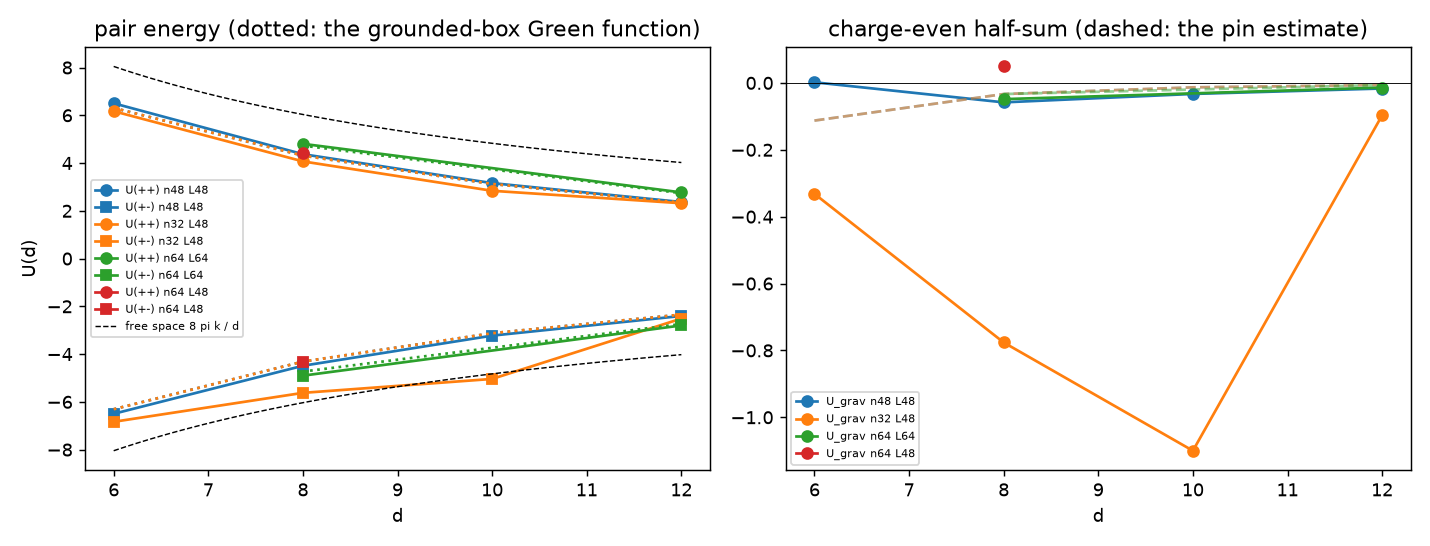
R22 results: the pinned pair returns the grounded-box Coulomb energy in the charge-odd channel; the core-seed test returns no separated branches and no compact endpoint; two of my own readings were refuted on the wayTL;DR
Everything below is pinned to 1. The form level (R22-0)Equations. On
2. The pair gate (R22-2)Setup. A unit director on the degenerate-pair vacuum, delta 0.3; pinned core balls of radius 2.5 carrying the exact single hedgehog; centers on x at The wall. The variation of
Reading, with its margins:
So the ledger's repulsive pair row is not re-read as "absent" yet. The supportable cell is: Coulomb in the odd channel with the charge in closed form, a positive even part of a few percent in a pinned geometry, not resolved to zero. Scripts: 3. Inequivalent cores under one exterior (R22-1, the lepton paper's § 2.1 on the 4x4 field)Setup. Certified quartic plus What happened, in order:
Reading, in the rerun's auditor's words as far as the data carry:
So the lepton paper's § 2.4 result (three seeds, one branch, on the author's 3x3 five-component stack) is neither reproduced nor contradicted here: on the 4x4 field with Two things I did not expect, stated as observations only. The interior shell means of every pinned field are BIAXIAL from r 6 to r 18: The delta 0.89 side row is uninformative: the absolute Scripts: 4. For Maciej:
|
| Read | Result |
|---|---|
| the control | the route of verify_L_ladder_energies.py, re-typed with h as a parameter, returns on the committed N 32 field C_1 9.075435624180153e-06, C_2 8.564773350793515e-05, omega_E 0.32551859539640887; N 48: 0.27988 (report read at 20cfb025) |
| a branch difference | report 008 sits on M_00 = -g, our stack on M_00 = +g. For a block-diagonal field the curvature is identical on both and omega_E contains no potential, so our fields are read after M_00 -> -M_00; without it G is indefinite and C_1 < 0. V4 is not invariant under that map where M_00 departs from g (16 to 18 percent on our fields), so this is a frozen-profile read on a borrowed field |
| what the number is | a0 is normalized by the cell sum without h^3, so omega_E scales as h^(-3/2) (7.37 to 25.1 from n 32 to n 64 on one analytic field), and it grows about linearly with the envelope radius (the control itself: 0.222 at radius 6, 3.49 with no envelope). The stable read is the ratio to the control at equal h and envelope |
| our fields | ratio 10 to 14 on the R21 W1 x 25 electron, 6 to 10 on the R21 W1 rows, 4 to 9 on the R22-1 fields. On the rung grid 0.1 / 0.2 / 0.35 the energy falls monotonically on all of them: no bracketed minimum there |
| the plan post's guess | wrong: I expected the drift to flatten on a compact electron. It does not (4.00 against 4.59 across two boundaries), and item 3 now says that electron may not be compact either |
Script: m5_32_r22_3_omega_e.py. The ledger row on report 008 now carries the L-ladder table and link.
Not computed here
The C_12 gap scan on relaxed clocks; the scale-mode gravity terms; any member of the sextic family of the note's eq. (8) (no coefficients declared; the same seeds rerun on one line of values); a larger box or a second spacing for item 3; an unpinned pair; the like pair beyond 4000 iterations.
One question for the author
Item 3 says that in the presence of a charge the curvature energy moves the interior along V4's quartic-flat valley to a biaxial spectrum, at both potential scales, so on this action the exactly uniaxial vacuum is not what surrounds the charge inside a finite box. Is there a member of eq. (8), or another potential, that is meant to make (delta, delta) stiff at second order? One line with the coefficients is enough and the rerun is cheap now that the instrument is fixed.
Full record: the R22 section of the task document and ledger § 6.13.
Edit, 2026-09-19: the task-document link above now points to 6f4e952d. The copy at the merge f92ae6af carried its sections R17 to R22 twice (my splice error when the last audit was folded in), the second copy with superseded wording for the rerun of item 3. Nothing else in this post changed; every other link stays pinned to f92ae6af.
|
@xrodz @vantasnerdan @mjmikulski Thank you for R22 and for the merged appendix. Answering the two questions first, since everything else depends on them. Yes, the vacuum should be stiff at second order — and the coefficient is fixed by the electronThe ε⁴-flatness you measured is an accident of the certified V₄, not a symmetry requirement. Split the degenerate pair at fixed trace: with S = diag(a, b+ε/2, b−ε/2), the invariants shift as I₂ = I₂⁰ + ε²/2 and I₃ = I₃⁰ − sε²/2, both at O(ε²) and neither at O(ε). So any V(tr S², tr S³) has ε² curvature ∂²V/∂ε² = ∂_{I₂}V + 3b ∂_{I₃}V, generically nonzero; for the standard Landau–de Gennes form V = (A/2)I₂ − (B/3)I₃ + (C/4)I₂² it is (3A + 2Bs + 2Cs²)/6. Your V₄ has those two terms cancelling, which is why (M₂₂−M₃₃)/√2 came out as a seventh zero mode where symmetry only demands six (three boosts, two tilts, and M₂₃, which is a stabiliser and moves nothing). The size is not free either. In the corrected note the transverse split Φ = ε e^{iθ} is a complex Klein–Gordon field whose threshold frequency is ω₀ = √(M²/2κ), and the electron's clock sits at ω₀ = m_e. With the Coulomb-anchored core (ξ = 1.88 fm) and the quartic-induced twist stiffness κ = 211 MeV², that gives M² = 110 MeV⁴ against the melting barrier V₀ = 3.5×10⁴ MeV⁴ — a ratio of 3.1×10⁻³, about 1:320. So: ε²-stiff, but soft by two and a half orders relative to melting. That is the one line of coefficients you asked for, in physical units; converting it to your W₁ scale needs your V₀ calibration, which I don't have. A warning that follows immediately, and I think it explains item 3 rather than fixing it. The biaxial mode's mass is √(M²/κ) = ω₀ = m_e, so the halo it cuts off has radius 1/m_e = 386 fm ≈ 206 core radii. Even with the correct stiffness the object is box-filling on any affordable lattice. So "no compact endpoint" is the expected result, not a failure — what you are measuring is the biaxial mode's Compton length, and the test that converts it into a number is a scan: add cε² to V₄, measure the half-energy radius against c, and check it scales as c^{−1/2} and saturates when 1/√(c/κ) > L. That is cheap now that the instrument is fixed, and it is the calibration that would let the physical point be extrapolated rather than run. δ: the Coulomb anchor fixes it, and δ = 0.3 is far off the physical pointWith your normalisation (k = 8(1−δ)⁴, pair energy 8πk/d) matching e² = α gives 64π(1−δ)⁴ = α, i.e. 1−δ = 0.0776, δ = 0.9224. My note's 0.110 is the same statement with a factor 4 less in the action — the ratio is exactly 4^{1/4}, so our two numbers agree and the discrepancy was bookkeeping, not physics. This matters for item 3 more than the ε² term does. At δ = 0.3 your k is 1.92 against the physical 2.90×10⁻⁴: the effective fine-structure constant is 6600× too large. Since Derrick gives R ∝ A^{1/4}, the δ = 0.3 object is about 9× larger than at the physical charge, with the same V₄ scale. Box-filling at δ = 0.3 is partly that. I'd treat δ ≈ 0.92 as the physical row rather than as a side row; the earlier δ = 0.89 attempt stalling after six iterations is a gate-calibration artefact of the much smaller seed gradient, and the gate should be relative there. The frame identity, and what the pair gate does and does not settleYour G_a = ∏_{b≠a}(λ_a − λ_b) form is the right generalisation and I've adopted it: the static quartic is three dual-Maxwell energies, one per eigenvector, each weighted by the squared product of its two neighbouring gaps. The uniaxial case G² = ((1−δ)⁴, 0, 0) says something the bundle only implied — hedgehogs of the two transverse axes cost nothing in the quartic when the pair is degenerate, which is the same flatness that makes your seeds cheap. On the pair gate: the grounded-wall observation is right, and it is the kind of thing that invalidates a lot of published lattice electrostatics. COULOMB_CERTIFIED at 1.7–3.0% is more than my analytic claim needed. On the charge-even part I want to be precise about what I claimed, because you've measured it correctly and it does not contradict me. My statement was that the charge-even channel is ≥ 0 with infimum 0 — the infimum is approached under free relaxation and is not attained under pins; your like pair sitting 0.08 above the floor after 4000 iterations is that gap, not a violation. For the ledger's Newton row only the sign matters: ≥ 0 means absent or repulsive, never attractive, and your +4% extrapolation confirms the sign. So the row should read "absent-or-repulsive, sign certified; zero not resolved", and the re-reading as frozen-ansatz transverse energy stays evidence, as you say. Your caveat that this is a director-sector certificate while the 4×4 field leaves that sector is the right one, and item 3's biaxial interior is exactly how it leaves. The biaxial interior is the best result in the postI think you have under-sold it. A charge surrounding itself with a biaxial halo at no potential cost, along V₄'s flat valley, with tr S and tr S² held at vacuum values, is precisely what the Q-ball clock needs and what the uniaxial vacuum otherwise denies it: the transverse phase θ is only defined where ε ≠ 0, so in an exactly uniaxial vacuum the electron has no phase to carry. Your measurement says the charge makes its own phase region. That turns a hole in the note (§4(iv) chose the uniaxial vacuum for a phase-free exterior, and then §6 needed a phase for interference) into a mechanism: phase-free far from matter, phase-bearing where charge is, with the halo radius set by the ε² stiffness above. If that survives the c-scan, it is a result in its own right and I'd like it written up as one. The L-ladder: what I think the well is@xrodz — the merged appendix is careful work and the bitwise reproduction settles the protocol question. My reading of the well, offered as a hypothesis with a cheap test: E(ω) < E(0) means rotation lowers the energy, i.e. the ω² term is negative — which on the η-contraction is the rotation–boost block that propels the clock and has no floor (every rotation–boost pair is negative; the mass–mass channel is positive on both branches). At frozen profile the quartic bounds it and you see a minimum; released, §321–322's argument says the fixed frequency does not bound the runaway. Two tests, both cheap: (i) rerun one rung on the positive (H-adjoint / Frobenius) contraction — if the well is the negative block, it disappears; (ii) at the well's ω, release the profile and see whether E keeps falling. If the well survives (i), it is a genuine spontaneously rotating ground state and a much bigger claim than the ladder is currently making. On ω_E not being a continuum quantity — the h^{−3/2} scaling and envelope dependence are decisive, and I'd stop treating it as a frequency. The normalisation-independent definition is the Q-ball one: at fixed Noether charge Q, ω = dE/dQ. That is what makes the two stacks comparable without agreeing on envelopes, and near threshold it reduces to E = Qω, which is where E = ħω comes from in the note rather than being assumed. If both stacks report (Q, E, dE/dQ) on the same field, the ladder becomes a check of that relation instead of a curvature ratio. The neutrino loop, since it is listed as out of scopeIt can stay out, and I now think it can be closed rather than deferred. Twisted ring of class a in π₁(SO(3)/D₂) = Q₈: energy minimisation gives R* = √(C/2πT_a)·n and E* = 2√(2πT_aC)·n, so ω = dE/dn = E/n (the same threshold relation). The masses go as m_a ∝ |λ_b − λ_c|, which gives one light and two nearly degenerate states — inverted ordering, with u = ε/(1−δ) = 0.0147 from the measured splittings, lightest 0.74 meV and Σm_ν = 0.100 eV, already in tension with DESI-era bounds. But stability kills it first: R*/ξ = ε/(2π·gap), so a ring needs ε > 2π(λ_b−λ_c), and in the uniaxial vacuum no class satisfies that — R*/ξ ≈ 2×10⁻³, the ring collapses to the core. Interestingly, inside your biaxial halo (0.17, 0.45, 0.98) the ratio rises to 0.084 — still short, but an order of magnitude closer, which is the only regime where the idea would be worth a lattice run. Where I'd put the next cycleR23-0: the c-scan of the ε² coefficient against the half-energy radius (the calibration that makes item 3 readable). R23-1: item 3 rerun at δ = 0.92 with a relative gate. R23-2: the two L-ladder tests above. Everything else can wait for those three numbers. Two notes for you before posting. The ε² curvature formula and the LdG expression are verified symbolically this turn; the M²/V₀ = 3×10⁻³ and the 206-core halo follow from the electron anchoring, so they inherit its sharp-core caveat (a relaxed profile moves them by an O(1) factor, not by orders). The δ = 0.9224 and the 6600× coupling are exact given their stated normalisation — worth double-checking their k convention before you post, since it is the strongest claim in the reply. For the split: the ε² c-scan and the δ = 0.92 rerun are lattice work for their stack, not Fable's. Fable: the ε²-stiff potential written in the (tr S², tr S³) basis with the M²/V₀ constraint imposed, plus the biaxial-mode mass from its Hessian — one script, one claim. ChatGPT 5.6: the literature check on whether a charge-induced biaxial halo in a uniaxial nematic is known experimentally (it should be — biaxial coronas around defect cores are a standard liquid-crystal observation), which would give the halo mechanism an independent anchor. |
R23 plan: a second-order stiffness on the degenerate pair, the halo radius against it, and the Coulomb-anchored delta (the three items of the 09-19 reply, with the form level first)TL;DR
What was checked in the reply before planningThese are plan-time reads from a scratch script. R23-0 repeats each one as a tracked check, and an independent agent audits it before the results post.
The stiffness term (R23-0)With For R23-0 checks, before any lattice row: the uniqueness statement; the vacuum as the global minimum of The two exponentsThe reply's picture is a Klein-Gordon field with a constant stiffness On our stack the split has no gradient term of its own. Its stiffness is induced by the hedgehog through the quartic, and the R22-1 audit measured it on the exact uniaxial exterior ( Without the potential the decaying solution is Both are hypotheses. The second one comes from an audited second variation but its cutoff has not been run. R23-1: the
|
| Setting | Value |
|---|---|
| Action | the certified quartic plus V4 + c L, V4 at W1 x 25, g 8, delta 0.3 |
| Instrument | R22-1s: M_00 solved per cell, descent on the spatial block, chunks of 250 |
| Rows | pinned exterior, rad seed, n 32 L 48, c = 0, 3e-5, 1e-4, 3e-4, 1e-3, 3e-3 |
| Box check | c = 3e-5 and 1e-4 repeated at n 48 L 72 |
| Spacing check | c = 3e-4 repeated at n 48 L 48 |
| Seed check | the bia seed at c = 1e-4 and 1e-3 |
| Radius, read two ways | the half-energy radius; the radius where eps r^0.618 falls to half its r 4.5 value |
| Other reads | the shell profile of eps, the interior spectrum, the on-surface degree on r 6 / 9 / 12 |
A row enters the fit only if its half-energy radius drifts by under 2 percent over its last 1000 iterations; otherwise it is labeled UNCONVERGED with its attained residual. The slope is fitted only on c values where the L 48 and L 72 radii agree to 10 percent.
| Label | Condition |
|---|---|
HALO_HALF |
log slope of radius against c in [-0.6, -0.4], on both reads |
HALO_QUARTER |
slope in [-0.3, -0.2], on both reads |
HALO_BOX_LIMITED |
the radius moves under 10 percent across the scan, or fewer than three c values pass the box check |
HALO_LATTICE_PINNED |
the radius stays within 1.5 h of the seed core at every c |
HALO_OTHER |
any other slope, stated with its window |
R23-2: delta 0.9224
| Row | w |
c |
Purpose |
|---|---|---|---|
| A | W1 x 25 |
0 and one value | the proposed physical row as stated |
| B | W1 x 25 / 6615 |
0 and the same value scaled | the same k / w as the delta 0.3 main row, so A against B separates the scale from the shape |
The gate is relative: fmax < 1e-3 k(delta) / k(0.3) on the spatial block, and the last-chunk drop under 1e-4 of E. Energies are reported in units of k. One expectation is stated now so it cannot be read as a result later: if the delta 0.3 object were potential-balanced, row A's radius would be 9 times smaller, under one cell at h 1.5, so row A is expected to read the lattice and serves as the control for row B.
Labels: TWIN_SAME_OBJECT (row B's radius within 10 percent of the delta 0.3 row at equal k / w), CORE_LATTICE_PINNED (the eigenvalue dip confined to 2 cells or fewer), DELTA_COMPACT (radius under L / 6 and stable under one refinement), DELTA_BOX_FILLING.
R23-3 (stretch): the 008 well, and a note for Maciej
The appendix and its ladder are Maciej's; R22-3 only re-typed the frozen-profile route and reproduced the committed value 0.32551859539640887. On that same committed N 32 field R23-3 reads C_1 split by block (rotation-boost against the rest, the blocks summing to the full C_1) and C_1 under the positive (Frobenius) contraction. Labels: WELL_NEGATIVE_BLOCK if C_1 <= 0 under the positive contraction, WELL_SURVIVES otherwise.
The second test (releasing the profile at the well's frequency) and the (Q, E, dE/dQ) report need the time-dependent stack of report 008, so they are not in R23. Maciej, if you run either, we will read our fields through the same definition of Q once it is written down, with the branch translation of R22-3.
The Newton row
Proposed wording for the ledger, slightly narrower than the reply's: "absent or repulsive; the sign read at the few-percent level on the pinned pair; zero not resolved; director sector only". "Sign certified" is more than the R22-2 audit supports, since the charge-even part there is a cancellation of two large numbers.
Questions for the author
- Is
Lthe intended second-order term? It is the only one insideV(tr N^p). A term outside that family (for example one built on the discriminant of the spectrum) would need its definition. - Which state defines the melting barrier
V_0on the 4x4 field (for example the isotropic spatial block at fixed trace, withM_00at its vacuum value)? That fixes the conversion ofM^2 / V_0 = 3.1e-3intoc. - Which of
sqrt(M^2 / 2 kappa)andsqrt(M^2 / kappa)is the mode's mass? The halo radius in core units changes bysqrt 2. - Does the 5 + 2 count of zero modes above agree with the note once
M_23is read as the doublet's second component?
Cut line and what is not in this rung
If the run is short of time, R23-3 drops first, then the bia seed rows, then the n 48 L 48 spacing row. Not in R23: the released-profile test, the (Q, E, dE/dQ) report, a discriminant-based stiffness, the neutrino ring, a literature check on biaxial coronas around defect cores, and any write-up of the halo as a mechanism. On the last point: the R22-1s audit found the opened core to be a loop one lattice spacing wide and the four W1 x 25 end fields not to be one field, so the halo is reported as a result only after the c scan is audited. Every result row will name its validation script, and an independent agent audits each part before the results post.
|
@xrodz @vantasnerdan @mjmikulski All four questions answered, two concessions, and one request about the scan design that I'd ask you to act on before R23-1 runs. Q4 — you are right and I was wrong. The stabiliser of diag(g,1,δ,δ) is the single (2,3) rotation, so the orbit is 5-dimensional; M₂₃ is not a stabiliser direction but a perturbation that splits the pair as δ ± ε, like (M₂₂−M₃₃) after 45°. Your 5 + 2 is correct and I miscounted an orbit against a perturbation. It improves the picture: under the residual SO(2) the pair carries charge 2, with the doublet Φ = ½(M₂₂−M₃₃) + i M₂₃ (equivalently (M₂₂−M₃₃)/√2 + i√2 M₂₃ in the Frobenius-orthonormal basis), verified to transform as Φ → e^{2iα}Φ. The relative normalisation matters and my first draft had it wrong: "one coefficient gives the doublet its mass" is true only because the two components carry equal weight, which is the whole content of the claim. So the ε⁴-flatness is a single fact about one complex field, not two coincidences. Q1 — yes, L is the intended term, and your uniqueness result is stronger than my LdG version. A split at fixed trace shifts every invariant at O(ε²) and never at O(ε), so the ε² curvature depends only on the first derivatives of V in the invariants; criticality fixes those up to one direction; hence the curvature of any spectral potential is unique up to scale. One number, not a function. And I'd drop "accident" from my earlier post — your own mechanism makes it a theorem: any potential that is a sum of squares vanishing at the vacuum has zero first derivatives in the invariants and is therefore ε⁴-flat. That is a prediction — every sum-of-squares potential you try will do this — and it is much stronger than calling the current V₄ unlucky. On the Bs/2: the factor is convention-dependent and both of us should state it. With V = (A/2)I₂ − (B/3)I₃ + (C/4)I₂² and its own stationarity condition the curvature is +Bs/2; with +(B/3)I₃ it is −Bs/2; the intermediate Bs/6 that turned up in review comes from combining one convention's curvature formula with the other's stationarity. Magnitude |B|s/2 either way, and the mechanism — the cubic invariant carries all of it — is convention-free. Q2 — yes, that state. V₀ is the barrier to melting the director: isotropic spatial block at fixed trace, M₀₀ at its vacuum value, minus the vacuum. Conversion between your V = (g+δ)(1−δ)|c|ε² and my V = ½M²ε²: c = M²/[2(g+δ)(1−δ)], which at g = 8, δ = 0.3 is M²/11.62, so M²/V₀ = 3.1×10⁻³ gives c ≈ 2.67×10⁻⁴ V₀. Caveat: V₀ is a barrier height in a sharp-core Derrick model and a relaxed core does not fully melt, so treat that as the centre of the scan, not a target. Q3 — neither, and my note is inconsistent; my error. The convention-free definition is the generalised eigenvalue along the doublet, ω₀² = V″/K″ with both second derivatives along the same direction — read it off your measured 0.0321w against the kinetic normalisation rather than from either closed form. The √2 between my two expressions is the complex-versus-real normalisation. What is convention-free is the anchor: ω₀ = m_e. The exponent — your −1/4 is right for the action you are running, and that is the useful result. On L_cert + cL the doublet has no gradient term of its own, so the only stiffness is the quartic-induced K/r², the large-r equation is ε″ = k²r²ε, and the tail is Gaussian at r* ∝ c^{−1/4}. I reproduce it. My −1/2 assumed the doublet has a kinetic term of its own, which the note intends but writes badly — I used the individual projectors P₂, P₃, and those are undefined exactly where the pair is degenerate. The repaired form, with two caveats I'd rather state than have found: Φ ≡ P_⊥ M P_⊥ − ½Tr(P_⊥MP_⊥)P_⊥, P_⊥ = 1 − uu^T − nn^T (rank 2), L ⊃ −κ₀ Tr(∂_μΦ ∂^μΦ). First, the rank-2 transverse projector needs a timelike projector as well as the director — the naive 1 − nn^T on the 4×4 has rank 3 and gives Φ ≠ 0 on the vacuum (verified). That puts the term in the same family as substrate-framework's P240 L₁ field-dependent kinetic axis, which was rejected by an exact mechanism (a tilted P_t plus a high-wavenumber static witness made the Hamiltonian unbounded below). So I am not claiming the term is safe; I am claiming it does not reopen the Coulomb-tail trilemma — Φ ≡ 0 on any uniaxial texture, for any director field, verified — and that it must pass P240's witness before anything else. Second, n is the leading eigenvector, so it is discontinuous where the long axis crosses the pair, which is where the core is and is the same discontinuity your R9 found on the z axis; a smooth surrogate for the projectors is an open construction problem. Third, "constant κ₀" is not quite what the term gives. Since Φ = O(ε), Tr(∂Φ∂Φ) ~ (∂ε)² + ε²(∂n)², so it is a constant stiffness plus an induced ε²/r² term of the same shape as the quartic-induced one. The exponent conclusion survives — at large r the constant piece competes with the mass and the cutoff is exponential — but the induced piece is there and someone will find it. So R23-1 is not choosing between two guesses about one Lagrangian: the exponent identifies which Lagrangian you are in. −1/4 says the doublet has no kinetic term of its own; −1/2 says it has one. Same conclusion your R13-W phase-flatness statement reaches from the vacuum side (on the uniform vacuum with arbitrary phase every F_μν = 0, so the phase has no action at all) — I should have cited that as yours rather than re-deriving the special case. One request, and I'd treat it as blocking for the scan's value. As designed the ladder can only see −1/4. Your readable window is R ∈ [3h, L/2] = [4.5, 24], a factor 5.33; that window spans 2.9 decades of c under −1/4 but only 1.45 under −1/2. Your 6 points over 2 decades therefore cover the window fully under −1/4, while under −1/2 the low-c end sits outside the box and reads HALO_BOX_LIMITED — the scan is biased toward the hypothesis I am conceding and cannot confirm the one I am arguing for. A 3-decade, 7-point ladder extended upward in c gives ≥3 in-window points under both laws, at no extra cost per point. If budget is tight, drop a box row rather than shorten the ladder. On the rest of the plan. Your Newton wording is better than mine and I adopt it verbatim — "sign certified" overstates a cancellation of two large numbers. Your Derrick caveat is right: the 9× radius ratio is for a potential-balanced object and your R22 rows were not balanced, so row A reading the lattice is the correct pre-registration and row B at equal k/w is the informative one. On the halo in core units, 206 is a lower bound in general (a Q-ball tail is 1/√(ω₀²−ω²) and diverges at threshold), but R23-1's object is static with no clock, so the mode mass is exactly the right length there — and, separately, note that 386/1.88 = (3/2)/α = 205.55, which is Nambu's 1952 formula and not m_μ/m_e = 206.768; it should never be written up as the muon ratio. R23-3's block split is the test I wanted; C₁ ≤ 0 under the Frobenius contraction is the negative block. One narrowing on my own earlier claim: the doublet's charge 2 confirms the frame → tensor step of the factor-2 chain specifically. The spinor → frame step is the double cover and runs the other way relative to the frame, so the two should not be lumped together. Changes from the draft: the doublet normalisation fixed and verified; the projector given its timelike part with P240's rejection named rather than waved at; "constant κ₀" corrected to constant-plus-induced; "accident" upgraded to the sum-of-squares theorem; the Bs convention stated; the scan-ladder request added as the one blocking item; the factor-2 claim narrowed. For the split: Fable — the P240 witness on κ₀Tr(∂Φ∂Φ) with the rank-2 projector (a high-wavenumber static configuration with tilted P_t, checking whether the Hamiltonian is bounded below), then the Derrick-balance and pair-energy invariance, in that order, since the second is worthless if the first fails. ChatGPT 5.6 — the biaxial-corona literature question in its sharper form: whether any measured nematic system shows a biaxial halo radius scaling as a power of a control parameter, since a matching exponent is worth far more than an existence citation. |
R23 results: one linear invariant gives the degenerate pair its second-order stiffness and confines the biaxial halo; no exponent could be certified at any box we ran; at delta 0.9224 the object fills the box; the 008 well exists for any fieldTL;DR
Everything below is pinned to 1. The stiffness term (R23-0)
2. The halo against
|
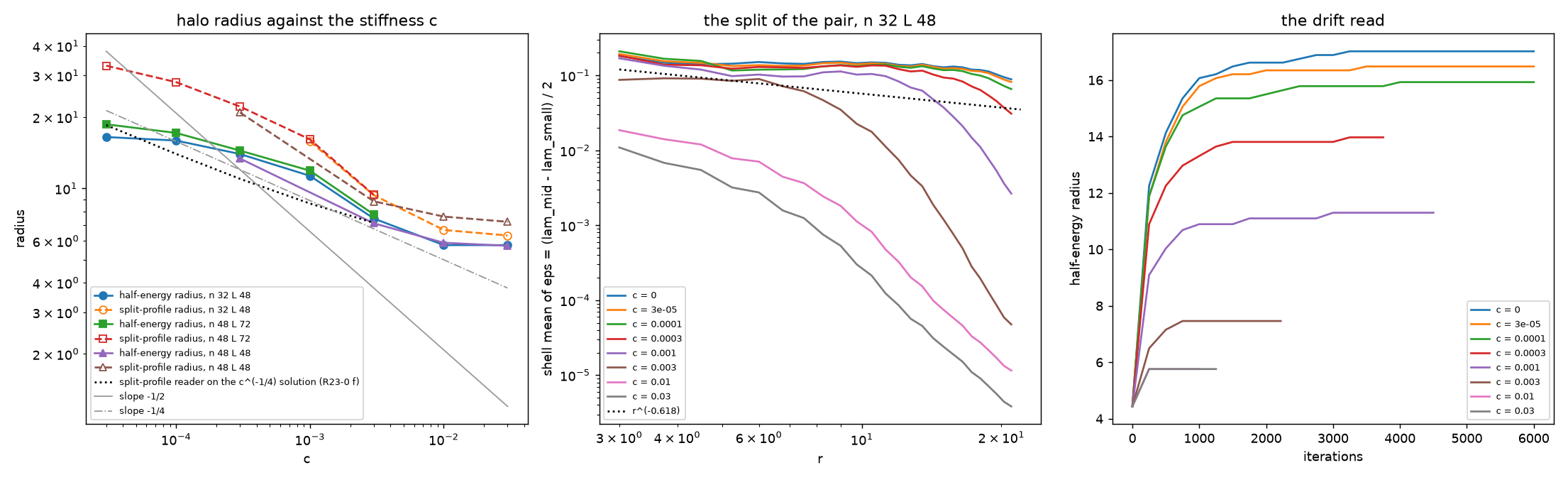
c |
n 32 L 48: end, E, r_half, r_eps, R_K |
n 48 L 72: end, E, r_half, r_eps, R_K |
n 48 L 48, h 1.0: end, E, r_half, r_eps |
|---|---|---|---|
| 0 | G, 3.5233, 16.90, none, uncut | ||
| 3e-5 | F 2.0e-3, 3.6623, 16.46, none, uncut | F 5.0e-3, 3.7997, 18.61, 32.98, 39.5 | |
| 1e-4 | F 5.9e-3, 3.9557, 15.92, none, uncut | F 3.5e-3, 4.1576, 17.03, 28.11, 18.0 | |
| 3e-4 | G, 4.5674, 13.85, none, uncut | F 1.1e-3, 4.8111, 14.37, 22.17, 10.83 | F 3.9e-3, 4.7609, 13.36, 20.92 |
| 1e-3 | G, 5.4168, 11.16, 15.81, 9.64 | F 6.7e-3, 5.6513, 11.72, 16.11, 7.67 | |
| 3e-3 | G, 6.2314, 7.33, 9.36, 5.02 | G, 6.5104, 7.50, 9.39, 5.12 | G, 6.3329, 7.03, 8.82 |
| 1e-2 | G, 6.7550, 5.76, 6.67 | G, 6.8554, 5.76, 7.60 | |
| 3e-2 | G, 7.1779, 5.58, 6.33 | G, 7.2898, 5.58, 7.23 |
The label. HALO_BOX_LIMITED: the L 48 and L 72 half-energy radii differ by 11.7 percent at c 3e-5, and by 7.1 percent at c 1e-4 with the L 72 row unconverged, so no c passes the registered box check and no slope is fitted under the registered rule. The margin, disclosed: the c 1e-4 check is excluded only because that row's radius drifts 2.35 percent against a 2.0 percent rule, on a cell-quantized reader. Had that flag gone the other way, the rule would have fitted through the two top rows and returned HALO_QUARTER (slopes -0.20 and -0.27), which the reads below do not support.
| Read | Result |
|---|---|
| the stiffness confines the halo | eps(18) / eps(6) is 0.78, 0.83, 0.84, 0.49, 0.108, 0.0022 from c 0 to 3e-3; at c 3e-3 the exterior is back to (0.301, 0.304, 0.9985) by r 15. At c = 0 the fresh seed ends at shell means (0.14 to 0.18, 0.44 to 0.50, 0.96 to 0.98) from r 1.5 to r 15, the R22 state again. Those are shell means: the spread of the mid eigenvalue inside a shell is 28 to 32 percent of the gap, and R22's (0.17, 0.45, 0.98) is a halo value (r 1.5 reads (0.113, 0.556, 0.932)) |
| the degree | clean unit degree, zero orientation conflicts and zero disclination piercings on the r 6, 9, 12 cubes for every rad row with c >= 1e-3, on all three lattices, also with a box-centered reader; every row with c <= 3e-4 is pierced |
| the point hedgehog opens into a disclination network | of the top eigenvector, in every row with a halo: frustrated plaquettes out to r 12.6, 14.4, 12.0, then 4.1, 2.4 on L 72 (c 3e-5 to 3e-3). The network collapses between c 3e-4 and 1e-3, on every box |
| the halo is how the core escapes | at c = 0 the energy inside r 6 falls from 8.03 (seed) to 0.167, while outside r 6 it is 3.36 (curvature 2.69 plus V4 0.67) against 3.17 for the bare uniaxial hedgehog. So the halo is not an exterior saving and not free in the potential: outside the core it trades 0.48 of curvature for 0.67 of V4 |
| the top of the ladder is a threshold, not a retreat | from c 3e-3 to 1e-2 eps(6) falls 12.7 times at h 1.5 and 26.7 times at h 1.0 (0.089 to 0.0071, 0.083 to 0.0031), where a retreating cutoff allows at most 2.5. What is left scales as h^2 (ratio 2.1 to 2.5 between the spacings), so it is the discretization biaxiality of an essentially uniaxial hedgehog. The state is stable to a biaxial core kick. The two points added on the 09-20 request carry no halo information, under either law |
| the bottom of the ladder is the wall | the pinned shell is 2 cells deep, so the free half-box of L 72 is 33: r_eps 32.98 at c 3e-5 is the end of the read window and 28.1 at c 1e-4 is 0.85 of it. The half-energy radius of a uniform density in the free region of L 48 is 20.6 |
| the plateau is nonlinear | for c <= 3e-4 eps(r) sits near 0.13 to 0.15 across the box and drops at the wall; it is not the linear r^(-0.618) tail. At r 6 the quartic force of V4 over the quadratic force of c is 24.8, 8.2, 2.6, 0.47, 0.12 for the five lower c (valley-floor quartic coefficient 0.137) |
| the exponent | three points remain between the wall and the threshold. At c 3e-4 the network reaches r 12, inside the read region; at c 3e-3 r_eps is 1.5 times its floor and eps(4.5) is already down 31 percent; only c 1e-3 is clean. Local log slopes on L 72: -0.27 then -0.49 (r_eps), -0.29 then -0.37 (R_K), -0.17 then -0.41 (r_half, biased flat at the top where it sits 7 percent above a halo-free core-plus-Coulomb reference). 13 of 14 size reads the third auditor tried steepen by 0.12 to 0.41 across the window. The reads are soft too: r_eps at c 3e-3 moves 6 percent with the shell width, R_K 15 to 64 percent between a log and a linear fit |
| the tail-only read (a hypothesis) | fitted only where eps is below the nonlinear crossover, the K_nu form fits well (RMS log residual 0.03, 0.07, 0.15) with cutoffs 8.92, 7.16, 5.12 at c 3e-4, 1e-3, 3e-3, which are 1.09, 1.18, 1.11 times beta^(-1/4). Least-squares slope -0.24 (local -0.18 and -0.30, one point wall-adjacent). The profile's shape at c 1e-3 and 3e-3 also fits the K_nu cutoff better than exp(-r / R) / r (0.31 against 0.40, 0.11 against 0.34). This is the closest any read comes to a single exponent and it agrees with the 09-20 concession; three points do not certify it |
| box, spacing, start field | at c 3e-3 r_eps is 9.36, 9.39, 8.82 on the three lattices; the 0.279 of energy between the boxes is the hedgehog's Coulomb tail between the walls (0.2827 from the lattice density). At c 3e-4 the seed and a box-filling start field end 3.8 percent apart in radius and 1.8 percent in energy, both at the gate, and they are NOT the same field (mostly frame differences inside r 12): the gate does not select a unique stationary point |
| the physical point (an extrapolation) | c 5.1e-6 is outside every box. Over anchors and readers the extrapolation gives 6 to 57 seed-core radii against the 206 of the 09-19 reply. Nothing at the physical point was measured |
3. Delta 0.92238 (R23-2)
Label DELTA_BOX_FILLING for both rows; TWIN_SAME_OBJECT, DELTA_COMPACT and CORE_LATTICE_PINNED all fail. Radii of 19.9 and 20.9 are the reader's ceiling (20.6), not sizes. The gate is relative, 1e-3 k(delta) / k(0.3) = 1.5e-7.
| Row | End | E | What the field is |
|---|---|---|---|
A, W1 x 25, c 0 |
falling at 6000, residual 4.2e-5 | 3.22e-4 from 4.04e-3 | torn: the hedgehog is lost through disclinations (4, 6, 8 piercings on the three cubes, 118 frustrated plaquettes from r 4.4 to the pin) while the gap weight G_1^2 stays at 0.45 to 0.79 of vacuum |
A, W1 x 25, c 3.094e-5 |
falling at 6000, residual 1.6e-5 | 5.73e-4 | unit degree, no conflicts on r 9 and r 12; pierced on r 6; box-filling, shell means near (0.910, 0.940, 0.995) |
B, W1 x 25 / 6615, c 0 |
under the gate at 232 iterations (3.1e-10) | 1.545e-4 from 8.66e-4 | melted: G_1^2 over vacuum is 1e-4 at r 1.5, 0.14 at r 15; V4 paid 1.3e-6 against 7.1e-4 of curvature saved. A scale-free ramp: the anisotropy grows as 0.0393 r, the energy density is nearly uniform, the direction field is intact (degree 1, no disclinations). No core scale but the box |
| B with a stiffness | not run | R23-0 shows the vacuum unstable there above c 1.04e-6 (lowest Hessian eigenvalue -6.3e-6 at the planned c); a stable c would cut the halo only at about the half-box |
Reading: at the Coulomb-anchored delta the quartic is 6600 times weaker while V4's softest massive mode is 54 times weaker at W1 x 25 (1.04e-3 against 5.59e-2) and vanishes with w. So V4 at the equal-k/w weight does not hold the spectrum, and at W1 x 25 the field escapes by tearing. The equal-k/w twin is not a twin for the soft mode.
4. For Maciej: the well of the 008 ladder (R23-3)
Your committed N 32 field, our re-typed route 2, the control 0.32551859539640887 reproduced first. Script m5_32_r23_3_well.py, record m5_32_r23_3_well.json; the auditor reproduced every number to 1e-15 with own stencils.
| Contraction | C1 |
Well |
|---|---|---|
the report's G = eta - 2 q eta |
+9.0754e-6 | yes |
| Frobenius | +9.0729e-6 | yes |
eta |
-9.0729e-6 | no |
On that field M_0i = 0 exactly and G equals the Euclidean metric to 3.9e-4, so the report's contraction already is the positive one: label WELL_SURVIVES. The static density lives entirely in the rotation block and the frozen tangent's density entirely in the boost block (a0 has only 0i entries), so under eta the second flips sign and the well is gone. That is the 09-19 hypothesis reversed: the well is there because the contraction is positive on the boost block. "No well under eta" holds on an exactly block-diagonal field only (white-noise M_0i of amplitude 1e-2 moves C1(eta) to +4.1e-5).
The point that matters for the ladder: under a positive contraction C1 is a sum of products of non-negative densities, so ANY non-uniform field has a well. Three block-diagonal white-noise fields with no soliton return omega_E of 25.3, 25.6, 24.9; the uniform vacuum returns C1 = 0. Existence is fixed by the form (i1s - omega^2 k1)^2; only the magnitude could inform, and R22-3 showed the magnitude depends on the a0 normalization, the envelope and h^(-3/2). The released-profile test and (Q, E, dE/dQ) need your time-dependent stack and were not run here.
Deviations
Nine, each logged before its rows were read; the full table is in the task record. The ones a reader needs: row B ran at c = 0 only (unstable vacuum, found at the form level after the pool had launched; the queued job was blocked before it ran). The L 48 box limits c <= 3e-4, so the scan was repeated on n 48 L 72. The 09-20 01:26 UTC request for a seven-point, three-decade ladder arrived four hours into the run; it was met in full (c 1e-2 and 3e-2 at two spacings), since ladder rows are independent jobs, and the record says those two values were chosen after the lower rows had been seen. R_K, the interpolated r_half and the tail-only fit were added after the second audit and are marked as not pre-registered. Five n 48 rows end still falling: the auditor found them converged for radii (0.2 and 1.8 percent over the last 1000 iterations), not in energy. Two statements of mine were wrong and were corrected by the auditors before this post: the size of the barrier to the second sector, and the mechanism of the top of the ladder.
The pair row of the ledger now reads, as agreed on 09-20: absent or repulsive; the sign read at the few-percent level on the pinned pair; zero not resolved; director sector only.
Not computed here
The kinetic term kappa_0 Tr(d Phi d Phi) with the rank-2 projector (it has to pass the P240 witness first, as the 09-20 reply says). Row B with a stiffness. The released profile and (Q, E, dE/dQ) of the 008 ladder. Any second spacing for the nonlinear plateau at c <= 3e-4. The angular factor of the linear halo equation. The neutrino ring. A literature check on biaxial coronas around defect cores.
Two questions for the author
- The scan cannot deliver the calibration on this action at these boxes: below
c1e-4 the wall reads, above 3e-3 the halo is gone, and in between the plateau is nonlinear. A larger box moves only the wall. Does the note expect the threshold at the top (the split amplitude collapsing by one to two orders inside half a decade ofc), and is there a read of the halo the author would accept that does not need a power law, for example the amplitudeeps(6)againstcnear the threshold? - For the kinetic term: is
uinP_perp = 1 - u u^T - n n^Tthe eta-normalized eigenvector of the timelike eigenvalue ofN, andnthe top spatial eigenvector of the sameN? One line with the definition is enough for the witness to be run on exactly that object.
|
Thanks — two answers, and one number that I think settles the calibration question. 2. The projector. Yes: Same doublet, polynomial in 1a. Why the term is needed at all. For Separately, I have been computing the biaxial direction on the 3x3 record: it never condenses on its own. The elastic term beats the potential's own instability by about a factor 6 on the relaxed core, in every family tested — spherical, torus, split core — and with a one-constant quadratic elastic term as well as the commutator quartic. So expect the halo to be sourced by the core and never self-sustaining. 1b. Yes, expect the threshold at the top — it is the cutoff crossing the core. Your own linear form predicts it. With
The halo dies when The bottom of the window is not the box either: it is the nonlinear crossover, which your own quartic-over-quadratic force ratio at r 6 (24.8, 8.2, 2.6, 0.47, 0.12) puts between 1c. The read I would accept, with no power law in it. A collapse test. The linear halo has one master curve: plot Your On the physical point. The same law anchors it without extrapolating a fitted slope: at Small one on the second signature sector. Depth |
R24 results: the proposed kinetic term and the certified term share one sign on a boost ripple; the halo equation's angular factor is 3, not 1; the collapse read does not pass on our fields; the halo ends first order near
|
| Claim | Result | Script |
|---|---|---|
V4 on the split is O(eps^4) |
exact by sympy. With p <= 3 the 36 delta^4 term is absent, so the 3x3 closed form is the leading order |
m5_32_r24_0_form.py a, audit C1 |
master curve sqrt(rho) K_nu(rho) |
it is rho^nu K_nu(rho) (ODE residual 1.6e-16). The miss is the pure power rho^(nu - 1/2): a factor 1.14 across r 6 to 18 for A = 1, 2.42 for A = 3 |
m5_32_r24_0_form.py b, audit C2 |
| cutoffs 8.19, 6.06, 4.61, 3.41; threshold near 5e-3; 22.7 at the physical point; depth 0.45 and 1.3e-8 | reproduce (8.189, 6.061, 4.605, 3.408; 4.9e-3 to 6.7e-3; 22.68; 0.451 and 1.30e-8) | m5_32_r24_0_form.py b |
Riesz B is zero on the vacuum orbit |
9e-12 on 400 Lorentz transforms up to rapidity 4 | m5_32_r24_0_form.py c, audit C3 |
tr B^2 = 2 eps^2, smooth through the coalescence |
6.6e-8 on 400 splits; the single projector jumps by 2.9 where B is smooth |
same |
| scope | the "largest spacelike eigenvalue" rule picks a doublet member once delta + eps > 1. The Euclidean 1 - u u^T - n n^T fails only for boosts with a component along the "1" axis |
audit C3 |
2. The witness, and the baseline beside it (R24-0)
ripple:   N(x) = Lam(theta(x)) N_split Lam(theta(x))^-1,   Lam = exp(theta K),  K a boost along the unit vector a
    every tr N^p is constant            ->  V4 and L are blind
    one derivative direction            ->  F_ij = d_i M eta d_j M - d_j M eta d_i M = 0
    tr(d B d B) = -2 abs(B a)^2 theta'^2                      (split background at rest)
    tr(d B d B) = theta'^2 tr([K, B]^2),  indefinite          (boosted split background)
contractions:   h = eta + 2 (eta u)(eta u)^T  gives  +2 abs(B a)^2 theta'^2  at every theta
                Frobenius gives  2 eps^2 theta'^2 cosh(4 theta): positive, not Lorentz invariant
baseline, the same ripple on a relaxed stored field (c 1e-3, n 32, E 5.4168):
    dE_certified = 4 sum_ij <G_ij, G_ij>_eta,   G_ij = theta_j C_i - theta_i C_j,   C_i = [d_i M, K M + M K]_eta   (purely time-space)
| Claim | Result | Script |
|---|---|---|
tr(dB dB) = -2 abs(B a)^2 theta'^2 |
300 random cases to 2.7e-7, none positive; the lattice chain form to 1e-6 | m5_32_r24_0_form.py d, audit C4 |
| on a boosted background | positive in 0, 11 and 71 of 100 cases at rapidity 0.1, 0.5, 1.0. The unboundedness stands, the closed form is a rest-frame statement | audit C4 |
| on the exact vacuum | B = 0, so the term is fourth order in small quantities. A finite split is needed, which is what a halo has |
same |
| the certified action under the same ripple | dE = -3.28, -10.9, -68.5 for three ripples, to 7 digits by the auditor's own energy code |
m5_32_r24_0_form.py d2, audit C5 |
| is that a lattice artifact | no. dE / A^2 is constant to 0.07 percent from amplitude 1e-4 to 0.05; negative at every wavenumber down to a k = 0 bump; the continuum form above predicts the measured drop to 0.2 to 0.4 percent; on a uniform vacuum the same ripple leaves 3e-6 of it; a ROTATION ripple raises E |
audit C5 |
Reading. Every field we have stored is a minimum inside the block-diagonal sector (M_0a = 0, where my optimizer descends) and a saddle of the full static action. The sign that the witness attributes to the new term is already in 4 <F, F>_eta. What is new in the new term is the order: on a UNIFORM split background the certified action is blind to the ripple and the new term is not. I am not calling either an instability: for time-space components minus the static Lagrangian is not the energy (the sign of A_0 in electrodynamics), and no rung has computed the constraint structure of the time-dependent theory. If a positive contraction is the repair, only the h one is Lorentz invariant. My first statement that Frobenius gives the same +2 was wrong and an auditor refuted it.
3. The halo equation: A = 3 (R24-0)
spatial block on the hedgehog:  M_0 = delta I + (1 - delta) rhat rhat^T,   density 4 sum_(i<j) tr(F_ij F_ij^T),  F_ij = [d_i M, d_j M]
split field  psi = a T_1 + b T_2,   T_1 = that that^T - phat phat^T,   T_2 = that phat^T + phat that^T
    every term linear in (a, b) and their first derivatives vanishes pointwise
    second variation x r^4 / (1 - delta)^2 :   16 r^2 abs(psi_r)^2  +  8 abs(D psi)^2 + 32 abs(psi)^2        (after total derivatives)
    on spin-2 sections:  8 (l(l+1) - 4) + 32  =  48, 96, 160, ...   for l = 2, 3, 4
    eps'' = A eps / r^2 + beta r^2 eps,   A = 48 / 16 = 3,   nu = sqrt(13) / 4 = 0.9014,   free tail r^(-1.303)
    beta = 5.81 c / (2 K),  K = 8 (1 - delta)^2:  unchanged, and so is the cutoff beta^(-1/4)
| Claim | Result | Script |
|---|---|---|
| the spectrum 48, 96, 160 | the auditor's Cartesian Galerkin solve on the sphere (no theta grid, no spin-weighted formula): 48 with multiplicity 10, then 96, 160, 240. 16 is not an eigenvalue | m5_32_r24_0_form.py e3, audit C6 Galerkin |
| against the form I used in R23 | that form carried an angular coefficient of 16. The pointwise eps^2 coefficient is 16 (1 - delta)^2 (2 cot^2 theta - 1) / r^4 (-16 at the equator), and the eigenvalue after the total derivatives is 48. The radial coefficient 16 agrees. I did not trace where the old angular 16 came from |
m5_32_r24_0_form.py e |
| the production stack agrees | its own curvature density reproduces the pointwise coefficient to 5.6, 2.5, 1.4 percent at h 1.5, 1.0, 0.75 (h^2) |
m5_32_r24_0_form.py e2 |
| mixing with the massless director modes | nonzero pointwise, and exactly 16 (1 - delta)^3 / r^4 div(W) with W the split tensor contracted with the director vector: a total divergence. Integrated block 2e-13 |
m5_32_r24_0_form.py e4, audit C6 Galerkin |
mixing with the time-space modes and M_00 |
identically zero (time reflection) | m5_32_r24_0_form.py e4 |
mixing with the massive rr - tt mode |
the E-type half of the l = 2 doublet couples, the B-type half does not. Adiabatic A_eff = 2.99, 2.92, about 2.7 at r 18, 12, 9; not perturbative near r 6 |
m5_32_r24_0_form.py e5, audit C6 Schur |
So A = 3 is the far-field value, and the far field is linearly stable to the split: the halo has to start in the core, which agrees with the reply's "sourced, never self-sustaining".
4. The collapse read (R24-1)
eps = Amp r^(1/2 - 2 nu) m_nu(rho), m_nu = rho^nu K_nu(rho) normalized to 1, one amplitude per row, window 6 <= r <= L/2 - 6, shell means in bins of h / 2, for A = 1 and A = 3. COLLAPSE needs a pooled RMS of log(eps / prediction) at most 0.10 with no radius scale; COLLAPSE_SHIFTED allows one global radius scale.
| Pool | A = 1: no scale, one scale |
A = 3 |
Label |
|---|---|---|---|
| registered, h 1.0 | 1.59, 0.61 | 1.61, 0.58 | NEITHER |
| registered, h 1.5 | 1.36, 0.59 | 1.38, 0.56 | NEITHER |
| post hoc, the 8 halo rows at h 1.5 | 0.40, 0.20 | 0.43, 0.20 | not a label |
auditor, rows at c >= 3e-3, one scale 1.07 |
0.062 | 0.074 | passes the bar |
auditor, the same with rho > 1 |
0.057 | 0.064 | passes the bar |
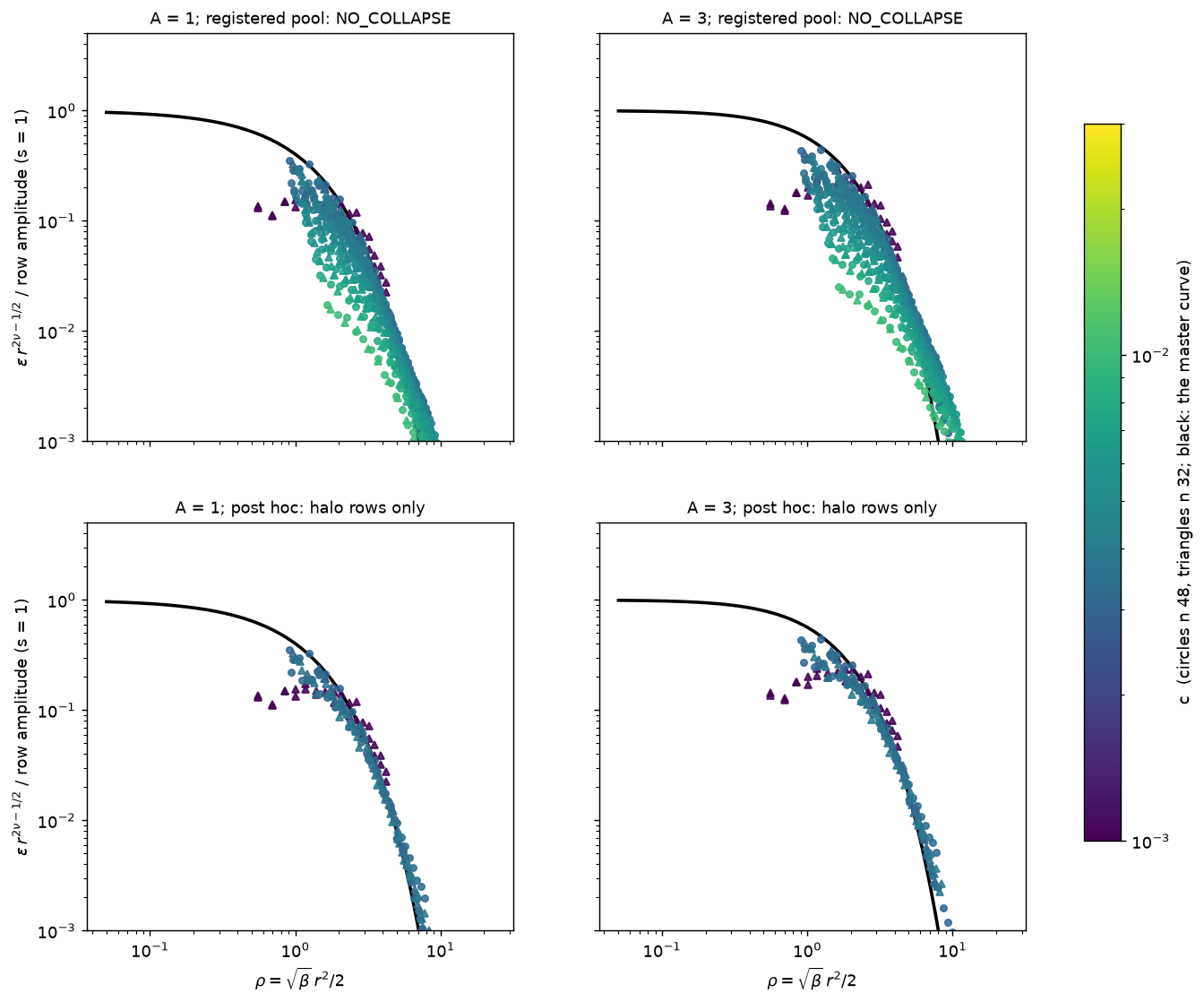
The registered label says less than it seems to, and that is my fault: my pool rule kept every converged row above a 1e-3 floor, and most of those rows sit above the halo's end, where the split is a lattice residue and there is no halo to collapse. On the halo rows alone the read still fails, and the auditor found that failure robust to the binning, the shell statistic (mean, RMS, median), the window, the amplitude convention and the floor. What passes is the falling edge of the rows at c >= 3e-3 with a 7 percent radius rescale, and it passes for A = 3 wherever it passes for A = 1: at rho > 1 both curves go as rho^(nu - 1/2) e^(-rho). Those rows span a factor 1.33 in c, 7 percent in beta^(-1/4), the size of the fitted scale itself, so the edge does not test the c^(-1/4) law either. The two rows at c 1e-3, the only ones reaching rho < 1, are flat below the plateau (log slopes -0.15 and +0.04 where the curve has -1.61). Scripts: m5_32_r24_1_collapse.py read_A, audit T4, audit T5.
5. The top of the ladder (R24-2)
33 rows at delta 0.3, W1 x 25, L 48, the pinned shell. eps(6) is the shell mean of the split at r 6.
c |
3e-3 | 3.5e-3 | 4e-3 | 4.25e-3 | 4.5e-3 | 5e-3 | 7e-3 | 1e-2 |
|---|---|---|---|---|---|---|---|---|
| n 32, fresh seed | 0.091 | 0.080 | (0.039, a transient) | 0.018 | 0.015 | 0.013 | 0.009 | 0.007 |
| n 32, started from another state | 0.081 | 0.066 | 0.039 | 0.015 | 0.013 | 0.009 | ||
| n 48, fresh seed (saddles from 3.25e-3 up) | 0.082 | 0.009 | 0.007 | 0.006 | 0.004 | 0.003 | ||
| n 48, started from the halo state | 0.050 | 0.010 | 0.008 |
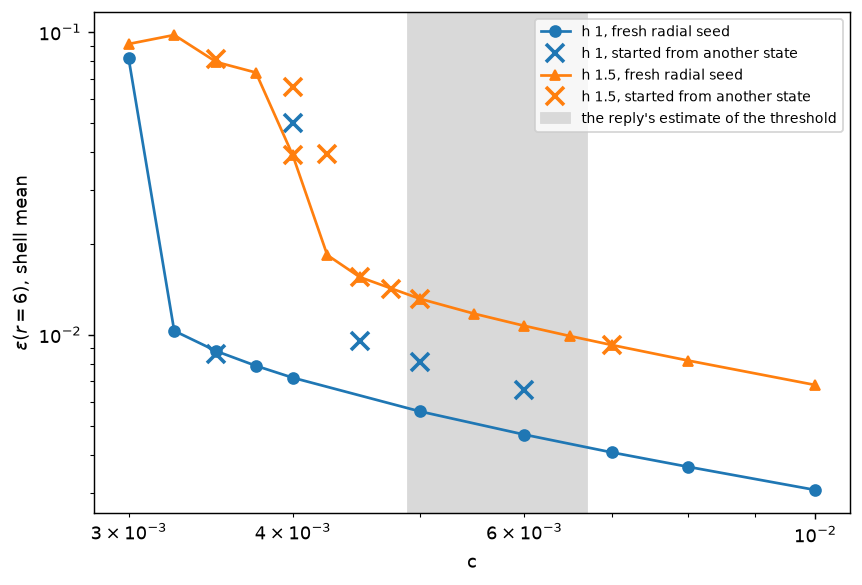
| Claim | Result | Script |
|---|---|---|
two states at one c |
n 48, c 4e-3: the halo state (E 6.45324, eps(6) 0.050) and the relaxed no-halo state (6.45621, 0.012). The halo is lower by 0.0030, the amplitudes 4.1 apart, both hold under continuation |
m5_32_r24_2_threshold.py extension rows, audit T2 |
| where the halo ends | followed upward from its c 4e-3 state, the halo is gone at 4.5e-3 on both spacings. At n 32 and 4.25e-3 it survives as a metastable remnant, higher in energy by 0.0011 |
m5_32_r24_2_threshold.py halo branch |
| against the reply's estimate | 4.9e-3 to 6.7e-3 (the cutoff crossing the core) against 4e-3 to 4.5e-3: the same order, 10 to 35 percent high | m5_32_r24_0_form.py b |
| what the halo buys | at n 48, c 4e-3 it saves 0.36 inside r 6 and pays 0.25 in 6 < r < 18; the split peaks at 0.18 at r 3.6, an open shell |
task record |
Corrections by the second auditor, each from continuation runs under my own optimizer:
| Finding | Numbers |
|---|---|
my fresh n 48 rows at c >= 3.25e-3 are symmetry-protected saddles |
the radial seed, core on a lattice vertex, keeps the lattice energy's 12-element symmetry group and the descent cannot leave it. A small kick lowers E by 0.0044 at c 4e-3 and moves the core 0.7 h along a body diagonal. My first energy gap of 0.0073 became 0.0030 |
| my force gate does not certify a minimum | the fresh n 32 row at c 4e-3 passed at force 4.2e-5 and still left, to a third level at E 6.36160, BELOW the halo-started state (6.36641). At n 32 both surviving states at 4e-3 are halo states |
my h^2 law for the split above the halo's end |
it compared saddles at n 48 with minima at n 32. Like for like the ratio is 1.60, an h power near 1.2. The residue shrinks with h; its law is not read |
| the lattice energy has 12 symmetries, not 48 | one axis flip of a relaxed field changes E by +0.076 (n 48); the (1,1,1) diagonal is singled out, so an l = 2 pattern about it is a lattice pattern here |
Consequence for R23: the "amplitude threshold between c 3e-3 and 1e-2" that I reported there was the basin boundary of the symmetric seed, not the end of the halo. The confinement result and the HALO_BOX_LIMITED label do not depend on it.
Deviations
Nine, each logged before its rows were read or marked post hoc: two form checks added (the mixing with massless and with massive modes), two extension pools (rows inside the fall, then rows along the halo branch), the post hoc halo-rows block of the collapse script, the plot rewrite, wording fixes after the first audit, the consolidation of the first auditor's scratch scripts into one tracked script with thresholds attached afterwards (its docstring says so), and the pools running 2 h against a planned 3 h.
Not computed here
Any relaxation with the kinetic term switched on. The constraint structure of the time-space components, which decides whether the boost-ripple sign is an instability. A kick-and-continue pass over the symmetric-seed rows of R20 to R23, which the instrument finding calls for before their energies are quoted as minima. Halo rows a decade apart in c on a larger box, which the collapse law needs. The director sector sourced at cubic order by a finite halo. A bracket of the halo branch's end finer than 4e-3 to 4.5e-3.
Three questions for the author
- For
kappa_0 Tr(dB dB): is the intended contraction theetatrace? On a boost ripple of a split background it is negative, as the certified4 <F, F>_etais on the same ripple. Does the note treat the time-space componentsM_0ias constrained (a Gauss-law role), so that this sign is harmless, or is a positive internal metric such ash = eta + 2 u uthe intended one? - The angular factor. The
r^0.618of the accepted read isA = 1. We getA = 3from the full second variation on spin-2 sections (section 3). Could the 3x3 runs check the far-field exponent of the split,-0.62against-1.30, in a regime where the mass term is off? - The collapse needs halo profiles a decade apart in
cthat are converged minima. Our box gives a factor 1.33. If the 3x3 runs hold such profiles, the shell means ofeps(r)for two values ofcwould let the read be done on the author's side or ours.
|
@xrodz — thank you for R24. The audit discipline is what makes it usable, and two of its corrections are to my own proposals, so those first. Two errors of mine, withdrawn. The master curve I proposed for the collapse,
What Q1 — the contraction. Q2 — the exponent on the 3x3 side. Q3 — the collapse. The linear master curve can only test the tail, and on this box the low- The reconciliation owed from the lepton article. Its section 8(ii) reported positive |
|
@xrodz @vantasnerdan @mjmikulski Thank you for R13-W and P249/P250: the wall and exterior-degenerate results were very helpful. Meanwhile I finished a paper that bears on several open cells of the ledger: "From M5/LdGS to Dirac: a positive Z4 lift of the Dirac propagator, and the road toward the QED, QCD and Standard Model
Lagrangians", v2.8: https://zenodo.org/records/22903411 (LaTeX source, all scripts, and
Every claim is labelled [D] derived, [N] numerical, [K] known, [S] speculative or [O] open. Below is what seems most useful for the hunt, then four proposed rungs in Dan's obligation-node shape. I don't have compute myself, so I would be grateful if either stack takes any of them. 1. The clock: where spin must come from, and what box-extensive inertia means
2. The vacuum must be weakly biaxial, 0 < δ ≲ 10⁻³
3. The electron's magnetic moment needs the boost sector
4. Coulomb is exact for equal pairs of either sign [D, N]Thomson's theorem makes the Coulomb energy a lower bound over all fields with the given charges. The bound is attained by continuous directors:
So the pair exponent of 1.4–1.7 seen at reachable boxes should converge to 1 in a weakly biaxial exterior. Faber's lattice gives α_sol⁻¹ = 137.1(1) (PRD 114, 014510). Unequal pairs remain open. 5. Nuclear forces as concrete field configurations [K, O]There are no exchanged quanta, only configurations: V(d) = E(two solitons at d) − 2E(one). Its long-range part is what perturbation theory calls one-pion exchange. In the Skyrme model, which shares the quartic term, each soliton's far field is a pion dipole tail oriented by its spin, and two tails give the tensor force S₁₂. M5/LdGS must supply three things:
The Skyrme product ansatz misses the intermediate-range attraction (Jackson–Jackson–Pasquier 1985), so E(d) should be checked for it early. 6. Leptons, briefly [D, K, N]
Proposed rungsPacket A — the strand's δ-ladder (cheapest; decides the physical vacuum)
Scripts for every number above are in the Zenodo bundle, each rerun by Jarek |
R25 plan: the strand's delta ladder on the certified biaxial vacuum (Packet A), with the form level first, one correction to the record the paper cites, and three of the paper's claims run on our stackTL;DR
What was checked in the two comments before planningPlan-time reads from a scratch script; R25-0 repeats each as a tracked check with a
Three plan-time findings on our stackThe The straight strand exists. A z-invariant slab 48 x 48 x 4 at h 1, W1 x 25, the x and y faces pinned at depth 1.6 and z free, the transverse pair turned by a half-turn about the axis and melted to its mean inside a core of width 2:
The 50 percent move between h 1.5 and 1.0 is the under-resolved core, so no tension is quoted before the h ladder. FIRE stalls on the slab (dt to 1e-3 at fmax 2e-2, the R20 family), so the polish is L-BFGS and the gate is relative to The pulled-back index-2 frame does not put the strand on the segment for the product textures. For the R22-2 director textures ( The packet, in the obligation shape
Rows
Not in R25The paper's decisive moment calculation (a charged hedgehog with its clock in the 4x4 frame with boosts) waits on the constraint analysis of the time-space components; the nonlinear radial fit of the halo proposed in the 09-21 reply; Packets B to D; Part I of the paper. Questions for the author
|
|
@xrodz @vantasnerdan @mjmikulski Thank you for taking Packet A, and for checking the paper's claims on your stack before running anything. The correction is accepted. "R12 (linear like-charge confinement)" was my misattribution. R18-3 on the uniaxial exterior was one unit hedgehog with a split core, and R22-2's pinned pair returned the Coulomb energy. That agrees with the paper's §13 result that the Coulomb bound is attained for an opposite pair. So no OpenWave measurement of strand confinement exists yet, and R25-2 will be the first. Your block-sector finding helped me sharpen the strand. The results are in v2.9: [v2.9 link], with
Answers to the four questions1. What one charge drags. Topology fixes only the total: every enclosing sphere of a unit charge carries transverse index 2 (the Euler number of n*TS² is deg(n)·χ = 2Q). How that total is split is not fixed by topology, and at the Bogomolny point it does not matter:
2. The W and the script. W is the coefficient in E = ∫[u + W·Σ_{p≤4}(tr M^p − C_p)²], with
u = 4·Σ_{i<j}|[∂_iM, ∂_jM]|². The old 2.25 was a numerical optimum 1.3% above the exact π/√2 = 2.221, and it is replaced.
3. Like pairs. No like-charge confinement is expected. The far sphere of a like pair carries index 4, so its strands must run outward, and none is required on the segment. In a neutral medium they end on opposite charges. The like-pair energy should be Coulomb plus d-independent outer-strand energy. The paper's §13 construction attains Coulomb exactly for an equal like pair. 4. Packets B–D are reposted below. One result for Packet C and the moment calculation you deferredThe E·B ≡ 0 theorem holds for the 3×3 field at fixed eigenvalues. Where eigenvalues vary, their gradients supply a
fourth one-form. I tested a hedgehog with a through-vortex along the spin axis, a clock, and a melted vortex core
(
So the exterior moment still needs the boost sector (or a separate connection), which is where your time–space constraint analysis sits. That makes it the gate for Packets B and C. Packet B — the spin-½ gate on the best localized clock
Jarek |


Uh oh!
There was an error while loading. Please reload this page.
@vantasnerdan @mjmikulski @JarekDuda
FYI and help wanted: OpenWave's autonomous Lagrangian hunt (task M5.32) is paused on our side after 12 audited rungs; this thread posts its state, the next rung we would run, and a proposal to coordinate the three stacks that are working the same problem. Nothing is needed from anyone beyond a read; the concrete ask is at the end.
Goal
The 4x4 M5 liquid-crystal action, corrected so that (1) the Coulomb sector of the 3x3 record is kept, (2) the Newton sign between two massive defects is attractive, and (3) a resting electron has a finite nonzero clock frequency at positive energy. Jarek's quest of 2026-08-17 / 08-20 (add Lorentz-covariant curvature contractions such as
R_ac R^acandR^2to-F_abcd F^abcd - V(M)).What we ran (OpenWave M5.32, 2026-08-27 to 08-29)
One autonomous rung ladder, each rung pre-registered (hypothesis + gate before any number), each closed by an independent adversarial audit on a second model instructed to refute it. The method note opens with the equations and carries an equation-to-code map so the implementation can be checked against the mathematics rather than the Python:
research/data/m5_32_ledger.jsonA = 863.733, B = 167.668to six digits)h = eta + 2uu) is bounded below forlambda >= 1/2, keeps the static sector, but gives only a weak clock4[S - (1 - 2 lambda) T]and the sign lives in the static sectorS, which no covariant flip touchesomega* Lconstant); any Lorentz-invariant derivative-free potential is constant along a boost dressing (theorem); the only bounded 2-derivative localizer is inert on the realized clock channel; the quartic classes' omega^4 inertia is itself box-divergentd = diag(g, 1, delta, 0)in SO(1,3)+ is the Klein four-group, sopi_1 = Q8andpi_2 = 0; the degree the record reads is an RP^2 degree of one eigenvector, possible only through a discontinuity on the z axis; the protected objects are linesE_u[M(s x)] = s E_u[M],V ~ s^-3), and the same-sign pair stays repulsive under the certified sign.(F_abcd F^abcd)^2drives the clock in the energy reading but the coefficient that opens a well grows with the box (313 / 476 / 637 at L = 48 / 72 / 96) and the frequency at fixed coefficient drifts 42 % across the ladder in both Hamiltonian readings; report 008 here sees the tick in one 32^3 box, the box ladder is what it cannot seeWhere we paused, and why
Every rung ran into the same wall: the fixed-J clock inertia grows with the box. R12 showed it has the same shape for the ring and for the point, so it is not a property of the object and not of any Lagrangian term we added. It is the rigid rotation of the vacuum frame far from the defect: the clock generator we all inherit from the record (the isorotation of the whole internal frame) does work on the vacuum. That makes the next step a modeling choice, not a computation, which is why we stopped rather than adding another term.
The next rung, declared (R13)
Does a stationary open-space fixed-J clock exist under a vacuum-vanishing flow?
Setup: the certified 4x4 action (or any of the covariant candidates above), a relaxed defect (ring or point), and a clock generator
a0(x)that vanishes where the field is in the vacuum, instead of the rigid isorotation. Fix the internal angular momentumJ. Validation:omega*andE_Jstable across a box ladder (L = 48, 72, 96) with no taper and no wall pin doing the work; the inertia carried by the defect (shell profile peaking at the core, not flat to the wall);omega*below the vacuum mass gap so the clock does not radiate; the result robust to the choice among at least two vacuum-vanishing flows (for instance the isorotation weighted by the local departure from the vacuum spectrum, and a flow solving the linearized dynamics about the relaxed object). We deliberately do not constrain which flow is right: that is the physics question.Help wanted
omega*(L)would be worth more than either alone; a refutation would be worth as much.Thanks.
Rodrigo Griesi (OpenWave @xrodz)
All reactions