Events and webhooks
warden history answers afterwards, and only if somebody thinks to look. The
interesting moments are the ones nobody is watching for: a port taken while a
deploy runs, a lease that quietly expired overnight, a holder that died and left
its port booked.
Every one of those already lands in warden's own book. This carries it further.
$ warden events
09:41:02  registered   shop-api  127.0.0.1:8600
09:41:11  renewed      shop-api  127.0.0.1:8600
09:41:44  released     shop-api  127.0.0.1:8600
warden events --json writes one event per line and flushes each as it arrives,
so it pipes into anything:
warden events --json | jq -r 'select(.action == "expired") | .name'GET /v1/events is the same stream as server-sent events, behind the same token
as every other read. See HTTP API.
Thirteen things, in three scopes. warden events --known prints this list on
any machine, so nobody has to guess what to write in webhook_events.
| Event | Means | Posted by default |
|---|---|---|
port.registered |
a name got a port it did not have | yes |
port.renewed |
a heartbeat, or a re-register on the same port | ask |
port.moved |
a name came back on a different port | yes |
port.released |
given back, by its holder or by hand | yes |
port.expired |
a lease ran out and warden took the port back | yes |
node.joined |
a warden reported in for the first time | yes |
node.returned |
one that had gone quiet is answering again | yes |
node.stale |
one stopped reporting, and is past its lease | yes |
node.forgotten |
one was removed by hand | ask |
firewall.applied |
a ruleset was made true on this machine | yes |
firewall.confirmed |
somebody kept it, and the rollback was called off | yes |
firewall.rolled_back |
nobody confirmed, so the machine went back | yes |
firewall.restored |
a snapshot was put back by hand | ask |
A node going quiet is said once, not on every listing. The same node still being quiet an hour later is not news.
webhook_events takes three ways of naming them, and mixes them freely:
warden settings set webhook_events "firewall.*, node.stale, port.registered"| Written | Means |
|---|---|
firewall.* |
every event in that scope, including ones added later |
node.stale |
that one |
registered |
the same as port.registered — the name 0.2.0 used, still understood |
warden setup asks for all of this and posts a test event before saving
anything. One setting at a time works too:
warden settings set webhook https://discord.com/api/webhooks/...
warden settings set webhook_format discord
warden settings set webhook_events registered,released
warden webhook --test
Restart the warden afterwards. It reads its settings once, at startup.
| Discord | Channel → Edit → Integrations → Webhooks → New Webhook → copy the URL |
| Slack | api.slack.com/apps → your app → Incoming Webhooks → Add New Webhook |
| Teams | Channel → ⋯ → Workflows → "Post to a channel when a webhook request is received" |
| Your own | Anything that accepts a POST |
The Teams route is a Power Automate flow because the old Office 365 connector cards are being retired; warden posts an adaptive card in a message, which is what that flow accepts.
webhook_format |
What arrives |
|---|---|
json |
The event as it is, signed. Build anything custom on this |
discord |
An embed: the event above, the subject as the title, the node in the footer |
slack |
A coloured attachment with the facts as fields, plus a text fallback for phone notifications |
teams |
An adaptive card with a toned header band, an icon and a fact set |
With webhook_format = json, this is the whole body. GET /v1/events sends
the same shape as the data: of each server-sent event.
Every event has these:
| Field | |
|---|---|
at |
when, in UTC |
scope |
port, node or firewall
|
action |
what happened, within that scope |
subject |
what it happened to: a service name, a node name, a backend |
node |
which warden is telling you |
A port event carries the registration's own fields at the top level, in the order 0.2.0 sent them. A reader written against that version does not notice that anything widened:
{
  "at": "2026-03-01T09:30:00Z",
  "scope": "port",
  "action": "registered",
  "subject": "shop-api",
  "name": "shop-api",
  "kind": "backend",
  "project": "shop",
  "host": "0.0.0.0",
  "port": 8000,
  "pid": 4242,
  "node": "hub"
}| Field | |
|---|---|
name |
the service, the same as subject
|
kind |
what it said it was |
project |
its project, or null
|
host port
|
where it is bound |
pid |
the process, when it gave one |
Anything else puts what it has in body, and leaves the port fields out
rather than sending them empty:
{
  "at": "2026-03-01T09:30:00Z",
  "scope": "node",
  "action": "stale",
  "subject": "build-01",
  "body": {
    "url": "http://build-01:7010",
    "last_seen": "2026-03-01T09:28:00Z"
  },
  "node": "hub"
}
{
"at": "2026-03-01T09:30:00Z",
"scope": "firewall",
"action": "rolled_back",
"subject": "nftables",
"body": { "snapshot": 3 },
"node": "hub"
}| Scope | subject |
body holds |
|---|---|---|
node |
the node's name |
url, and pool version on joining, last_seen when it goes quiet |
firewall |
the backend |
rules, rollback, reason on applying; snapshot on going back |
body is open on purpose: an event added later can carry what it needs without
the shape changing again.
| Header | |
|---|---|
X-Warden-Event |
the bare action — registered, stale
|
X-Warden-Scope |
port, node, firewall
|
X-Warden-Node |
which warden sent it |
X-Warden-Signature |
sha256=…, when a secret is set |
X-Warden-Event keeps the bare action rather than the full name so that a
receiver routing on it since 0.2.0 keeps working. The scope is beside it.
Each event comes with a colour, an icon and the words that follow the subject — green and an inbox tray for a port being taken, red for a node going quiet. Naming one changes that one and leaves the other twelve alone.
The Embed tab of warden settings picks an event, takes the three, and draws
the message it would send underneath as you type:
warden settings embed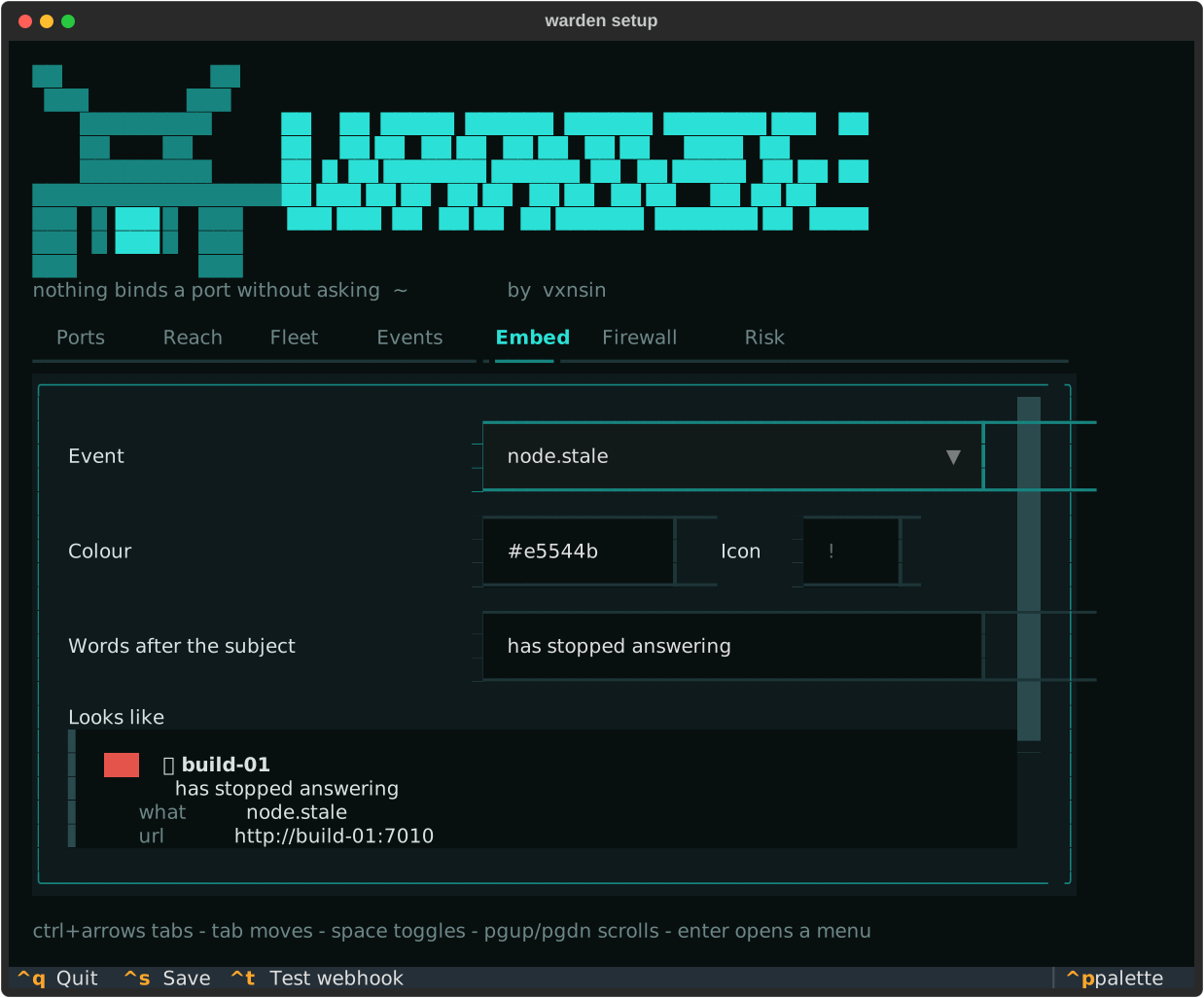
It writes three settings, which can be set by hand instead:
warden settings set webhook_colours "node.stale=#e5544b, port.moved=#c8892a"
warden settings set webhook_titles "node.stale=has stopped answering"
warden settings set webhook_icons "node.stale=!, port.moved=-"
! build-01
has stopped answering
| Setting | What it changes |
|---|---|
webhook_colours |
The stripe on a Discord embed, the bar on a Slack attachment. #4c9a5b or 4c9a5b
|
webhook_titles |
The words after the subject, in every shape that shows words |
webhook_icons |
What stands in front of the subject. A single - means none at all |
In warden.toml all three are inline tables, one entry per event:
webhook_colours = { "node.stale" = "#e5544b", "port.moved" = "#c8892a" }
webhook_titles = { "node.stale" = "has stopped answering" }
webhook_icons = { "node.stale" = "!" }
A colour that is not one keeps the colour it came with, rather than posting something the far end will refuse: losing the stripe beats losing the message.
json carries none of it. It sends the event, and whatever reads it decides
how that should look — which is the point of having it.
There is no template to write. A shape that can be edited freely is a shape that can be edited into invalid JSON, and a broken embed is not noticed until the moment it matters.
Discord puts the event name and the mascot in the author line, the icon and the subject in the title, the sentence under it, the facts as inline fields, and the node in the footer — the node is the same on every message in the channel and does not deserve a field of its own. Addresses are set as code, so they are not something to hunt for in the middle of a line.
Slack wraps everything in one attachment, which is the only way Slack will
draw a coloured bar down the side of a message. The mascot rides along as the
section accessory, the facts go in a two-column field block, and the time is
sent as <!date^…> so it renders in whichever timezone the person reading it is
sitting in. The plain text is still there for phone notifications and for
clients too old for blocks.
Teams cannot be given a hex colour, so the header band takes the nearest
tone the format has a name for — good, warning, attention — which comes
from what the event means rather than from the colour you chose for it. The
icon sits beside the subject, and the facts go in a fact set below. An adaptive
card has no code spans, so an address there is written plainly.
None of the three repeats what its own sentence already said: an address in the line is not an address in a field underneath it as well.
warden webhook --all                 # one made-up event of each kind, in order
warden webhook --event node.stale    # just that one
warden webhook --test                # one port.registered, as before
Posted one at a time and in order, because a chat window shows them in the order they land. Nothing is registered, nothing changes: the events are made up on the spot, and only the message is real.
port.registered       posted
port.renewed          posted
...
firewall.restored     posted
to https://discord.com/api/webhooks/...
With json and a webhook_secret, every post carries a signature:
X-Warden-Signature: sha256=b1646dcf...
That is an HMAC over exactly the bytes that were sent, keyed with the secret. warden serialises the body itself rather than leaving it to the HTTP client, because a signature over a body somebody else re-serialises signs something else.
expected = hmac.new(secret.encode(), request.body, hashlib.sha256).hexdigest()
hmac.compare_digest(request.headers["X-Warden-Signature"], f"sha256={expected}")
Every post also carries X-Warden-Node and X-Warden-Event, whatever the shape.
Handing out a port never waits on a webhook. Delivery happens after the change is committed and off the request path, retried three times and then given up on. A chat server having a bad afternoon cannot make a port take longer to hand out. A reader that falls behind loses its oldest event, never its newest, and never the write.
A webhook that fails is not allowed to fail quietly. From the inside, one
failing all day looks exactly like a quiet day. warden webhook and
warden doctor both report the target, the shape and the last failure:
$ warden doctor
...
warn  events to https://discord.com/... are not arriving - Server error '502 Bad Gateway'
The address is always cut back to its host. A webhook URL is a credential, and its path is the half worth stealing.
Every warden reports its own events, so every node you want to hear from needs the setting. A hub does not relay its nodes' events — a node that cannot reach the hub still hands out ports, and the same independence applies here.