



Make the gap between “passes the benchmark” and “reviewable by a chip-design team” explicit.
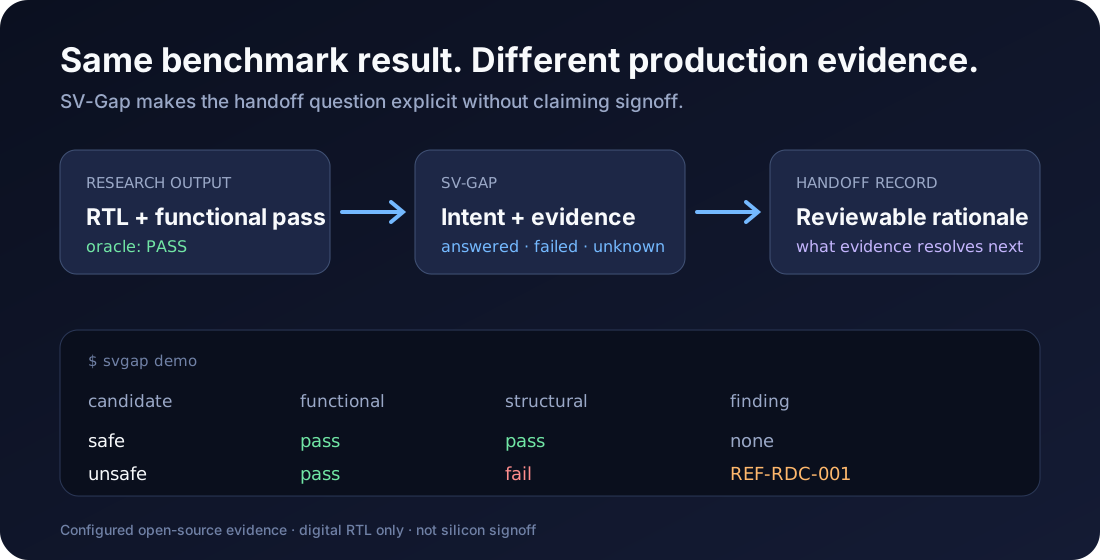
SV-Gap is an open evaluation layer for AI-generated digital RTL: LLM-written Verilog and SystemVerilog scored today by functional benchmarks. It preserves the functional result, adds declared design intent for clock-domain crossing (CDC), reset-domain crossing (RDC), and power-on state, and reports the structural evidence a hardware verification or signoff team can review: which production questions are answered, failed, or still unknown.
Supply RTL and evaluation evidence. Receive a reviewable account of what that evidence establishes, what it contradicts, and what evidence would resolve the remaining uncertainty.
| Goal | Start here | Time |
|---|---|---|
| Name one unanswered production question | Open a one-sentence issue | 60 seconds |
| Understand the result without installing anything | Inspect the controlled result or a public model profile | 2 minutes |
| Create and interpret a local evidence profile | svgap study quickstart --output my-first-svgap-study after installation |
2 minutes |
| Evaluate one model or agent | Run the packaged smoke study | about 10 minutes after prerequisites |
| Run or report the Harbor experiment | Use the eight-task Harbor path | 2 minutes to report; run time varies |
| Scope a qualification experiment | Request a research call or email the maintainer | 30 minutes |
Do not send proprietary RTL or confidential constraints through GitHub or email. A public or synthetic artifact is enough for the first experiment.
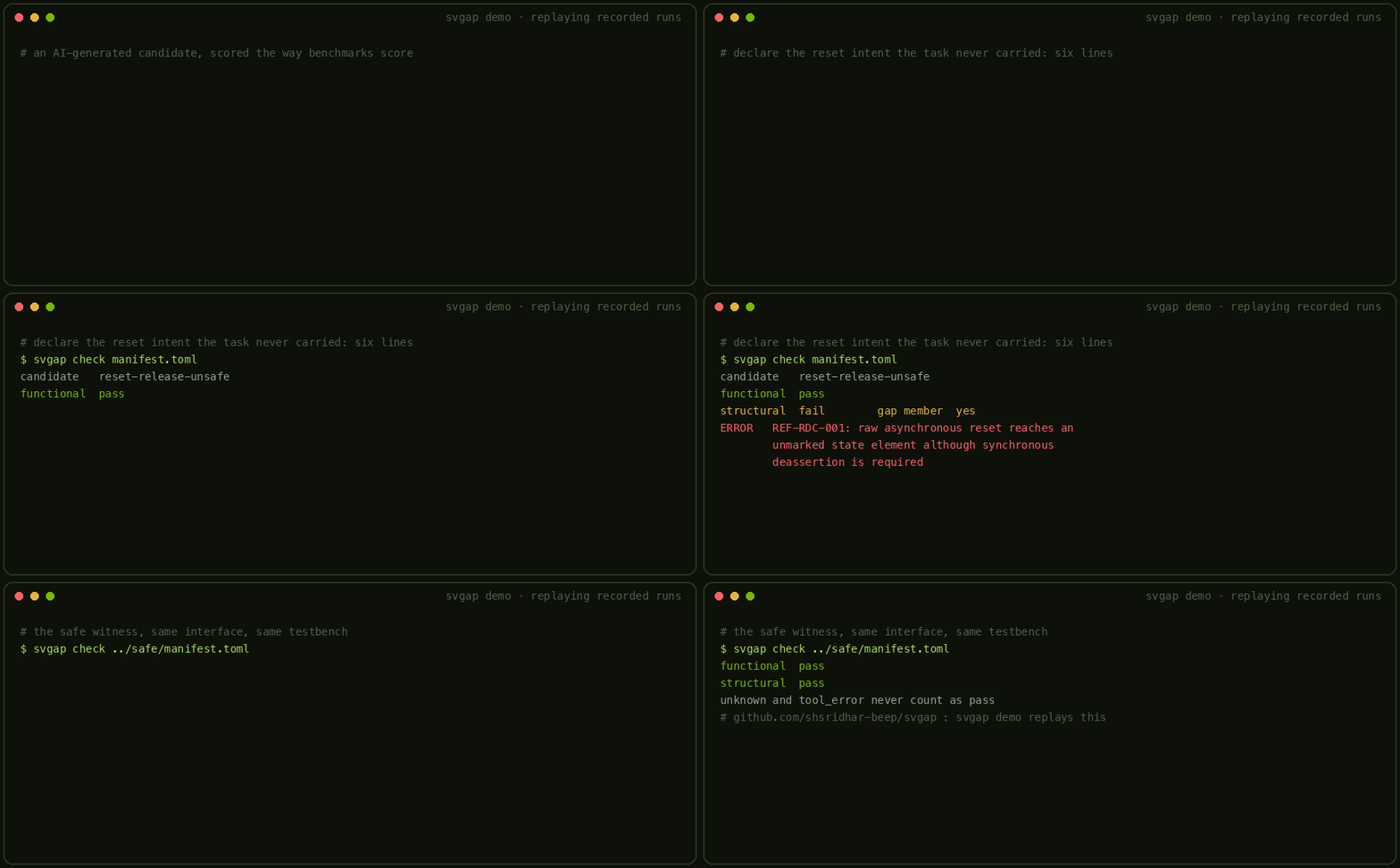
candidate  functional  structural  finding
safe       pass        pass        none
unsafe     pass        fail        REF-RDC-001
Both implementations pass the supplied functional test. Declared reset-release intent and configured structural evidence distinguish them. This is an executable existence result: it is not a defect-rate estimate, certification, or silicon signoff.
| Surface | Current support | Boundary |
|---|---|---|
| Domain | AI-generated digital RTL | Analog and mixed-signal design are out of scope |
| Initial properties | Documented CDC/RDC and power-on reset-coverage patterns | Not comprehensive structural signoff |
| Research tracks | Generation, diagnosis, and repair | Profiles remain multidimensional; no scalar leaderboard |
| Functional evidence | Executed commands or digest-bound imported results | Evidence quality remains visible |
| Structural backend | Narrow open Yosys reference backend | Backend pass means no configured finding, not a true negative |
| Outcomes | pass, fail, unknown, tool_error |
Missing intent or coverage never becomes pass |
| Platforms | Python 3.11–3.13; tested on macOS and Linux | Native Windows is not tested; use Docker Desktop or WSL2 |
Read the full methodology, limitations, and scope boundary before making claim-bearing use of a profile.
- SV-Gap runs locally and performs no telemetry or artifact uploads. A model generator command supplied by the user may contact its configured provider.
- Generated RTL and functional commands are untrusted input. Do not evaluate them on a workstation containing credentials or sensitive source trees.
- The recommended two-stage workflow generates in the credentialed environment and evaluates saved responses in a network-disabled, read-only container.
- Only open-source runtime tools are assumed by default. Tool versions, provenance, unknowns, and errors remain in the evidence record.
- SV-Gap is evidence infrastructure, not a replacement for organizational review, commercial verification, or signoff.
- GitHub's automatic contributor graph reflects commit authors, including disclosed AI assistance; it is not a roster of verified human researchers. Maintainer accountability and accepted contributions are documented in CONTRIBUTORS.md.
Follow the isolated evaluation recipe for model or contributor outputs you have not reviewed.
The browser result above is the fastest path from a new visit to the research idea. The container includes the complete open RTL toolchain, but its first large image pull depends on network speed; the demo itself runs in under two minutes once the image is cached:
docker run --rm ghcr.io/shsridhar-beep/svgap:v0.3.0-alpha.9 demoFor a native macOS installation:
brew install yosys icarus-verilog
python3 -m venv .venv
.venv/bin/python -m pip install svgap==0.3.0a9
.venv/bin/svgap doctor
.venv/bin/svgap study quickstart --output my-first-svgap-study
quickstart evaluates a clearly labelled bundled unsafe fixture, writes a
portable HTML evidence profile, and prints the exact report to pass to
svgap explain. It teaches the workflow; it is not a model result. Run
.venv/bin/svgap demo for the paired safe/unsafe executable witness.
Ubuntu, Debian, CI, and troubleshooting instructions are in
Linux installation and doctor checks.
If doctor finds a missing prerequisite, it prints the installation command
or container fallback rather than leaving the user at a missing-tool report.
Any model harness can participate: read a prompt from stdin and write the model response to stdout.
svgap study run reset-release-v0.2 \
  --command "python3 my_generate.py" \
  --label my-model-a \
  --smoke \
  --output my-first-svgap-study
The run produces a portable summary, evidence-file list, reports, and static
HTML profile. Replace --smoke with --full for the frozen eight-task,
three-sample protocol. See Evaluate your model.
For existing RTL, use svgap init, validate, check, and explain; the
bring-your-own-RTL tutorial includes an executable
manifest and imported-result path. Python integrations can call
svgap.evaluate(manifest); see the Python API.
- Five controlled witness pairs have identical functional outcomes and different configured structural outcomes.
- A frozen 72-call reset-release study contains 57 functional passes; at least 14 contain the declared raw-reset pattern.
- A heuristic inventory covers 508 public RTL-generation tasks across VerilogEval, RTLLM, and CVDP.
- A separate audit of those 508 tasks inventories stated power-on intent and recognizable unknown-initial-state scoring.
- Two reproducible open-weights profiles demonstrate the public submission path; they are maintainer-produced anchors, not independent replications.
Controlled result · Reset result · Benchmark audit · Power-on audit · Evidence profiles · Compact research note
These are bounded existence, taskpack-conditional, and heuristic results. They are not a population defect estimate, general model ranking, or signoff claim.
The preferred entry point is one question a functional RTL evaluation leaves unanswered. A 30-minute scoping call should end with a bounded qualification experiment, explicit claim boundary, and go/revise/stop decision.
- Research-call intake
- Report a Harbor run or setup blocker
- Current research collaboration pulse
- Private maintainer email
- Design-partner workflow
- One-page experiment contract
- Replication and co-design discussion
Joining a call is not contributor status. Named credit follows accepted, attributable protocol design, redistributable evidence, task design, analysis, validation, documentation, or code. See Contributors and Contributing.
- Submit a result
- Write a checker backend
- Integrate an existing benchmark
- Use the GitHub Action or container
- Good first issues
- Roadmap
SV-Gap is early research software maintained by Shraddha S, who is accountable for project direction, incorporated changes, research claims, and releases. Material AI development assistance is disclosed in CONTRIBUTORS.md.
Cite the exact release used. The independently fetched and scanned alpha.5 archive is doi:10.5281/zenodo.21226232. The all-versions DOI always resolves to the latest archived release.
Apache-2.0. External tools and imported datasets retain their own licenses.