Your tool returned 50KB. Your harness forwarded only 9KB. toolseen shows what changed between the two.
A harness can truncate, filter, summarize, or alter a tool result before passing it downstream. toolseen compares the original value with the downstream value you measured.
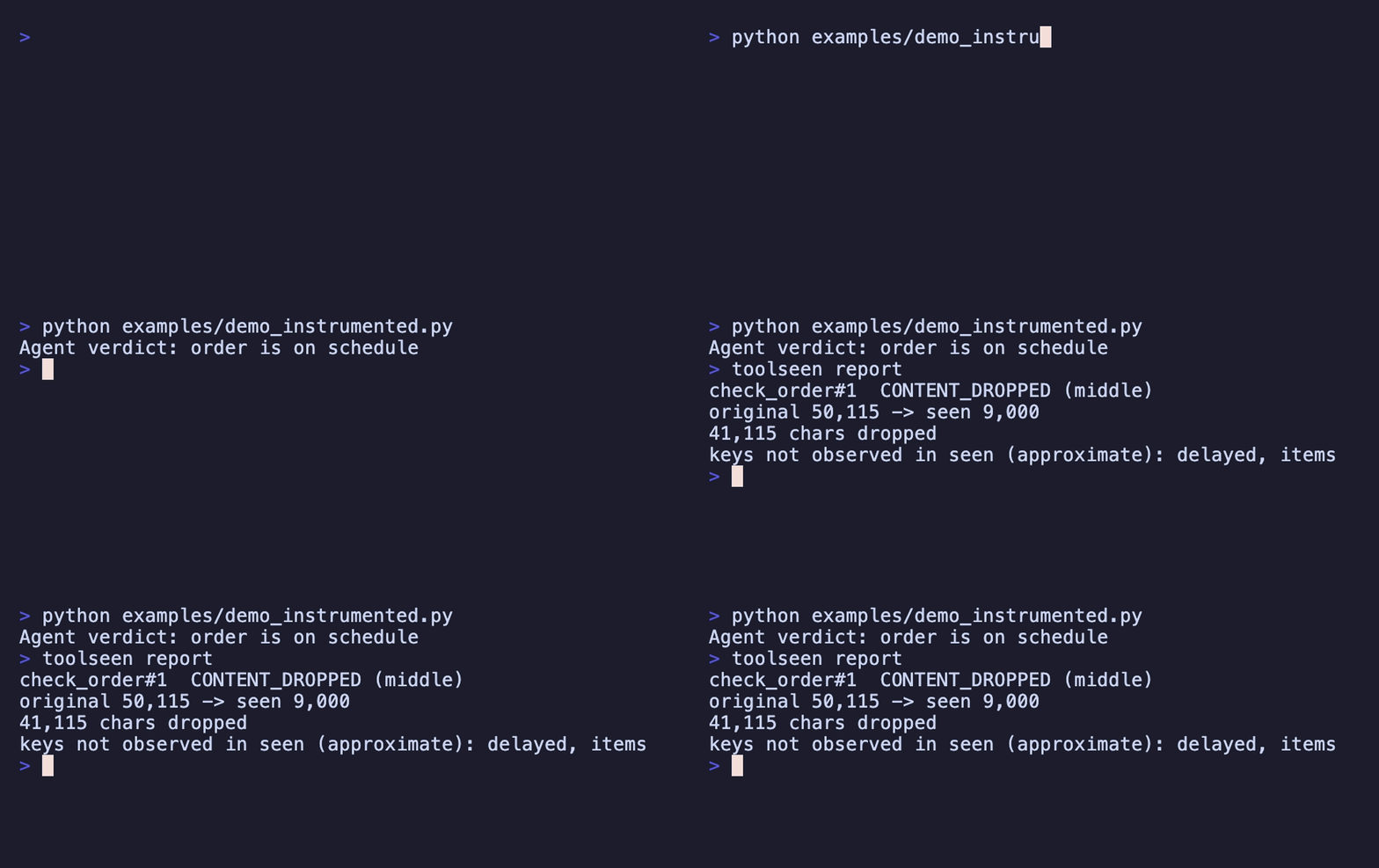
That is the whole problem in eleven seconds. A fake tool returns ~50KB of JSON with "delayed": true in the middle. A fake harness keeps only the head and the tail. The agent checks whether the word delayed reached it, finds nothing, and reports that the order is on schedule.
Nothing errored. Nothing warned. The fake agent was answering from text that no longer contained the key fact, and toolseen report is what makes that visible.
pip install toolseen

# from a checkout
pip install -e ".[dev]"
Requires Python 3.10+. No runtime dependencies. Comparison is local and deterministic. No network calls or model API.
If you can get both values—two log lines, two captured payloads, or two request bodies—compare() is the whole API. For files, use the CLI below.
from toolseen import compare

verdict = compare(original_text, seen_text)
print(verdict.kind)
Optional arguments: threshold=64 (minimum dropped characters for drop/truncation kinds), ignore_ws=False.
toolseen compare original.txt seen.txt [--threshold 64] [--ignore-ws]CONTENT_DROPPED (middle)
original: 50,000 chars
seen: 9,000 chars
dropped: 41,000 chars
cause: unknown
mode: raw
keys not observed in seen (approximate): delayed, carrier_notes
If you control the code that calls your tools, wrap the call instead of carrying the strings around.
from toolseen import watch_call, saw

call_id, result = watch_call(check_order)      # records what the tool returned
delivered = my_harness(result)                 # whatever your pipeline does
saw(call_id, delivered)                        # records what went downstream
toolseen reportcheck_order#1 CONTENT_DROPPED (middle)
original 50,115 -> seen 9,000
41,115 chars dropped
keys not observed in seen (approximate): delayed, items
By default, toolseen report reads the newest session under .toolseen/ in the current working directory.
report() is available from Python too, returning (call_id, Verdict) pairs:
from toolseen import report

for call_id, verdict in report():
    print(call_id, verdict.kind)
watch_call preserves the wrapped function's return value and exception behavior. A str return is recorded as-is; other allowed types are serialized with json.dumps(..., sort_keys=True). Events go to .toolseen/session-<uuid>.jsonl, created 0700/0600 with a .gitignore alongside, and toolseen refuses to record when that is not the case.
Phase 2 requires O_NOFOLLOW and is unavailable on platforms that do not provide it. compare() and toolseen compare are unaffected.
# the recording above
python examples/demo_instrumented.py
toolseen report

# file comparison, no instrumentation needed
python examples/demo_agent.py
toolseen compare examples/original.txt examples/seen.txt
These demos do not claim to model any commercial product's truncation rules.
| Code | Meaning |
|---|---|
| 0 | Every verdict is OK |
| 1 | One or more non-OK verdicts |
| 2 | Input / session / schema error |
| Kind | Meaning (short) |
|---|---|
OK |
Exact, JSON-semantic, or (optional) whitespace match |
EMPTY_SEEN |
Original non-empty-like; seen empty-like ("", null, [], …) |
SUSPECTED_STRINGIFIED |
Seen fully matches closed patterns like [object Object] |
TRUNCATED |
Exactly one known truncation marker; pieces fit original |
CONTENT_DROPPED |
Large head/tail/middle drop without a marker; cause unknown |
SCHEMA_MISMATCH |
Both sides JSON objects; top-level key sets differ |
MODIFIED |
Any other difference (redaction insert, rewrite, …) |
CONTENT_DROPPED is not always truncation—it may be filtering or intentional removal.
toolseen compares the two boundaries you provide or measure. It does not guarantee what the model ultimately received, and it does not auto-hook Codex, Claude Code, Gemini CLI, or any other harness.
- If you pass the wrong two values, the verdict is still correct for those two values.
keys not observed in seen (approximate)is a substring heuristic on top-level JSON keys, not proof a field was deleted.- The capture layer records one process and does not share a session across processes.
- Phase 2 is intended for ordinary local development, not as a tamper-evident audit log.
Tool results can contain secrets, PII, or tokens, and session files hold what your tools returned. Keep .toolseen/ and production payloads out of public commits and issues.
MIT