Repository navigation
Releases: zeikar/chordotomy
Release list
v0.3.1

The agent skill now writes out a song's chords, and installs into other agents too.
uv tool install --upgrade "chordotomy[model]"   # or pip install -U "chordotomy[model]"
npx skills add zeikar/chordotomy                # the skill, for Claude Code, Codex, Cursor and others
Everything still runs locally; your audio never leaves your machine.
What's new
extract-chordsreplacesexplain-harmony. Hand it a recording, a YouTube link or a.chords.jsonand it writes out the key and a timed chord chart; it explains the harmony when you ask. In the Claude Code plugin it is/chordotomy:extract-chords.- skills.sh.
npx skills add zeikar/chordotomyinstalls the skill for agents other than Claude Code. Installed that way, it runs this release throughuvxwith the model extra, or the DSP engine where torch has no build, as on an Intel Mac. - Viewer. The big chord name keeps its descenders (the g of E♭aug is no longer clipped).
- PyPI. The description and keywords name chord recognition, key changes and the lv-chordia model, and the README is shorter, with install details moved to docs/install.md.
The timeline JSON is still schema 11, and the chord and beat scores are unchanged from 0.3.0.
v0.3.0
chordotomy now follows a song through its key changes, and a timeline can say where its recording came from.
uv tool install --upgrade "chordotomy[model]"   # or pip install -U "chordotomy[model]"
chordotomy analyze song.mp3 --source-url "https://www.youtube.com/watch?v=..."
Everything still runs locally; your audio never leaves your machine.
What's new
- Key regions. A song that changes key is split into regions, and every numeral, role and function is read in its own region's key. adrenaline!!!'s E → G → E → G → E → F now comes out as the song goes, where 0.2.0 read all of it in G major. The regions come from the chords alone, so editing a chord in the viewer moves them too.
--keystill analyzes the whole song in one key. docs/harmony.md has the rules, and docs/decisions.md the songs behind the penalty. --source-url.analyzestores the web page a recording came from in the JSON, and the viewer links to it. The CLI never fetches it.- Viewer. Chords are named and spelled in their key region, and the key changes are listed. A timeline opened without its recording plays its chords alone. Corrections can add a ninth (Cadd9, Cmadd9).
- Bass (model engine). In band mixes, a root sounding below a bass inversion no longer wins over the inversion lv-chordia's bass head is sure of, so a D/F♯ stays D/F♯. The dataset scores are unchanged.
- Claude Code plugin. The
explain-harmonyskill takes a YouTube link (anything yt-dlp reads). It runs yt-dlp throughuvx, so only ffmpeg has to be installed, and it explains key changes. - Evaluation, for development.
chordotomy evaluate --cachekeeps the slow stages between runs, andchordotomy evaluate local <folder>scores your own recordings against chord charts you type in.
Breaking: the timeline JSON is schema 11
0.2.0 wrote schema 8.
- 9 added
source.url. - 10 added the key regions, and made
numeral,role,functionandtargetrelative to the region containing the segment. - 11 renamed
keytoglobal_keyandkeystokey_regions, and added themaj(9)andmin(9)qualities with theadd9numeral. No recognizer writes them; they come only from corrections.
The viewer still opens schema 4 to 10 and saves 11. Anything else that reads the JSON should follow docs/timeline-json.md.
The chord and beat scores are unchanged from 0.2.0 on both engines.
v0.2.0
chordotomy is now on PyPI, and the model engine finds the beats with Beat This!.
uv tool install "chordotomy[model]"   # or pip install "chordotomy[model]"
chordotomy analyze song.mp3           # writes song.chords.json
Without [model] you get the DSP engine only. Everything still runs locally; your audio never leaves your machine.
What's new
- On PyPI. Install with
uv tool install,pipxorpipinstead of cloning the repository. - Better beats for the model engine. Its beat grid now comes from Beat This! (Foscarin, Schlüter and Widmer, ISMIR 2024; code and weights MIT), whose beat activation feeds librosa's one-tempo tracker. The DSP engine keeps librosa's grid, so the two engines' beats can differ for the same file.
chordotomy fetch-weights. Beat This!'s weights (81 MB) are downloaded on the first model-engine run into~/.cache/chordotomyand checked against a pinned SHA-256 on every load. This command fetches them ahead of time. Without network and without the file,analyzestops with an error that names the fix; it never falls back silently.
Accuracy (model engine)
| before | now | |
|---|---|---|
| Tiny AAM majmin / sevenths | 0.934 / 0.898 | 0.950 / 0.914 |
| GuitarSet majmin / sevenths | 0.872 / 0.819 | 0.900 / 0.847 |
| Beat F, Tiny AAM / GuitarSet | 0.827 / 0.517 | 0.896 / 0.919 |
GuitarSet is in Beat This!'s training data, so its row is scored with the fold checkpoints, each take by the checkpoint that did not train on it. The DSP engine's scores are unchanged. These are development numbers, not a benchmark claim; docs/ARCHITECTURE.md has every column and its caveats.
The JSON format is unchanged (schema 8).
chordotomy 0.1.0
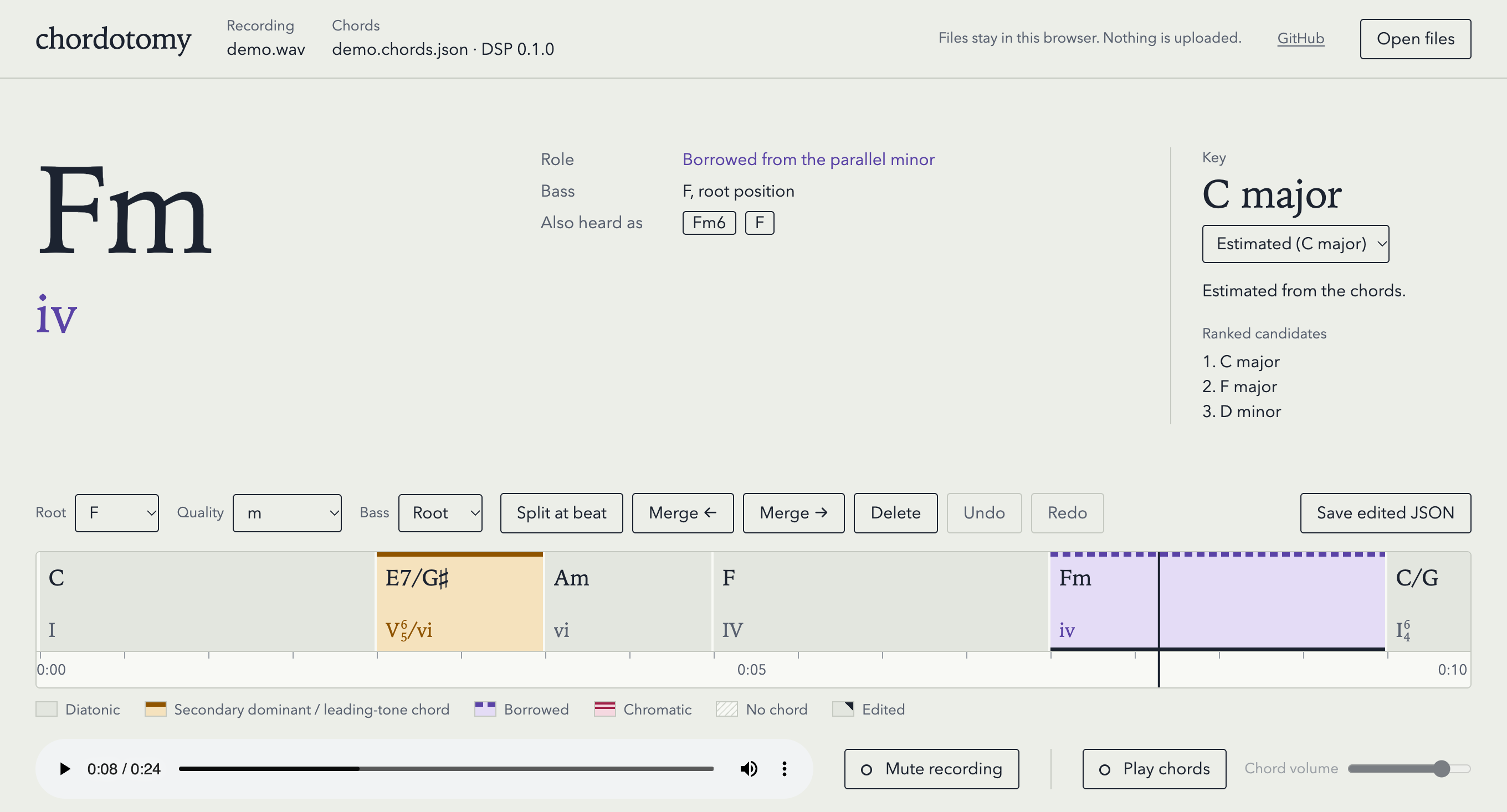
The first tagged release of chordotomy: give it a recording and it finds the chords on the beat, labels them with Roman numerals, and highlights the moves worth noticing. Everything runs locally; your audio never leaves your machine.
What's in it
- Chords on the beat: major, minor, dominant 7th, major 7th, minor 7th, half-diminished 7th, diminished 7th, sus4, 7sus4, augmented, diminished triad, sus2 and minor 6th, with
Nfor no chord. - Two engines: the lv-chordia model (Jiang, Chen, Li and Xia, ISMIR 2019; MIT code and weights) with
uv sync --extra model, or chordotomy's own DSP front end without it. - Key and Roman numerals with figured bass; secondary dominants, secondary leading-tone chords and borrowed chords are labeled.
- Bass and inversions: slash chords from the bass note, with a weak bass outside the chord shown at root position rather than as a doubtful slash chord.
- A viewer at https://zeikar.dev/chordotomy/ that plays the recording with its chords, plays the chords to check them by ear, and lets you correct and enter chords. It reads your files in the browser and uploads nothing.
- A Claude Code plugin with the
explain-harmonyskill, which explains the highlighted moves from the chord timeline. - A documented JSON format (schema 8), described in
docs/ARCHITECTURE.md.
Accuracy
Scored with mir_eval by chordotomy evaluate, duration-weighted:
| root | majmin | sevenths | |
|---|---|---|---|
| Tiny AAM, lv-chordia model | 0.939 | 0.934 | 0.898 |
| Tiny AAM, DSP front end | 0.842 | 0.803 | 0.768 |
| GuitarSet, lv-chordia model | 0.827 | 0.872 | 0.819 |
| GuitarSet, DSP front end | 0.722 | 0.696 | 0.583 |
Development numbers, not a benchmark claim; docs/ARCHITECTURE.md has every column and its caveats.
Install
git clone https://github.com/zeikar/chordotomy && cd chordotomy
uv sync --extra model          # or plain `uv sync` for the DSP only
uv run chordotomy analyze song.mp3