Repository navigation
GPU Arbitration
Explanation. How agentbox shares one GPU between Ollama and on-demand vLLM servers without pulling a model out from under a running agent.
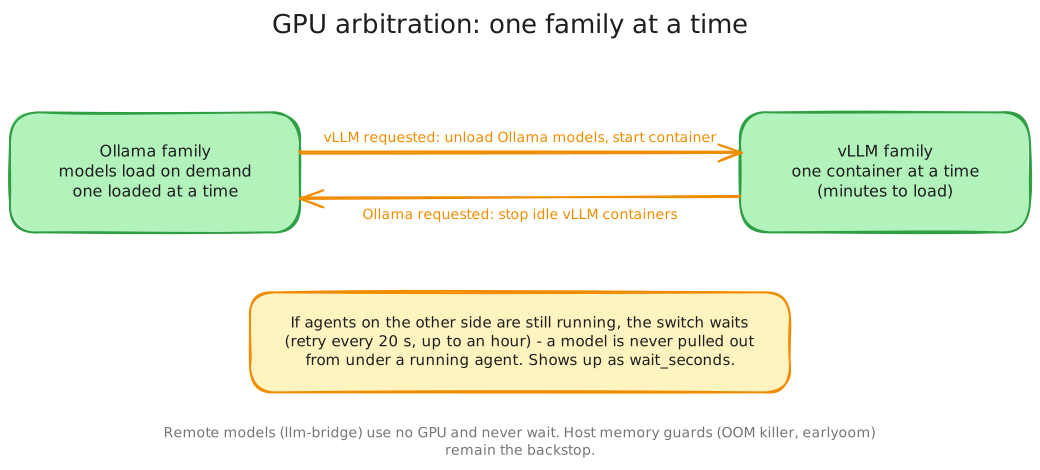
- One vLLM model at a time. Starting vLLM model A stops any idle vLLM container for model B. If B has running agents, the request waits.
-
One GPU family at a time.
- Before a vLLM model starts, Ollama is asked to unload its models (
keep_alive: 0). - Before an Ollama model is used, idle vLLM containers are stopped.
- Either switch waits while agents on the other side are running.
- Before a vLLM model starts, Ollama is asked to unload its models (
-
Waiting is bounded and visible. agentbox retries every 20 s for up to an hour, and reports the time as
wait_seconds. Batch tasks per model instead of alternating models. - Remote models don't count. They use no local GPU and never wait for arbitration.
-
Concurrency per model is
max_agentsinmodels.yaml. Keep it ≤ vLLM's--max-num-seqsorOLLAMA_NUM_PARALLEL.
Arbitration decides which containers run, not how much memory they take. Size each vLLM entry's
--gpu-memory-utilization / --kv-cache-memory-bytes for your GPU. On unified-memory machines (for
example NVIDIA GB10), keep a host-level memory guard (earlyoom, or your own watchdog) as a backstop.