Repository navigation
Life of a Delegation
Explanation. Step by step: what happens between a
delegate_taskcall and a merged change.
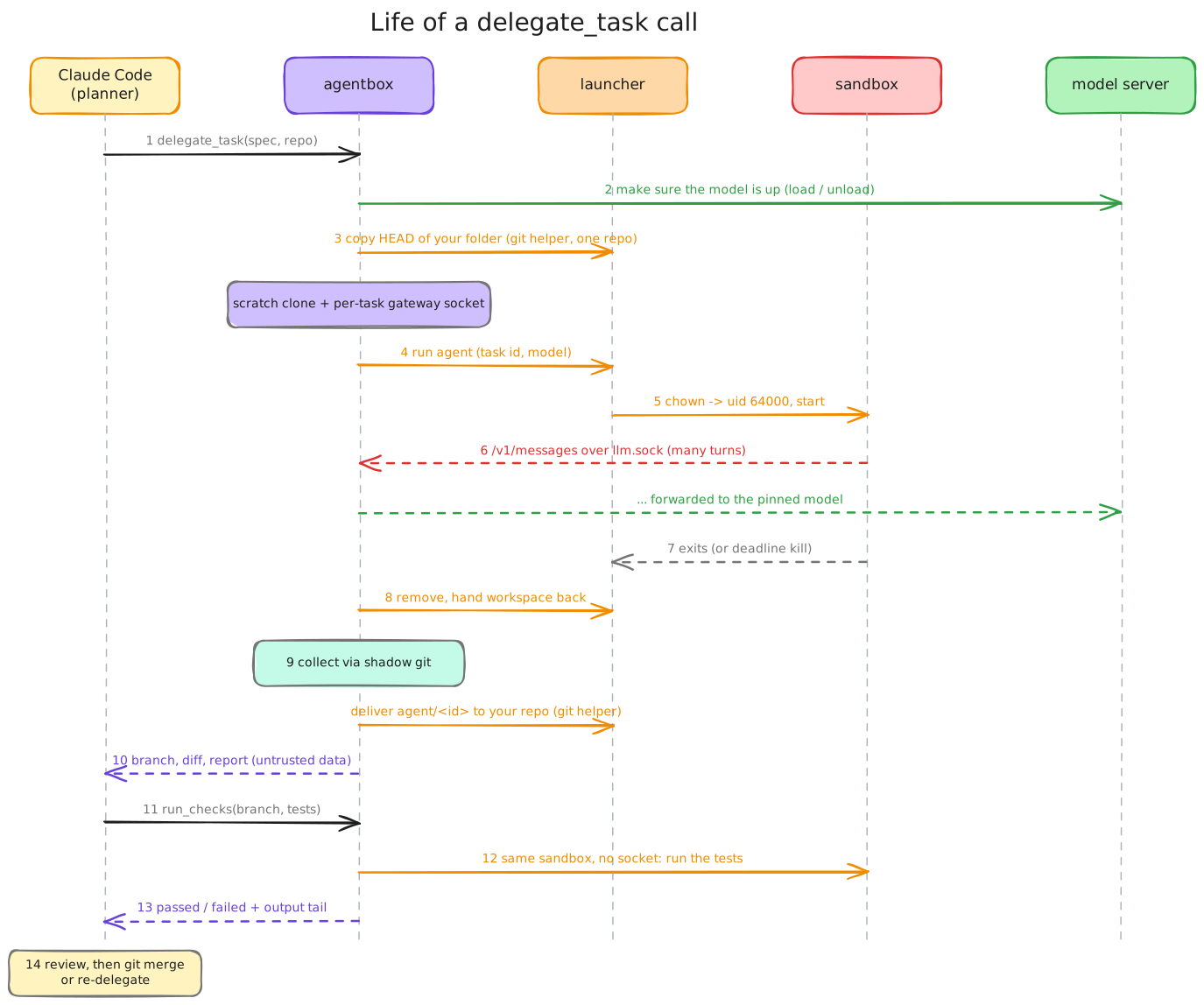
-
Call. The planner calls
delegate_task(task, repo_path, model, …)with its current folder asrepo_path. agentbox checks that the model exists and that the path is an absolute path inside theAGENTBOX_REPOS_ROOTallowlist. The task then waits for a slot on that model's semaphore (max_agents). -
Backend. agentbox makes sure the model is servable:
- vLLM models are started by the launcher if needed, which can take minutes the first time;
- Ollama models are pulled if missing;
- remote models are checked through llm-bridge.
If the GPU belongs to the other family and agents are still using it, the call waits. See GPU arbitration. Time spent here is reported as
wait_seconds. -
Prepare.
- The launcher starts a git helper that mounts only that folder, read-only. The helper finds the repo
root (walking up from a subfolder, and handling git worktrees), refuses anything not owned by you, and
copies the
HEADcommit into a bare shadow git dir. - A scratch clone of it becomes the workspace, on a new branch
agent/<id>. - A per-task gateway starts on
sockets/<id>/llm.sockwith a one-time token.
Anything uncommitted in your checkout is not included.
- The launcher starts a git helper that mounts only that folder, read-only. The helper finds the repo
root (walking up from a subfolder, and handling git worktrees), refuses anything not owned by you, and
copies the
-
Launch. agentbox asks the launcher to run the agent. It sends only the task id, the model, the
claude …command, a short env allowlist and an optional venv path. -
Start. The launcher hands the workspace to uid 64000 with a throwaway
chowncontainer, starts the hardened sandbox, and arms a hard deadline. -
Work. Claude Code runs headless (
claude -p <spec> --output-format json). Every model call goes through the socket to the gateway. The gateway checks the token, pins the model, strips server-side tools, meters tokens and enforces the budget. The executor guide (CLAUDE.md) is installed unless disabled. -
Exit. The agent finishes, or the deadline kills it.
-
Hand back. agentbox removes the container, and the launcher hands the workspace back to your uid.
-
Collect. agentbox commits the workspace's files through the shadow git dir. Then a git helper, which mounts only your repo, fetches branch
agent/<id>into it. Nothing in the agent's own.gitis executed. -
Return. The planner gets the branch, status, the agent's report, the diff, token usage and timings, all marked as untrusted data. A record is appended to
$AGENTBOX_DATA/logs/delegations.jsonl. -
Verify. The planner calls
run_checks(repo, branch, command). -
Test. The same kind of sandbox, without any socket, checks out the branch and runs the command.
-
Result. Pass or fail, plus the tail of the output.
-
Decide. The planner merges (
git merge --no-ff agent/<id>, thencleanup_delegation) or re-delegates with the failing output pasted into a corrected spec.