Repository navigation
How agentbox Works
Explanation. This page describes the moving parts and why each exists. For steps, see the how-to guides; for exact settings, see Reference.
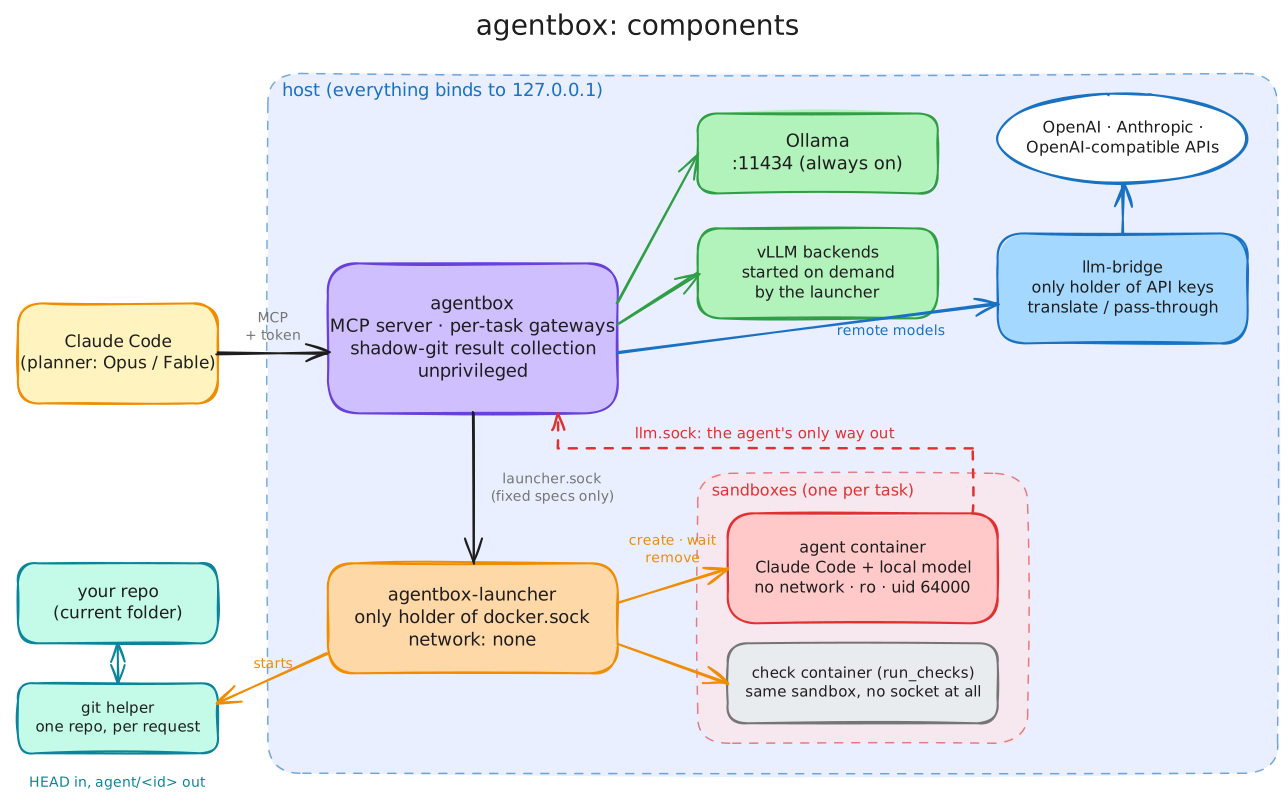
Frontier models are good at deciding what to change. Open-weight models on a local GPU are free per token and keep code on your machine, but they are slower and fail in predictable ways. agentbox puts the two together:
- the planner (Claude Code with Opus or Fable) investigates and writes a precise spec;
- the executor (Claude Code driving a local model) does the hands-on work;
- the planner then reviews and verifies the result before anything is merged.
The executor runs code it wrote, in a repository that may contain untrusted text such as issues, comments and dependencies. So agentbox treats it as untrusted, and builds the whole system around one rule:
The executor gets exactly one way out: a socket to a model, and nothing else.
| Component | Runs as | Network | Why it exists |
|---|---|---|---|
| agentbox (MCP server) | your uid, no capabilities, read-only rootfs | host (127.0.0.1) | Talks MCP to the planner. Prepares scratch clones, runs one gateway per task, and collects results through a trusted shadow git dir. It parses model output, so it holds no privileges and has none of your repos mounted. |
| agentbox-launcher | your uid + the docker group | none | The only component with the Docker socket, which is root-equivalent. It exposes a tiny API ("run this task with this model") and builds every container spec itself, so whoever calls it can't choose how a container runs. It never sees model output. |
| agent sandbox | uid 64000 (doesn't exist on the host) | none | Claude Code plus the executor model, on one scratch clone. See [[Sandbox specification |
| git helper | your uid, no capabilities, read-only root | none | Started by the launcher for each repo operation. It mounts just the one repo you passed (read-only to copy HEAD in, read-write to deliver agent/<id>), refuses anything that isn't a git repo owned by you, and exits in seconds. |
| check sandbox | uid 64000 | none | Same sandbox, with no socket at all. run_checks uses it to run tests on the returned branch, so agent-written code never runs on your host. |
| Ollama | your uid, read-only | host (127.0.0.1:11434) | Always-on model server; pulls models on first use. |
| vLLM backends | per image | host (127.0.0.1:port) | High-throughput model servers, started and stopped on demand by the launcher. |
| llm-bridge | your uid, read-only | host (127.0.0.1:8790) | The only component with provider API keys. It translates to OpenAI Chat Completions or passes through to Anthropic. See [[Remote models |
- The planner calls
delegate_taskover MCP (HTTP on 127.0.0.1, bearer token), passing its current folder asrepo_path. - agentbox makes sure the model is being served. It has a git helper copy that folder's
HEADinto a private scratch clone, starts a per-task gateway on a unix socket, and asks the launcher to start a sandbox. - Inside the sandbox, Claude Code talks to "the Anthropic API" on its own loopback. A tiny relay forwards that to the socket, and the gateway forwards it to the model. See How a network-less agent reaches a model.
- When the agent exits, agentbox commits the changed files through a shadow git dir the agent never saw.
A git helper then writes branch
agent/<id>into your repo. See Collecting results safely. - The planner reads the diff, then calls
run_checksto run the tests on that branch in a fresh sandbox, and merges or re-delegates.
The full sequence is in Life of a delegation. The security reasoning is in Security model.