Repository navigation
Open Engine 2026.10.0-alpha.5
Pre-release
Open Engine 2026.10.0-alpha.5
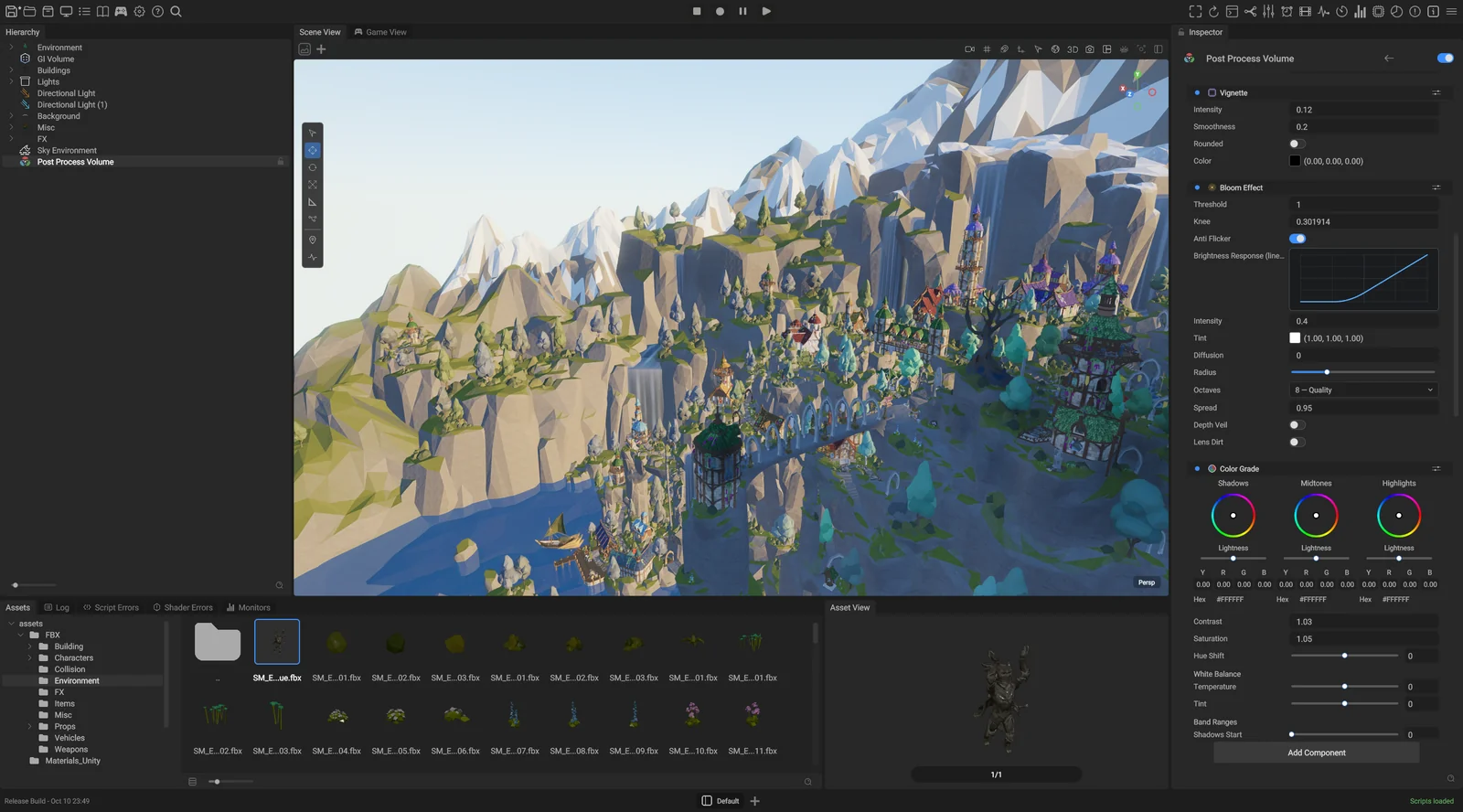
A modern, high-performance, open-source game engine built for the community, by the community, with the goals of bringing power, scale, ease of use and true ownership to game developers.
It also builds for the web: the same engine runs in the browser on WebGPU, shipped as the @game-crafters-guild/openengine-web package with live examples. Its Web API is designed to bring the capabilities and performance of the engine into an HTML canvas anywhere: a few lines of JavaScript put a scene, its lighting and its models on any page.
Foundation
- Open source, MIT licensed.
- A modern C++20 code base.
- Hot-reloadable C# scripting on CoreCLR (.NET 10).
- Native C++ scripting.
- A modern renderer built on Vulkan, Metal and WebGPU.
- A cross-platform editor for Windows, macOS, Linux and the web. Yes, the editor runs in the browser.
- An ECS built on a true data-oriented design.
- UI driven by CSS layout and XML, in the editor and in games.
- Built for AI-assisted development: a bundled MCP server and CLI let AI agents drive the running editor, and an in-editor AI assistant ships as a preview.
New in this release
- A crisp clear day. The sky's default air is now a crisp clear day instead of pristine air, which made the noon sky a deep navy and the horizon several times brighter than the zenith. The aerosol scatters light the way measured haze does: a bright aureole around the sun, a horizon that brightens toward the sun, and a zenith that keeps its blue. The ground lights the sky from below through the Sky Environment's Ground albedo setting, whose default moves from bright sand to typical land, and the sky is baked for the camera's altitude in bands, so a camera at one kilometer or at ten sees the horizon drop and the atmosphere's limb instead of the ground-level sky. Every scene that uses the physical sky gets the new day; a scene that set its own Ground albedo keeps its value.
- Stars that breathe. Each star has its own brightness and its own twinkle: one in five stays faint, most sit below white at their brightest, and only the brightest few reach it. At the low phase of its twinkle a star dims as a whole, core and points together, and the sparkles turn further off the screen's axes, so a sky of identical upright crosses becomes a field of stars.
- Three looks. The Post Process Volume's list of eight tonemap operators is replaced by one Look with three choices: Neutral (the default) keeps colors as the scene lit them; Filmic lowers the upper mid-tones and rolls the highlights off, so a sun glint reads as a bright shape rather than a clipped patch; Photographic is a wide-latitude transform that desaturates toward white as it brightens. A scene stores the look by name (
PostProcessVolume.look = Filmic). A scene that still stores the old numbered operator renders Neutral and reports one notice when it loads; replace the line withlook = Filmicfor the ACES operator,look = Photographicfor AgX, orlook = Neutralfor the rest. The starter templates and the community projects are updated, and volume exposure keys the engine no longer reads are reported at load instead of dropped silently. - The AI Assistant's replies, drawn from their Markdown. Replies render as formatted text: headings, bold and italic, lists, code, quotes, tables and links. A reply that arrives in pieces around a tool call keeps its pieces apart, and a long file path wraps at its separators. The Markdown text control behind it is part of the UI module, for games too.
- Navigation, UI lookups and frame memory. A frame's grid path requests are solved in parallel on the job system and applied in a fixed order, so results do not depend on timing or on the worker count.
FindPathandFindPathAcrossLinksanswer synchronously; a game that usedRequestPathcallsFindPathinstead. UI lookups by id take a hashed id (a"hud"_sidliteral) rather than a string, and two different ids that hash the same are reported once. The sorted transparency build and the draw batch tables take their working memory from the frame's scratch allocator, so neither allocates on the heap per frame. - Housekeeping. The documentation is live at https://openengine.dev/docs/ with a sidebar per area, and 91 tracker issues were closed with the evidence that each was fixed or no longer applies.
Everything since alpha.4, with pictures: the changelog pages for 13 October (a believable day and night sky in the starter scene, navigation baked in the editor, pointer lock for games, exported games that ship their shaders, the documentation rewrite, and this push) and 11 October.
In this release
- The source, built from a clean checkout with the steps in README.md and BUILD.md; the documentation at https://openengine.dev/docs/.
- An experimental Windows x64 build of the Editor,
OpenEngine-Editor-2026.10.0-alpha.5-win-x64.zip(125 MB, SHA-2561bfcad52dc683d2046ec4260a5c953d2a24d3eeee93c2f653658cf280e5e3800), to try the editor without building it. Requirements and limitations are in its README.txt: a Vulkan 1.3 driver, the .NET 10 SDK, the Visual C++ 2015-2022 x64 redistributable, and Visual Studio 2026 with the C++ workload for game export and C++ scripting; the Claude Code command-line tool for the AI Assistant. - An experimental macOS arm64 build of the Editor,
OpenEngine-Editor-2026.10.0-alpha.5-macos-arm64.zip(189 MB, SHA-2564defdb341e4916a51501f5a8d7a02691b245d41e29144f332a53895ab2dafd57). It needs an installed .NET 10 runtime or SDK as its README describes, and it is ad-hoc signed, not notarized: macOS asks for an explicit allow on first launch. - The web package
@game-crafters-guild/openengine-web2026.10.0-alpha.5 on npm under thealphatag (npm install @game-crafters-guild/openengine-web@alpha), with the live examples at https://game-crafters-guild.github.io/opengine-web/.
An early release
This is an alpha: APIs and file formats may change between releases.
The engine is yours as much as ours: open issues, send pull requests, and help shape it.
Join us on Discord: https://discord.gg/c8JASm4q8
Known issues at this tag
- At night the sky dome reads a dark red-purple until the moon lights the sky and a night exposure lands; being fixed on
main. - The starter scene's horizon haze looks like a solid layer when the camera rises above about 1 km; being fixed on
main. - The headless Player (
Player --headless) has been run on Windows only. - On ARM64 Linux the default build does not link with video support yet; build with video turned off.
- The web examples fail to load on Android phones; being investigated.