Repository navigation
Architecture
Felix is a low-latency distributed data backend designed to unify the roles of event streaming, message-oriented middleware, and distributed caching. It is built for Kubernetes from day one and optimized for real-time workloads where latency, isolation, and security matter as much as throughput and durability.
Felix is not a Kafka clone. It deliberately optimizes for:
- Low tail latency (p99/p999), not just aggregate throughput
- Unified primitives (streams, queues, cache) over a single core log
- Strong cryptographic boundaries, including optional end-to-end encryption (planned)
Region and data sovereignty as a first-class concept, with explicit, auditable cross-region data movement, is a design goal for a later milestone — not current behavior. See Status and Multi-Region and Bridges below; do not rely on region isolation for compliance purposes until it ships.
Internally, Felix is built around a single append-only log abstraction. Different external semantics are projections over this core:
- Streams (Pub/Sub): fanout cursors per subscription
- Queues: shared consumer-group cursors with acknowledgements. A group's position is itself a key → latest-value projection, the same one the cache is, so it reuses that machinery rather than adding a second store.
What each of the three stores, keeps in memory, and rebuilds from the log — and
the test behind every claim about them — is in
projections.md. Claims about a semantic belong there, where
scripts/check_doc_evidence.py checks that the tests cited still exist.
-
Cache: key → latest value with TTL, written to the same log as records and read back through an index rebuilt from it. Compaction reclaims superseded and expired entries. Cache operations route across brokers like a stream's do: a key hashes to a shard, and a broker that does not own it forwards — see
docs/cache-on-log.md
This drastically reduces operational complexity and consistency bugs compared to running Kafka, Redis, and a queueing system side-by-side.
Felix prioritizes predictable low latency over maximum batch throughput. Design choices reflect this:
- QUIC for transport (multiplexed, encrypted, congestion-aware)
- Optional non-persistent (ephemeral) streams with no disk on the hot path
- Aggressive backpressure and bounded memory everywhere
- Leader-based writes with tunable acknowledgement policies
Every subscriber has its own bounded queue, so one that cannot keep up sheds records rather than slowing anybody else down:

Felix assumes Kubernetes for:
- Process lifecycle
- Identity (ServiceAccounts)
- Networking and service discovery
- Failure detection
Felix does not attempt to reimplement scheduling or node membership logic that Kubernetes already provides.
The broker is responsible for:
- Accepting client connections
- Routing publish and subscribe requests
- Managing streams, shards, and cursors
- Enforcing backpressure and delivery semantics
Each broker hosts zero or more shard leaders and followers. Only leaders accept writes.
Felix uses QUIC as its sole transport:
- Encrypted by default
- Multiplexed streams per connection
- Built-in flow control
- Resistant to head-of-line blocking

The wire protocol is versioned and explicitly framed to allow forward compatibility.
- Ephemeral: in-memory ring buffers and TTL maps for ultra-low latency
-
Durable: a segmented, checksummed append-only log on persistent volumes,
selected per stream by
durable: true. See Durable Storage. -
Retention: implemented per broker via
FELIX_DURABLE_RETENTION_BYTES/_SECONDS, and off unless set. A per-stream policy is recorded and not yet read, so a stream's declared retention is not the one enforced.truncateexists for replication's benefit; nothing deletes segments on age or size. -
Tiering: not yet implemented.
TieredStoreis declared and unimplemented; tracked as #172.
Durable storage is optional and configurable per stream.
Note that this is a log-structured store, not write-ahead logging. In a WAL system the log is a journal that protects a separate primary structure - a B-tree, a memtable, heap pages - and is replayed into it after a crash, then checkpointed away. Here the log is the primary structure: records are appended to segments and read back from those same segments, and recovery validates and truncates rather than replaying into anything. The two share most of their mechanisms (sequential append, group commit, fsync policy, checksums, torn-tail repair), which is why the techniques are borrowed freely from WAL implementations, but the shapes are different.
Metadata is strongly consistent and minimal by design. It stores:
- Stream definitions
- Shard counts and placement
- Retention and quota policies
- Region and bridge configuration
The control plane exposes administrative APIs and is off the data path for
reads, for subscribes, and for Leader publishes. A Quorum publish is the
one exception, and it is deliberate — see "Routing & Placement" below.
Routing is region-aware and shard-aware. Clients are routed directly to shard leaders to avoid unnecessary hops. Region boundaries are enforced at the routing layer.
Felix provides tunable consistency, configured per stream:
- Leader-only acknowledgements (low latency)
- Quorum acknowledgements (higher durability)
- Asynchronous or synchronous replication
Delivery guarantees:
- At-least-once (default)
- At-most-once (ephemeral streams)
- Exactly-once (future, via idempotent producers and transactions)
- TLS 1.3 for client connections, with no unencrypted mode — QUIC has none
- Broker-to-broker QUIC is mutually authenticated when
FELIX_INTERNAL_TLS_CERT,_KEYand_CAare set: every peer connection is verified against that CA and the certificate's name is checked against the node id in both directions. Left unset, the internal listener accepts any certificate — encrypted, unauthenticated, and warned about at startup - All encryption uses modern, configurable cipher suites
The rest of this section is the intended design, not what ships today. The status table is per capability and is the page to trust when another disagrees.
- Envelope encryption per region and per tenant
- Optional end-to-end encryption (broker routes ciphertext only)
- Explicit key rotation and key IDs embedded in message metadata
- Tenant / namespace / stream-level RBAC
- Policy enforcement at publish and subscribe time
- Full audit logging for administrative and data-access actions
Felix does not federate clusters implicitly.
Cross-region data movement requires:
- An explicit bridge definition
- Explicit allowlists of streams
- Independent encryption contexts
- Auditable replication behavior
This model is designed to satisfy strict data residency and regulatory requirements.
- Real-time microservice backbones
- Cache + event unification to reduce system sprawl
- Edge-to-cloud data pipelines
- Regionally-isolated SaaS platforms (finance, healthcare, government) — once region isolation ships; see Multi-Region and Bridges
- Regulated environments requiring strong auditability
Felix intentionally does not aim to:
- Replace the entire Kafka ecosystem
- Optimize for maximum historical batch throughput
- Support every possible protocol or client initially
Felix is opinionated by design.
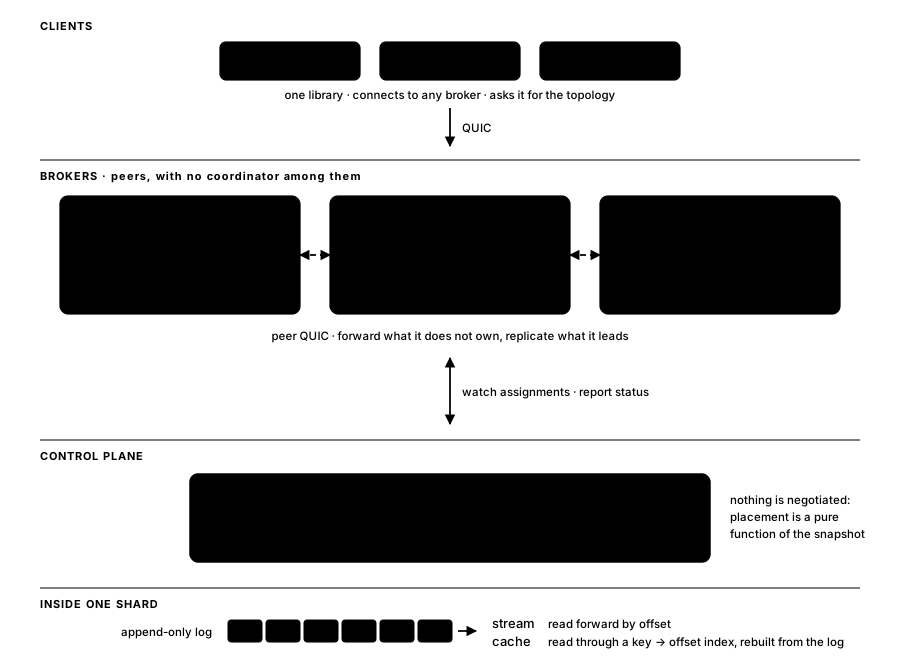
Three properties carry most of the design.
Any broker accepts any request. A client connects to whichever broker it can reach and asks it for the topology. If that broker does not lead the shard the request belongs to, it forwards the request to the one that does and relays the answer. The client never has to find the right broker first, and never talks to two of them for a single request.
Ownership comes from the control plane and nowhere else. Every shard of every stream and cache has exactly one leader, chosen by rendezvous hashing over the live nodes. Brokers watch the assignment feed — a snapshot, then a change stream — and never negotiate ownership among themselves.
No consensus protocol runs between brokers. Placement is a pure function of a
metadata snapshot, so two control-plane instances reading the same catalog reach
the same answer without having to agree on one. Durability across a leader change
comes from log shipping and leader leases instead; replication-design.md argues
that choice in full, including why per-shard Raft was rejected.
That rejection is about replicating records. Making the control plane's own
metadata highly available is a separate problem, and Raft is the decided
answer there — designed in
metadata-raft-design.md and tracked as milestone
M13 under #333, and shipped:
FELIX_CONTROLPLANE_STORAGE_BACKEND=raft selects it and the instances hold
the metadata themselves, with no external database. Postgres remains fully
supported — any number of stateless instances over one HA database, whose
required properties are spelled out in ha-postgres.md.
Resolving an owner is an atomic load of a routing snapshot the broker already holds — no lock and no network call, because it is the hottest question a broker is asked. The snapshot is refreshed in the background.
One path does reach the control plane, and it is not an oversight. A
Quorum publish is released by the shard's quorum mark, and the leader sends
its replica report before moving that mark, awaiting the answer. Releasing the
publish first would leave a window where a leader has told a client its record
is on a majority while the control plane knows nothing about which replica holds
it — and a leader dying in that window is replaced by whichever replica scores
highest, which may be the one without the record. The acknowledgement would then
be a promise nothing could keep.
So a quorum acknowledgement costs a control-plane round trip, and a control
plane that cannot be reached stalls Quorum publishes rather than
acknowledging them on a report that never landed. Leader publishes,
subscribes and cache operations are untouched by this. Coalescing those round
trips across a sweep is #479.
A publish entering a broker that does not lead the shard:
sequenceDiagram
  participant Client as Producer
  participant B0 as Broker (ingress)
  participant Bp as Broker (owner)
  participant S as Subscribers

  Client->>B0: Publish(stream, key, batch)
  B0->>B0: hash the key, resolve the owner locally
  B0->>Bp: AuthorizedForwardPublish(shard, generation, payloads, client credential)
  Bp->>Bp: check ownership at that generation, verify the credential, commit
  Bp->>S: Fanout (batched events on uni streams)
  Bp-->>B0: ForwardPublishOk(offsets)
  B0-->>Client: Ack
The control plane does not appear here, and that is the design. Resolving the owner is an atomic load of a snapshot the broker already holds.
The generation travels with the request. The owner compares it against its own
and answers a mismatch explicitly in either direction, so a stale routing view
produces a typed answer rather than a write to a shard that has been reassigned.
A broker asked for a shard it does not own answers NotLeader — it never
forwards onward on the requester's behalf, because a chain of relays would have
unbounded latency and a failure mode nobody can reason about.
Clustering, replication, and cross-broker routing are implemented; see the status
table in docs-site/src/content/docs/getting-started/what-felix-is-for.md, which
is kept current per capability. Multi-region and the sovereignty features below
are design intent, not code.
Felix ships with runnable demo binaries under demos/ that illustrate pub/sub,
cache, latency benchmarking, multi-tenant workflows, live RBAC mutation, and
cross-tenant isolation. These demos are self-contained and start an in-process
broker or full control-plane/broker stack on local ports.
See docs/demos.md and demos/README.md for details, run commands, and
expected output.
Generated from docs/architecture.md in the repository. That file is the source of truth; this page may be behind it.