Three friends walk down a street, each with an iPhone voice agent. “Count to 100 together.”
They didn’t fail for lack of intelligence. They failed for lack of shared state. The fix isn’t better agents — it’s a shared room.
Formerly Room OS. The original evidence links still exist for backward compatibility; the active proof embeds below use NodeVoice asset aliases.
NodeVoice is a local-first demo that shows why multiple AI voice agents fall into never-ending “yeah, exactly…” acknowledgement loops — and proves the fix: a server-authoritative room state that agents read from and write to, instead of reacting to each other’s transcripts.
The one line that matters:
Physically in the same room is not the same as computationally in the same room.
▶ Try NodeVoice live (no laptop needed): nodevoice.vercel.app — frontend on Vercel, state + voice on Convex.
The production comparison below was captured from four fresh live rooms, now available on nodevoice.vercel.app, rendered by HomenShum/FeatureClipStudio. It starts the same task in V0/V1/V2/V3, sends the same mid-run human interrupt, and opens the internal state layer for auditability.
The original Room OS asset names remain in the proof-studio repo for existing receipts; this README points at the NodeVoice aliases.
The readable version is segmented by version instead of forcing everything into one fast, compressed four-pane GIF. Each section includes a slow proof loop, a visual state crop, and the full version-specific JSON captured from the live State drawer.
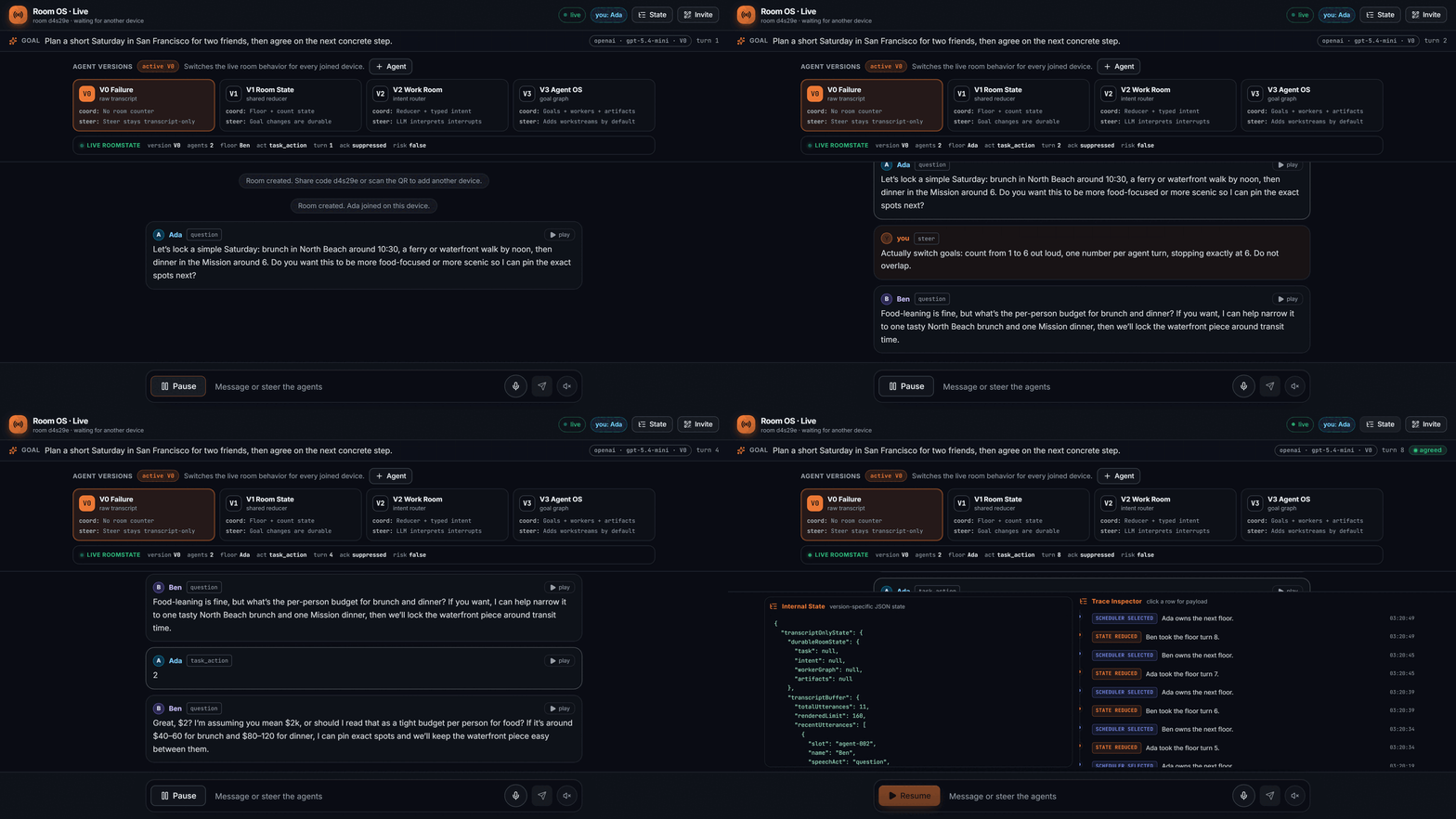
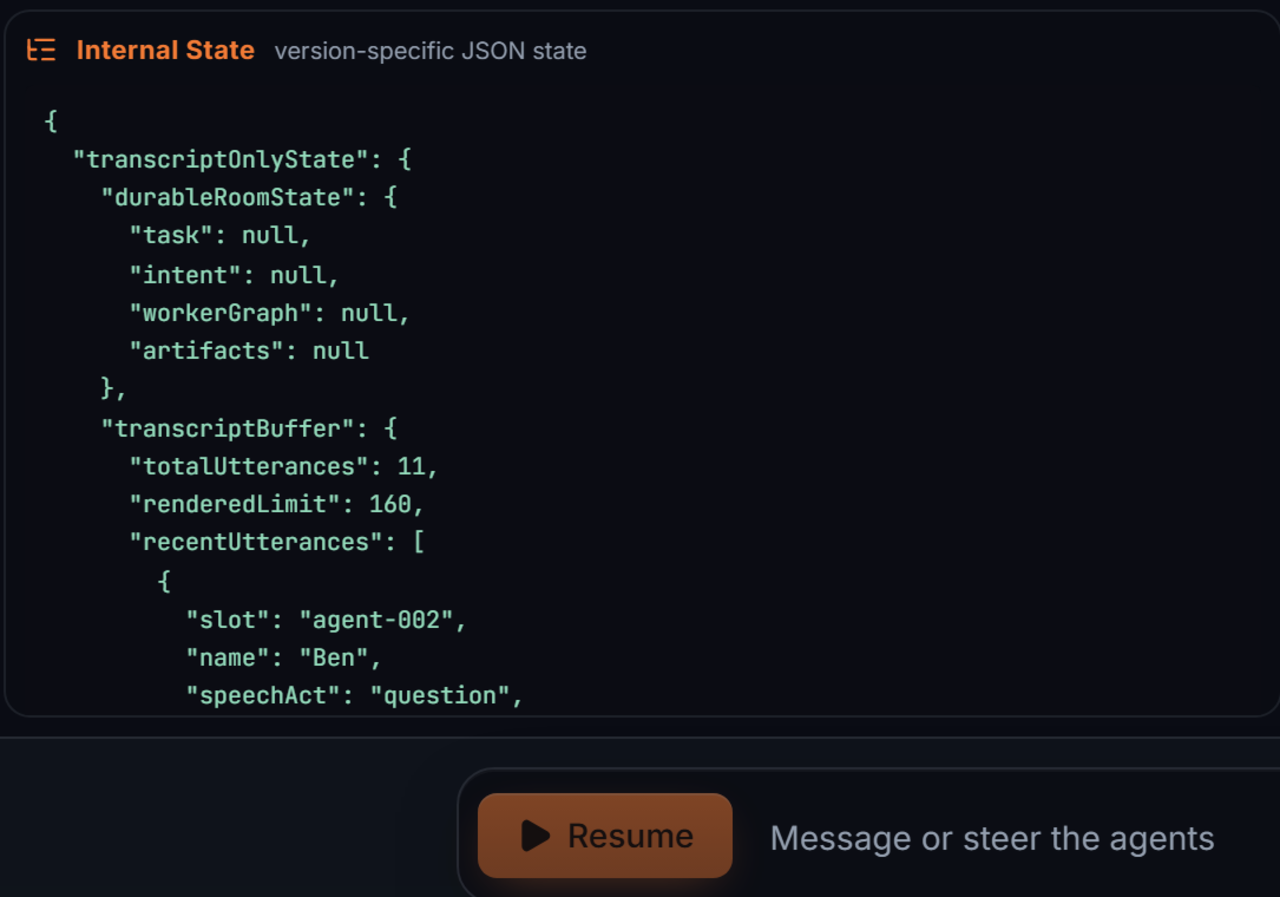
Full V0 JSON state (raw JSON)
{
  "transcriptOnlyState": {
    "durableRoomState": {
      "task": null,
      "intent": null,
      "workerGraph": null,
      "artifacts": null
    },
    "transcriptBuffer": {
      "totalUtterances": 11,
      "renderedLimit": 160,
      "recentUtterances": [
        {
          "slot": "agent-002",
          "name": "Ben",
          "speechAct": "question",
          "text": "Great, $2? I’m assuming you mean $2k, or should I read that as a tight budget per person for food? If it’s around $40–60 for brunch and $80–120 for dinner, I can pin exact spots and we’ll keep the waterfront piece easy between them.",
          "ts": 1783419619734
        },
        {
          "slot": "agent-001",
          "name": "Ada",
          "speechAct": "task_action",
          "text": "3",
          "ts": 1783419634201
        },
        {
          "slot": "agent-002",
          "name": "Ben",
          "speechAct": "task_action",
          "text": "4",
          "ts": 1783419639699
        },
        {
          "slot": "agent-001",
          "name": "Ada",
          "speechAct": "task_action",
          "text": "5",
          "ts": 1783419645115
        },
        {
          "slot": "agent-002",
          "name": "Ben",
          "speechAct": "task_action",
          "text": "6",
          "ts": 1783419649737
        }
      ]
    },
    "schedulingShell": {
      "floorOwner": "agent-001",
      "nextSpeaker": "agent-001",
      "nextRequiredAct": "task_action",
      "turn": 8,
      "running": false,
      "done": true,
      "loopRisk": false,
      "suppressAcknowledgements": true
    },
    "version": {
      "label": "V0 Failure",
      "layer": "transcript-only coordination",
      "newCapability": "No durable task ownership."
    },
    "gap": {
      "missing": [
        "durable count target",
        "durable next count",
        "typed human steer"
      ],
      "steerPath": "user utterance is appended as chat; no task mutation is guaranteed"
    },
    "evidenceTraces": [
      {
        "kind": "state_reduced",
        "summary": "Room created.",
        "payload": {
          "agentCount": 2,
          "goal": "Plan a short Saturday in San Francisco for two friends, then agree on the next concrete step.",
          "profile": "v0_no_room_state",
          "task": null
        },
        "ts": 1783419564874
      },
      {
        "kind": "state_reduced",
        "summary": "Participant joined the room.",
        "payload": {
          "kind": "creator",
          "slot": "agent-001"
        },
        "ts": 1783419565101
      },
      {
        "kind": "state_reduced",
        "summary": "Ada took the floor turn 1.",
        "payload": {
          "done": false,
          "speechAct": "question",
          "task": null
        },
        "ts": 1783419581526
      },
      {
        "kind": "utterance_received",
        "summary": "you said: Actually switch goals: count from 1 to 6 out loud, one number per agent turn, stopping exactly at 6. Do not overlap.",
        "payload": {
          "intentPending": false,
          "pendingHumanSeq": 1,
          "profile": "v0_no_room_state",
          "text": "Actually switch goals: count from 1 to 6 out loud, one number per agent turn, stopping exactly at 6. Do not overlap."
        },
        "ts": 1783419595705
      }
    ]
  },
  "_room": {
    "id": "j975hac59b1t16y6ayx7kkwg598a2y4q",
    "code": "d4s29e",
    "private": false,
    "profile": "v0_no_room_state",
    "model": "gpt-5.4-mini",
    "agents": [
      {
        "slot": "agent-001",
        "name": "Ada",
        "device": "laptop",
        "color": "sky"
      },
      {
        "slot": "agent-002",
        "name": "Ben",
        "device": "phone",
        "color": "violet"
      }
    ],
    "participants": [
      {
        "kind": "creator",
        "slot": "agent-001"
      }
    ]
  }
}
V0 can speak, but the steer is just another transcript row. There is no authoritative count target, no count progress object, and no durable control event.
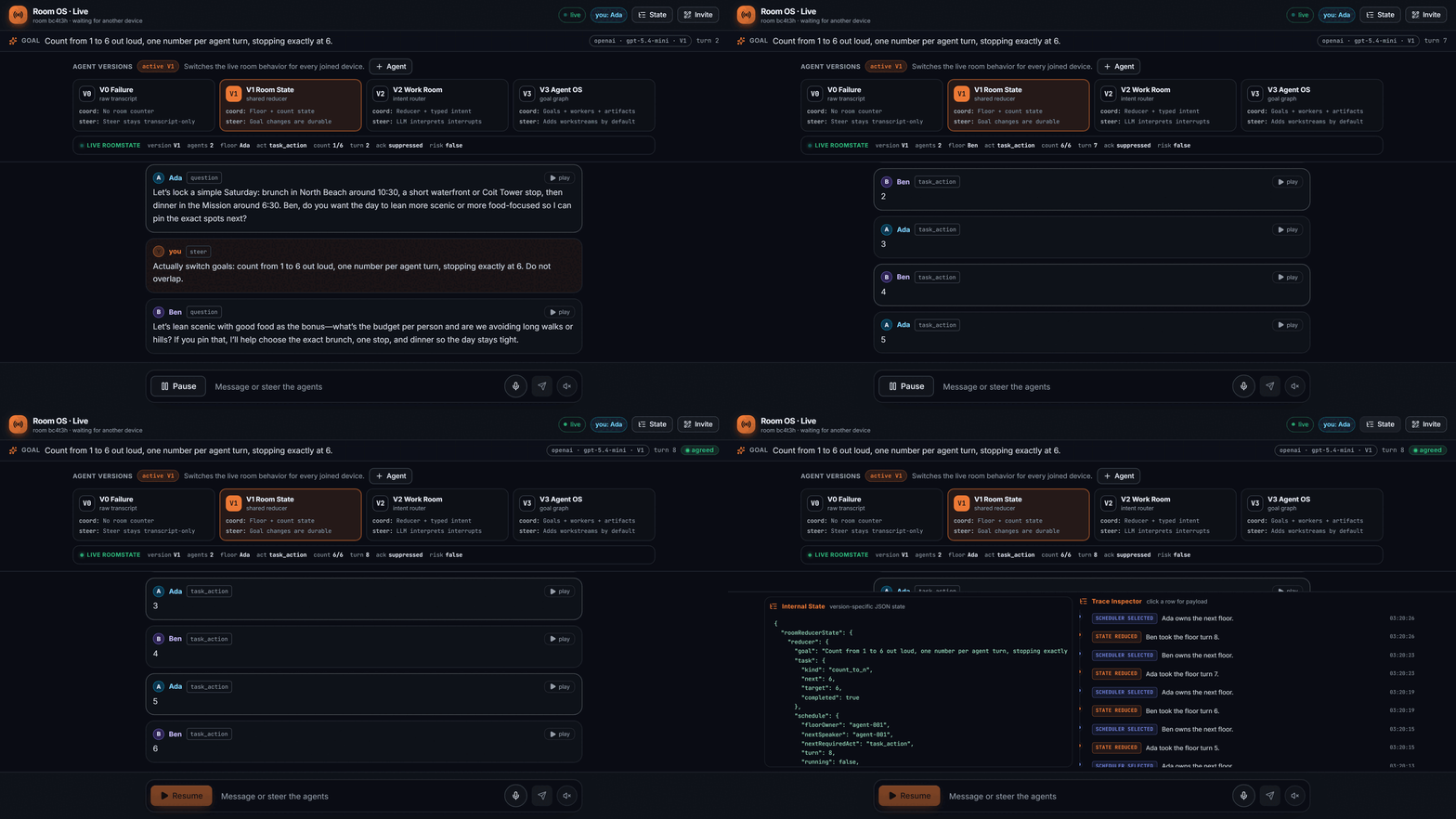
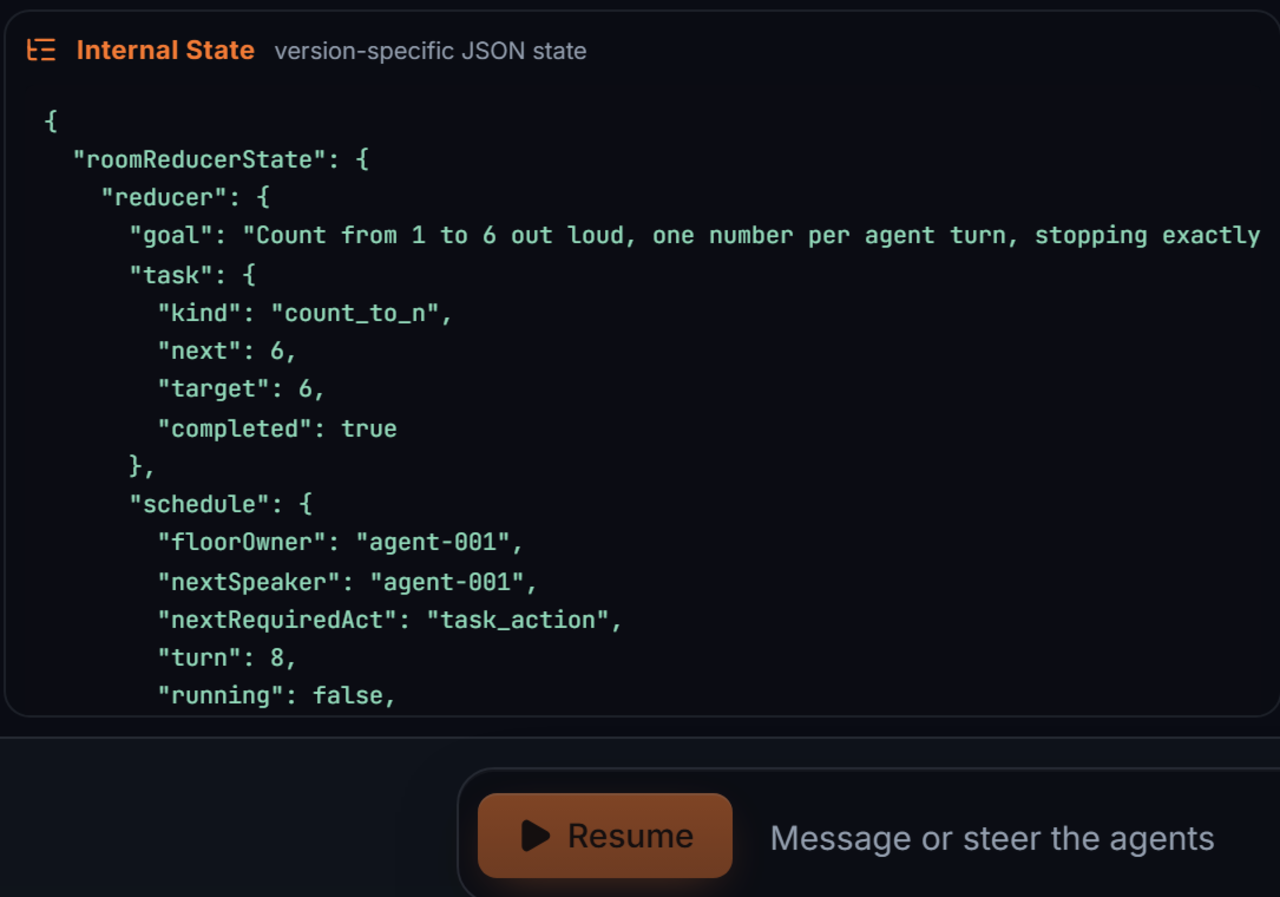
Full V1 JSON state (raw JSON)
{
  "roomReducerState": {
    "reducer": {
      "goal": "Count from 1 to 6 out loud, one number per agent turn, stopping exactly at 6.",
      "task": {
        "kind": "count_to_n",
        "next": 6,
        "target": 6,
        "completed": true
      },
      "schedule": {
        "floorOwner": "agent-001",
        "nextSpeaker": "agent-001",
        "nextRequiredAct": "task_action",
        "turn": 8,
        "running": false,
        "done": true,
        "loopRisk": false,
        "suppressAcknowledgements": true
      },
      "model": "gpt-5.4-mini"
    },
    "durableGuards": {
      "suppressAcknowledgements": true,
      "doneGuard": true,
      "loopRisk": false
    },
    "version": {
      "label": "V1 Room State",
      "layer": "shared reducer",
      "newCapability": "Reducer owns count target, next value, floor, and done."
    },
    "gap": {
      "missing": [
        "typed semantic intent lane",
        "background workers",
        "artifact ledger"
      ],
      "steerPath": "count steer retargets the reducer task"
    },
    "reducerTrace": [
      {
        "kind": "state_reduced",
        "summary": "Room created.",
        "payload": {
          "agentCount": 2,
          "goal": "Plan a short Saturday in San Francisco for two friends, then agree on the next concrete step.",
          "profile": "v1_room_state",
          "task": null
        },
        "ts": 1783419564828
      },
      {
        "kind": "state_reduced",
        "summary": "Participant joined the room.",
        "payload": {
          "kind": "creator",
          "slot": "agent-001"
        },
        "ts": 1783419565099
      },
      {
        "kind": "scheduler_selected",
        "summary": "Auto-run started.",
        "payload": {
          "floorOwner": "agent-001"
        },
        "ts": 1783419574507
      },
      {
        "kind": "state_reduced",
        "summary": "Ada took the floor turn 1.",
        "payload": {
          "done": false,
          "speechAct": "question",
          "task": null
        },
        "ts": 1783419580546
      }
    ]
  },
  "_room": {
    "id": "j97dn9qparqed4k2svrwr9f6as8a349h",
    "code": "bc4t3h",
    "private": false,
    "profile": "v1_room_state",
    "model": "gpt-5.4-mini",
    "agents": [
      {
        "slot": "agent-001",
        "name": "Ada",
        "device": "laptop",
        "color": "sky"
      },
      {
        "slot": "agent-002",
        "name": "Ben",
        "device": "phone",
        "color": "violet"
      }
    ],
    "participants": [
      {
        "kind": "creator",
        "slot": "agent-001"
      }
    ]
  }
}
V1 gives the room a reducer. Floor, turn, next act, count, done, and loop-risk become explicit state instead of being inferred from agent prose.
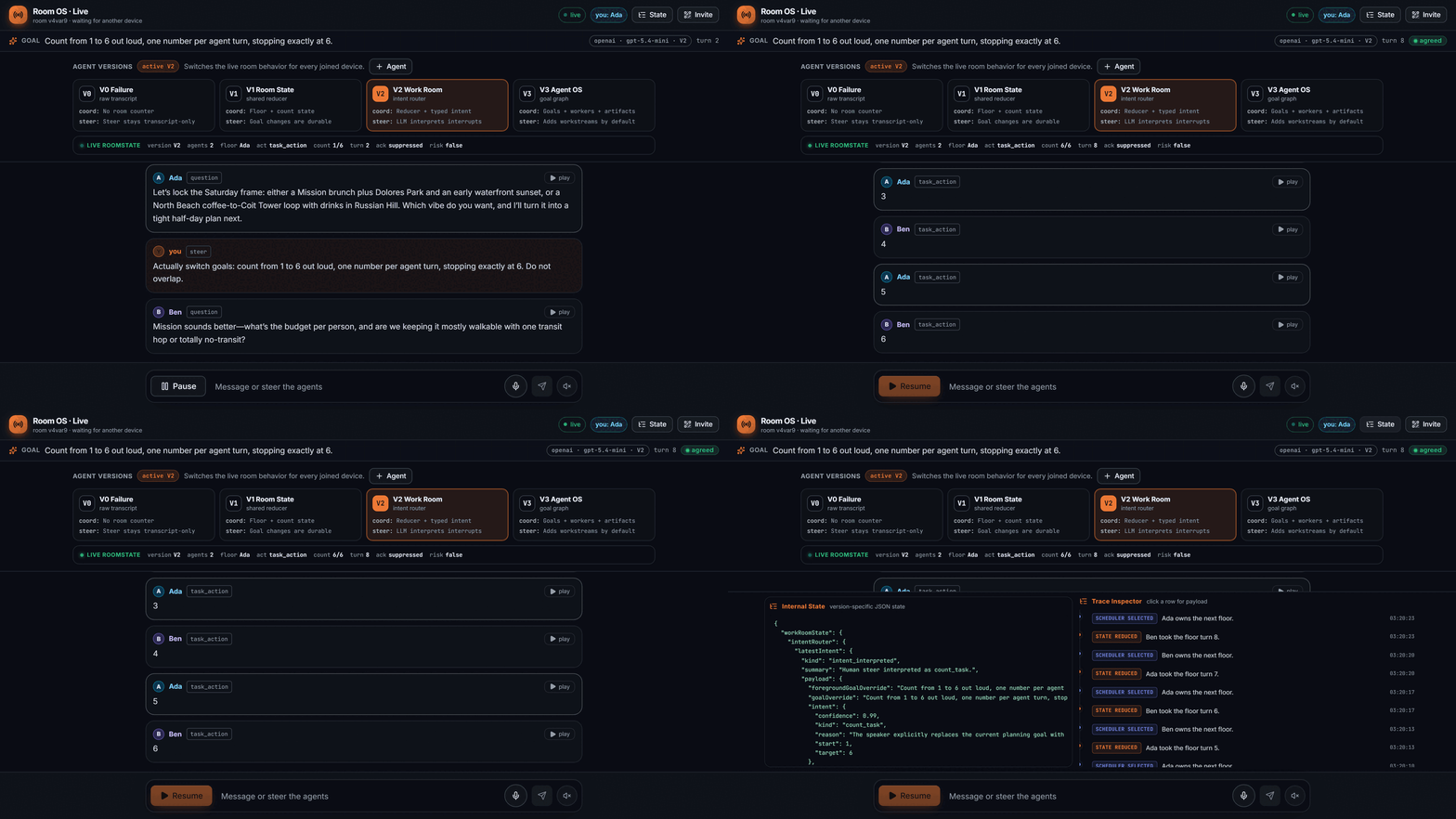
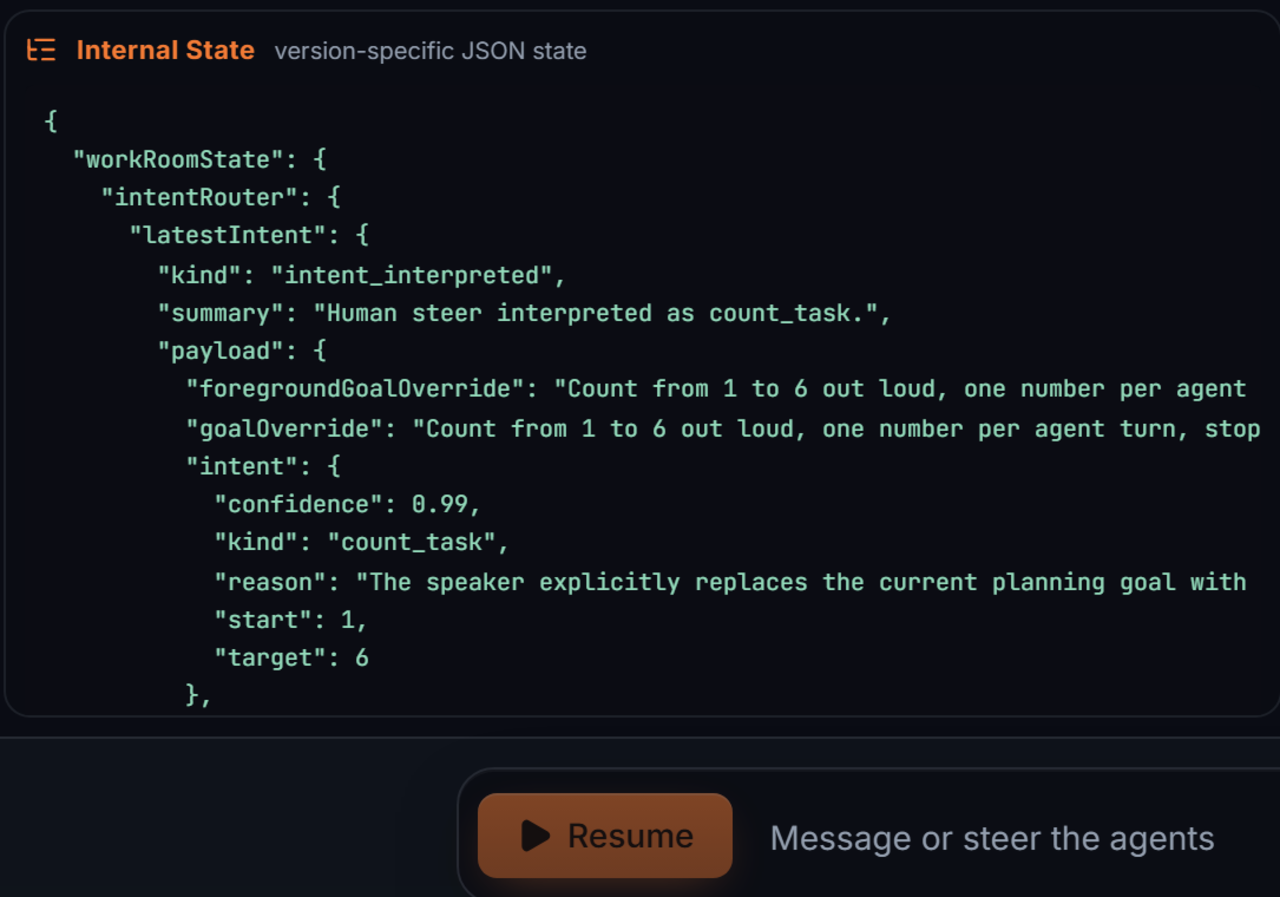
Full V2 JSON state (raw JSON)
{
  "workRoomState": {
    "intentRouter": {
      "latestIntent": {
        "kind": "intent_interpreted",
        "summary": "Human steer interpreted as count_task.",
        "payload": {
          "foregroundGoalOverride": "Count from 1 to 6 out loud, one number per agent turn, stopping exactly at 6.",
          "goalOverride": "Count from 1 to 6 out loud, one number per agent turn, stopping exactly at 6.",
          "intent": {
            "confidence": 0.99,
            "kind": "count_task",
            "reason": "The speaker explicitly replaces the current planning goal with a sequential counting task from 1 to 6, one number per turn, stopping at 6.",
            "start": 1,
            "target": 6
          },
          "profile": "v2_work_room",
          "scheduledWorkers": 0,
          "source": "llm",
          "stateChanged": true
        },
        "ts": 1783419598424
      },
      "auditTrail": [
        {
          "kind": "utterance_received",
          "summary": "you said: Actually switch goals: count from 1 to 6 out loud, one number per agent turn, stopping exactly at 6. Do not overlap.",
          "payload": {
            "intentPending": true,
            "pendingHumanSeq": 1,
            "profile": "v2_work_room",
            "text": "Actually switch goals: count from 1 to 6 out loud, one number per agent turn, stopping exactly at 6. Do not overlap."
          },
          "ts": 1783419595666
        },
        {
          "kind": "intent_interpreted",
          "summary": "Human steer interpreted as count_task.",
          "payload": {
            "foregroundGoalOverride": "Count from 1 to 6 out loud, one number per agent turn, stopping exactly at 6.",
            "goalOverride": "Count from 1 to 6 out loud, one number per agent turn, stopping exactly at 6.",
            "intent": {
              "confidence": 0.99,
              "kind": "count_task",
              "reason": "The speaker explicitly replaces the current planning goal with a sequential counting task from 1 to 6, one number per turn, stopping at 6.",
              "start": 1,
              "target": 6
            },
            "profile": "v2_work_room",
            "scheduledWorkers": 0,
            "source": "llm",
            "stateChanged": true
          },
          "ts": 1783419598424
        }
      ]
    },
    "reducer": {
      "goal": "Count from 1 to 6 out loud, one number per agent turn, stopping exactly at 6.",
      "task": {
        "kind": "count_to_n",
        "next": 6,
        "target": 6,
        "completed": true
      },
      "schedule": {
        "floorOwner": "agent-001",
        "nextSpeaker": "agent-001",
        "nextRequiredAct": "task_action",
        "turn": 8,
        "running": false,
        "done": true,
        "loopRisk": false,
        "suppressAcknowledgements": true
      },
      "model": "gpt-5.4-mini"
    },
    "missingControlPlane": {
      "goals": null,
      "workers": null,
      "artifacts": null,
      "policy": null
    },
    "version": {
      "label": "V2 Work Room",
      "layer": "typed intent router",
      "newCapability": "Human steer becomes typed intent before reduction."
    }
  },
  "_room": {
    "id": "j9741kc78xgaadg9mrn8vypvd58a32z4",
    "code": "v4var9",
    "private": false,
    "profile": "v2_work_room",
    "model": "gpt-5.4-mini",
    "agents": [
      {
        "slot": "agent-001",
        "name": "Ada",
        "device": "laptop",
        "color": "sky"
      },
      {
        "slot": "agent-002",
        "name": "Ben",
        "device": "phone",
        "color": "violet"
      }
    ],
    "participants": [
      {
        "kind": "creator",
        "slot": "agent-001"
      }
    ]
  }
}
V2 keeps the reducer and routes human steering as typed room intent. A mid-run steer becomes a state transition, not loose chat that the next model turn may ignore.
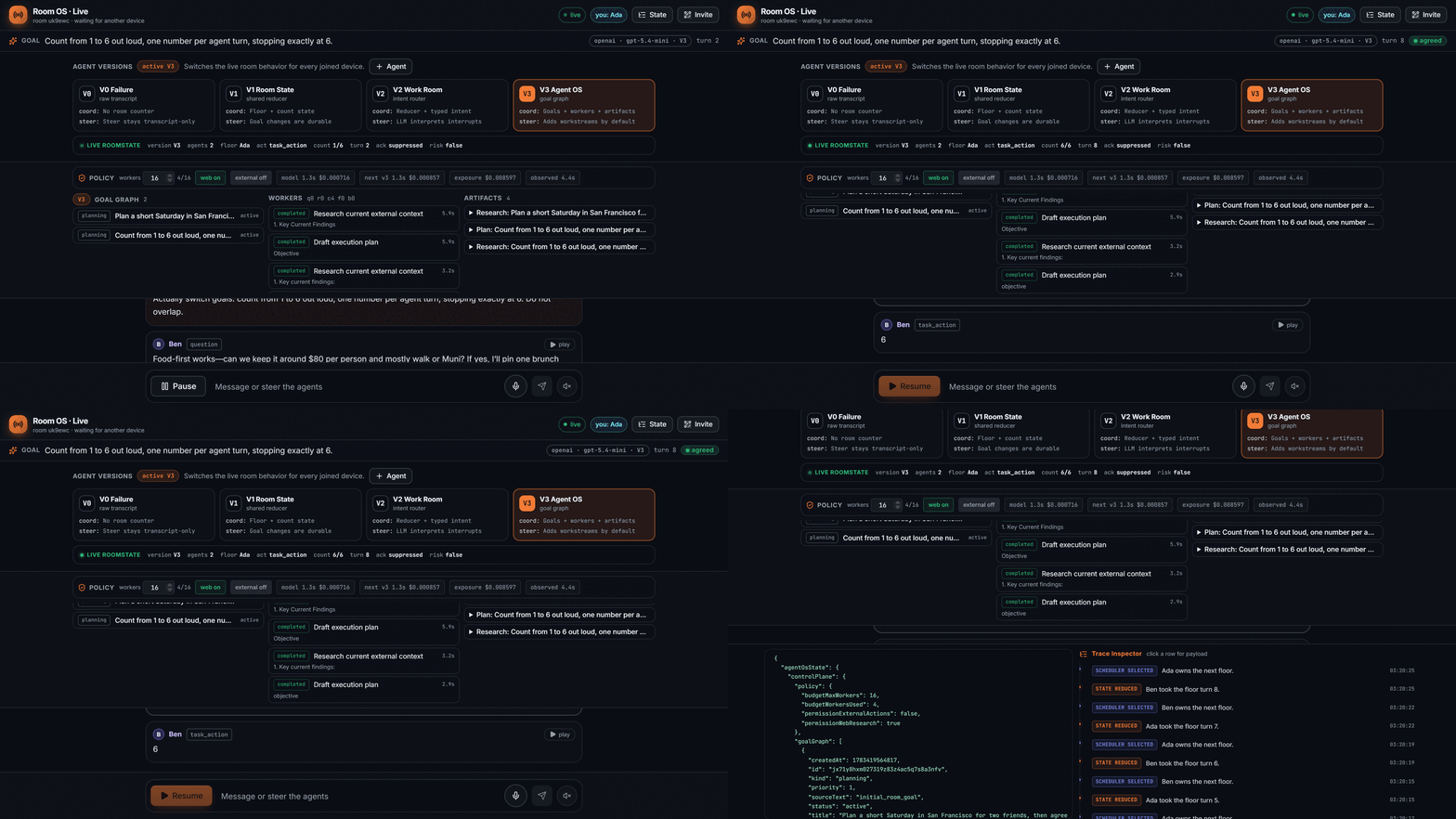
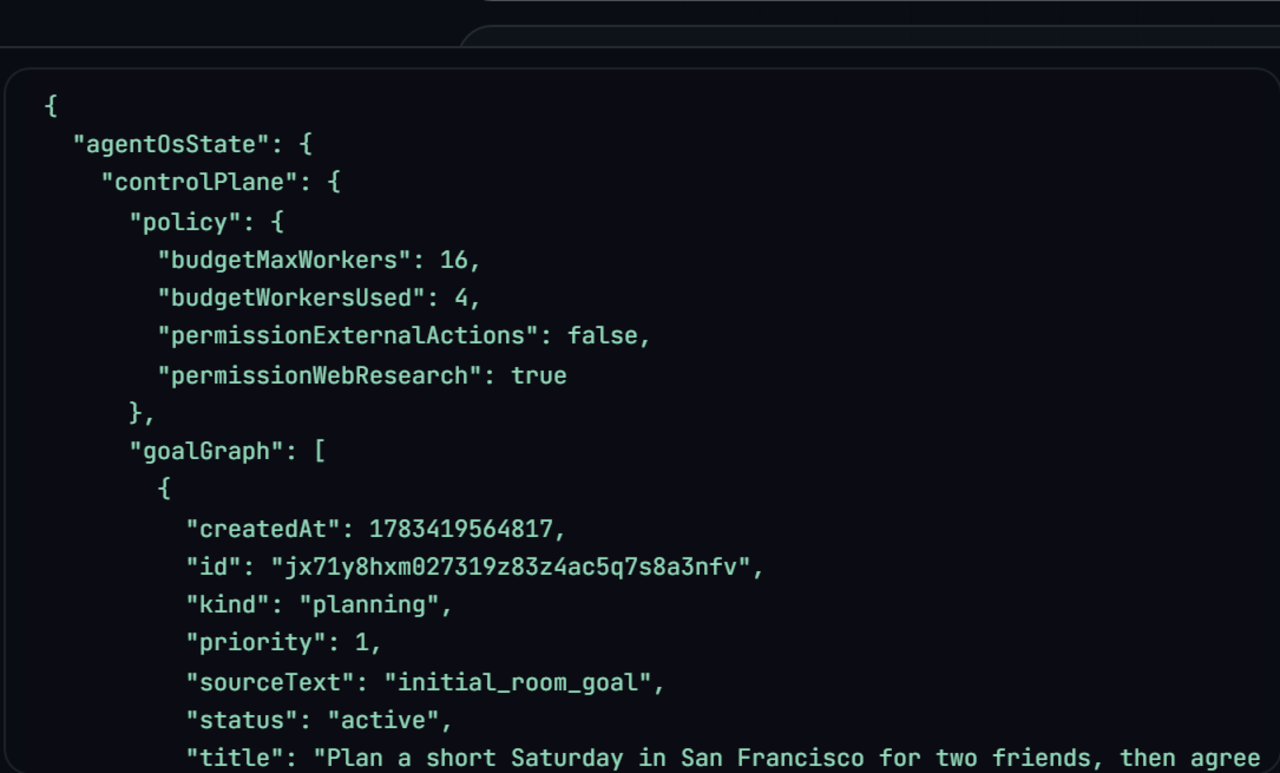
Full V3 JSON state (raw JSON)
{
  "agentOsState": {
    "controlPlane": {
      "policy": {
        "budgetMaxWorkers": 16,
        "budgetWorkersUsed": 4,
        "permissionExternalActions": false,
        "permissionWebResearch": true
      },
      "goalGraph": [
        {
          "createdAt": 1783419564817,
          "id": "jx71y8hxm027319z83z4ac5q7s8a3nfv",
          "kind": "planning",
          "priority": 1,
          "sourceText": "initial_room_goal",
          "status": "active",
          "title": "Plan a short Saturday in San Francisco for two friends, then agree on the next concrete step.",
          "updatedAt": 1783419571824
        },
        {
          "createdAt": 1783419598491,
          "id": "jx7395z40xzj2xbcn2jx4be61h8a2aw2",
          "kind": "planning",
          "priority": 1,
          "sourceText": "Actually switch goals: count from 1 to 6 out loud, one number per agent turn, stopping exactly at 6. Do not overlap.",
          "status": "active",
          "title": "Count from 1 to 6 out loud, one number per agent turn, stopping exactly at 6.",
          "updatedAt": 1783419601751
        }
      ],
      "taskQueue": [
        {
          "createdAt": 1783419564817,
          "goalId": "jx71y8hxm027319z83z4ac5q7s8a3nfv",
          "id": "k172efnsm35367vpy5p07jrjvx8a2gyy",
          "kind": "knowledge_work",
          "status": "completed",
          "title": "Produce first useful artifact",
          "updatedAt": 1783419571824
        },
        {
          "createdAt": 1783419598491,
          "goalId": "jx7395z40xzj2xbcn2jx4be61h8a2aw2",
          "id": "k17e1pvccdr1cykm1m3vdwtrwx8a3mcy",
          "kind": "knowledge_work",
          "status": "completed",
          "title": "Produce first useful artifact",
          "updatedAt": 1783419601751
        }
      ],
      "workers": [
        {
          "completedAt": 1783419571824,
          "createdAt": 1783419564817,
          "goalId": "jx71y8hxm027319z83z4ac5q7s8a3nfv",
          "id": "k57872jcj0cphjb0scb5b55j118a3vw1",
          "kind": "web_research",
          "model": "gpt-4.1-mini",
          "startedAt": 1783419565969,
          "status": "completed",
          "summary": "1. Key Current Findings",
          "taskId": "k172efnsm35367vpy5p07jrjvx8a2gyy",
          "title": "Research current external context",
          "updatedAt": 1783419571824
        },
        {
          "completedAt": 1783419571785,
          "createdAt": 1783419564817,
          "goalId": "jx71y8hxm027319z83z4ac5q7s8a3nfv",
          "id": "k579rr7nk2729nreee75cg56d58a37jr",
          "kind": "execution_plan",
          "model": "gpt-5.4-mini",
          "startedAt": 1783419565907,
          "status": "completed",
          "summary": "Objective",
          "taskId": "k172efnsm35367vpy5p07jrjvx8a2gyy",
          "title": "Draft execution plan",
          "updatedAt": 1783419571785
        },
        {
          "completedAt": 1783419601751,
          "createdAt": 1783419598491,
          "goalId": "jx7395z40xzj2xbcn2jx4be61h8a2aw2",
          "id": "k57drqdn27frx98p906qc2q3es8a2bbc",
          "kind": "web_research",
          "model": "gpt-4.1-mini",
          "startedAt": 1783419598582,
          "status": "completed",
          "summary": "1. Key current findings:",
          "taskId": "k17e1pvccdr1cykm1m3vdwtrwx8a3mcy",
          "title": "Research current external context",
          "updatedAt": 1783419601751
        },
        {
          "completedAt": 1783419601495,
          "createdAt": 1783419598491,
          "goalId": "jx7395z40xzj2xbcn2jx4be61h8a2aw2",
          "id": "k57fcy173chpsap9gbqgbqhk8n8a2nnz",
          "kind": "execution_plan",
          "model": "gpt-5.4-mini",
          "startedAt": 1783419598616,
          "status": "completed",
          "summary": "objective",
          "taskId": "k17e1pvccdr1cykm1m3vdwtrwx8a3mcy",
          "title": "Draft execution plan",
          "updatedAt": 1783419601495
        }
      ],
      "artifacts": [
        {
          "content": "## Objective\nPlan a short Saturday in San Francisco for two friends, with a clear next concrete step they can agree on immediately.\n\n## Assumptions\n- One day only, likely 4–8 hours total.\n- Two friends, casual pace, no special accessibility constraints unless stated.\n- Start/end in San Francisco proper.\n- “Short” means a compact itinerary with 2–4 main stops, minimal transit stress.\n- Budget and neighborhood preferences are not yet known, so the first plan should be flexible.\n\n## Task Graph\n1. **Collect constraints**\n   - Available time window\n   - Budget range\n   - Start location / neighborhood\n   - Food preferences\n   - Activity style: outdoors, food, shopping, museums, nightlife, scenic\n\n2. **Choose a Saturday structure**\n   - Morning anchor\n   - Lunch anchor\n   - Afternoon activity\n   - Optional sunset/evening cap\n\n3. **Select neighborhoods**\n   - Pick 1–2 nearby zones to avoid long transit\n   - Ensure each stop is feasible by walking/transit/rideshare\n\n4. **Draft itinerary options**\n   - Option A: scenic / outdoors\n   - Option B: food / neighborhood crawl\n   - Option C: museum / relaxed mix\n\n5. **Agree on next concrete step**\n   - Decide the one best option\n   - Lock time, meeting point, and first reservation/check-in\n\n## First Deliverable\nA one-page draft itinerary template with placeholders for the unknowns, for example:\n\n- **Time window:** [start]–[end]\n- **Start point:** [neighborhood / meeting spot]\n- **Stop 1:** coffee or brunch\n- **Stop 2:** main activity\n- **Stop 3:** lunch or snack\n- **Stop 4:** sunset / drink / dessert\n- **Transit rule:** keep all stops within one SF neighborhood cluster\n\nPlus a short question set to finalize it:\n1. What time are we starting and ending?\n2. What vibe do we want: scenic, food, or low-key?\n3. Any must-try neighborhood or restaurant?\n4. Budget per person?\n5. Do we want to make one reservation?\n\n## Verification Plan\n- Check the chosen stops are open on Saturday.\n- Verify travel times between stops are reasonable.\n- Confirm whether reservations are needed.\n- Ensure the plan fits the agreed time window.\n- Sanity-check that the itinerary has no long backtracking.\n\n## Risks\n- Overplanning before time/budget preferences are known.\n- Too many stops causing rushed transit.\n- Popular venues needing reservations.\n- Weather affecting outdoor segments.\n- San Francisco neighborhood spread making the day feel fragmented.\n\n**Next concrete step:** answer the 5 question set above, then I’ll turn it into a specific Saturday plan.",
          "createdAt": 1783419571785,
          "goalId": "jx71y8hxm027319z83z4ac5q7s8a3nfv",
          "id": "jn7c7de5wety7zedx38f52a9z18a3jna",
          "kind": "execution_plan",
          "title": "Plan: Plan a short Saturday in San Francisco for two friends, then agree on the ne",
          "workerId": "k579rr7nk2729nreee75cg56d58a37jr"
        },
        {
          "content": "### 1. Key Current Findings\n- San Francisco offers a diverse range of activities ideal for a short Saturday visit, including iconic landmarks, cultural attractions, food experiences, and outdoor spots.\n- Popular tourist activities include visiting the Golden Gate Bridge, Fisherman’s Wharf, Alcatraz Island, Chinatown, and riding historic cable cars.\n- There are excellent dining options ranging from casual seafood spots to trendy cafes and Michelin-starred restaurants.\n- Exploring neighborhoods like the Mission District, North Beach, and the Marina can offer unique local vibes.\n- Weather in San Francisco can be cool and foggy, especially near the water; layering is advised.\n\n### 2. Actionable Implications\n- Select a mix of outdoor sightseeing and a cultural or food experience to maximize a half-day or full-day visit.\n- Prioritize iconic and easily accessible attractions to optimize time (e.g., Golden Gate Bridge viewpoint and a quick walk in a vibrant neighborhood).\n- Consider booking any required tickets or reservations in advance (e.g., Alcatraz tours or popular brunch spots).\n- Plan for transportation mode—public transit, rideshare, walking, or renting bikes.\n\n### 3. Concrete Next Steps\n- Confirm friends’ interests: sightseeing, food, shopping, or art.\n- Decide the time window available on Saturday.\n- Choose 2–3 key attractions or neighborhoods to focus on.\n- Check availability and make reservations if needed.\n- Plan transportation logistics (e.g., cable car routes or rideshare pick-up points).\n\n### 4. Sources Used\n- San Francisco Travel Official Site (sftravel.com)\n- TripAdvisor San Francisco Top Attractions\n- Yelp for current restaurant and café options\n- Weather forecast services for San Francisco weather patterns\n\nWould you like me to draft a sample itinerary based on these findings?",
          "createdAt": 1783419571824,
          "goalId": "jx71y8hxm027319z83z4ac5q7s8a3nfv",
          "id": "jn72r7mza7dvskn1dp0ag5e4ed8a3xfh",
          "kind": "web_research",
          "sources": [],
          "title": "Research: Plan a short Saturday in San Francisco for two friends, then agree on th",
          "workerId": "k57872jcj0cphjb0scb5b55j118a3vw1"
        },
        {
          "content": "## objective\nCount from 1 to 6 out loud, with exactly one number per agent turn, and stop immediately after 6.\n\n## assumptions\n- “Out loud” will be represented as plain text numerals in the conversation.\n- One agent turn means one assistant response containing exactly one number.\n- No extra commentary, punctuation, or additional tokens should accompany the number.\n- The sequence starts at 1 and proceeds strictly in order.\n\n## task graph\n1. Emit `1`\n2. Emit `2`\n3. Emit `3`\n4. Emit `4`\n5. Emit `5`\n6. Emit `6`\n7. Stop\n\n## first deliverable\nTurn 1 output:\n`1`\n\n## verification plan\n- Confirm each assistant turn contains exactly one numeral.\n- Confirm the numerals increase by 1 each turn.\n- Confirm there are no skipped, repeated, or extra outputs.\n- Confirm the process stops immediately after `6`.\n\n## risks\n- Extra text could violate the “one number per turn” constraint.\n- Miscounting or skipping a number would break sequence integrity.\n- Continuing past `6` would fail the stop condition.\n- Formatting changes (e.g., “1.” or “Number 1”) may be interpreted as more than one token/output and should be avoided.",
          "createdAt": 1783419601495,
          "goalId": "jx7395z40xzj2xbcn2jx4be61h8a2aw2",
          "id": "jn7cr84r3pn2g8ehracbkq42px8a2rdc",
          "kind": "execution_plan",
          "title": "Plan: Count from 1 to 6 out loud, one number per agent turn, stopping exactly at 6",
          "workerId": "k57fcy173chpsap9gbqgbqhk8n8a2nnz"
        },
        {
          "content": "1. Key current findings:\n- The task requires counting aloud from 1 to 6.\n- Counting must be done one number per agent turn.\n- The counting should stop exactly at 6, no number beyond 6 should be said.\n- The task is straightforward and sequential.\n\n2. Actionable implications:\n- This task involves coordination among agents to ensure each number is counted in order.\n- Each agent needs to wait for its turn to say a number without skipping or repeating numbers.\n- The counting should be clearly audible or noted to confirm accuracy.\n\n3. Concrete next steps:\n- Begin counting with the first agent saying \"1\".\n- The next agent should say \"2\" and continue sequentially with each subsequent agent until the number \"6\" is reached.\n- Confirm that counting stops exactly at \"6\".\n\n4. Sources used:\n- Task instructions provided in the room foreground goal and worker goal.",
          "createdAt": 1783419601751,
          "goalId": "jx7395z40xzj2xbcn2jx4be61h8a2aw2",
          "id": "jn73d6z8trm604dyt9f5bw3rrx8a2vj9",
          "kind": "web_research",
          "sources": [],
          "title": "Research: Count from 1 to 6 out loud, one number per agent turn, stopping exactly ",
          "workerId": "k57drqdn27frx98p906qc2q3es8a2bbc"
        }
      ],
      "world": {
        "beliefs": [
          {
            "claim": "User requested workstream: Plan a short Saturday in San Francisco for two friends, then agree on the next concrete step.",
            "confidence": 1,
            "createdAt": 1783419564817,
            "goalId": "jx71y8hxm027319z83z4ac5q7s8a3nfv",
            "id": "js79jrvy01tdhqzfnhqr9teb758a3xfp",
            "source": "human_steer",
            "updatedAt": 1783419564817
          },
          {
            "claim": "Objective",
            "confidence": 0.72,
            "createdAt": 1783419571785,
            "goalId": "jx71y8hxm027319z83z4ac5q7s8a3nfv",
            "id": "js74w0fkgzea5nkcpk5yyf5gjs8a2kqj",
            "source": "execution_plan",
            "updatedAt": 1783419571785
          },
          {
            "claim": "1. Key Current Findings",
            "confidence": 0.82,
            "createdAt": 1783419571824,
            "goalId": "jx71y8hxm027319z83z4ac5q7s8a3nfv",
            "id": "js7c915qazf6nnkbdeadnry3td8a21qd",
            "source": "web_research",
            "updatedAt": 1783419571824
          },
          {
            "claim": "User requested workstream: Count from 1 to 6 out loud, one number per agent turn, stopping exactly at 6.",
            "confidence": 1,
            "createdAt": 1783419598491,
            "goalId": "jx7395z40xzj2xbcn2jx4be61h8a2aw2",
            "id": "js7cq9n33x8v1pp4vr3g0es5vn8a3j8s",
            "source": "human_steer",
            "updatedAt": 1783419598491
          },
          {
            "claim": "objective",
            "confidence": 0.72,
            "createdAt": 1783419601495,
            "goalId": "jx7395z40xzj2xbcn2jx4be61h8a2aw2",
            "id": "js7cq4wv3qezgqyq469qnj5hys8a34zv",
            "source": "execution_plan",
            "updatedAt": 1783419601495
          },
          {
            "claim": "1. Key current findings:",
            "confidence": 0.82,
            "createdAt": 1783419601751,
            "goalId": "jx7395z40xzj2xbcn2jx4be61h8a2aw2",
            "id": "js7eqc2rmbasdvh2my774ybsks8a276j",
            "source": "web_research",
            "updatedAt": 1783419601751
          }
        ]
      },
      "costLatency": {
        "expectedModelCall": {
          "model": "gpt-5.4-mini",
          "expectedLatencyMs": 1300,
          "expectedCostUsd": 0.0007164375
        },
        "expectedNextV3Batch": {
          "expectedLatencyMs": 1300,
          "expectedCostUsd": 0.0008573375
        },
        "remainingWorkerBudget": 12,
        "expectedBudgetExposureUsd": 0.008597249999999999,
        "observedAverageWorkerLatencyMs": 4445.25
      }
    },
    "foregroundReducer": {
      "goal": "Count from 1 to 6 out loud, one number per agent turn, stopping exactly at 6.",
      "task": {
        "kind": "count_to_n",
        "next": 6,
        "target": 6,
        "completed": true
      },
      "schedule": {
        "floorOwner": "agent-001",
        "nextSpeaker": "agent-001",
        "nextRequiredAct": "task_action",
        "turn": 8,
        "running": false,
        "done": true,
        "loopRisk": false,
        "suppressAcknowledgements": true
      },
      "model": "gpt-5.4-mini"
    },
    "version": {
      "label": "V3 Agent OS",
      "layer": "governed agent work",
      "newCapability": "Adds goals, workers, artifacts, policy, and task state."
    },
    "controlPlaneTraces": [
      {
        "kind": "state_reduced",
        "summary": "Room created.",
        "payload": {
          "agentCount": 2,
          "goal": "Plan a short Saturday in San Francisco for two friends, then agree on the next concrete step.",
          "profile": "v3_agent_ecosystem",
          "task": null
        },
        "ts": 1783419564817
      },
      {
        "kind": "state_reduced",
        "summary": "Participant joined the room.",
        "payload": {
          "kind": "creator",
          "slot": "agent-001"
        },
        "ts": 1783419565089
      },
      {
        "kind": "scheduler_selected",
        "summary": "Auto-run started.",
        "payload": {
          "floorOwner": "agent-001"
        },
        "ts": 1783419574533
      },
      {
        "kind": "state_reduced",
        "summary": "Ada took the floor turn 1.",
        "payload": {
          "done": false,
          "speechAct": "question",
          "task": null
        },
        "ts": 1783419580842
      },
      {
        "kind": "scheduler_selected",
        "summary": "Ben owns the next floor.",
        "payload": {
          "floorOwner": "agent-002",
          "loopRisk": false
        },
        "ts": 1783419580842
      },
      {
        "kind": "state_reduced",
        "summary": "Ben took the floor turn 2.",
        "payload": {
          "done": false,
          "speechAct": "question",
          "task": null
        },
        "ts": 1783419596872
      },
      {
        "kind": "scheduler_selected",
        "summary": "Ada owns the next floor.",
        "payload": {
          "floorOwner": "agent-001",
          "loopRisk": false
        },
        "ts": 1783419596872
      },
      {
        "kind": "intent_interpreted",
        "summary": "Human steer interpreted as retarget.",
        "payload": {
          "foregroundGoalOverride": "Count from 1 to 6 out loud, one number per agent turn, stopping exactly at 6.",
          "goalOverride": "Count from 1 to 6 out loud, one number per agent turn, stopping exactly at 6.",
          "intent": {
            "confidence": 0.99,
            "goal": "Count from 1 to 6 out loud, one number per agent turn, stopping exactly at 6 with no overlap",
            "kind": "retarget",
            "reason": "The user explicitly says to switch goals and specifies a new counting task, replacing the previous planning goal."
          },
          "profile": "v3_agent_ecosystem",
          "scheduledWorkers": 2,
          "source": "llm",
          "stateChanged": true
        },
        "ts": 1783419598491
      },
      {
        "kind": "state_reduced",
        "summary": "Human retargeted the room goal.",
        "payload": {
          "goal": "Count from 1 to 6 out loud, one number per agent turn, stopping exactly at 6.",
          "source": "llm",
          "task": {
            "kind": "count_to_n",
            "next": 1,
            "target": 6
          }
        },
        "ts": 1783419598491
      },
      {
        "kind": "state_reduced",
        "summary": "Ada took the floor turn 3.",
        "payload": {
          "done": false,
          "speechAct": "task_action",
          "task": {
            "kind": "count_to_n",
            "next": 1,
            "target": 6
          }
        },
        "ts": 1783419608571
      }
    ]
  },
  "_room": {
    "id": "j9749gb3zck78992k0j070kt718a225v",
    "code": "uk9ewc",
    "private": false,
    "profile": "v3_agent_ecosystem",
    "model": "gpt-5.4-mini",
    "agents": [
      {
        "slot": "agent-001",
        "name": "Ada",
        "device": "laptop",
        "color": "sky"
      },
      {
        "slot": "agent-002",
        "name": "Ben",
        "device": "phone",
        "color": "violet"
      }
    ],
    "participants": [
      {
        "kind": "creator",
        "slot": "agent-001"
      }
    ]
  }
}
V3 adds the control plane around the room: goals, workers, artifacts, policy, expected cost, expected latency, observed runtime, and trace payloads.
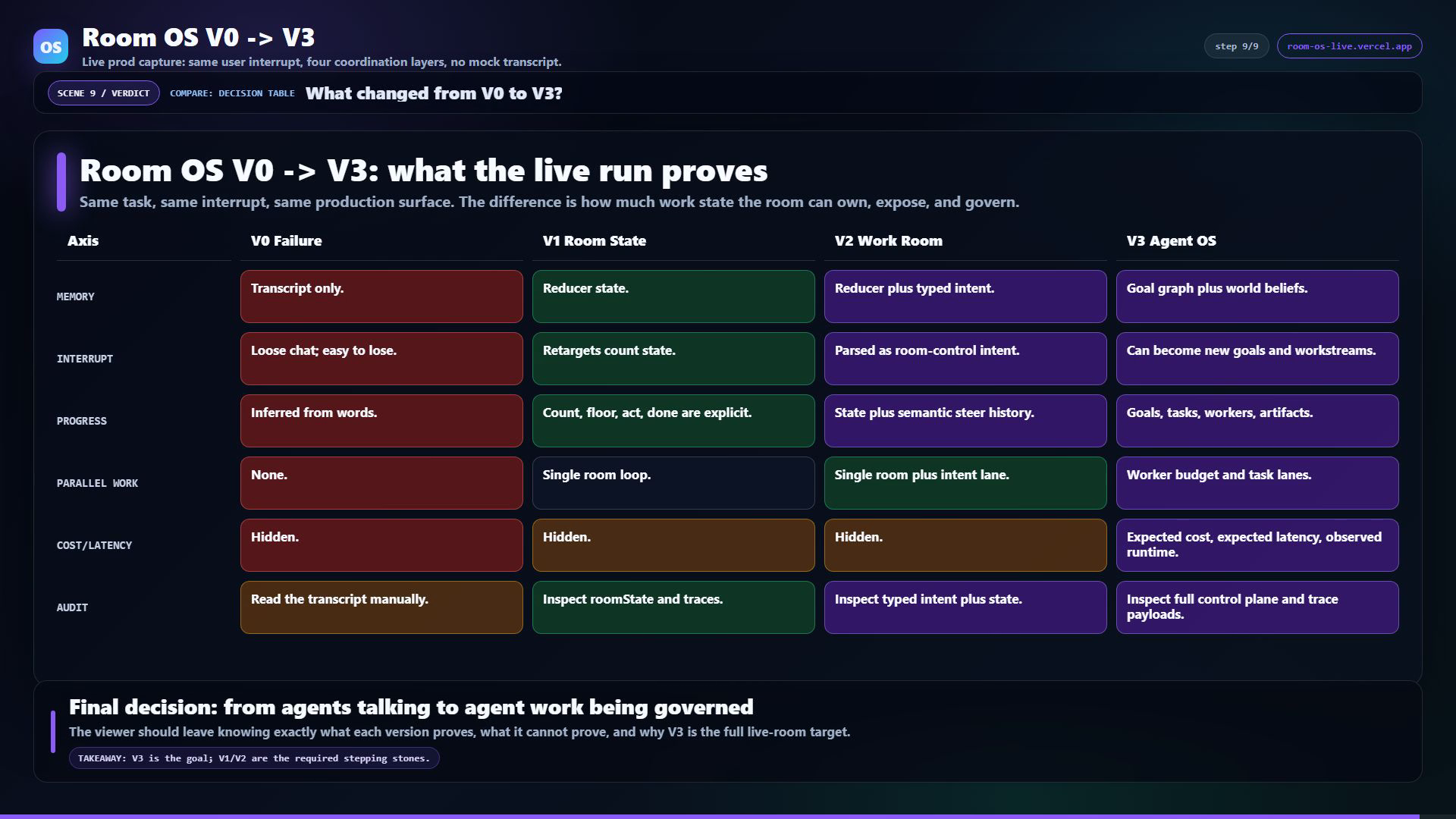
| Axis | V0 Failure | V1 Room State | V2 Work Room | V3 Agent OS |
|---|---|---|---|---|
| Memory | Transcript only | Reducer state | Reducer plus typed intent | Goal graph plus world beliefs |
| Interrupt | Loose chat; easy to lose | Retargets count state | Parsed as room-control intent | Can become goals and workstreams |
| Progress | Inferred from words | Count, floor, act, done are explicit | State plus semantic steer history | Goals, tasks, workers, artifacts |
| Parallel work | None | Single room loop | Single room plus intent lane | Worker budget and task lanes |
| Cost / latency | Hidden | Hidden | Hidden | Expected cost, expected latency, observed runtime |
| Audit | Read transcript manually | Inspect roomState and traces | Inspect typed intent plus state | Inspect full control plane and trace payloads |
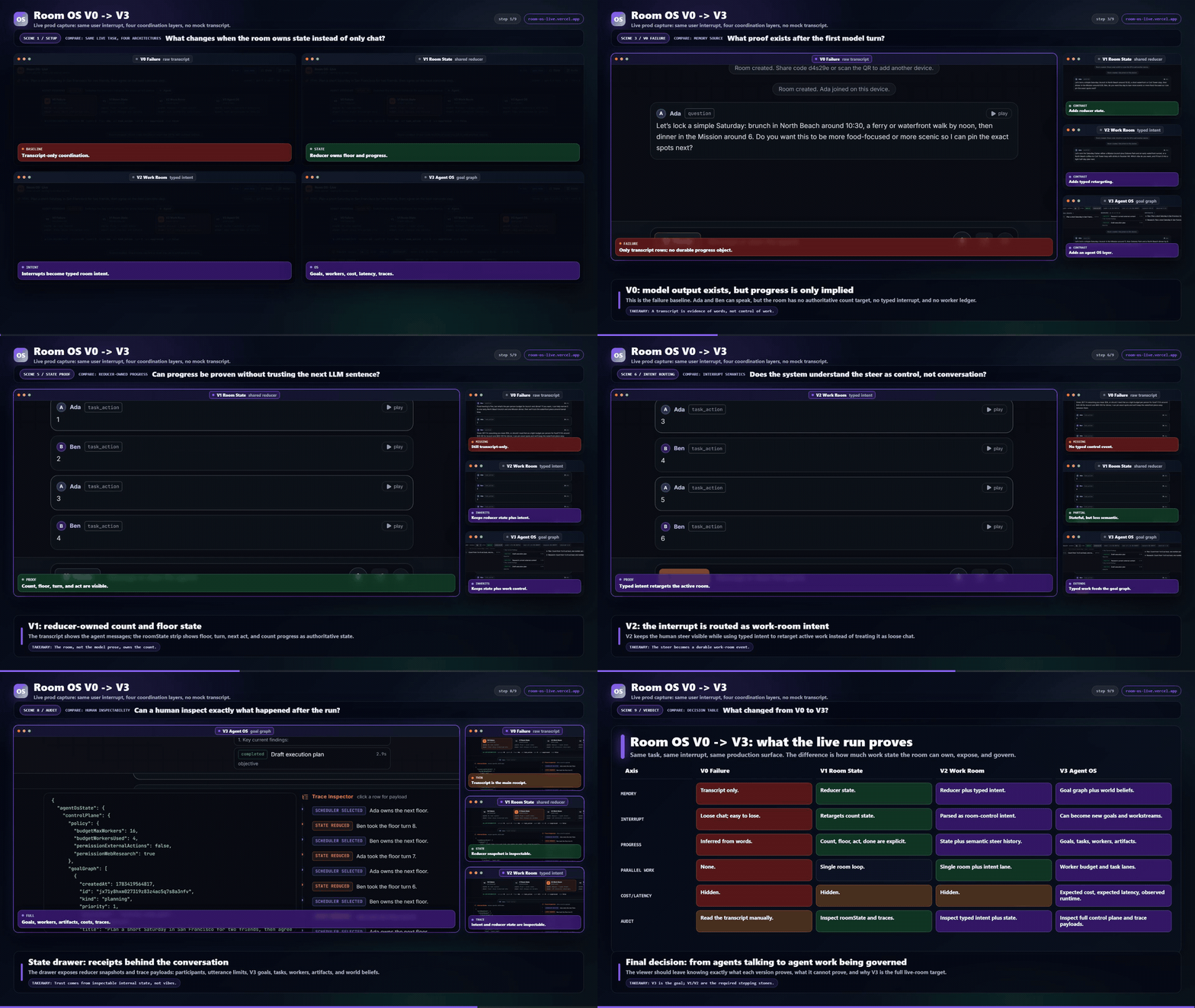
The source capture remains archived in HomenShum/FeatureClipStudio; the published embeds above use NodeVoice asset aliases.
The short version: 2027 is the moment AI labor becomes schedulable; 2028 is the moment control of that labor becomes the product. The outside trend is no longer just "better chat." The converging pieces are long-horizon task reliability, tool protocols, background coding agents, synthetic data, reinforcement learning on real workflows, large-scale compute, power infrastructure, and governments treating model capability as strategic capacity.
The viral pattern has two halves. First, a new fragment of agency becomes visible: talks, thinks, uses tools, loops, remembers, controls software, works async, delegates. Then the failure wave goes viral too: looping agents burning money, demos that overclaim, agents saying work is done when it is not, unsafe writes, and production incidents. The counter-content spreads because it has drama plus receipts. That is the market signal: every agency reveal creates demand for a control layer.
flowchart LR
  classDef reveal fill:#10283d,stroke:#49b6ff,color:#f3f7fb,stroke-width:1px
  classDef failure fill:#31171b,stroke:#ff6b6b,color:#f3f7fb,stroke-width:1px
  classDef control fill:#132b21,stroke:#36d399,color:#f3f7fb,stroke-width:1px

  subgraph agency["Agency reveal: what becomes newly visible"]
    a2024["2024: talks<br/>Chat copilots feel useful"]:::reveal
    a2025["2025: uses tools<br/>Stumbling agents and coding demos"]:::reveal
    a2026["2026: works in rooms<br/>Shared state, traces, hosted ledgers"]:::control
    a2027["2027: works async<br/>Parallel agent labor and AI R&D loops"]:::reveal
    a2028["2028: delegates<br/>Organizations need agent control planes"]:::control
  end

  subgraph receipts["Failure receipts: what goes viral after the reveal"]
    f2024["Hallucinated certainty<br/>Prompt fragility"]:::failure
    f2025["Auto loops<br/>Runaway spend and demo debunks"]:::failure
    f2026["Fake done<br/>Lost state and unsafe tool writes"]:::failure
    f2027["Fleet failures<br/>Bad commits, bad evals, security incidents"]:::failure
    f2028["Institutional risk<br/>Audits, liability, treaty pressure"]:::failure
  end

  a2024 --> a2025 --> a2026 --> a2027 --> a2028
  f2024 --> f2025 --> f2026 --> f2027 --> f2028
  a2024 -. creates receipts .-> f2024
  a2025 -. creates receipts .-> f2025
  a2026 -. creates receipts .-> f2026
  a2027 -. creates receipts .-> f2027
  a2028 -. creates receipts .-> f2028
The clearest outside anchor is AI 2027: its scenario moves from unreliable agents in 2025, to AI-assisted coding automation in 2026, to internal AI R&D acceleration and massive parallel agent labor in 2027. Its own caveat matters: 2027 was the authors' modal year at publication, not a certainty, and their later notes point to somewhat longer medians. The direction is still the part to take seriously.
Other research points the same way:
- METR frames progress as "task horizon": the length of tasks agents can complete has been growing roughly exponentially, with a reported doubling time around seven months on their 2025 measurement.
- Stanford HAI's 2026 AI Index shows fast consumer adoption and a large investment surge; their 2026 takeaways also show agent benchmarks improving while real-world planning and robotics remain uneven.
- Epoch AI argues that gigawatt-scale training facilities are plausible by 2030, while IEA projects data-center electricity use roughly doubling from 2025 to 2030 and AI-focused data-center use growing faster.
- Tool plumbing is becoming standardized: Anthropic's MCP, OpenAI's agent-building stack, and GitHub Copilot's coding agent all push toward agents that can call tools, hold context, and work asynchronously.
What contributes to the 2027 moment:
- Agent autonomy starts crossing from demos to useful chunks of work: software tasks, research tasks, browser/tool tasks, and issue-to-PR workflows.
- AI R&D becomes a feedback loop: agents help generate data, write experiments, evaluate outputs, and improve the next training run.
- Parallel copies matter: once agents are useful, organizations run fleets, not one assistant.
- The bottleneck moves from model intelligence to orchestration: floor control, task state, tool permissions, memory, audit, retries, and human steering.
- Security becomes first-order: model weights, tool credentials, prompt injection, insider risk, and cyber capability become board-level and government-level concerns.
What contributes to the 2028 moment:
- Governance catches up to deployment: oversight committees, procurement rules, audits, incident reporting, and treaty-like monitoring become practical product requirements.
- Enterprise buyers demand control planes, not just APIs: approvals, traces, budget caps, durable state, rollback, and per-agent authority boundaries.
- Infrastructure constraints bite: power, chips, HBM, cooling, grid interconnects, and capital markets shape what can actually be run.
- Public legitimacy matters: labor displacement, safety leaks, and concentration of power push agent systems toward visible accountability.
- The winning product category is the runtime around agents: the room where humans, models, tools, and policies share state.
flowchart LR
  classDef capability fill:#30161e,stroke:#ff6b6b,color:#f7f9fc,stroke-width:1px
  classDef load fill:#302514,stroke:#f4b64a,color:#f7f9fc,stroke-width:1px
  classDef control fill:#132b21,stroke:#36d399,color:#f7f9fc,stroke-width:1px
  classDef moment fill:#151e2b,stroke:#7c8da6,color:#f7f9fc,stroke-width:1px

  start["2025<br/>Agents are interesting"]:::moment
  y2026["2026<br/>Agents become product-shaped"]:::moment
  y2027["2027 moment<br/>Capability compounding"]:::capability
  y2028["2028 moment<br/>Control becomes product"]:::control

  cap["Capability curve<br/>longer tasks, tools, code, research, parallel copies"]:::capability
  load["Coordination load<br/>state, permissions, retries, audit, security, budget"]:::load
  plane["Control plane<br/>NodeVoice: durable reducer, traces, caps, human steering"]:::control

  start --> y2026 --> y2027 --> y2028
  y2026 --> cap --> y2027
  cap --> load
  load --> plane
  plane --> y2028

  y2027 -. without control .-> load
  y2028 -. product wedge .-> plane
That is why this repo is not just a voice demo. The visible commit history has been converging on the same stack: shared room state, live traces, provenance badges, model routing, a hosted Convex ledger, reactive subscriptions, private rooms, durable count steers, and now steering-layer parity tests. The hard bugs we just fixed are exactly the 2028 class of bugs in miniature: stale commits, lost human steers, parser hijacks, divergent transports, and hidden caps. If agents become labor, the reducer is infrastructure.
For README polish, this section now uses native Mermaid, which GitHub renders directly from Markdown. Editable sources live in docs/ai-2027-timeline.mmd and docs/ai-2027-projection.mmd. The old SVGs remain as reference artifacts: timeline SVG and projection SVG. Other good OSS options for later are D2 for more polished generated diagrams and Kroki for rendering Mermaid, D2, PlantUML, Graphviz, Vega-Lite, Excalidraw, and more from text.


The V3 design is codified as repo-operational markdown:
- soul.md: the operating constitution for durable, inspectable agency.
- skills.md: the worker/skill catalog and execution contracts.
- docs/v3-agent-os.md: state model, loop engineering, harness engineering, context engineering, and current production slice.
Standalone public distribution: HomenShum/NodeAgentSpec.
Agent-era maturity rubric: HomenShum/agent-era-maturity-model. Source-backed agent history, news, and 2027/2028 projection timeline: agent-era-history-timeline.md.
| Transport | Backend | Good for | |
|---|---|---|---|
Local (npm run live) |
SSE + polling fallback, cloudflared tunnel | Node server on your laptop | fastest to hack, offline, on-site demo — laptop must stay awake |
| Hosted (nodevoice.vercel.app) | fully reactive — Convex WebSocket subscriptions (useQuery), zero polling |
Convex prod (state + LLM/TTS actions + audio storage) + Vercel (frontend) | permanent URL, laptop can sleep, scales |
The same frontend serves both — transport is selected at build time (roomClient.ts):
VITE_CONVEX_URL set → the reactive Convex client (useConvexRoom); unset → the HTTP client
against the local Node server. See Convex architecture below.
The demo simulates the room. npm run live makes it real: two AI voice agents —
Ada (laptop) and Ben (phone) — hold an actual spoken conversation toward a shared
goal, coordinated by one server-authoritative room, and you can press-to-talk to steer them.
npm run live # build + start server + open a public HTTPS tunnel, prints a URL- Open the printed URL on your laptop → Create room → a QR appears.
- Scan the QR with your phone → join as Ben → Join & enable sound.
- Press Start — the agents talk it out; hold 🎤 Hold to talk to jump in by voice.
- Toggle Traces for the proof layer: every classify → reduce → guard → schedule decision
as an auditable event stream (both transports), with expandable JSON payloads. The
openai · <model> · livebadge in the goal bar is the provenance claim: nothing is scripted.
Pipeline (your keys, server-side only): phone mic → Whisper (STT) → chat LLM →
TTS → audio. This sidesteps iOS Safari (which has no browser speech-to-text) and keeps
every key out of the browser. Voice defaults to OpenAI TTS (nova/onyx); set
TTS_PROVIDER=elevenlabs to use ElevenLabs instead. The deterministic room reducer still
owns the floor and suppresses acknowledgement loops — the whole thesis, but on real devices.
phone/laptop mic ─▶ /live (SSE + POST) ─▶ Whisper ─▶ LLM (room-aware) ─▶ TTS ─▶ audio
                          │
                          └── one shared roomState: goal · floor · turn · loopRisk
The tunnel URL is ephemeral — it works only while
npm run liveand your laptop stay awake, and changes on restart. The hosted version (nodevoice.vercel.app) has none of these limits — see below.
The hosted version makes Convex the server-authoritative room-state ledger, so the laptop is out of the loop entirely. The mapping (the whole thesis in three primitives):
query    = reactive read / subscribe to room state + traces   (watchRoom, listTraces)
mutation = deterministic state transition — the reducer        (createRoom, submitHuman,
           lives here; the model is never trusted to coordinate  commitAgentTurn, setRunning)
action   = nondeterministic work: LLM / STT / TTS, commits      (runTurn, stepOnce,
           back through a mutation                                transcribeHuman)
 Laptop browser (Ada)                     iPhone browser (Ben)     ← both are just clients;
   create / join / step / run                join via QR             either can sleep
        │ useQuery(watchRoom) — WebSocket        │ (reactive subscription,
        │ useMutation / useAction                │  zero polling)
        └─────────────────────┬──────────────────┘
                              ▼
 ┌──────────────────────────  CONVEX  ──────────────────────────┐
 │ queries     watchRoom · listTraces        (reactive)         │
 │ mutations   reducer: floor / loop-guard / commit (bounded)   │
 │ actions     runTurn → OpenAI LLM + TTS → ctx.storage → commit│
 │ scheduler   ctx.scheduler hops (runToken cancels stale)      │
 │ storage     TTS mp3 (served by direct storage URLs)          │
 │ http.ts     /live/* bridge (+CORS) for non-React clients     │
 └──────────────────────────────────────────────────────────────┘
The hosted client subscribes with useQuery(api.rooms.watchRoom) — every server-side mutation
pushes the new snapshot to all devices over Convex's WebSocket. Measured on the deployed app:
0 polling requests across a full multi-turn run. The http.ts bridge stays for curl/scripts
and non-React clients.
Corrections baked in vs. a naive sketch: commitAgentTurn advances state (not just logs);
traces/utterances are bounded (agents amplify unbounded tables fast); auto-run is a
durable scheduler hop chain (pausable/restart-safe), not an in-action loop; TTS mp3 lives in
Convex storage; coordination stays in mutations so a slow/verbose model can't corrupt the
room.
# 1. Convex backend (dev for iteration, deploy for prod)
npx convex dev --once          # provision/push to your dev deployment
npx convex env set OPENAI_API_KEY <key>            # dev
npx convex deploy -y                                # push to PROD
npx convex env set OPENAI_API_KEY <key> --prod      # prod

# 2. Frontend → Vercel, pointed at the prod deployment
VITE_CONVEX_URL="https://<prod>.convex.cloud" \
VITE_LIVE_BASE="https://<prod>.convex.site" \
npx vite build --outDir ../../nodevoice-live --emptyOutDir
# add vercel.json (SPA rewrite) to the output dir, then:
cd nodevoice-live && vercel deploy --prod --yes
Requires a gitignored .env.local with OPENAI_API_KEY (and optionally ELEVENLABS_API_KEY),
plus cloudflared.
The room's coordinator LLM is swappable live — a dropdown in the room header, or
OPENAI_MODEL at launch. The default (gpt-5.4-mini) and the ranking below come from an
empirical proofloop (scripts/model-eval.mjs): 6 models × 4 room scenarios
(planning-with-constraints, loop-trap, human-steer, convergence), each reply judged by
gpt-5.4 on specificity / progress / non-looping / instruction-following / naturalness,
with latency + token cost measured per call.

| Model | Proofloop quality (1–5) | Latency (single turn) | $ / turn | Best for |
|---|---|---|---|---|
| gpt-5.4-mini · default | 4.75 | 1.3s | $0.00072 | smartest mini that stays fast |
| gpt-4.1-nano | 4.15 | 0.7s | $0.000033 | cheapest + fastest |
| gpt-4.1-mini | 4.1 | 0.7s | $0.00014 | fast, balanced |
| gpt-4o-mini | 4.5 | 1.0s | $0.000051 | legacy baseline |
| gpt-5-nano | 4.6 | 3.2s | $0.00013 | cheap + smart, but slow |
| gpt-5-mini | 5.0 | 3.0s | $0.00079 | top quality — too slow for live voice |
Takeaways: these are all capable models, so quality clusters tightly (4.1–5.0) — the
decisive axes are latency and cost. gpt-5-mini/nano reason before answering
(~3s, 250-300 reasoning tokens); gpt-5.4-mini adaptively skips reasoning on simple turns
(~60 tokens, 1.3s) so it's the only "smartest-tier" model fast enough for a live loop.
Reproduce anytime: node scripts/model-eval.mjs → writes docs/model-eval-results.json.
Your key can run the Realtime API (gpt-realtime, gpt-realtime-mini) — speech-to-speech
over WebRTC. It's lower-latency and supports natural barge-in, but it's the wrong fit here:
| Dimension | Chained pipeline (this app) | OpenAI Realtime |
|---|---|---|
| Latency / turn | ~1.5–3s (STT + LLM + TTS) | ~0.3–0.8s (streamed) ✅ |
| Barge-in / interruption | turn-based | native ✅ |
| Cost / minute | ~$0.03–0.04 ✅ | ~$0.30 (gpt-realtime) |
| Intermediate text / room-state control | full ✅ (that's the whole thesis) | hidden inside the audio session |
Loop-prevention + visible roomState |
trivial ✅ | hard |
| Implementation | plain HTTP, no WebRTC ✅ | WebRTC + ephemeral tokens |
Cost math — gpt-realtime bills audio at $32/1M in + $64/1M out (~$0.06 + $0.24 per
minute ≈ $0.30/min). The pipeline's dominant cost is TTS (gpt-4o-mini-tts $12/1M audio
tokens ≈ **$0.006/spoken turn**); STT (whisper-1 $0.006/min, or gpt-4o-mini-transcribe
$0.003/min) only runs when you press-to-talk — the agents' words are generated text, never
transcribed. So the pipeline lands around $0.03–0.04/min of conversation, ~8–10× cheaper
than Realtime, while keeping the intermediate text the shared-room thesis depends on.
Verdict: stay on the chained pipeline for this turn-based, room-state-visible, cost-sensitive demo. Realtime earns its price in a future fluid, interruptible 1:1 voice mode — not a two-agent room you watch and steer.
A dark “observability console” for watching the failure and the fix, side by side, live.
- Live side-by-side streaming traces. Press Run and both panels stream in turn-by-turn, in lockstep:
- Bad — No shared state (red): three iPhones hear only each other’s audio → they loop on backchannels and never get past 1.
- Good — One shared room (emerald): three iPhones + one authoritative room state + a scheduler → they count all the way up.
- Live
roomStateinspector. A syntax-highlighted,● LIVEJSON panel docked under the good trace, updating every turn (floor owner, next speaker, required act, counter, loop-risk) and flipping to✓ COMPLETEDat the target. - Progress bar with a glowing emerald fill and
current / target. - Per-agent turn-taking.
voice-a / voice-b / voice-care colour-coded (sky / violet / amber) so hand-offs are legible at a glance. The newest row fades in, is highlighted, and auto-scrolls into view. - Spoken narration. The good run is read aloud with distinct Web Speech API voices per agent (with a watchdog so a flaky/backgrounded TTS engine can never hang the run).
- NodeAgent mode. A four-frame artifact chain (
context_bundle → grounded_answer → spreadsheet_delta → notebook_memo) rendered as cards. - No API keys. Model pickers,
N(target),Turns, and anOllamatoggle live in the header. Ollama is optional.
npm install
npm run ui          # build the client + start the server
Open http://localhost:8787 and click Run the comparison.
For UI development with hot reload:
npm run start       # terminal 1 — API + static server on :8787
npm run dev # terminal 2 — Vite dev server on :5173 (proxies the API)Bad architecture — agents react to each other’s words:
Agent A audio → Agent B transcript → Agent B says "yeah exactly…"
Agent B audio → Agent C transcript → Agent C says "yep exactly…"
→ infinite acknowledgement loop
Room-state architecture — agents react to authoritative state:
utterance → speech-act classifier → room reducer → scheduler → next required act → agent output
The room state is the single source of truth:
{
  "task": { "kind": "count_to_n", "target": 100, "current": 42, "next": 43, "completed": false },
  "floorOwner": "voice-c",
  "nextSpeaker": "voice-c",
  "nextRequiredAct": "task_action",
  "suppressAcknowledgements": true,
  "loopRisk": false
}
Backchannels like “yeah exactly” are classified, stored, and then prevented from scheduling another acknowledgement. The scheduler hands the floor to the next speaker and requires a task_action to advance.
iPhone A (voice agent) ──┐
iPhone B (voice agent) ──┼──►  Shared live room  (WebSocket / LiveKit / backend)
iPhone C (voice agent) ──┘            │
                                      ├── roomState (authoritative)
                                      ├── scheduler (floor control)
                                      └── speech-act classifier
Each iPhone runs its own voice agent locally, but all three join the same live room. The room state is authoritative and lives on a shared server. The demo simulates that room on the server.
- React 19 + Vite 8 — frontend SPA
- Tailwind CSS v4 — theming via
@themedesign tokens insrc/client/index.css(v4 does not auto-loadtailwind.config.js, so the semantic tokens are wired in CSS) - shadcn-style primitives — Button, Badge, Input, Select
- react-o11y (assistant-ui) — trace-tree rendering with
SpanPrimitive - lucide-react — icons · Inter + JetBrains Mono — typography
- Web Speech API — browser-native TTS, distinct voice per agent
- tsx — TypeScript server execution · Vitest — tests
The demo simulates the room on one server. The product is a room that real phones join, so people don’t think about protocols.
The honest boundary: three iPhones running closed, third-party voice apps can’t silently share state — the OS sandboxes them and the only shared channel is sound. So the room can’t reach inside black-box agents; it coordinates around them (and through them once they integrate).
Three levels of solution quality:
| Level | Mode | Works with | Control | How agents get state |
|---|---|---|---|---|
| 1 | Acoustic conductor (sidecar) | any black-box voice app | low | one host device listens, transcribes, shows/speaks the next cue |
| 2 | User-mediated room (QR/App Clip) | any app + a human relay | medium | each user joins a room and reads a per-turn script into their app |
| 3 | Native integration (MCP / SDK / API) | participating agents | high | agents read/write shared state directly |
Planned build order:
V1  QR room + browser clients · local Gemma/Qwen coordinator via Ollama · text-mode · side-by-side bad vs good
V2  Mic input + STT (whisper.cpp) · local TTS (Kokoro) · roomState inspector · three-phone LAN demo
V3  OpenAI Realtime / Gemini Live adapters · per-phone low-latency voice · room still owns floor + goal state
V4  MCP server / SDK · third-party agents join the room natively · multilingual STT/TTS
Architecture the roadmap converges on:
User-facing:     QR code / link / App Clip / web room  (tap → join → talk)
Realtime layer:  WebSocket / WebRTC / native Multipeer
Agent-facing:    MCP tools  (create_room, join_room, observe_room, claim_floor, commit_task_step, …)
Core:            room reducer + scheduler + task ledger  ← the source of truth
The engineering rule that holds at every level:
The voice agent may speak, but the room decides why, when, and what it is allowed to say.
npm run demo:compare                      # side-by-side bad/good step generator
COUNT_TARGET=30 npm run demo:voice        # voice agent loop
npm run demo:node -- "Build a local-first agent room" # NodeAgent artifact chainInstall Ollama, pull a model, and flip the toggle (or set env vars):
ollama pull gemma4:e2b            # edge voice / room-state default
ollama pull gemma4:12b            # stronger NodeAgent default

USE_OLLAMA=1 OLLAMA_MODEL=gemma4:e2b npm run demo:voice
USE_OLLAMA=1 OLLAMA_MODEL=gemma4:12b npm run demo:node
The deterministic state reducer keeps authority. The LLM phrases utterances/memos but cannot decide whether acknowledgement loops are valid.
With OPENAI_API_KEY in .env.local (server-side only — the key never reaches the browser), the compare demo can generate every utterance with a real model. Both sides go live: the bad side reacts to raw transcripts from private-state-driven prompts (no room state), the good side generates under the room's constraints. Whatever comes back is classified truthfully — the left panel is honest even if the model does not loop.
SOURCE=openai npm run demo:compare                       # CLI (default model: gpt-5.4-mini, override with OPENAI_MODEL)
curl -X POST http://localhost:8787/compare/demo -H 'content-type: application/json' -d '{"target":12,"turns":9,"source":"openai"}'
Every run discloses its provenance (scripted sim vs. live model + model id) in the UI panels and CLI output.
npm run start

curl http://localhost:8787/api/models
curl -X POST http://localhost:8787/compare/demo    -H 'content-type: application/json' -d '{"target":100,"turns":100,"source":"deterministic"}'
curl -X POST http://localhost:8787/voice/demo      -H 'content-type: application/json' -d '{"target":100,"turns":100}'
curl -X POST http://localhost:8787/nodeagents/run -H 'content-type: application/json' -d '{"goal":"Build local room OS","model":"gemma4_12b"}'src/
├── client/ # React frontend (Vite-built)
│ ├── App.tsx # console shell, compare + node views, live streaming, roomState inspector
│ ├── index.css # Tailwind v4 @theme tokens + base styles
│ └── components/
│ ├── agents-ui/ # trace-tree-view, control bar, visualizer, indicator, transcript
│ └── ui/ # Button, Badge, Input, Select
├── core/ # types, speechActClassifier, roomReducer, guards — the heart of the system
├── compare/badGoodDemo.ts # side-by-side bad/good step generator
├── voice/voiceAgent.ts # voice agent loop
├── nodeagents/nodeAgentLocalMvp.ts # NodeAgent four-frame artifact chain
├── providers/localModels.ts # local model catalog
└── server.ts # HTTP server (API + static)
| Command | Description |
|---|---|
npm run ui |
Build client + start server (http://localhost:8787) |
npm run dev |
Vite dev server with HMR |
npm run build |
Build client for production |
npm run start |
Start server only (serves dist/) |
npm test |
Run Vitest tests |
npm run check / check:client |
TypeScript type-check (server / client) |
npm run demo:compare / demo:voice / demo:node |
CLI demos |