Repository navigation
MS4
Students at Los Andes University who lose personal belongings on campus often need to physically visit the Lost and Found office without knowing whether their item has already been recovered. The current process provides limited ways to report lost items, track their status, receive updates, and verify ownership, resulting in unnecessary trips, uncertainty, and inefficient record keeping.
Our solution is a mobile app that allows students to report, search, and track lost and found items on campus without needing to visit the Lost and Found office for every step. Students can digitally report lost items, browse found items, track their report status, and receive notifications when a potential match is found. The solution also includes automatic matching based on item information and secure ownership verification through private questions.

| Persona | Problem | Alternative | Solution |
|---|---|---|---|
| Nicolas Martinez – Student who lost an item | He does not know if his lost item has already arrived at the Lost Items Office, so he may waste time going several times. | He goes physically to the office and asks if the item has arrived. If it is not there, he returns another day. | Allow students to check the status of their report and receive a notification when a possible match is found. |
| Nicolas Martinez – Student who lost an item | He has no easy way to report a lost item immediately after noticing that it is missing. | He asks friends, retraces his steps, and later explains what happened when he visits the Lost Items Office. | Allow students to create a digital lost-item report with the item type, description, location, date, and time. |
| Nicolas Martinez – Student who lost an item | He cannot easily know if one of the objects already found by the University could be his. | He visits the office and describes the object so an employee can manually search for a similar item. | Provide a catalog of found items with general information so he can check possible matches before going to the office. |
| Nicolas Martinez – Student who lost an item | Similar items can make it difficult to prove that a specific object really belongs to him. | He answers questions about the color, brand, model, or location where the object was lost. | Use private characteristics and verification questions to help confirm ownership before the item is returned. |
| Santiago Ramirez – Student who finds an item | He may find an item but not know what he should do with it or who should receive it. | He asks another student or employee, takes it to security, or leaves it with a nearby university service. | Provide a clear found-item reporting process with instructions about what to do and where the item should be delivered. |
| Santiago Ramirez – Student who finds an item | Taking a found object to the correct office may require a detour and interfere with his classes or other activities. | He keeps the object until he has time to deliver it or gives it to the first university employee he finds. | Show authorized or convenient drop-off locations where he can safely deliver the found item. |
| Santiago Ramirez – Student who finds an item | He may forget useful details about where and when the object was found. | He explains what he remembers when he eventually gives the object to someone. | Allow him to immediately register the location, approximate time, description, and optional photo from his phone. |
| Santiago Ramirez – Student who finds an item | After delivering an object, he may not know if it was correctly registered in the Lost Items system. | He simply leaves the object with an employee and assumes that the rest of the process will be completed. | Provide a confirmation that the found item was successfully registered and received by the corresponding service. |
| Maria Gonzalez – Library Assistant | Found items may arrive with incomplete information, making them more difficult to identify later. | She records whatever information the person provides using the current manual process. | Use a standardized digital form with required fields such as category, location, date, time, and description. |
| Maria Gonzalez – Library Assistant | Searching for a specific object among many stored items can take time, especially when several objects look similar. | She manually checks stored items and existing records based on the description given by the student. | Provide a searchable inventory with filters such as item category, date, location, and characteristics. |
| Maria Gonzalez – Library Assistant | It can be difficult to determine whether the person asking for an item is really its owner. | She asks the student to describe the object and manually compares the answers with the available information. | Show private verification information so she can compare it with the student's answers before returning the item. |
| Maria Gonzalez – Library Assistant | There may be little traceability about what happens to an item after it is received, transferred, or claimed. | She depends on manual records or communication with other employees to know what happened to the item. | Keep a digital history showing when the item was registered, transferred, matched, claimed, and who received it. |

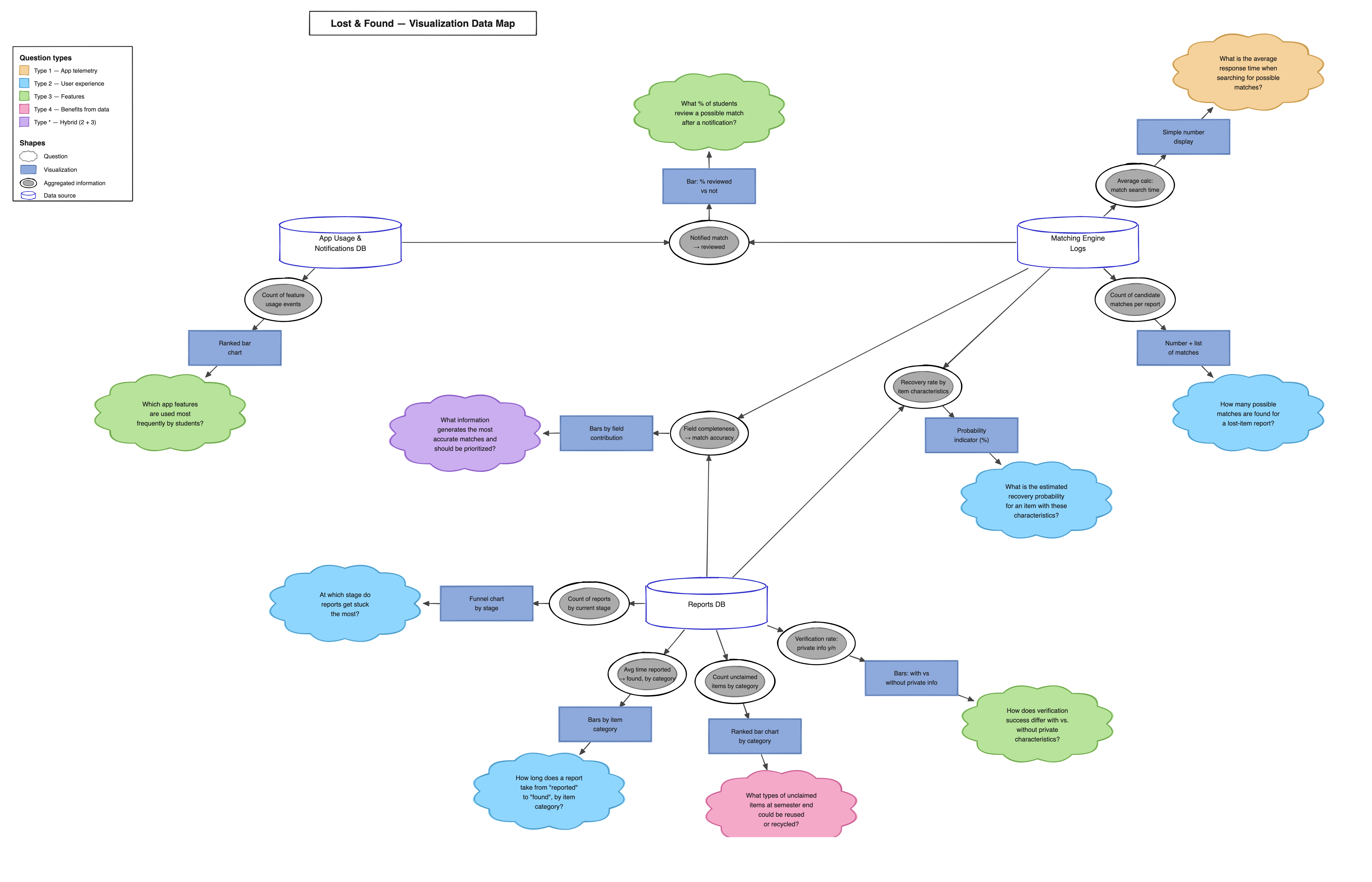
- What is the average response time of the app when searching for possible matches between lost and found item reports?
- How many possible matches are found for a student's lost-item report?
- At which stage of the process (reported, found, ready to pick up, claimed) do reports get stuck the most?
- Based on previous reports, what is the estimated recovery probability for an item with the reported characteristics?
- How long does a report take on average to move from "reported" to "found", and how does this vary by item category?
- Which app features are used most frequently by students?
- What percentage of students review a possible match after receiving a notification?
- How does the successful ownership-verification rate differ between reports that include private identifying characteristics and those that do not?
- What types of unclaimed items at the end of the semester could be reused or recycled?
- What information provided by the student generates the most accurate matches and should be prioritized in the report?
The map is read from each data source outwards: data source → aggregated information → visualization → business question. Cloud colors follow the question types defined in Section 5.
All three data sources are obtainable through the proposed solution. Two aggregations combine information from more than one source: the notification-review rate (App Usage & Notifications DB + Matching Engine Logs) and both the recovery-probability and field-completeness analyses (Reports DB + Matching Engine Logs).