


Map your Sigma detection rules onto the MITRE ATT&CK matrix and find your coverage gaps — fast, offline, and CI-friendly.
Part of a detection-engineering toolkit that pairs perfectly with a Detection-as-Code pipeline (Sigma → CI → SIEM). It answers the question every blue team eventually asks: "Which ATT&CK techniques do my rules actually cover, and where are the blind spots?"
- 🔍 Extracts ATT&CK technique IDs from Sigma rules via:
- canonical
attack.<id>tags, - raw
T1059tags, attack.mitre.org/techniques/...URLs inreferences:.
- canonical
- 📊 Per-tactic coverage bars + overall coverage ratio in the terminal.
- 🎨 Four HTML styles to show off your coverage:
matrix(default) — tactic cards with technique chips,rows— compact tactic progress bars,heat— dense heatmap of every technique,report— print-ready dossier with canonical vertical ATT&CK columns and sub-techniques nested under their parents (PDF it for audits/portfolio).
- 🟢 Covered techniques (incl. parent techniques of covered sub-techniques) render green; gaps render red; explicitly ignored ones render grey.
- 🔎 Scope filters —
--includeand--ignorenarrow the analysis to the techniques/tactics you care about (or exclude the ones you don't). The active scope is shown in the report so readers know what was filtered. - 🏅 Portfolio badge (
--badge) — a shields.io-style SVG coverage badge. - 🧾 JSON summary (
--json) — machine-readable output for dashboards/CI. - 🧭 ATT&CK Navigator export — every HTML report embeds an "Export layer" button that downloads a ready-to-import Navigator layer.
- 🧱 Uses the real MITRE ATT&CK enterprise dataset (v19 structure: Stealth + Defense Impairment). Revoked/deprecated techniques are filtered out so the coverage denominator matches the official matrix (15 tactics, 222 techniques, 475 sub-techniques). Shipped as a compact JSON, no network needed at runtime.
- ✅ Pure Python stdlib +
pyyaml; tiny dependency footprint. - 🤖 Non-zero exit when nothing maps → use it as a CI gate in your detection repo.
report (print-ready dossier) |
matrix (cards) |
|---|---|
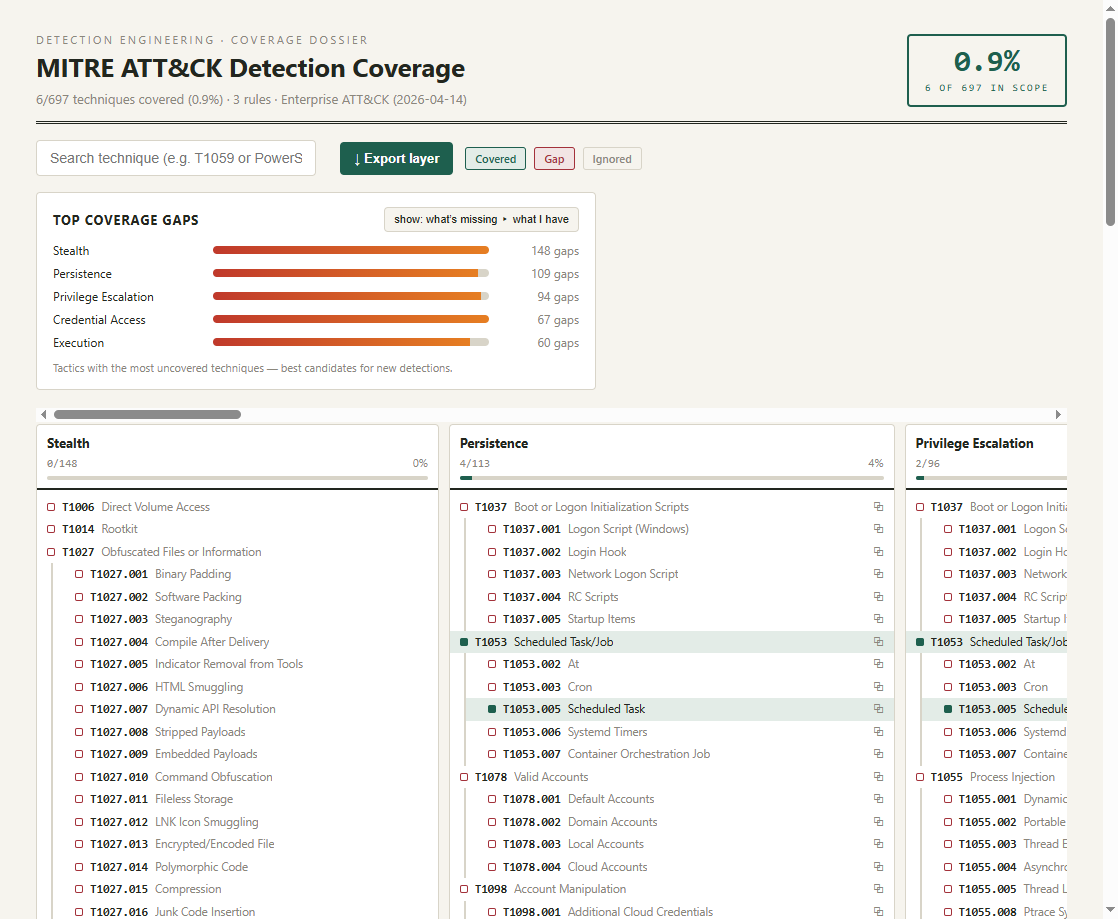 |
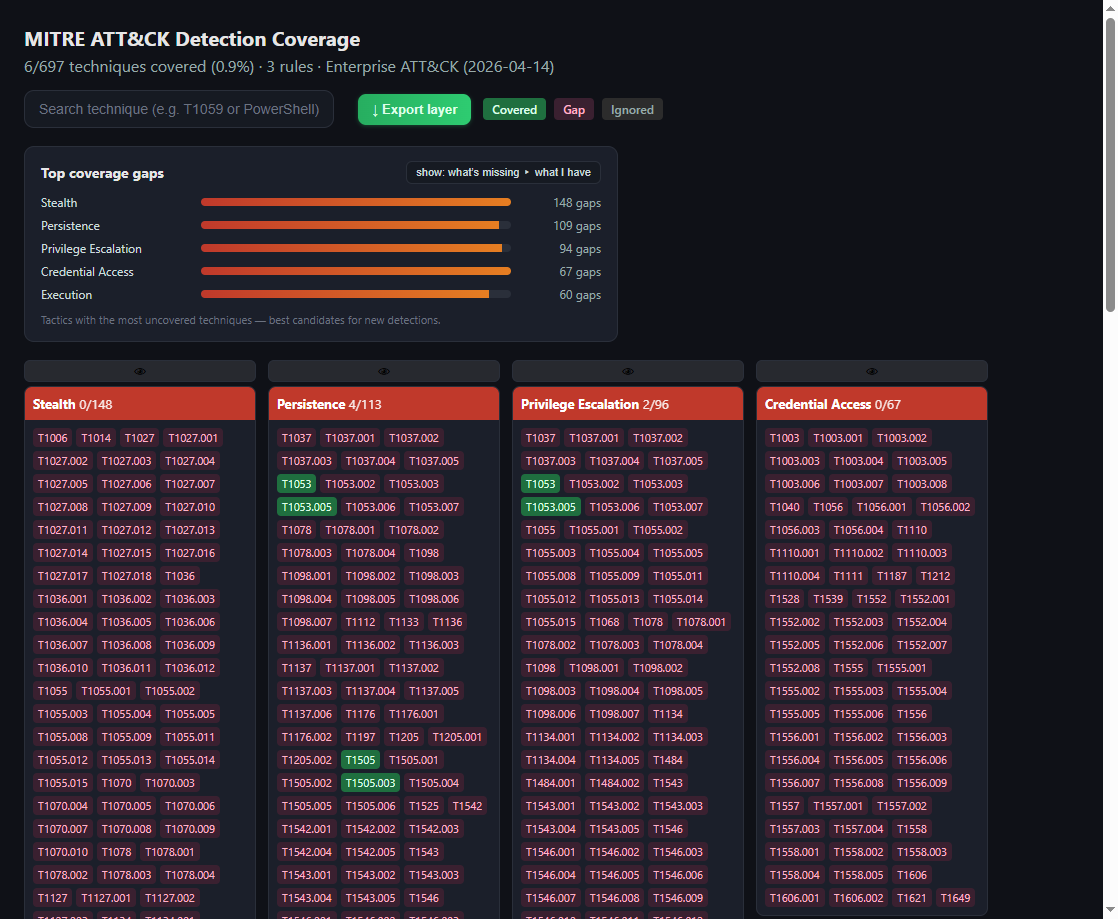 |
pip install attack-mapperFor development:
python -m venv .venv && source .venv/bin/activate
pip install -e ".[dev]"
pytest# Map a folder of Sigma rules, print the terminal report, emit HTML (matrix)
attack-mapper rules/ --html sample/coverage_matrix.html
# Try the other HTML styles
attack-mapper rules/ --html sample/coverage_rows.html --style rows
attack-mapper rules/ --html sample/coverage_heat.html --style heat
attack-mapper rules/ --html sample/coverage_report.html --style report
# Scope the analysis: only Execution + T1053, ignore Reconnaissance
attack-mapper rules/ --include T1059 TA0002 --ignore Reconnaissance
# Portfolio artifacts: badge + JSON
attack-mapper rules/ --badge sample/coverage_badge.svg --json sample/coverage.jsonRun against the bundled sample rules:
attack-mapper rules/ --html sample/coverage_matrix.html --badge sample/coverage_badge.svgBoth are excellent and you should know they exist. sigma2attack (from the Sigma tooling) converts Sigma rules into an ATT&CK Navigator heatmap layer — if all you need is a layer file, it does the job. DeTT&CT is the heavyweight: it scores data-source visibility as well as detection coverage, and is the right tool for a mature SOC doing formal capability assessments.
attack-mapper sits in between, optimized for Detection-as-Code pipelines: it runs offline with a bundled dataset, produces self-contained HTML reports you can email or print (plus the Navigator layer, a badge, and JSON), gates CI with its exit code, and supports scope filters for counting only the techniques relevant to your environment. It is also ATT&CK v19-native (Stealth + Defense Impairment) with a scheduled workflow that flags future MITRE updates automatically.
Sigma rules ──▶ sigma_parser ──▶ technique IDs
                                    │
ATT&CK DB  ──▶ attack_loader       │
                                    ▼
            coverage.build_report (with --include/--ignore) ──▶ CoverageReport
                                    │
            renderers (terminal / HTML matrix|rows|heat)
            plugins  (badge SVG / JSON)
--include and --ignore accept technique IDs (e.g. T1059), sub-technique
prefixes (e.g. T1059 also covers T1059.001), tactic shortnames
(e.g. execution) or tactic IDs (e.g. TA0002). A covered technique is always
recorded as covered even if it falls outside an --include scope, but only
in-scope covered techniques count toward the coverage ratio (both numerator
and denominator are scoped).
The shipped attack_mapper/data/attack_db.json is a snapshot (regenerated
automatically by a monthly GitHub Action that fails when MITRE ships an update). To regenerate from the latest
official STIX bundle:
curl -L -o enterprise-attack.json \
  https://raw.githubusercontent.com/mitre/cti/master/enterprise-attack/enterprise-attack.json
ATTACK_MAPPER_STIX=enterprise-attack.json python -m attack_mapper.build_db
You can also run directly off the STIX bundle at runtime by setting
ATTACK_MAPPER_STIX.
attack-mapper/
├── attack_mapper/
│   ├── cli.py            # argparse entry point
│   ├── sigma_parser.py   # Sigma → ATT&CK technique IDs
│   ├── attack_loader.py  # ATT&CK DB (compact JSON / STIX)
│   ├── coverage.py       # coverage + gaps + scope filters
│   ├── renderers.py      # terminal table + 4 HTML styles
│   ├── plugins.py        # badge SVG + JSON summary
│   ├── build_db.py       # regenerate the compact ATT&CK DB
│   └── data/attack_db.json  # real ATT&CK (compact, ships with the package)
├── rules/                # sample Sigma rules
├── sample/               # generated HTML / badge / JSON examples
├── tests/                # pytest suite
└── pyproject.toml
MIT