v0.3.0 - Memory Galaxy visualization workspace

v0.3.0 - Memory Galaxy visualization workspace
Memnex v0.3.0 upgrades the graph viewer from a plain node-link export into a
local Memory Galaxy workspace: a cinematic but practical interface for reading
personal AI memory systems.
Visual tour
Galaxy overview
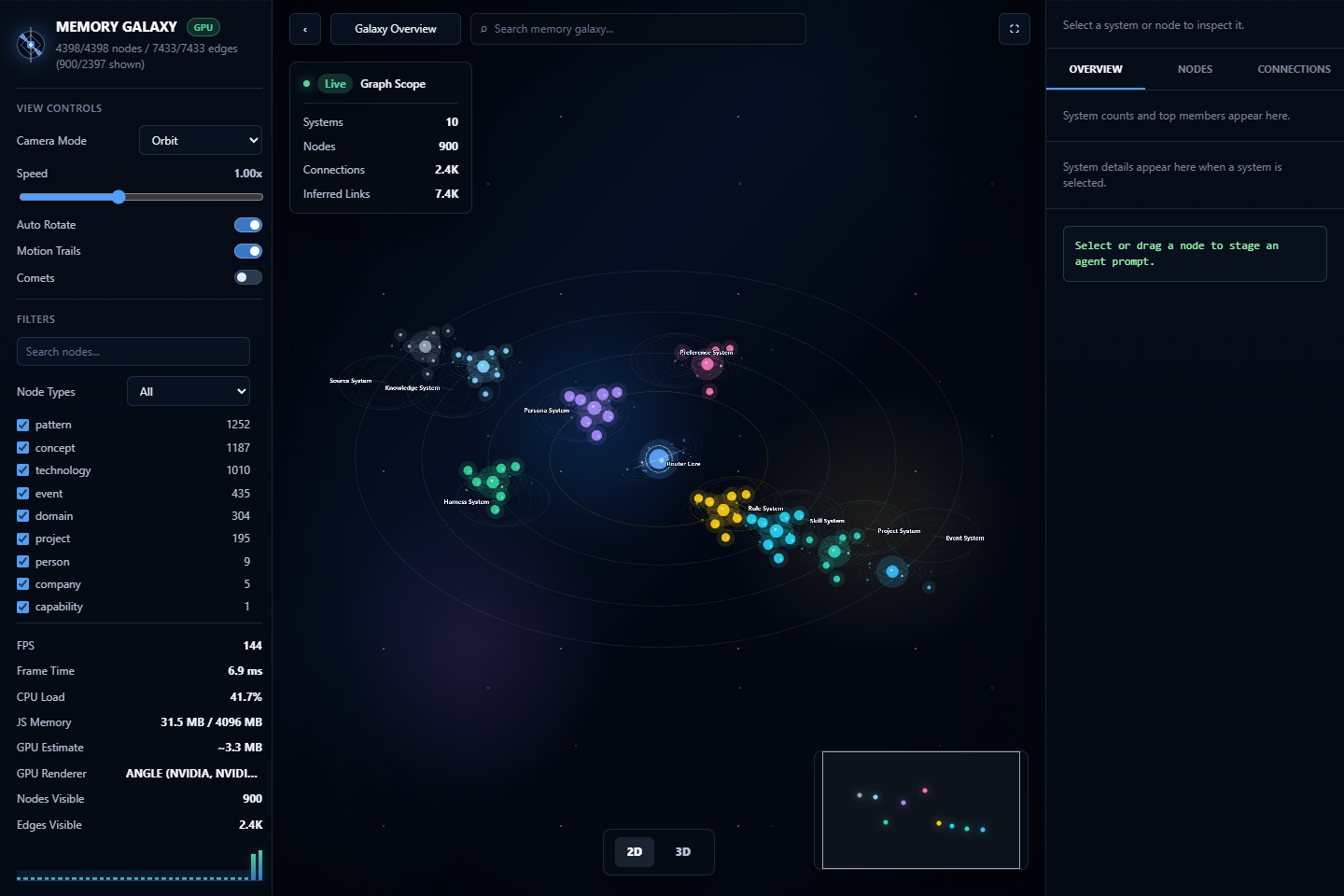
The overview turns the whole memory graph into an orbiting map of memory
systems. Use it to scan system density, search nodes, filter types/layers, and
watch the live performance HUD while navigating large graphs.
System solar-system view
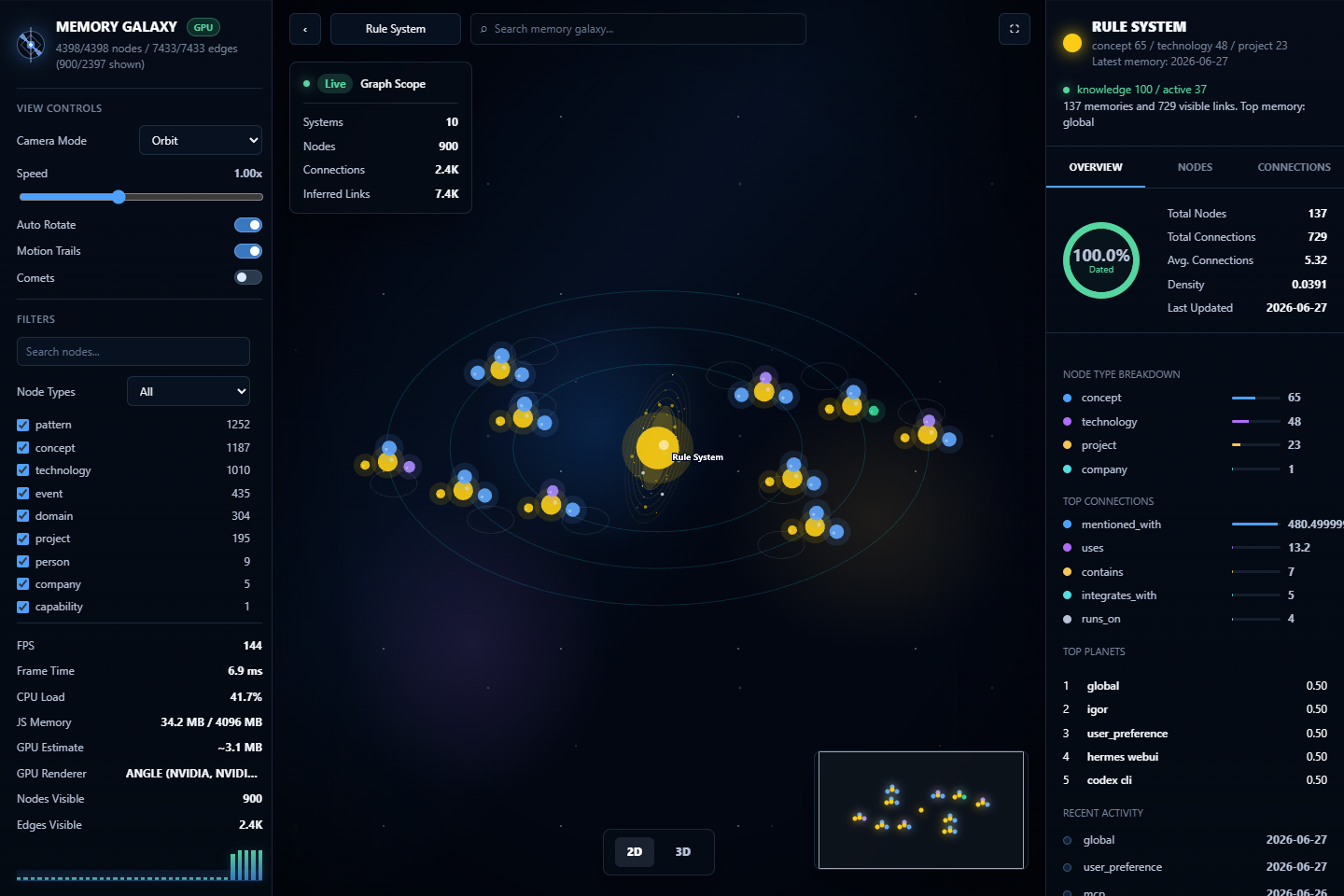
Double-click a system to enter its local solar system. The system center becomes
the star; important memories become planets; the inspector shows counts,
density, recent activity, and high-weight connections.
Planet-satellite context
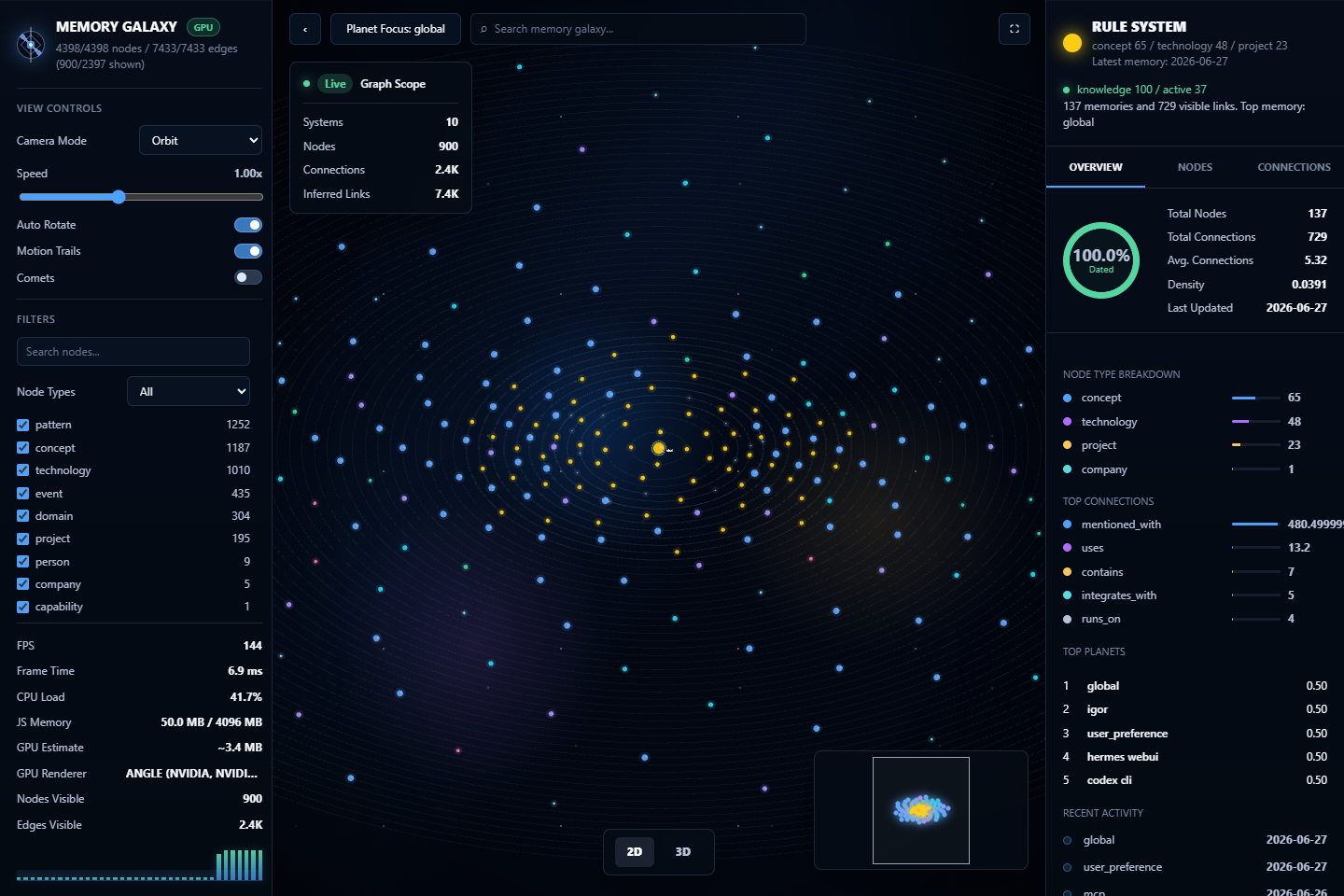
Double-click a planet to inspect direct neighbors, derived context, evidence,
and external relations as readable orbital rings.
What is included
- PixiJS-powered Memory Galaxy UI.
- Galaxy overview, system drill-down, and planet-satellite navigation.
- Full graph export by default. Node/edge limits are used only when explicitly
requested with--max-nodesor--max-edges. - Search, node type filters, layer/edge filters, breadcrumbs, minimap, and
inspector tabs. - Performance HUD for FPS, frame time, memory estimate, GPU renderer, and
visible graph size. - Exporter support for embedded graph data and inlined viewer modules, making
exported folders easy to open locally. - Animation rendering tuned to update existing scene objects instead of
rebuilding the scene on every animation tick.
Who should try it
- Codex, Claude, Cursor, and MCP users with local memory graphs.
- People who want to audit what their AI assistant has learned without reading
raw SQLite rows. - Developers building local-first agent memory workflows.
- Researchers comparing rule, preference, skill, and evidence structures inside
a personal memory system.
Privacy boundary
This release includes viewer source code and sanitized demo screenshots only. It
does not include live memory databases, raw memories, private graph exports,
logs, transcripts, backups, WAL/SHM files, tokens, cookies, or user data.
Generated viewer folders may contain private memory summaries from the selected
database. Keep generated graph.json files private unless you have reviewed and
sanitized them.
How to use
python .\memory-system\tools\graph-viewer\export_graph_viewer.py `
  --db "$env:USERPROFILE\.tam\memory.db" `
  --output .\graph-viewer-output
Open graph-viewer-output\index.html for the full 2D Memory Galaxy workspace.
Do not pass --max-nodes or --max-edges when you want the full graph.
Current limitations
- The viewer is a local static export, not a hosted service.
- Very large graphs may need export limits or local filtering.
- The exporter expects Total Agent Memory-style graph tables.
- Demo screenshots use synthetic/sanitized graph data, not a public dump of a
private memory database.
Suggested repository description
Local-first memory vault for personal AI agents, now with a Memory Galaxy viewer
for exploring rules, skills, preferences, evidence, and graph context.
Suggested topics
ai-memory, ai-agent, local-first, mcp, codex, claude, cursor,
knowledge-graph, memory-graph, graph-visualization, personal-ai,
agent-tools