A drop-in React single-page admin for any Django 5+ project. Same
pip install, same INSTALLED_APPS, same urls.py include() — and
your ModelAdmin classes drive everything. No React code on your side.
Pre-alpha. Available on PyPI as an alpha. Pin tightly; expect breaking changes between alpha releases. Track progress on the Project board and the Issues list.
The Django admin is a 20-year-old hypertext app: full-page reloads,
mid-2000s aesthetics, no real mobile support, no client-side state.
It is also the most powerful piece of Django: ModelAdmin already
encodes your permissions, querysets, forms, fieldsets, search,
ordering, and inlines.
django-admin-react keeps every line of ModelAdmin you already
have and replaces only the UI:
| What you write | What the React SPA does with it |
|---|---|
list_display |
Renders columns in a virtualised, sortable, mobile-collapsing table. |
search_fields |
Renders a search bar that hits get_search_results verbatim. |
list_filter |
Renders a sidebar drawer (desktop) / bottom-sheet (mobile) + filter chips. |
date_hierarchy |
Renders a year → month → day drill-down strip. |
list_editable / list_per_page |
Renders inline-editable cells + paginated list with deep links. |
actions |
Renders a bulk-actions menu wired to the same ModelAdmin.actions. |
fieldsets / readonly_fields |
Renders the detail form respecting groups + read-only rules. |
autocomplete_fields |
Renders type-ahead pickers that hit <model>/autocomplete/?q=…. |
inlines = [TabularInline, ...] |
Renders inlines as tables / card stacks alongside the parent. |
has_*_permission |
Hides Add / Save / Delete buttons accordingly; never invents a permission. |
get_queryset(request) |
Every list, search, and detail lookup starts here. Never Model.objects.all(). |
The SPA is metadata-driven — it learns your models, fields, and
permissions at runtime from GET /api/v1/registry/. Add a new
ModelAdmin and refresh; no rebuild, no codegen.
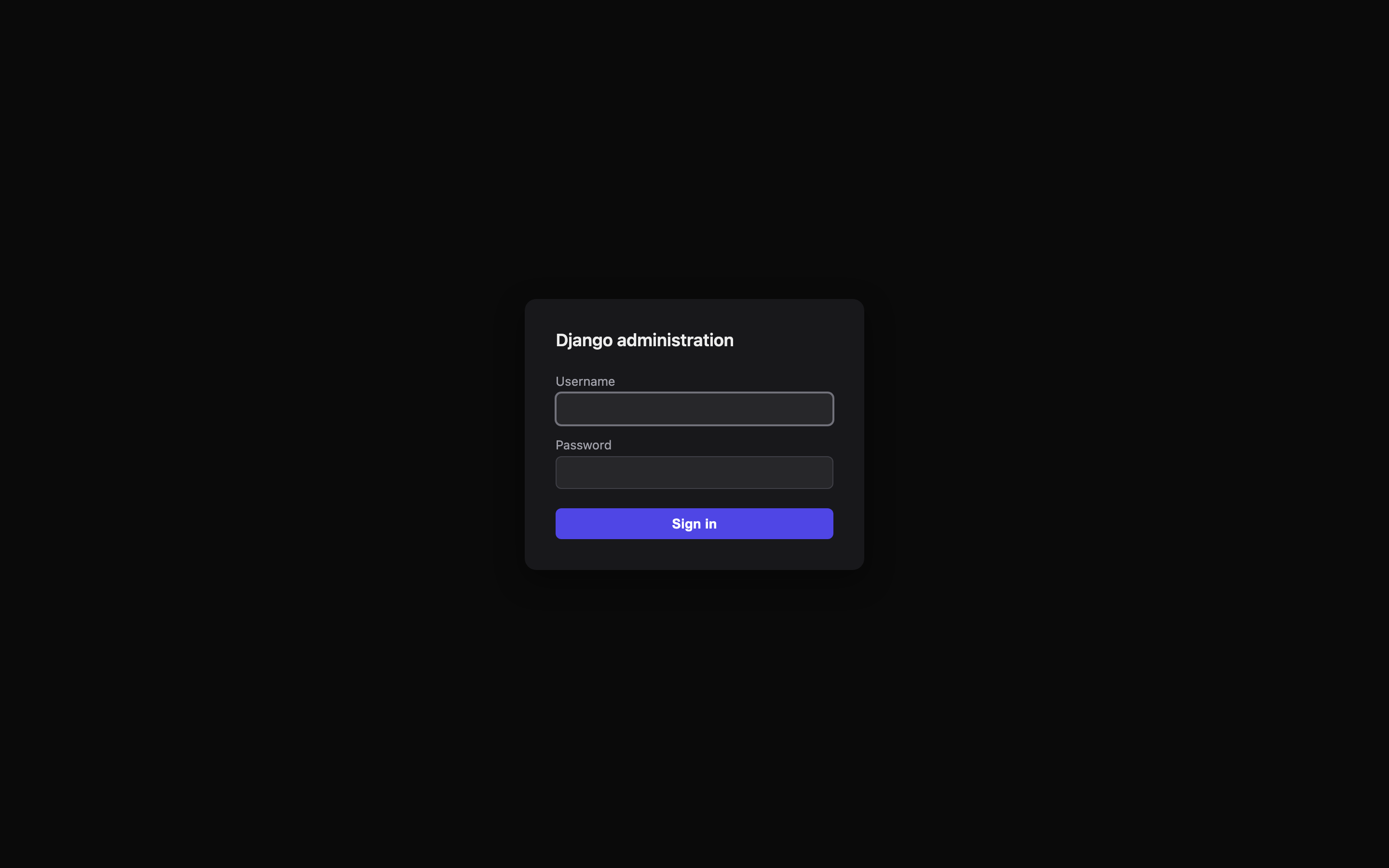
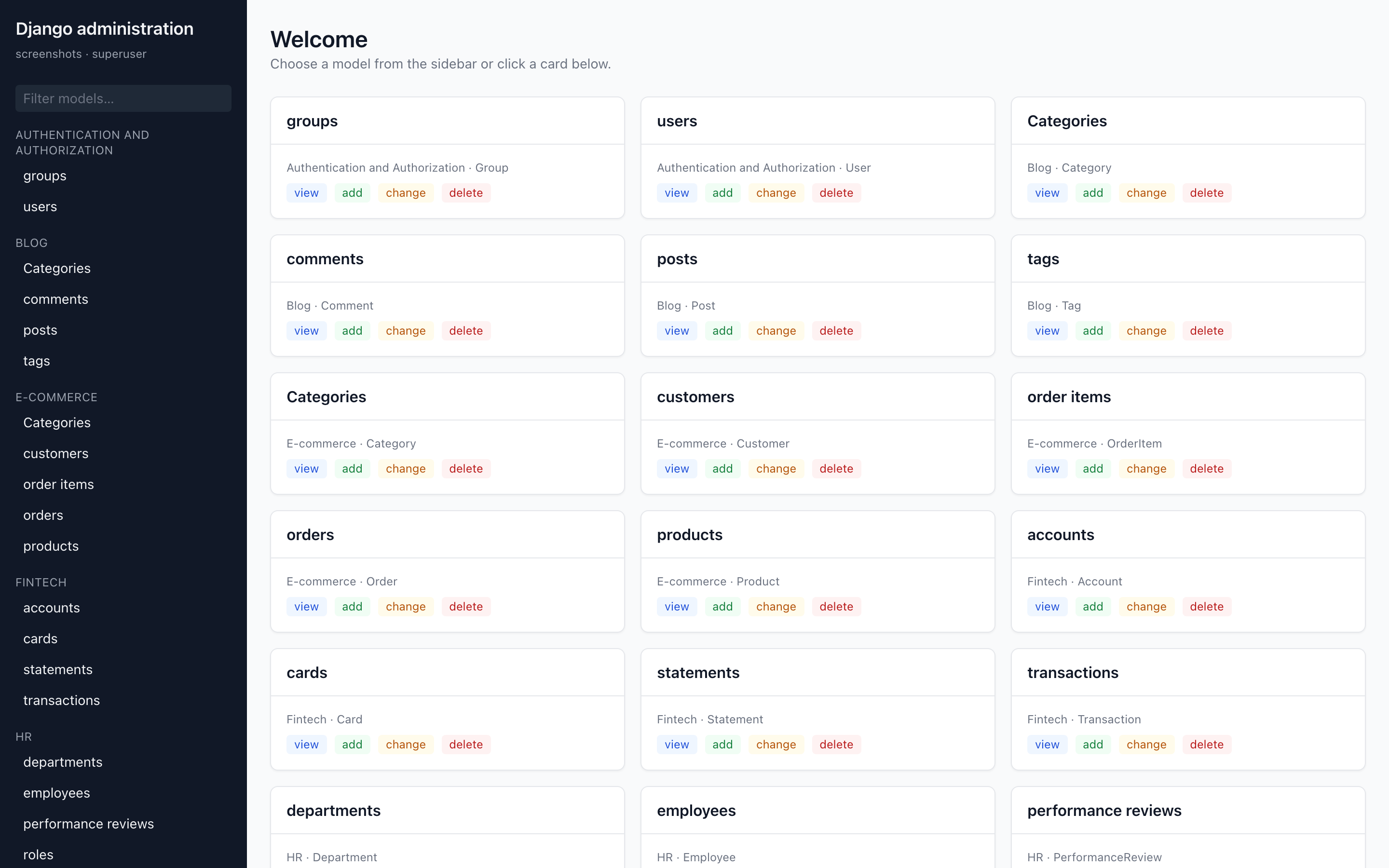
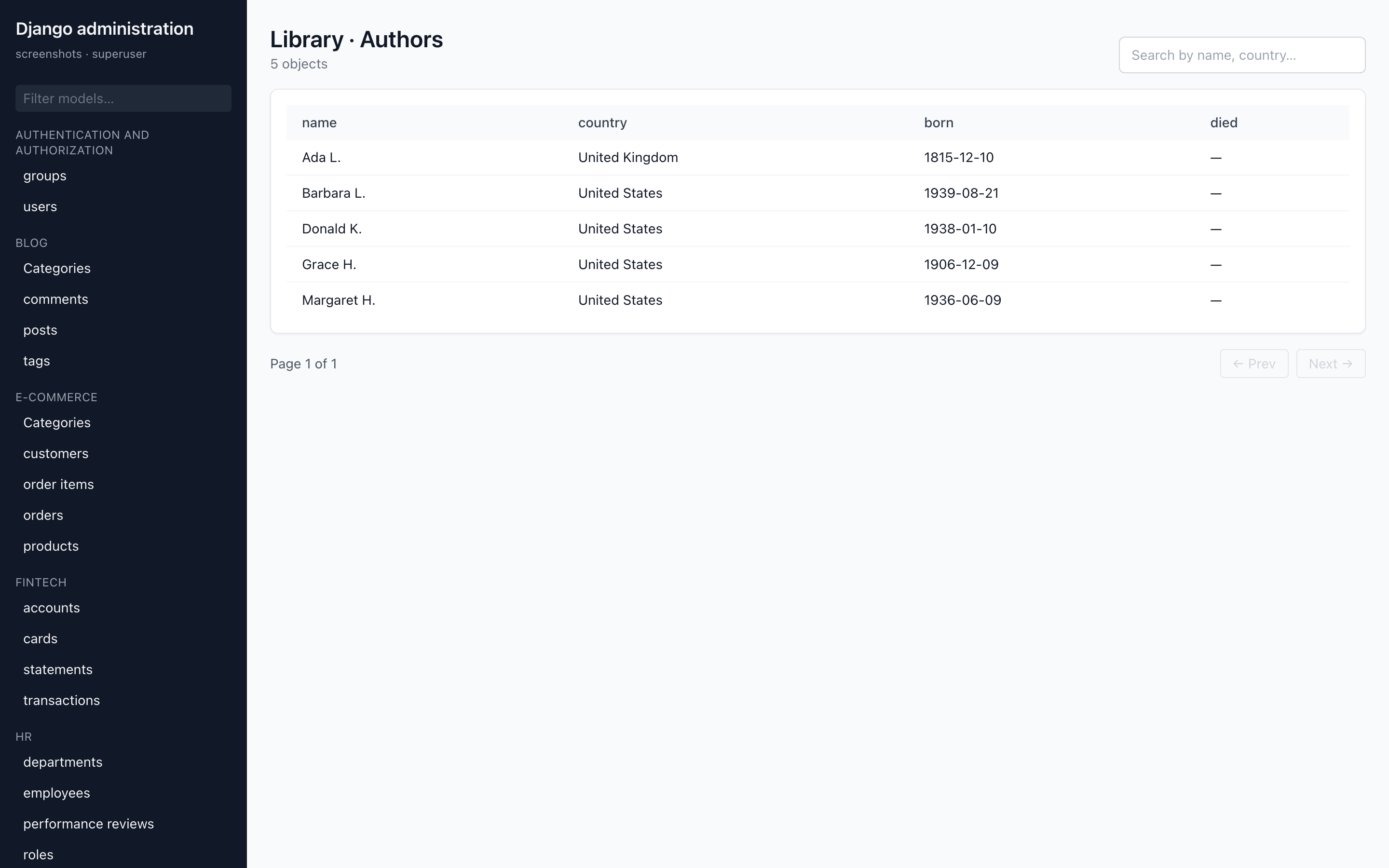
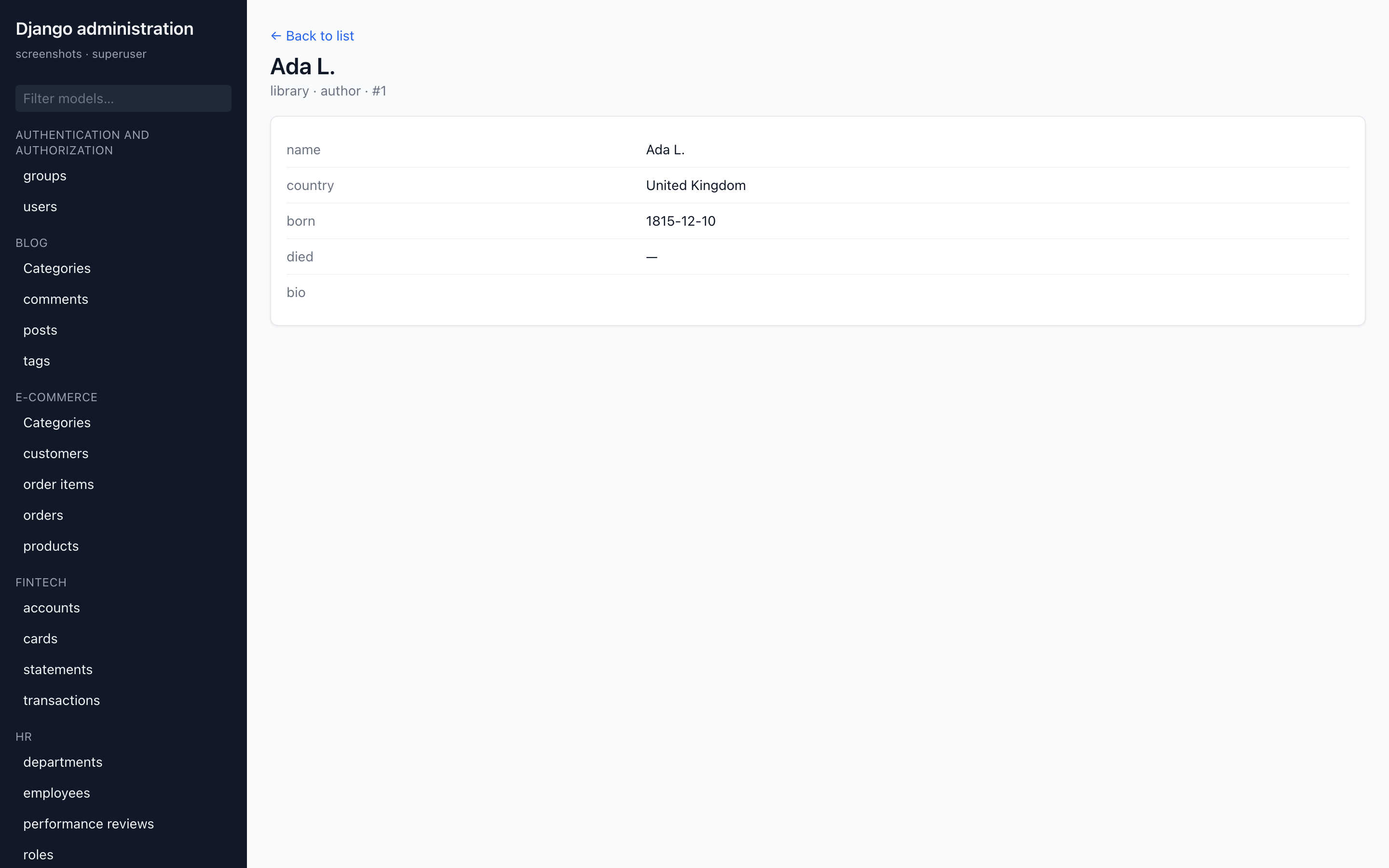
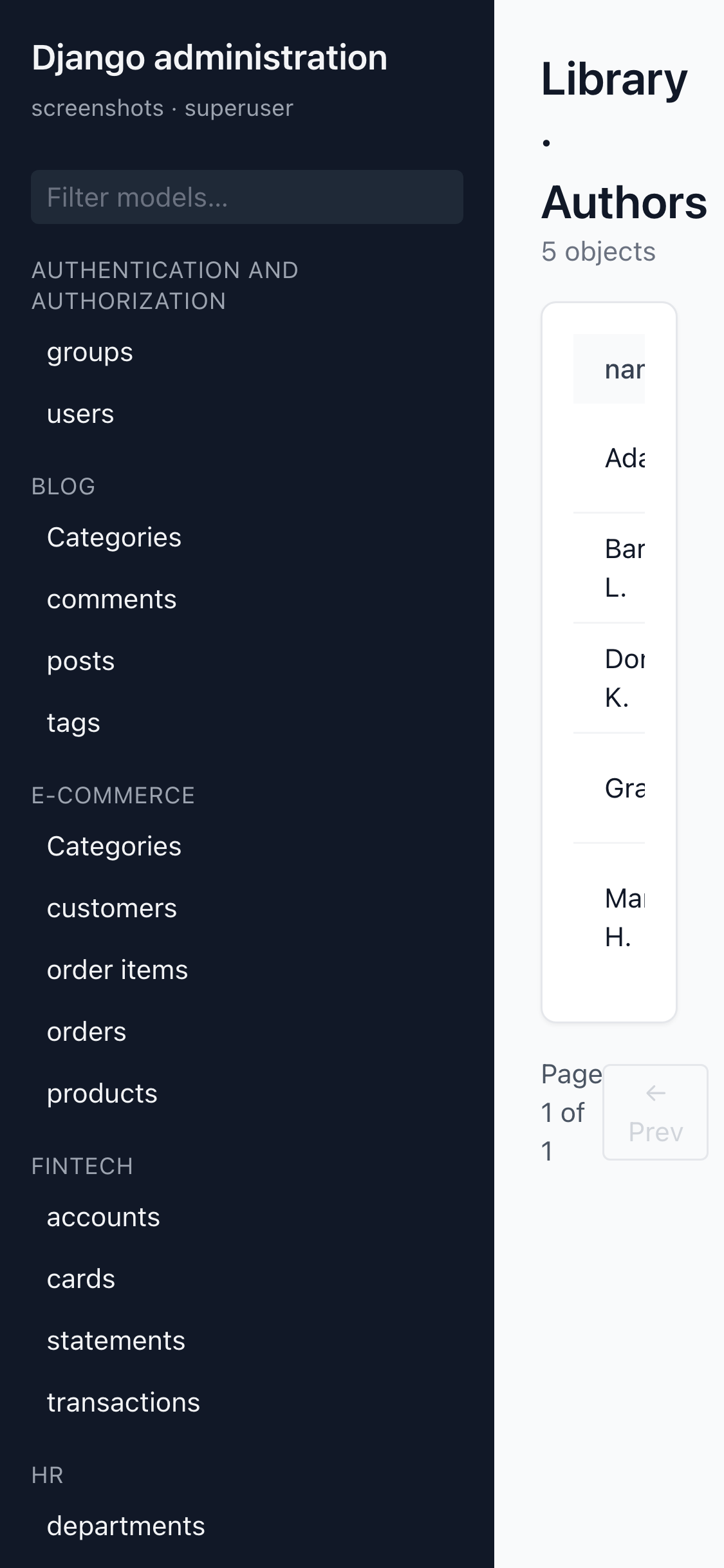
Real captures of the django-admin-react SPA rendering the bundled
examples/ apps — driven entirely by each app's ModelAdmin.
Regenerate any time with scripts/screenshots.sh (Playwright against a
throwaway example server).
| Sign in (package login) | Registry / home |
|---|---|
 |
 |
List view (list_display + search) |
Detail view |
|---|---|
 |
 |
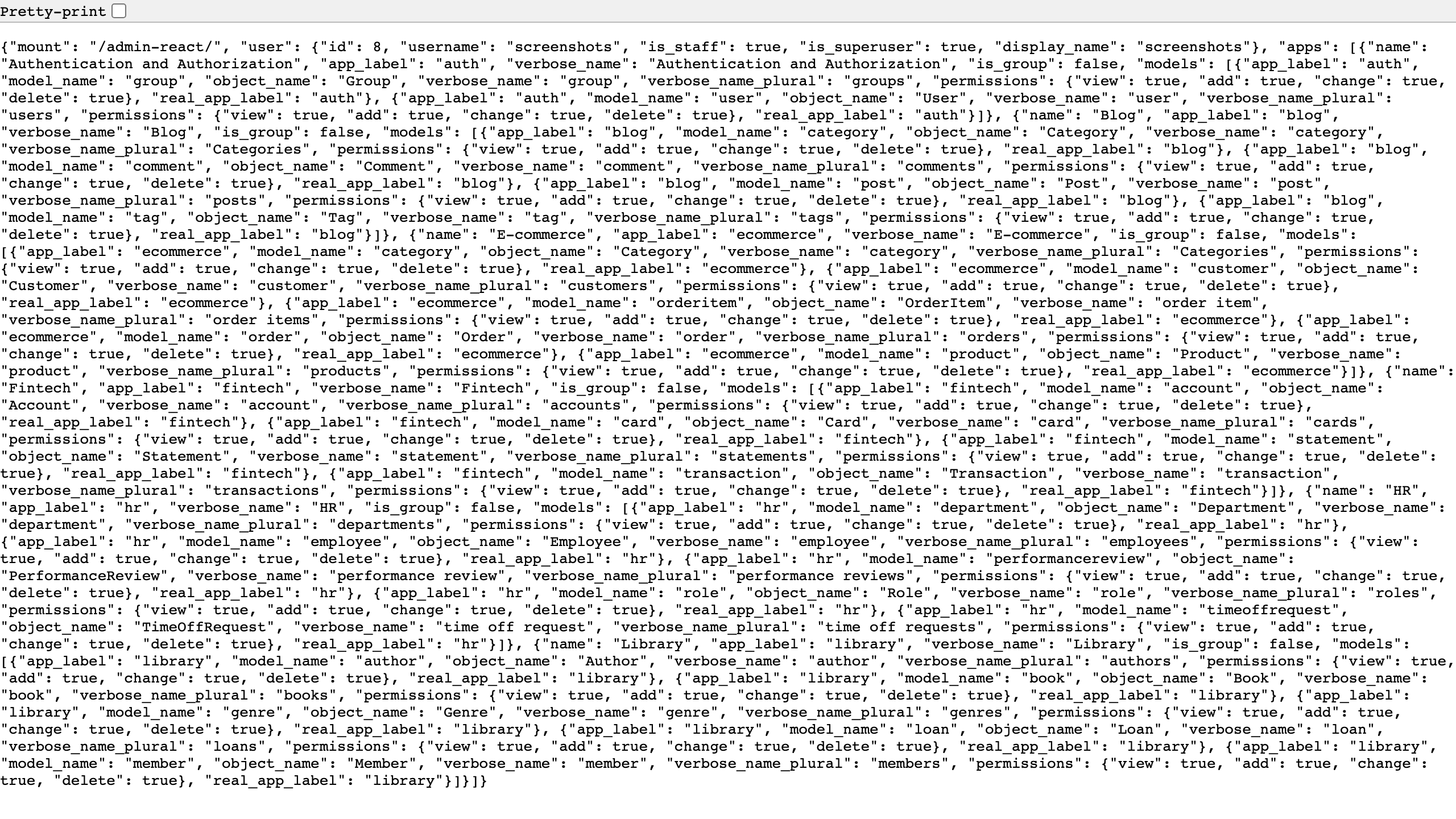
| Mobile (375 px) | API: GET /api/v1/registry/ |
|---|---|
 |
 |
Screenshots use deterministic synthetic fixtures (no real names, emails, account numbers, or PII).
pip install django-admin-react# settings.py
INSTALLED_APPS = [
"django.contrib.admin",
"django.contrib.auth",
"django.contrib.contenttypes",
"django.contrib.sessions",
"django.contrib.messages",
"django.contrib.staticfiles",
"django_admin_react", # ← add this
# ... your own apps
]# urls.py
from django.urls import include, path
urlpatterns = [
path("admin/", include("django_admin_react.urls")),
# any prefix is fine:
# path("admin-react/", include("django_admin_react.urls")),
# path("staff/", include("django_admin_react.urls")),
]That is the entire integration. Log in as a staff user → modern,
Tailwind-styled SPA driven by your existing ModelAdmin classes.
The wheel ships the pre-built React bundle. You do not need Node, pnpm, or any frontend toolchain to install or run.
All settings are optional. Defaults shown:
DJANGO_ADMIN_REACT = {
    "ADMIN_SITE": "django.contrib.admin.site",   # dotted path to AdminSite instance
    "DEFAULT_PAGE_SIZE": 25,
    "MAX_PAGE_SIZE": 200,
    "ENABLE_PROFILING": False,

    # Branding — rendered server-side into the SPA shell, so the
    # consumer's title + favicon are present on first paint (no FOUC).
    "BRAND_TITLE": None,        # str | None — sidebar header + browser tab.
    "BRAND_LOGO_URL": None,     # str | None — used as the favicon and
                                # the sidebar logo. Absolute URL or a
                                # path under your STATIC_URL.
}Both default to None. Resolution order for the title:
DJANGO_ADMIN_REACT["BRAND_TITLE"]— explicit override.<your AdminSite>.site_header— if you already setsite_headeron a customAdminSite, the SPA reuses it automatically. No need to repeat yourself."Django Admin"— last-resort fallback.
BRAND_LOGO_URL accepts either an absolute URL or a path the browser
can resolve under your STATIC_URL. It is used both as the favicon
(<link rel="icon"> in the SPA shell) and as the small logo next to
the brand title in the sidebar.
# settings.py
DJANGO_ADMIN_REACT = {
    "BRAND_TITLE":    "Acme",
    "BRAND_LOGO_URL": "/static/acme/logo.svg",
}
Both values are written into the SPA index template as standard
<meta> tags (dar-brand-title, dar-brand-logo); the React shell
reads them at boot, so the first paint already carries the consumer's
brand. No flash of the package's defaults.
- Python: 3.10+
- Django: 5.0, 5.1, 5.2, 6.0 (and any later 6.x)
- Database: anything Django supports — the package is ORM-only, no direct SQL.
- Auth: Django's built-in session + CSRF. Works with custom
AUTH_USER_MODEL, customAUTHENTICATION_BACKENDS, and customAdminSite.has_permission.
A common rollout: keep /admin/ on the legacy HTML admin, mount the
React SPA at /admin-react/, and migrate users at your own pace.
Both run off the same ModelAdmin registrations — there is no
duplicate state.
urlpatterns = [
    path("admin/",        admin.site.urls),                          # legacy, unchanged
    path("admin-react/",  include("django_admin_react.urls")),       # SPA
]Everything below is just ModelAdmin. No JavaScript. No new
classes. The UI follows whatever your admin declares.
@admin.register(Invoice)
class InvoiceAdmin(admin.ModelAdmin):
list_display = ("number", "customer", "status", "total", "issued_at")class InvoiceAdmin(admin.ModelAdmin):
list_display = ("number", "customer", "status", "total", "issued_at")
sortable_by = ("issued_at", "total") # everything else is fixedclass InvoiceAdmin(admin.ModelAdmin):
search_fields = ("number", "customer__name", "notes__icontains")
# The SPA wires `?q=<term>` to `ModelAdmin.get_search_results` verbatim.class InvoiceAdmin(admin.ModelAdmin):
ordering = ("-issued_at",)class InvoiceAdmin(admin.ModelAdmin):
exclude = ("internal_audit_hash",) # never reaches the SPA
readonly_fields = ("total",) # rendered as read-onlyThe SPA respects exclude and readonly_fields exactly the way the
legacy admin does. Sensitive-named fields (password, secret,
token, api_key, hash, private_key, session, nonce, salt)
are filtered on top of those rules as defense-in-depth.
class InvoiceAdmin(admin.ModelAdmin):
    fieldsets = (
        ("Identity",  {"fields": ("number", "customer")}),
        ("Money",     {"fields": ("subtotal", "tax", "total")}),
        ("Lifecycle", {"fields": ("status", "issued_at", "paid_at")}),
        ("Internal",  {"fields": ("notes",), "classes": ("collapse",)}),
)class InvoiceAdmin(admin.ModelAdmin):
list_filter = ("status", "issued_at", "customer")
# Boolean / choices / FK / date / SimpleListFilter all supported.class InvoiceAdmin(admin.ModelAdmin):
date_hierarchy = "issued_at"
# SPA renders a year → month → day strip wired to ?year=&month=&day=class InvoiceAdmin(admin.ModelAdmin):
list_editable = ("status",)
# SPA: click cell → input swap → blur/Enter saves via PATCH /<app>/<model>/bulk/class InvoiceAdmin(admin.ModelAdmin):
actions = ["mark_paid"]
@admin.action(description="Mark selected as paid")
def mark_paid(self, request, queryset):
queryset.update(status="paid", paid_at=timezone.now())The SPA renders a bulk-actions menu and posts to the same
ModelAdmin.actions machinery — same signatures, same audit
trail.
class InvoiceAdmin(admin.ModelAdmin):
    def has_add_permission(self, request):
        return request.user.has_perm("billing.create_invoice")

    def has_change_permission(self, request, obj=None):
        if obj is None:
            return request.user.has_perm("billing.change_invoice")
        return obj.owner_id == request.user.id   # row-level rule

    def has_delete_permission(self, request, obj=None):
        return False    # nobody deletes invoices

    def has_view_permission(self, request, obj=None):
        return request.user.has_perm("billing.view_invoice")
The SPA hides the Add / Save / Delete buttons automatically
based on these. UI never invents a permission; it asks ModelAdmin.
class InvoiceAdmin(admin.ModelAdmin):
    def get_queryset(self, request):
        qs = super().get_queryset(request)
        if request.user.is_superuser:
            return qs
        return qs.filter(owner=request.user)
The list view never sees rows the queryset excludes. No
Model.objects.all() in the package — every list, search, and
detail lookup starts at ModelAdmin.get_queryset(request).
class InvoiceAdmin(admin.ModelAdmin):
    def save_model(self, request, obj, form, change):
        obj.last_edited_by = request.user
        super().save_model(request, obj, form, change)
Writes always go through ModelAdmin.get_form() → form.is_valid()
→ save_model(). Signals, audit logs, and post-save hooks all fire
exactly like they do in /admin/.
# myproject/admin.py
from django.contrib.admin import AdminSite

class StaffAdminSite(AdminSite):
    site_header = "Operations Console"
    site_title  = "Ops"
    index_title = "Welcome"

    def has_permission(self, request):
        return request.user.is_active and request.user.is_staff and \
               request.user.groups.filter(name="ops").exists()

staff_admin = StaffAdminSite(name="staff")

# myproject/settings.py
DJANGO_ADMIN_REACT = {
    "ADMIN_SITE": "myproject.admin.staff_admin",
}
The SPA inherits the custom site's permission gate and the
ModelAdmin registrations on that site — no parallel registry.
# yourapp/admin_react.py
from django_admin_react.api.serializers import register_field_type
from yourapp.fields import MoneyField

register_field_type(MoneyField, vocab_type="decimal")
# SPA renders MoneyField with the built-in decimal widget; no React
# code required.
For coining a brand-new vocab_type (with a matching SPA widget)
see docs/extensions.md.
get_form, get_fieldsets, get_fields, get_exclude,
get_readonly_fields, get_search_results, get_list_display,
get_sortable_by, get_list_filter, get_actions — all of them
are called by the SPA the same way the HTML admin calls them. If
you customised them for /admin/, the SPA already honours those
customisations.
The backend — the ModelAdmin-driven REST API — is the stable,
complete surface and the table below tracks it. The React SPA that
consumes it is in active development; to keep this README from drifting,
per-feature SPA (UI) status is not duplicated here — it is tracked
live in the frontend implementation tracker (#160)
and the project board.
ModelAdmin surface |
Backend (REST API) |
|---|---|
| Registry / list / detail / create / update / delete | ✅ |
list_display, sortable_by, search_fields |
✅ |
list_filter (boolean / choice / FK / date / Simple) |
✅ |
date_hierarchy |
✅ |
list_editable + bulk PATCH |
✅ |
actions (custom + bulk runner) |
✅ |
autocomplete_fields / raw_id_fields |
✅ |
ManyToManyField read + write |
✅ |
inlines (TabularInline / StackedInline) — read + write |
✅ |
FileField / ImageField — read |
✅ |
FileField / ImageField — multipart upload |
🟡 #241 |
JSONField / ArrayField / range — read |
✅ |
| range fields — write coercion | 🟡 #238 |
register_field_type + per-model extension hook |
✅ |
| React login / logout (Django session + CSRF) | ✅ |
Password set / change (UserAdmin parity) |
✅ |
| Session-expiry re-login contract | ✅ |
OpenAPI 3.1 schema at /api/v1/schema/ |
✅ |
| PWA manifest + service worker (cache-purge on logout) | ✅ |
✅ = shipped in the current alpha. 🟡 = not yet built (tracked). This
column is the backend capability only — for which surfaces the React
UI renders today, see the frontend tracker (#160).
ACCEPTANCE.md carries the full criterion-by-criterion list.
The SPA is a thin client over a small, closed REST surface. You can also use these endpoints from any HTTP client (curl, your own frontend, a script).
| Method | Path | Purpose |
|---|---|---|
GET |
/api/v1/registry/ |
All apps + models the current user can see, with their permissions. |
GET |
/api/v1/schema/ |
OpenAPI 3.1 schema for the envelopes + closed type vocabulary. |
GET |
/api/v1/<app>/<model>/ |
Paginated list. Honours ?search=, ?ordering=, ?page=, list_filter. |
POST |
/api/v1/<app>/<model>/ |
Create. Runs ModelAdmin.get_form() + form.is_valid() + save_model(). |
GET |
/api/v1/<app>/<model>/<pk>/ |
Detail with serialised fields, permissions, inlines, panels. |
PATCH |
/api/v1/<app>/<model>/<pk>/ |
Partial update. Same form pipeline as POST. |
DELETE |
/api/v1/<app>/<model>/<pk>/ |
Hard delete via ModelAdmin.delete_model(). |
PATCH |
/api/v1/<app>/<model>/bulk/ |
list_editable round-trip for multiple rows. |
POST |
/api/v1/<app>/<model>/<action>/ |
Invoke a registered ModelAdmin.actions entry on a queryset. |
GET |
/api/v1/<app>/<model>/autocomplete/?q=… |
autocomplete_fields lookup. Permission-gated on the target model. |
Every endpoint is staff-only by default (or whatever
AdminSite.has_permission returns), CSRF-required on unsafe
methods, and emits Cache-Control: no-store. Full wire contract:
docs/api-contract.md.
Six runnable example projects ship with the repo under
examples/:
| Project | What it exercises |
|---|---|
library/ |
Author, Book, Genre — basic CRUD, FKs, M2M, search_fields, list_filter. |
fintech/ |
Account, Transaction — permissions, queryset narrowing, custom actions. |
blog/ |
Post, Tag, Comment — list_editable, inlines, date_hierarchy. |
ecommerce/ |
Product, Order, LineItem — fieldsets, readonly, register_field_type for MoneyField. |
hr/ |
Employee, Department — autocomplete_fields, raw_id_fields, organisational filters. |
project/ |
Glue project that mounts every example app for an end-to-end demo. |
Boot any of them with:
cd examples/project
python manage.py migrate
python manage.py loaddata seed
python manage.py runserver
# → http://127.0.0.1:8000/admin/    (legacy admin)
# → http://127.0.0.1:8000/admin-react/ (the React SPA)- Plug-and-play: works with any
ModelAdminyou already have. - Shared auth: Django sessions, CSRF, staff permissions. No new user model, no parallel permission system.
- Responsive, modern UI: React + Tailwind + React Query, served
as a single bundle from
django_admin_react/static/admin_react/. - Extensible by editing
ModelAdmin, not React. Per-model SPA extension hooks for the cases that genuinely need them. - Configurable URL prefix —
/admin/,/admin-react/, anywhere. - Conservative & secure-by-default — never exposes models the
admin doesn't already expose; never writes fields the admin form
excludes; CSRF on every unsafe method;
Cache-Control: no-storeon every API response; sensitive-name denylist on top of the admin's ownexcluderules. - Boring + auditable — no parallel permission system, no
client-side workarounds for backend permissions, conservative
serializer with
str()fallback.
MIT — see LICENSE.
Please report security issues privately through GitHub's Private
Vulnerability Reporting on the repository (Security → Advisories).
See SECURITY.md. Do not open a public issue.
Humans and AI agents both welcome. Start with
CONTRIBUTING.md.