Repository navigation
Ricorsa and IGL
Ricorsa is the consumer product SMEPro built on Identity Governed Logic first. You ask it questions, it answers with citations, and it keeps a living identity graph of what it has learned about you: your topics, the people and organizations in your work, your goals, your expertise, your style. The graph is yours. It stays in one account, it is never shared or used for training, you can pause it, forget any part of it, reset it or export it, and everything Ricorsa derives from it carries a provenance id chained from the exact state it came from.
That rule set is IGL as Ricorsa practices it. The platform at id-me.ai is the same rule set written as a contract any application can build on, at the scale of an organization rather than one person, with governance over who may see which part of the graph for which purpose. Since contract 0.3 the platform guarantees Ricorsa's four controls as operations: pause, forget, reset and export, each a governed action with a signed receipt and an entry in the audit chain.
Ricorsa's recursive learning loop is simple to state: a question adds nodes to the graph, the graph shapes the next answer, and what happens afterwards strengthens or weakens what was learned. The platform runs the same loop with the pieces named. Applications write context, facts and relationships about an identity. A projection under a purpose decides what a model may see of it. Interactions and outcomes are recorded. In the runtime underneath, inherited inference decays unless it is re-derived, so a guess that is only ever reused loses confidence until it is no longer admissible as context.
Ricorsa's Discover traverses the graph with the IGL check shown at every hop and turns what it finds into ideas, each with a lineage id. On the platform that is POST /graph/paths, search, and the crosswalk and investigate operations: every hop is a certified or proposed relationship, proposed ones never become authority, and every result must cite the records it came from or it is refused.
| Ricorsa says | The platform says |
|---|---|
| Identity graph, one per user | Identities, relationships, facts and context, in one tenant |
| Identity, Memory, Knowledge, Opportunity, Action, Communication (the six regions of the brain) | Identity types; context entries and documents; facts and entities; goals and outcomes; agents, workflows and runs; preferences and webhooks |
| Space, a governed ring around a set of threads | Purpose profile plus consent record |
| Pathway between nodes learned together | Relationship, proposed or certified |
| Profile placed in the model's prompt | Projection under a purpose, bounded by four gates, with what was withheld counted |
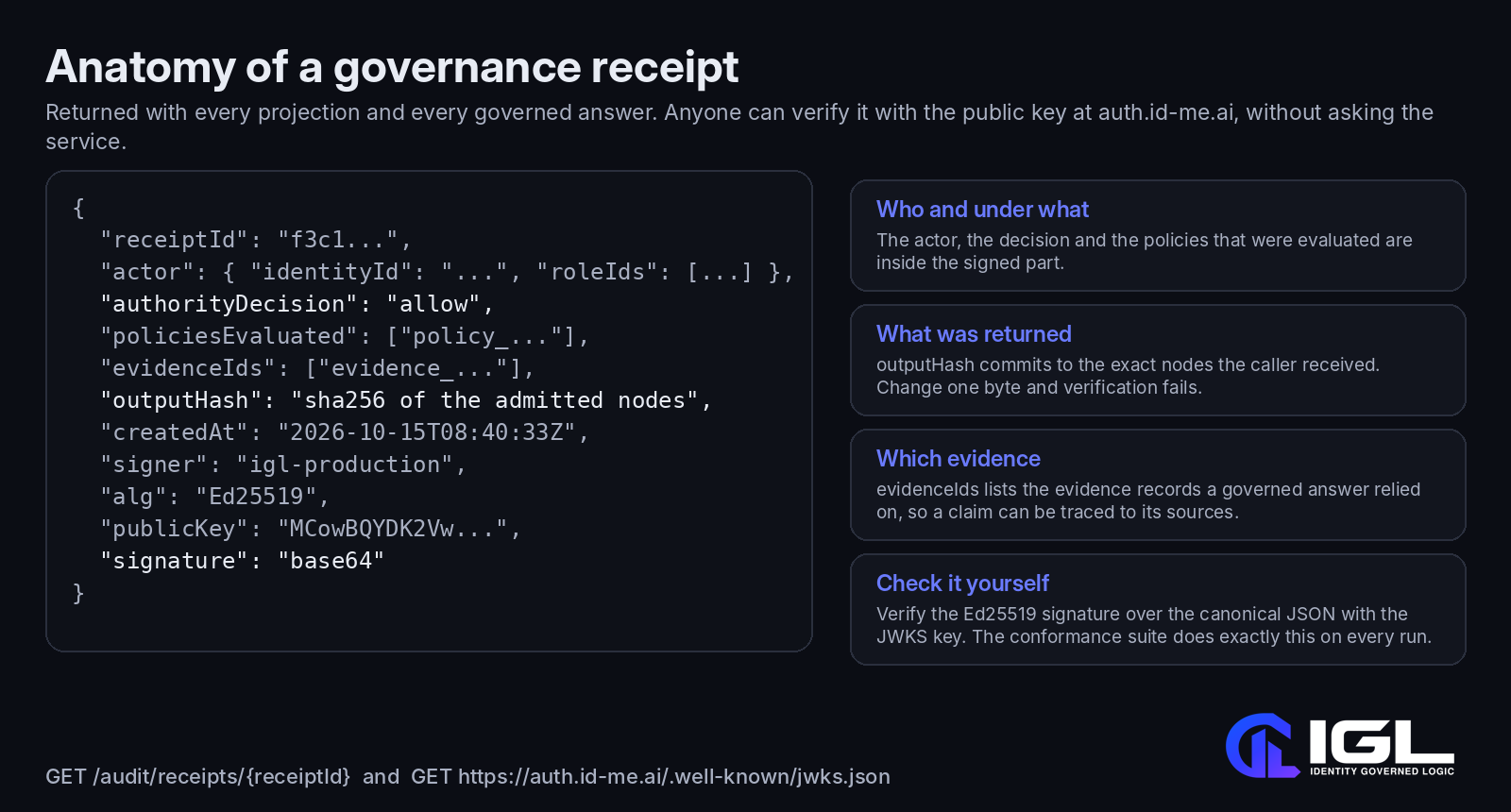
| Provenance id, fingerprint, lineage | Governance receipt, audit chain, and the fingerprint and lineage in an identity export |
| Pause, forget, reset, export | The Subject service: /learning, /forget, /reset, /export
|
| Discover | Graph paths, search, crosswalk, investigate |
| VDRPros Vault custody chain | Audit chain with append-only triggers |
Pause. POST /identities/{id}/learning with paused: true. While paused, anything that would add to the record (context, a fact, a relationship) is refused with 409 learning_paused. What is already known is still served under its purposes. Resume with paused: false.
Forget. POST /identities/{id}/forget with the targets, each a fact, a relationship or a context entry. The record is emptied in place and marked forgotten, so it leaves every projection, search, path and intelligence context at once. A tombstone keeps the id, the kind, the time and a SHA-256 of the record as it was. The audit chain records the act with the same hash and never the content. Someone holding the original can prove that it was the thing forgotten; nobody can quietly bring it back, because tombstones are append-only at the database.
Reset. POST /identities/{id}/reset, with the identity id repeated in the body as confirmation, forgets everything learned in one governed action. The identity itself, its declared attributes, its obligations and its consents stay; they were declared, not learned.
Export. GET /identities/{id}/export returns the whole record: the identity, its context, facts, relationships, obligations, consents, learning state and tombstones, a fingerprint over all of it with the sentence that says how to recompute it, the lineage of every chain event about the identity, and a receipt that signs the fingerprint and names the chain head. Keep it, and you can show later that the record was this record at that point in the chain.
Every one of the four is evaluated against policy like any other action. They are allowed by default, because they are the person's own, and a policy can deny or escalate any of them; a refusal gets the same signed, chained record a success gets.
The platform does not learn from conversation. It records what applications tell it. Ricorsa's answer pipeline, Discover, the Build studio and billing are product features above the platform. The seven MCP tools are read-only plus one that records what the model did; the subject controls are deliberately not tools, because a model must never be able to change what is learned about a person. The person does, through the application.
The full mapping, with file paths, is docs/RICORSA.md in the repository.