Repository navigation
Village
Village stands houses and a scanned building on the meadow, beside a pond of still water. A character can walk into each house at its front door.
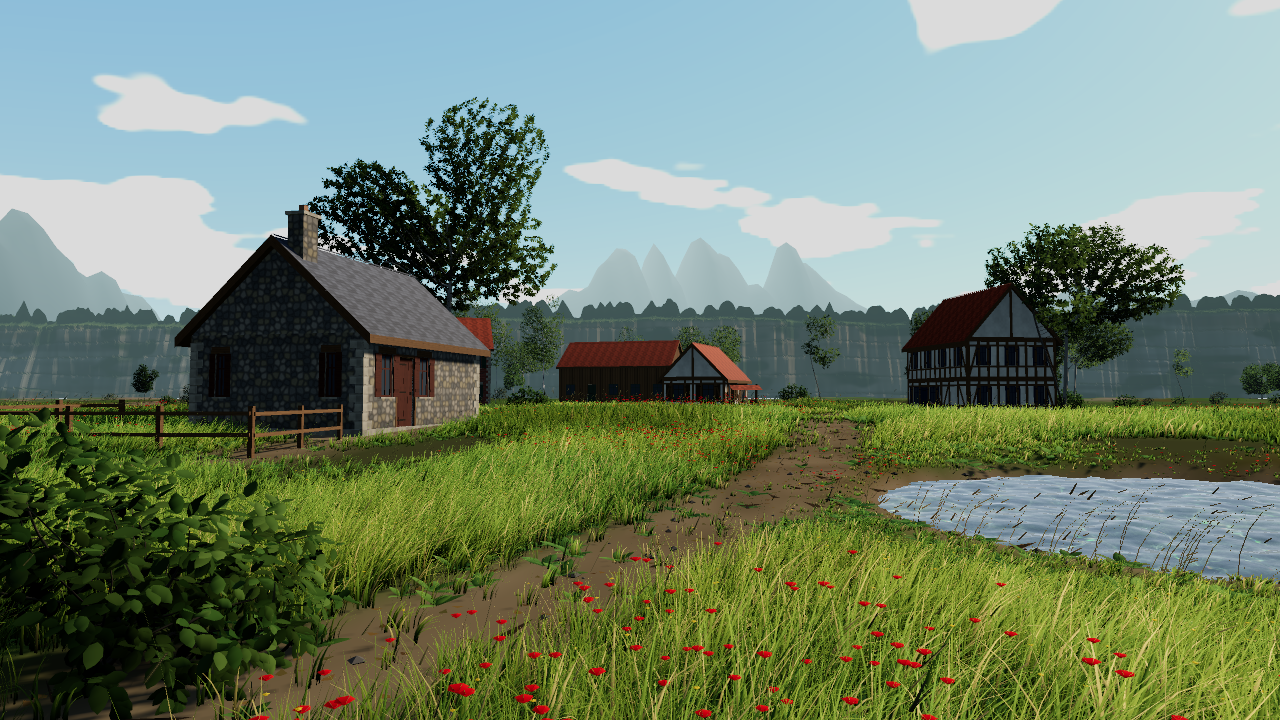
examples/village.mojo draws this picture. The modules live in extensions/village/. A village joins three subjects in one scene:
- the meadow of Vegetation,
- the houses of Village houses, and the scans of Scanned buildings,
- the Clearwater water of Water.
See Extensions. To put people and animals in the village and walk through it, see Village walk.
from core.assets import Assets
from core.scene import Scene
from extensions.vegetation.meadow import meadow_camera, meadow_renderer
from extensions.village.village import Village, VillageParameters
from extensions.water.pebbles import pebble_bed
from render.jpeg import decode
from std.pathlib import Path
from units.si import METER, SECOND, Duration, Length

var renderer = meadow_renderer(1280, 720)
var assets = Assets()
var scene = Scene()
var parameters = VillageParameters()
var bed = pebble_bed(decode(Path("assets/pebbles.jpg").read_bytes()))
var village = Village(scene, assets, renderer, parameters, bed^, None)
var camera = meadow_camera(parameters.meadow, 1280, 720, Length(0.0, METER))
_ = village.update(scene, assets, camera, Duration(2.0, SECOND))
var image = village.render(renderer, scene, assets, camera)
Village adds the meadow, the houses and the scanned building to the scene. None gives a village with no scanned building. update grows the grass for one camera and one time, and moves the water's clock on to that time. Call update before each render.
Village.terrain gives what carries and stops a character: the ground, and each house's walls, floor and steps. The furniture and the scanned building are solid lots. Village.doors holds every door. See Village houses.
render draws the scene, and then composes the pond's water into the picture. Do not draw the scene with renderer.render alone: that picture has no water.
Fetch a scan first. Then give its id to the example:
sh tools/tool.sh .venv/bin/mojo building_scans fetch seem-church
mojo run -I . examples/village.mojo out/village-church.png seem-church
The id names a scan in assets/building_scans/manifest.json. A path to a scan file that extensions.scan.files reads works too. A scan's license can require a credit. See Scanned buildings.
In code, cut the building out of its scan, and give it to Village:
from extensions.scan.files import read_scan
from extensions.village.scanned import cut_building

var cut = cut_building(read_scan(path).geometry, frame, Length(0.5, METER))
var village = Village(scene, assets, renderer, parameters, bed^, cut^)
On a four-core Linux host, the example cuts the Seem church out of its scan in 1.2 seconds. The village builds in 3.2 seconds. The render takes about 20 seconds at 1280 by 720, with the church or without it.
| Module | Holds |
|---|---|
house.mojo |
Facade, HouseParameters, fieldstone, lime_plaster, front_wall, house_model, house_lot and footing. |
house_view.mojo |
Hinge, StandingHouse, door_leaf, facade_look and stand_house. |
interior.mojo |
Doorway, HouseInterior and house_interior. |
terrain.mojo |
WallSpan, Floor, Terrain, wall_push and view_entry. |
doors.mojo |
Doors. |
props.mojo |
PropKind, Prop, StandingProps and stand_props. |
sheet.mojo |
Sheet. |
surfaces.mojo |
The textures, HouseLooks and house_looks. |
scanned.mojo |
CutBuilding, cut_building, grid_voxel, linear_splats, scan_lot and stand_scan. |
village.mojo |
HousePlacement, VillageParameters and Village. |
VillageParameters() holds the meadow of Vegetation, with these additions:
| Part | Where it stands |
|---|---|
| A pond 12 meters across and 1.2 meters deep | Right of the trail, 11 meters ahead of the camera. |
| A stone cottage of one storey, 7 by 5.5 meters, under slates | Left of the trail, about 25 meters away, turned 80 degrees. |
| A framed cottage of one storey, 6.5 by 5 meters | Left of the trail, about 60 meters away, turned 70 degrees. |
| A framed house of two storeys, 8 by 6 meters | Right of the trail, about 55 meters away, turned -80 degrees. |
| A brick house of two storeys, 9 by 7 meters | On the left, about 75 meters away, turned 20 degrees. |
| A boarded barn of one storey 4.2 meters tall, 13 by 8 meters | Ahead, about 90 meters away, turned -12 degrees. |
| The scanned building, if there is one | On the right, about 110 meters away, turned 28 degrees. |
The houses' textures are 128 texels on a side.
The water's ocean spectrum is 256 texels on a side, and its glare is 128 texels. Its caustic grid is 64, as in the still, and its caustic texture is 256 texels on a side. The water's clock starts at 5 seconds, as the Clearwater page's does.
VillageParameters.props lists the things that stand about the village. Each Prop is a PropKind, a place, a turn and a length. stand_props draws them with the houses' materials, in one mesh for each material.
| Kind | What it is | Its length |
|---|---|---|
WELL |
A round stone wall, two posts, a beam, a little roof and a bucket | Its radius |
BARREL |
Oak staves with two iron hoops | Its radius |
CRATE |
A box of boards with slats on its edges | Its side |
HAY_BALE |
A bale of hay, tied with two cords | Its length |
FENCE |
Posts at most 2 meters apart, and two rails, a meter tall | Its length |
BENCH |
A plank on two trestles | Its length |
WOODPILE |
Split logs stacked under a board lid, their ends out, 0.6 meters deep and 1.15 meters tall | Its length |
The default village has a well and a bench by the trail, and barrels, crates and hay before the barn. A fence closes a garden behind the stone cottage, and a bench stands before the framed house. A woodpile stands outside the hearth's gable of each house with a hearth: woodpile_by places it, and hearthed says which houses have one. Each prop but a fence is a solid lot of the terrain, and each fence is a wall span. The residents' routes keep off the props.
Each building stands on a Lot: its footprint, turned about +y. Village puts the lots into MeadowParameters.lots before it builds the meadow. So no grass grows on a lot or on the bare apron round it, and no tree or bush stands there. The ground under a lot is mottled dirt. See Ponds and lots.
A worn footpath 0.8 meters wide leads from each house's front door to the trail. door_path gives it as two lots with narrow aprons. The first runs 3.5 meters straight out from the door. The second runs on to the nearest point of the trail. A door with no trail within 60 meters, or on ground with no trail, has only the first.
Each house is a canonical building model with a hall, a front door, windows and furniture. The village draws it with its own view, on a stone plinth, under a gable roof. See Village houses.
A scan of a building also holds its ground: paths, graves, a lawn or a street. cut_building keeps only the building:
- It fills an occupancy grid of the scan.
grid_voxelstarts the voxel at the size that you give, and doubles it until the grid holds at most 4,194,304 voxels. - It finds the ground as a terrain surface of column tops. The surface must cover a quarter of the plan, and two columns of it differ by 2 meters at most.
- It cuts the grid into parts above the ground, of 20 voxels or more. See Scan parts.
- It copies the splats of the largest part.
A scan of a room has its floor as its ground, so do not use one for a village.
stand_scan stands the cut building as one Gaussian splat object. The middle of its footprint stands at the point that you give, and the building is turned about +y. Its foot is 15 centimeters below the lowest ground under its corners, so no gap shows on a slope.
A scan's colors are sRGB, as a screen shows them. The renderer blends splats as linear light, and tone maps the frame after. So stand_scan gives the scene a copy of the splats from linear_splats. Each color byte of the copy is linear light, and its opacity is kept. The copy has no spherical harmonics, because their shading adds to the sRGB color and has no exact linear form. The building keeps its colors and loses its sheen, which changes with the view.
The pond's water is a WaterScene. Its sun is the meadow's sun, so the water's glints agree with the grass's shadows.
render composes the water into the picture at the ground's water_level. The water is an endless plane, and the composition tests it against the depth of each pixel. The ground outside the basin lies above the water, so the water shows only in the basin. Grass and trees in front of the water keep their pixels.
update moves the water's clock on to the frame's time. An earlier time leaves the clock where it is, because the water's state moves only forward.
- The water does not reflect the houses, the trees or the sky cube. It reflects the Clearwater sky.
- A house is a box of storeys under one gable roof. It has no porch and no wing. Its upper storeys have no stairs.
- A scanned building's splats are lit by the scan's own light, not by the meadow's sun. They cast no shadow.
- A lot keeps plants off the ground, but it does not level the ground. The plinth and the sunk foot fill the slope.