Repository navigation
What is REP
A REP (retraction-extrusion pulse) is the measurement RheoBoard runs.
The board draws a sample into a tube, then pushes it back out. One pump pulls. The valve switches. The other pump pushes. A pressure sensor on the air line records the trace. The shape of that trace is a short record of how the material flows.
The air in the line follows (PV = nRT). (P) is the pressure the sensor reads, (V) is volume, (n) is the amount of gas, (R) is the gas constant, and (T) is temperature.
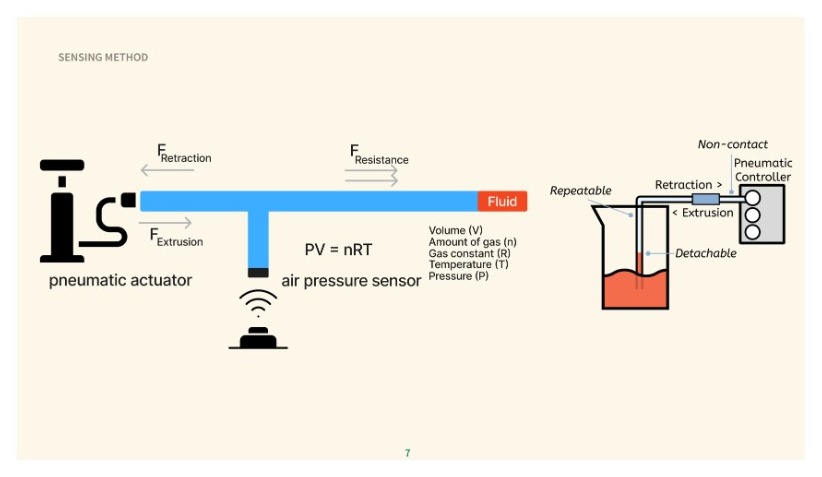
How a REP works. The diagram marks (PV = nRT).
A REP measures how a material responds to a brief pull and push. The pressure trace follows three phases: retraction, extrusion, and stabilization.
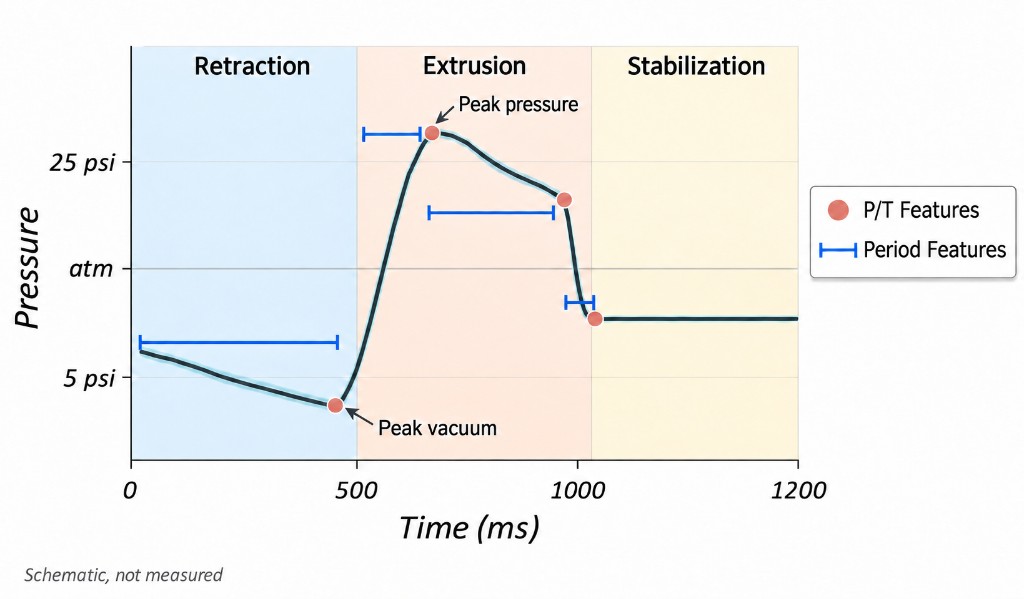
Pressure trace from 0 to 1200 ms. Peak vacuum in retraction, peak pressure in extrusion, then stabilization. Schematic, not measured.
RheoBoard uses two pumps and a switching valve to draw a sample into a tube and push it back out. A sensor on the air line records the pressure throughout the cycle.
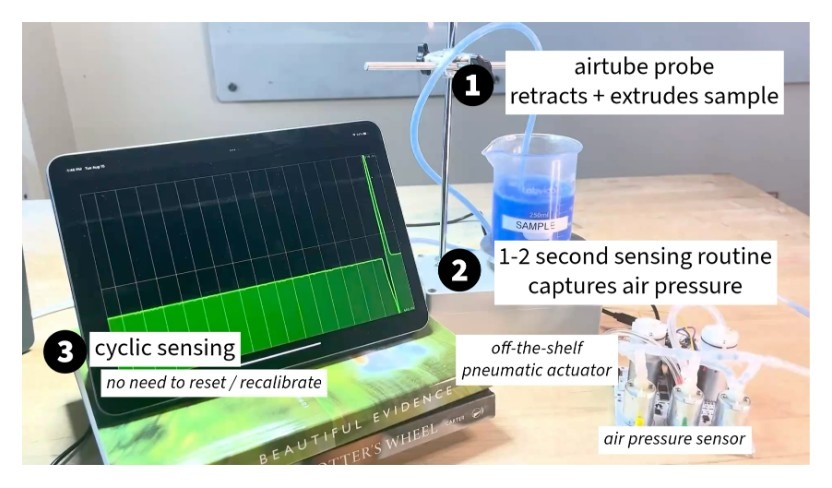
Bench with the probe, actuator, and sensor.
Next: Build options.