
A premium drop-in music player — now on npm for Vue, React, Svelte, Angular, Web Components, and React Native.
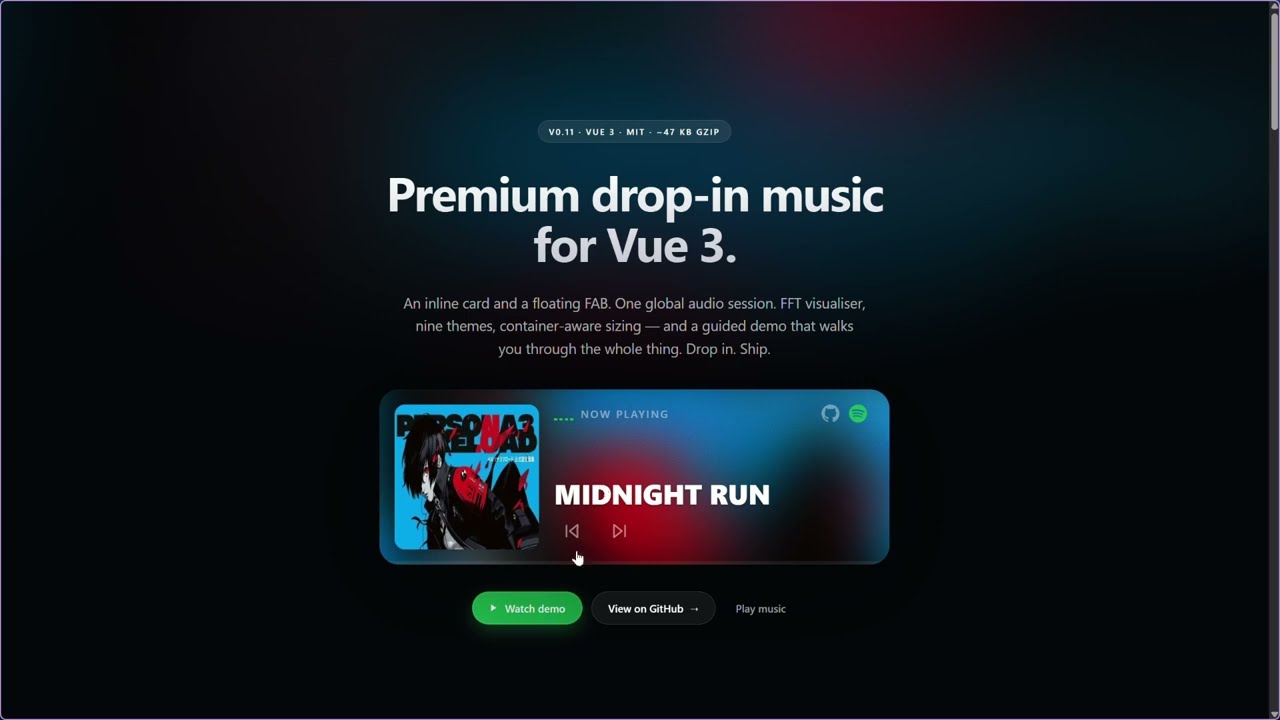
▶ Watch the 3-minute demo on YouTube — 9 themes, ambient EQ, pulso heartbeat, drag-to-resize, FAB radial menu, keyboard shortcuts, multi-framework architecture.
v3.0.0-rc.0is LIVE on npm (2026-06-08). The 7@pulse-music/*packages shipped after a 21-tag audit-driven alpha cycle (types, core, tokens, web-component, react, svelte, react-native). The Vue 3 reference (src/lib/) stays source-available — vendor it directly or use the Web Component from any Vue template. The Angular wrapper stays source-available (packages/angular/) until the peer floor decision is made for rc.1. Try it now:npm install @pulse-music/react @pulse-music/core— see the install block below. Architecture map:docs/universal/ARCHITECTURE.md. Cadence to v3.0.0 stable:docs/universal/VERSION_STRATEGY.md. Roadmap:docs/universal/ROADMAP.md.
| Framework | Package | Status today | Chrome parity vs Vue v2.3.4 |
|---|---|---|---|
| Vue 3 | pulse-player v2.3.4 (source-available, not on npm) |
✅ Reference implementation (validated, 26 alphas byte-identical) — vendor via git or use Web Component | 100 % |
| React 18 / 19 | @pulse-music/react |
✅ wrapper + 16 RTL tests + apps/demo-react runnable | ~95 % |
| Svelte 5 | @pulse-music/svelte |
✅ plain TS hook + 8 store tests + apps/demo-svelte runnable | ~95 % |
| Web Components | @pulse-music/web-component |
✅ <pulse-player> + <pulse-fab> (Lit) + 22 element tests |
~95 % |
| Vanilla HTML / Solid / Astro / Qwik | @pulse-music/web-component |
✅ apps/demo-vanilla runnable, inherits web-component chrome | ~95 % |
| Angular 17+ | @pulse-music/angular (private) |
~95 % (code), 0 % (distribution) | |
| React Native | @pulse-music/react-native |
✅ rc.1 LIVE on npm (expo-av + Reanimated) + Expo demo Android-tested | ~60 % |
Need the full premium chrome today (resize handle, three responsive states, social icons, prev / next, FAB drag, palette / menu, fullscreen)? → use the Vue version. Just need the audio engine + minimum card chrome (play / pause / variants / ambient EQ / pulso)? → any framework wrapper works.

See docs/universal/SANDBOXES.md for the per-framework playground templates.
# React 18 / 19
npm install @pulse-music/react @pulse-music/core

# Svelte 5
npm install @pulse-music/svelte @pulse-music/core

# Vanilla / Solid / Astro / Qwik (Web Component)
npm install @pulse-music/web-component

# React Native (Expo SDK 56+)
npm install @pulse-music/react-native @pulse-music/core
# then from your app dir:
npx expo install expo-av react-native-reanimated react-native-gesture-handler react-native-svg @react-native-async-storage/async-storage

# Vue 3 (reference build v2.3.4 — source-available, see Vue setup below)
# Until the Vue rc.1 package ships at @pulse-music/vue, the Vue reference
# is consumed directly from this repository (git clone or git submodule).
# Tracking issue: https://github.com/YamadaBlog/pulse-player/issues
Vue 3 install path (honest): the Vue v2.3.4 reference build at
src/lib/is not yet published to npm — it ships as the source-of-truth + visual regression baseline for the multi-framework wrappers. Vue consumers today either (a) use the Custom Element via@pulse-music/web-componentfrom any Vue 3 template, or (b) vendorsrc/lib/into their app via git submodule. A published@pulse-music/vuepackage ships at v3.0.0 stable cut — seedocs/universal/VERSION_STRATEGY.md§"Vue publishing decision".
| Package | Version | Bundle gzip | Source |
|---|---|---|---|
@pulse-music/types |
3.0.0-rc.0 | 0.1 kB | npm |
@pulse-music/core |
3.0.0-rc.0 | 2 kB | npm |
@pulse-music/tokens |
3.0.0-rc.0 | 0.6 kB | npm |
@pulse-music/web-component |
3.0.0-rc.1 | 8.5 kB | npm |
@pulse-music/react |
3.0.0-rc.0 | 1 kB | npm |
@pulse-music/svelte |
3.0.0-rc.0 | 0.4 kB | npm |
@pulse-music/react-native |
3.0.0-rc.1 | 12 kB | npm |
pulse-player (Vue v2.3.4) |
2.3.4 | 14 kB | source-available at src/lib/, npm publish at v3.0.0 stable |
@pulse-music/angular |
rc.0 | 1 kB | source-available at packages/angular/, private until rc.1 |
Copy-paste-ready integration patterns for the most-asked-about meta-frameworks. Each one is the smallest possible "Pulse is now in my app" sample — ~30-50 LOC, no extra abstractions.
- Next.js 14+ (App Router) — client-component pattern + SSR-safe dynamic import
- Nuxt 3+ —
.client.vue+<ClientOnly>wrappers - SvelteKit 2+ —
+page.svelte+ ViteoptimizeDepstweak - Astro 4+ — Custom Element +
client:loaddirective - Vanilla HTML + CDN — one
<script type="module">line, no build step
Honest, datapoint-by-datapoint comparison with Plyr, Howler.js, WaveSurfer.js, Vidstack Player, and react-player. See docs/universal/COMPARISON.md for the full table — including when Pulse is not the right choice. Headline summary:
| You build… | Use… |
|---|---|
| A content site / portfolio / landing page with polished audio | Pulse (smallest scope, premium chrome, multi-framework) |
| A media platform at scale (Netflix-clone, podcast app, music streaming) | Vidstack or Plyr (battle-tested, video + HLS) |
| A DAW / audio editor / podcast cutter (waveform UI) | WaveSurfer.js + Howler |
| A React-only app needing YouTube / Vimeo embed | react-player |
| A game with 3D spatial audio | Howler.js |
docs/universal/ARCHITECTURE.md — dependency graph · docs/universal/FEATURE_MATRIX.md — what works in each framework · docs/universal/API.md — canonical API reference · docs/universal/LICENSING.md — the MIT-and-why strategy · docs/universal/PRICING.md — business model locked · docs/universal/METRICS_TRACKING.md — adoption discipline · docs/universal/ROADMAP.md — per-alpha plan · docs/universal/COMPARISON.md — vs Plyr / Vidstack / Howler · docs/universal/SCREEN_READER_TEST_PLAN.md — manual SR test plan · docs/universal/VERSION_STRATEGY.md — alpha → rc → stable cadence · docs/_archive/ — superseded docs (RENAMING_DECISION, RN_RUNTIME_SETUP, PROTECTION_NOTES, PUBLISH_CHECKLIST, GIF_GUIDE).





A drop-in inline card. · A floating draggable FAB. · One global audio session.
Every visible dimension scales from a single CSS variable.
You're early. Pulse v3.0.0-rc.0 went live on npm on 2026-06-08. We track real production users here as they come on board — see
docs/universal/METRICS_TRACKING.mdfor the public adoption metrics.Shipping Pulse in production? Open a PR adding your project + logo to this section. We honour requests to stay anonymous.
pulse-player started as two Vue 3 components — MusicPlayer (inline
card) + MiniPlayer (floating FAB) — backed by a Pinia store that owns
the audio session. Drop them anywhere, they stay in sync. Mount the FAB at
the app root, playback survives every route change.
As of v3.0.0-rc.0 (2026-06-08), the same chrome ships across 5 web
frameworks under the @pulse-music/* scope on npm:
- React 18 / 19 —
npm install @pulse-music/react @pulse-music/core - Svelte 5 —
npm install @pulse-music/svelte @pulse-music/core - Web Components / Vanilla / Solid / Astro / Qwik —
npm install @pulse-music/web-component - Angular 17+ —
@pulse-music/angular(NgModule, awaiting peer-dep floor bump) - Vue 3 —
pulse-player(v2.3.4 reference) or@pulse-music/vue(re-export)
All wrappers share the same @pulse-music/core audio engine and
@pulse-music/tokens variant tokens. See docs/universal/ARCHITECTURE.md.
The unusual bit: every visible dimension scales from one CSS variable.
A ResizeObserver watches the container, writes --pulse-scale inline, and
the entire component — artwork, title, icons, buttons, padding, shadows, EQ
bars, progress — breathes together. Three responsive states layer on top:
narrow below 220 px (NOW PLAYING label hides, social icons stay),
compact below 130 px (top row collapses), FAB below 110 px (the
player morphs into a circular disc). No media queries. No layout breaks.
Nine curated background presets ship in, including a true transparent
variant with the original dashboard's gradient + noise texture intact. Pass
accentColor to retune the EQ + progress hue.

Vinyl · warm analog, gold border |

Sunset · sepia / brown gradient |

Midnight · deep navy → violet |

Aurora · teal / cyan night |

Light · inverted palette for light-mode apps |
|
Also available: Auto · Transparent (hero above) · Dark · Solid · Custom. → Full customization guide

Compact < 130 px |

Mobile ≈ 390 px |

Tablet ≈ 820 px |

Desktop ≥ 1280 px |
Same component, four screens, zero breakpoints. → Read the responsive guide
git clone https://github.com/YamadaBlog/pulse-player.git
cd pulse-player
npm install && npm run dev       # http://localhost:5174
In your own app, copy src/lib/ and:
<MusicPlayer variant="vinyl" />
<MiniPlayer />
That's it. Pinia is the only setup step. → Detailed install + usage
| 📖 API reference | Props for MusicPlayer, MiniPlayer, the useAudioStore state + actions + keyboard surface |
| 🏗️ Architecture | How the store, audio element and FFT analyser fit together (with diagram) |
| 🎨 Customization | Variants, accent colors, CSS variables, custom backgrounds |
| 📐 Responsive | The auto-scale curve, the four responsive states, drag-to-resize |
| 🛠️ Advanced usage | Replace playlist, custom controls, multiple players, hide on routes |
| The "Watch demo" feature — scenario, controls, fullscreen, custom steps | |
| 🔔 Events & telemetry | Opt-in typed subscribe() API + per-session counters (no third-party tracking) |
| ⚡ Performance | Bundle map, runtime cost per hot path, integration guidelines, prefers-reduced-motion story |
| 🆘 Troubleshooting | Autoplay rejection, 404s, EQ silent, FAB persistence, hydration mismatch |
| 🧪 Examples | 3 ready-to-fork integrations: minimum SPA, custom playlist, event subscriptions |
| 🚀 Release procedure | Tag → GitHub Release → npm publish flow with release-notes templates |
| 📝 Changelog | Every version from 0.1.0 to today, with rationale |
| Truly proportional | One CSS variable scales artwork, type, chrome and shadows together. |
| Container-aware | Sizes itself off its container, not the viewport. |
| Three responsive states | Narrow (≤ 220 px) → compact (≤ 130 px) → FAB (≤ 110 px). All driven by ResizeObserver, no media queries. |
| Drag-to-resize | Optional handle in the bottom-right corner. Pointer events. Mouse, touch, stylus. |
| Persistent session | One Pinia store. Survives every route change. |
| 9 themes + custom | Includes a true transparent variant with gradient + noise. |
| Ambient EQ | 64-bar GPU-composited spectrum across the player. Globally toggleable. |
| Pulso ripple | Optional heartbeat ring around the FAB — only while music is playing. |
| Guided demo tour | ~50 s scripted walkthrough with pause / resume / step jump and fullscreen. |
| Opt-in events | store.subscribe('play', …) returns an unsubscribe. Plus play / pause / track-change counters. No third-party tracking. |
| a11y | prefers-reduced-motion honoured everywhere — tweens snap, scrolls jump, transitions disabled. |
| Tiny | ~49 kB gzipped (JS + CSS combined). Three deps (Vue, Pinia, lucide-vue-next). Zero domain code. |
- Volume slider + mute on the inline card
- Shuffle / repeat modes
- Persist
currentTimetolocalStorage(persistKeyalready covers FAB position) - Keyboard shortcuts (
Space,←,→) in the demo tour - Media Session API (hardware media keys + lock-screen art)
- Waveform variant (canvas alternative to the EQ bars)
- Extract
src/lib/shared/to deduplicate variant CSS betweenMusicPlayerandMiniPlayer - Publish as a standalone npm package
Every release is pinned to a signed git tag (v1.0.0 … v1.0.12) and surfaced as a GitHub Release.
| Latest | One-line summary |
|---|---|
| v1.0.12 | Spotlight blur stays active during the Pulso demo step; boost to the FAB section is 1.5× slower for readability. |
| v1.0.11 | Options divider between the FAB colour palette and the action buttons. |
| v1.0.10 | Stable 680 × 233 baseline for the demo stages — never shrinks, grows past the baseline if the player does. |
| v1.0.6 → 1.0.9 | Pick-a-mood demo step rewritten — precise framing, single continuous descent, title always in view; pulso ring + heartbeat aligned to the beat. |
| v1.0.1 → 1.0.5 | Ambient EQ moved to a pure-CSS animation (0 JS / frame), bullet-proof pulso centring, dem o tour pause / resume / step jump, distance-aware scroll easings. |
| v1.0.0 | Production-ready: CI matrix, 30 unit tests, ESLint + Prettier + Husky, npm-publish-ready package.json, shared PulseVariant type, CONTRIBUTING.md. |
Full history with rationale per release: CHANGELOG.md.
MIT. The two demo tracks under public/audio/ are shipped
for local testing only and are not part of the MIT-licensed source —
replace them with content you own before redistributing.
Built with Vue 3, Pinia, a ResizeObserver and a small amount of obsessive proportional tuning.