
Build •
Docker •
Structure •
Snapshot
[Українська] | [česky] | [中文] | [Magyar] | [Español] | [فارسی] | [Français] | [Deutsch] | [Polski] | [Indonesian] | [Suomi] | [മലയാളം] | [日本語] | [Nederlands] | [Italiano] | [Русский] | [Português (Brasil)] | [Esperanto] | [한국어] | [العربي] | [Tiếng Việt] | [Dansk] | [Ελληνικά] | [Türkçe] | [Norsk] | [Română]
We need your help to translate this README, RustDesk UI and RustDesk Doc to your native language
Caution
Important Legal and Ethical Notice:
RustDesk and RustDeskMCP must not be used for any illegal, unauthorized, abusive, deceptive, or privacy-invasive activity. This includes, without limitation, unauthorized access, remote control without informed consent, credential theft, surveillance, data exfiltration, persistence, lateral movement, ransomware activity, or attempts to bypass security, auditing, or law-enforcement controls. Such use is strictly forbidden. Operators, integrators, and distributors of this fork are solely responsible for ensuring lawful use, valid authorization, and compliance with all applicable laws, regulations, contracts, and internal policies. The authors and contributors do not endorse misuse and disclaim responsibility for any unlawful or abusive deployment of this software.
This repository is a modified fork of the official RustDesk project and remains licensed under AGPL-3.0. It adds an embedded localhost MCP server, a separate RustDeskMCP app identity, and agent-oriented desktop and terminal control flows on top of the upstream RustDesk codebase.
Chinese version of this fork overview: docs/README-ZH.md
- an embedded localhost MCP server inside the desktop Flutter client
- a separate Windows runtime identity,
RustDeskMCP, so this fork does not collide with a normal RustDesk installation - MCP desktop-session operations that follow the normal RustDesk connection path
- MCP terminal-session operations
- explicit local input lock and unlock semantics for agent-driven desktop tasks
- remote desktop frame capture for vision-based automation
- Keep the normal non-MCP RustDesk user path working.
- Enable MCP from the GUI, not from a separate startup mode.
- Make MCP operations follow the same user-visible session flow as RustDesk.
- Keep the current MCP surface scoped to desktop and terminal sessions.
- Start
RustDeskMCP. - In the GUI, enable
Settings -> Security -> Enable MCP server. - Send JSON-RPC requests to
http://127.0.0.1:59940/mcp. - Use
initialize, thentools/list, thentools/call.
Desktop session tools:
open_desktop_sessioninput_passwordselect_desktop_displayget_desktop_framelock_remote_user_inputunlock_remote_user_inputmouse_movemouse_clickkeyboard_inputkeyboard_hotkey
Terminal session tools:
open_terminal_sessioninput_passwordterminal_inputterminal_output
If you are here for the MCP-specific behavior of this fork, continue with:
- docs/RustDeskMCP.md for the fork overview, current MCP scope, and runtime model
- docs/README-ZH.md for the Chinese README
- NOTICE.md for upstream attribution, licensing, and fork notice
Chat with us: Discord | Twitter | Reddit | YouTube

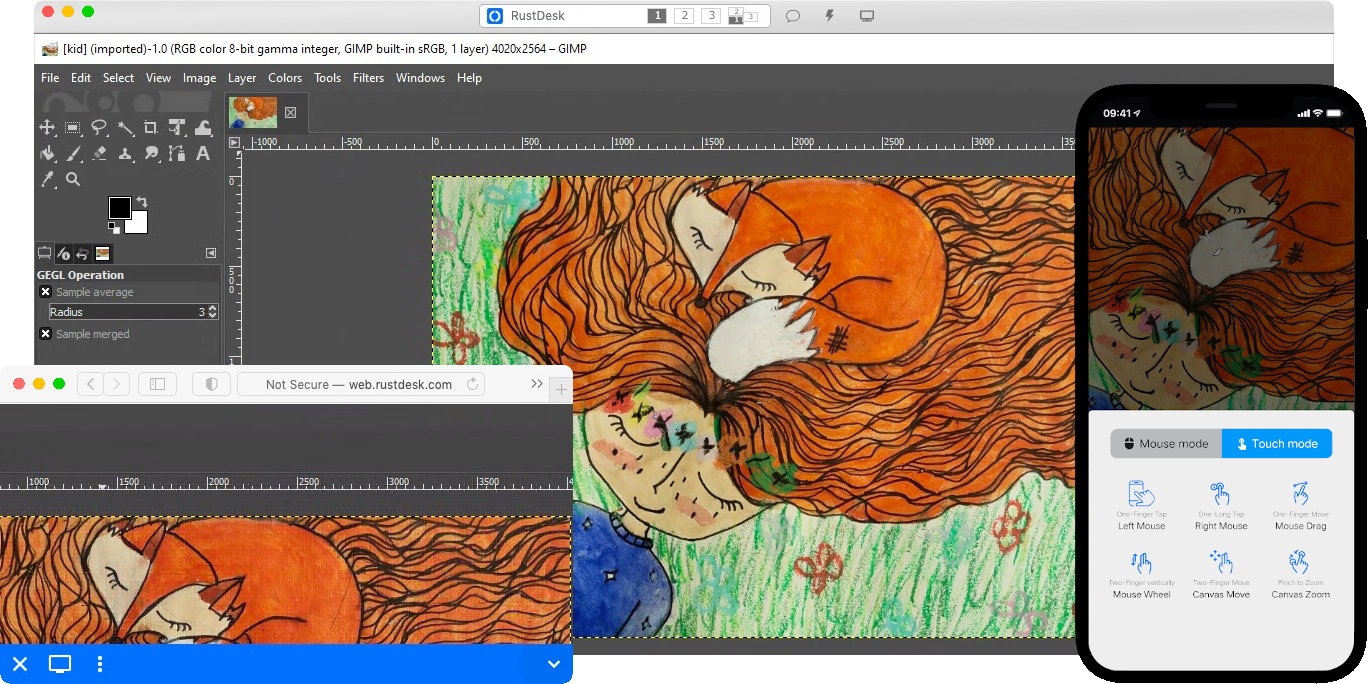
Yet another remote desktop solution, written in Rust. Works out of the box with no configuration required. You have full control of your data, with no concerns about security. You can use our rendezvous/relay server, set up your own, or write your own rendezvous/relay server.
RustDesk welcomes contribution from everyone. See CONTRIBUTING.md for help getting started.

Desktop versions use Flutter or Sciter (deprecated) for GUI, this tutorial is for Sciter only, since it is easier and more friendly to start. Check out our CI for building Flutter version.
Please download Sciter dynamic library yourself.
-
Prepare your Rust development env and C++ build env
-
Install vcpkg, and set
VCPKG_ROOTenv variable correctly- Windows: vcpkg install libvpx:x64-windows-static libyuv:x64-windows-static opus:x64-windows-static aom:x64-windows-static
- Linux/macOS: vcpkg install libvpx libyuv opus aom
-
run
cargo run
sudo apt install -y zip g++ gcc git curl wget nasm yasm libgtk-3-dev clang libxcb-randr0-dev libxdo-dev \
        libxfixes-dev libxcb-shape0-dev libxcb-xfixes0-dev libasound2-dev libpulse-dev cmake make \
libclang-dev ninja-build libgstreamer1.0-dev libgstreamer-plugins-base1.0-dev libpam0g-devsudo zypper install gcc-c++ git curl wget nasm yasm gcc gtk3-devel clang libxcb-devel libXfixes-devel cmake alsa-lib-devel gstreamer-devel gstreamer-plugins-base-devel xdotool-devel pam-develsudo yum -y install gcc-c++ git curl wget nasm yasm gcc gtk3-devel clang libxcb-devel libxdo-devel libXfixes-devel pulseaudio-libs-devel cmake alsa-lib-devel gstreamer1-devel gstreamer1-plugins-base-devel pam-develsudo pacman -Syu --needed unzip git cmake gcc curl wget yasm nasm zip make pkg-config clang gtk3 xdotool libxcb libxfixes alsa-lib pipewiregit clone https://github.com/microsoft/vcpkg
cd vcpkg
git checkout 2023.04.15
cd ..
vcpkg/bootstrap-vcpkg.sh
export VCPKG_ROOT=$HOME/vcpkg
vcpkg/vcpkg install libvpx libyuv opus aomcd vcpkg/buildtrees/libvpx/src
cd *
./configure
sed -i 's/CFLAGS+=-I/CFLAGS+=-fPIC -I/g' Makefile
sed -i 's/CXXFLAGS+=-I/CXXFLAGS+=-fPIC -I/g' Makefile
make
cp libvpx.a $HOME/vcpkg/installed/x64-linux/lib/
cdcurl --proto '=https' --tlsv1.2 -sSf https://sh.rustup.rs | sh
source $HOME/.cargo/env
git clone --recurse-submodules https://github.com/rustdesk/rustdesk
cd rustdesk
mkdir -p target/debug
wget https://raw.githubusercontent.com/c-smile/sciter-sdk/master/bin.lnx/x64/libsciter-gtk.so
mv libsciter-gtk.so target/debug
VCPKG_ROOT=$HOME/vcpkg cargo runBegin by cloning the repository and building the Docker container:
git clone https://github.com/rustdesk/rustdesk
cd rustdesk
git submodule update --init --recursive
docker build -t "rustdesk-builder" .
Then, each time you need to build the application, run the following command:
docker run --rm -it -v $PWD:/home/user/rustdesk -v rustdesk-git-cache:/home/user/.cargo/git -v rustdesk-registry-cache:/home/user/.cargo/registry -e PUID="$(id -u)" -e PGID="$(id -g)" rustdesk-builderNote that the first build may take longer before dependencies are cached, subsequent builds will be faster. Additionally, if you need to specify different arguments to the build command, you may do so at the end of the command in the <OPTIONAL-ARGS> position. For instance, if you wanted to build an optimized release version, you would run the command above followed by --release. The resulting executable will be available in the target folder on your system, and can be run with:
target/debug/rustdeskOr, if you're running a release executable:
target/release/rustdeskPlease ensure that you run these commands from the root of the RustDesk repository, or the application may not find the required resources. Also note that other cargo subcommands such as install or run are not currently supported via this method as they would install or run the program inside the container instead of the host.
- libs/hbb_common: video codec, config, tcp/udp wrapper, protobuf, fs functions for file transfer, and some other utility functions
- libs/scrap: screen capture
- libs/enigo: platform specific keyboard/mouse control
- libs/clipboard: file copy and paste implementation for Windows, Linux, macOS.
- src/ui: obsolete Sciter UI (deprecated)
- src/server: audio/clipboard/input/video services, and network connections
- src/client.rs: start a peer connection
- src/rendezvous_mediator.rs: Communicate with rustdesk-server, wait for remote direct (TCP hole punching) or relayed connection
- src/platform: platform specific code
- flutter: Flutter code for desktop and mobile
- flutter/web/js: JavaScript for Flutter web client


