Advanced Pointers
This page covers three pointer layouts that the Getting Started tutorial does not:
- Pointers that are inside code.
- One pointer that reaches several strings.
- Pointers into length-prefixed records.
It uses the same ROM and project. Select @mk2 in the Table list for every step.
In the Text tab, find "PLAYER 1 HAS". Five link-cable messages are stored
together at $83E0.

These messages have no pointer table. The game loads the address of each message into a register, then calls the print routine:
21 E0 43 ld hl,$43E0 ; PLAYER 1 HAS ENTERED
21 is the Game Boy instruction load HL. The two bytes after it are a normal
pointer, low byte first. The messages are in bank 2, so the value $43E0 is
file offset $83E0.
To find the pointer to a string, search for 21 followed by the address of the
string, low byte first. In the Hex tab, find 21 E0 43:

The match is at $976, so the pointer is at $977. Repeat the search for each
string:
| String | Address | Find | Pointer |
|---|---|---|---|
| PLAYER 1 HAS ENTERED | $83E0 |
21 E0 43 |
$977 |
| PLAYER 2 HAS ENTERED | $83F5 |
21 F5 43 |
$97E |
| THE TOURNAMENT ! | $840A |
21 0A 44 |
$989 |
| YOU ARE PLAYER 1 | $841B |
21 1B 44 |
$994 |
| YOU ARE PLAYER 2 | $842C |
21 2C 44 |
$99B |
There is code between the five pointers, so a Pointer table cannot read them. A Pointer list can. A pointer list holds the address of each pointer.
- Set Show as to Pointers.
- Select the two bytes at
$977to$978. - Choose New Block…, name the block
Linkand press OK. The block is a pointer table with one pointer. - On the Reading bar, set Source to Pointer list.
- Open Addresses. Each row of the list is one address. Add adds a row. Remove deletes the selected row.
- Type all five addresses into one row, separated by commas. mapchar puts each address in its own row:
$977, $97E, $989, $994, $99B
| One pointer | The list | In Hex |
|---|---|---|
 |
 |
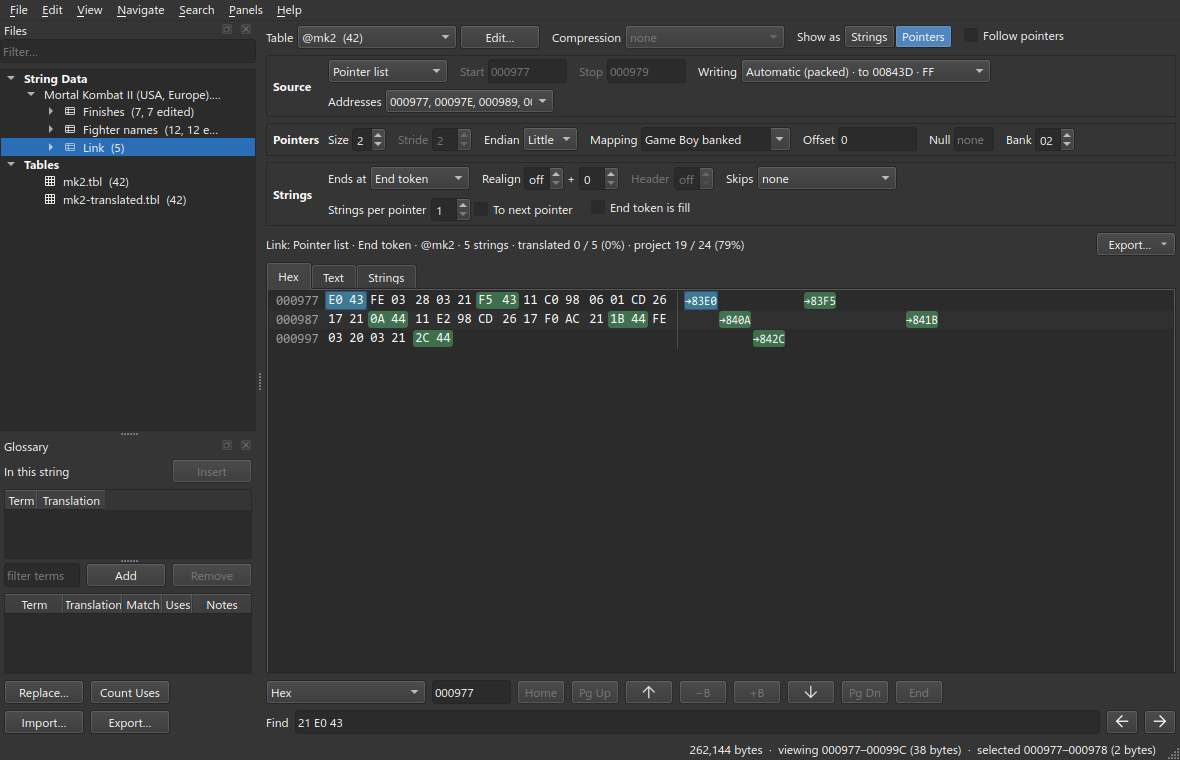 |
The block is written packed, like every pointer block. The strings share their space. When a string moves, mapchar rewrites the two pointer bytes inside the instruction.
Only the two bytes after
21are the pointer. Check every address in the Hex tab. If an address is wrong by one byte, mapchar overwrites part of the instruction.
Find "START GAME". It is at $8141. OPTIONS follows it at $814C.

Find 21 41 41. This is the pointer to START GAME, at $310. Find
21 4C 41. There is no match, because no pointer reaches OPTIONS. The print
routine stops at 00 and keeps its position at the next byte. The game prints
OPTIONS by calling the routine again without loading a new address.
Create a block over the pointer at $310 to $311, as in step 1. Rename it to
Main menu. The block reads one string and stops at the first [end]. This
causes two problems:
-
OPTIONSis not in the block. -
START GAMEcannot become longer, because the space of the block ends at$814C, whereOPTIONSstarts.
Set Strings per pointer to 2. The pointer now reaches two strings. Each string has its own row. Only the first row has the pointer.
| Strings per pointer 1 | Strings per pointer 2 |
|---|---|
 |
 |
Translate each string separately. The two strings share their space, so one
can become longer when the other becomes shorter. OPTIONS is always written
directly after START GAME.
The options menu has the same layout with three strings. The pointer at $367
reaches OPTIONS, CREDITS and DIFFICULTY.
If a block has several pointers and each pointer reaches a different number of strings, select To next pointer. The strings of each pointer then continue up to the address of the next pointer. Strings per pointer then applies to the last pointer only.
The winner messages are records like the ones in
Finishes: two position bytes, a
length byte, then the text. The game selects a message by fighter, so the
records also have a pointer table. The table is directly before the records, at
$857B. It holds twelve 2-byte pointers. The first pointer holds $4593,
which is file offset $8593.
Set Show as to Pointers and select $857B to $8592:

Choose New Block…, name the block Winners and press OK. The records contain no
00 byte, so each string continues through all the records after it.
Set Ends at to Length prefix and Prefix to 1. The strings are still wrong:
03 CB   0D   4C 49 55 20 4B 41 4E 47 20 57 49 4E 53
pos     len  LIU KANG WINS
^ the pointer points here
Each pointer points to the start of its record, so the first position byte is read as the length. A range block skips these bytes with Header. A pointer block has no Header setting. Use Offset instead: set Offset to 2. mapchar adds the offset to every pointer value, so each pointer now points to its length byte.
| End token | Length prefix | Offset 2 |
|---|---|---|
 |
 |
 |
Change one more setting. A pointer block is written packed by default. Packing writes each string directly after the previous one, which overwrites the position bytes between them. Open Writing and set Write to Slotted. Each string then keeps its address and its own space:

Bytes now shows 14 / 14 instead of space shared with the other records. A
translation can be shorter than the original, but not longer.