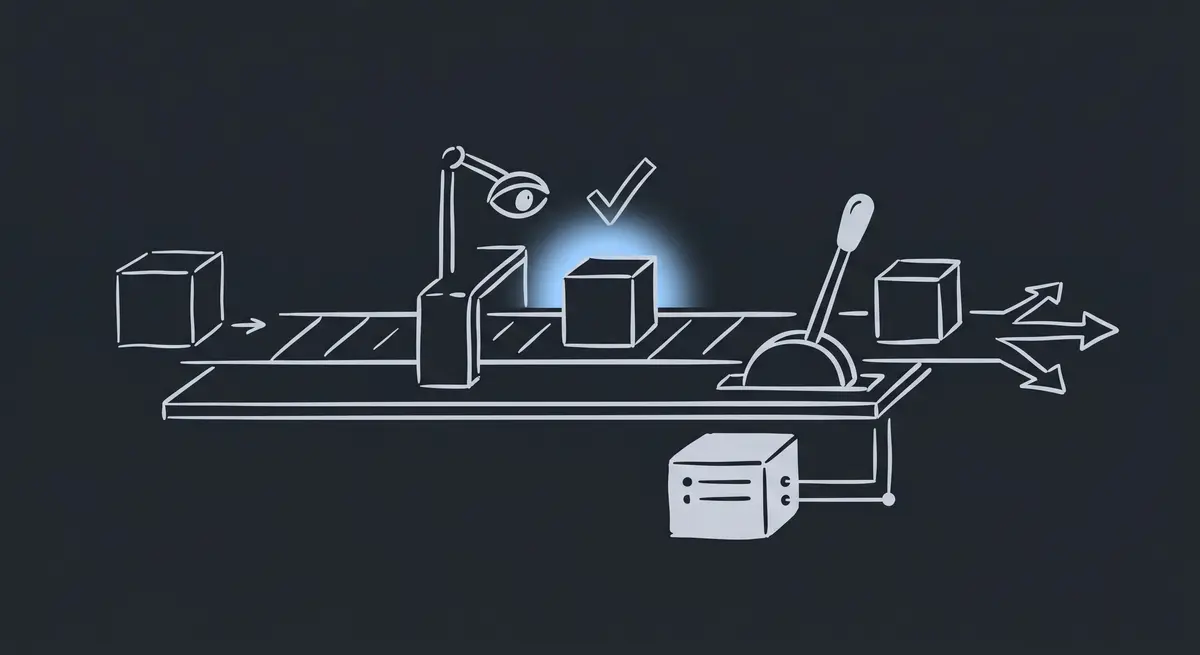
Deterministic deployment and runtime convergence for containerized applications on a single node.
Forge is a Rust control plane for teams that want a smaller, stricter alternative to a full platform stack. It deploys containers, validates them, activates routing, and keeps runtime state converged after restarts or drift.
The core rule is simple:
running container != successful deployment
A deployment only succeeds after it completes the full lifecycle:
candidate -> validated -> finalized -> activated -> promoted
Starting a container is easy. Operating it correctly is not.
Common failure mode:
- the image builds
- the container starts
- the app is not actually reachable
- routing points to the wrong thing
- rollback is unclear
- a restart leaves reality different from what operators think is live
Forge exists to make deployment truth explicit and enforceable. It treats deployment as a control-plane problem, not a docker run problem.
- Prevents traffic from moving to a container that merely started but never became healthy
- Keeps
currentandpreviousgeneration pointers authoritative and rollback-safe - Restores control-plane truth after daemon or host restarts from durable filesystem-backed state
- Repairs drift in runtime and route state through convergence instead of relying on one-shot deploy scripts
- Keeps readiness fast by serving cached control-plane truth instead of doing live fleet-wide inspection on request paths
- Gives operators and automation clear diagnostics when a deployment fails
- Deterministic deployment lifecycle with explicit promotion gates
- Single-node control plane built for Docker and Caddy
- Crash-safe, restart-safe persistence under
storage_root - Atomic route activation and rollback-aware generation management
- Cache-backed
/readyzand/metrics - Durable checkpoints, snapshots, and reconciliation intent logs
- Leader/follower scaffolding with lease-based single-writer semantics
- Secret redaction across logs, diagnostics, and events
- Stateful workload support with backup and restore primitives
- Operator surfaces for status, diagnostics, replay, lease, and upgrade workflows
- Correctness before convenience: a healthy process is not enough; promotion waits for validation and route activation.
- Convergence, not just deploys: Forge keeps reconciling toward the intended state after the initial rollout.
- Small operational scope: single-node by design, not a generic multi-node scheduler.
- Control-plane truth is durable: state lives on disk with atomic writes, not only in memory.
- Fast readiness semantics:
/readyzreports cached control-plane truth in constant time.
Forge keeps authority in the control plane:
forgebinary: operator CLI and current daemon entrypointsrc/deployments.rs: deployment FSM and promotion flowsrc/convergence.rs: steady-state repair, rollback, retention, runtime truthsrc/storage.rs: durable state, pointers, checkpoints, snapshots, journalssrc/http.rs: API and operator-facing HTTP surfaces- Docker: runtime substrate
- Caddy: routing substrate
Operational model:
- A deploy request enters through CLI, API, or webhook.
- Forge resolves source, creates a candidate generation, and starts validation.
- Validation checks runtime reachability and health before traffic moves.
- Route activation happens atomically.
- Convergence keeps runtime and routing aligned with promoted truth.
Guiding principle:
Convergence computes truth. APIs serve cached truth.
Prerequisites:
- Rust and Cargo
- Docker daemon
- Caddy with admin API enabled on
http://127.0.0.1:2019 curl
Build Forge:
cargo build --releaseCreate a minimal local config:
mkdir -p .local/var/lib/forge
cat > .local/forge.conf <<EOF
storage_root=$(pwd)/.local/var/lib/forge
api_bind=127.0.0.1:18080
bearer_token=dev-token
EOF
Export the required environment:
export FORGE_CONFIG="$(pwd)/.local/forge.conf"
export FORGE_MASTER_KEY="$(openssl rand -hex 32)"
export FORGE_CADDY_ADMIN_URL="http://127.0.0.1:2019"
export FORGE_CADDY_PUBLIC_URL="http://127.0.0.1"
export FORGE_URL="http://127.0.0.1:18080"
export FORGE_TOKEN="dev-token"
Run a local health check:
./target/release/forge doctorStart the daemon:
./target/release/forge --config "$FORGE_CONFIG" daemonFrom another shell, verify the control plane:
curl http://127.0.0.1:18080/healthz
curl http://127.0.0.1:18080/readyz
curl http://127.0.0.1:18080/metrics
For the full local flow, see docs/LOCAL_QUICKSTART.md.
Initialize a project and deploy from a local checkout:
forge init
forge deploy api production --from .
forge status api production
forge rollback api production
Typical operator surfaces:
forge status: lightweight runtime and environment summaryforge diagnose: deep runtime inspection and failure contextforge control-plane leader: current single-writer statusforge control-plane replay-status: startup replay progress and health
- Operators running containerized apps on a VPS or single bare-metal host
- Teams that want stronger deployment guarantees without Kubernetes
- Builders who care about rollback correctness, restart safety, and explicit control-plane semantics
- AI-assisted software workflows that need deterministic deployment behavior instead of best-effort container startup
- A running container is not a deployment success
- Promotion must be earned through validation
- Request paths stay cheap; background convergence does the expensive work
- Filesystem-backed durability is part of correctness, not an implementation detail
- Followers stay read-only; mutating control-plane work is leader-only
- Narrow scope is a feature, not a limitation
- Rust 2024
- Axum
- Tokio
- Docker CLI
- Caddy Admin API
- Serde
- Reqwest with
rustls
Forge is in alpha.
Current validated scope:
- single Rust crate, shipping the
forgebinary - single-node control plane
- Docker runtime orchestration
- Caddy route activation
- durable checkpoints, snapshots, and replay state
- backup/restore primitives for stateful services
Deliberate non-goals right now:
- distributed consensus
- true multi-node HA
- generic cluster scheduling
Near-term focus is intentionally narrow:
- operator UX polish around status, diagnostics, history, and restore lineage
- deeper crash and recovery validation for stateful workloads
- read-only web visibility on top of the existing control-plane model
See docs/ROADMAP.md for the detailed milestone history and forward plan.
Forge favors narrow, correctness-first contributions.
Before opening a PR:
- read docs/INVARIANTS.md if you are touching deployment, convergence, rollback, routing, replay, or storage code
- keep the change focused on one concern
- add or update tests with every behavior change
- run
cargo test -qat minimum
Start here: docs/CONTRIBUTING.md